The ideal sofa seat height for short people is 15 to 17 inches. But that number alone does not tell the whole story. The true ergonomic target is your lower leg length minus one inch, because every body is different and a blanket measurement can still leave you sitting with dangling feet and aching hips after 30 minutes.
If you are under 5 feet 4 inches and you have ever sunk into a sofa only to feel your lower back tighten. Your feet lose contact with the floor or a dull ache develop under your thighs this guide is built for you. It walks through the biomechanics, the formula, the purchasing decisions, and the fixes for sofas you already own.
Quick Reference Summary
- Ideal seat height: 15 to 17 inches from floor to compressed cushion
- Personal formula: lower leg length minus 1 inch
- Ideal seat depth: 18 to 20 inches
- Avoid any sofa above 17.5 inches for users under 5’4″
- Goal: feet flat, knees level with or slightly below hips, zero thigh pressure
- Quick fixes: footrest, leg swap, firmer cushion inserts
Instant Answers to Common Questions
What is the best sofa height for short people?
15 to 17 inches, measured from the floor to the top of the compressed seat cushion. The exact number depends on your lower leg length and the firmness of the cushion material.
Is 18 inches too high for a sofa?
For most people under 5 feet 4 inches, yes. At 18 inches, the seat is typically above popliteal height, which causes feet to hover or rest on the tips of the toes, shifting weight unevenly onto the thigh bones and lower lumbar region.
What is the perfect sitting position on a sofa?
Feet flat on the floor, knees at or just above hip level, back fully supported by the backrest, and no upward pressure on the underside of the thighs near the knee joint.
What matters more: seat height or seat depth?
Both are equally important. Seat height controls whether your feet touch the floor. Seat depth controls whether you can sit back fully without the edge digging into the back of your knees. A sofa that gets height right but has excessive depth still causes poor posture.
What Sofa Seat Height Actually Means
Sofa seat height is the distance between the floor and the top surface of the seat cushion after it has been compressed under a person’s weight. Retail listings almost always state the uncompressed measurement, which can be 1.5 to 2 inches higher than what you actually sit at. This distinction matters significantly for short users because a sofa listed at 17 inches may measure closer to 15 to 15.5 inches once you sit down, while one listed at 19 inches compresses to roughly 17 to 17.5 inches, still too tall for many petite frames.
When evaluating any sofa, always ask about cushion compression or test it in person for at least 10 minutes before committing.
The Biomechanics of Sitting: Why Short People Struggle with Standard Sofas
Most furniture in the United States and Europe is designed around an average body height of approximately 5 feet 9 inches for men and 5 feet 4 inches for women. Standard sofa seat heights typically land between 17 and 19 inches, which works reasonably for taller frames but creates a cascade of biomechanical problems for shorter bodies.
What Happens When the Seat Is Too High
When a sofa seat exceeds your popliteal height, the point behind your knee when your feet are flat on the floor, a series of physical changes occur that feel subtle at first but compound over time. Your center of gravity shifts backward and downward into the seat rather than distributing evenly across your sit bones and thighs. Your feet lose contact with the floor, removing the grounding support that helps stabilize your pelvis. Your pelvis tilts posteriorly, which flattens the natural lumbar curve and increases compression on the lower spinal discs. Muscles in your lower back begin compensating almost immediately, and within 20 to 30 minutes the tension becomes noticeable.
Ideal Joint Angles for Short Sitters
Ergonomic research consistently points to the same target angles for seated comfort. The knee joint should be between 90 and 100 degrees, with the thigh level or angled very slightly downward. The hip joint should be at 90 to 100 degrees, ideally with the hips slightly above the knee to encourage a mild anterior pelvic tilt that preserves lumbar curvature. The ankle should rest in a neutral position with the foot flat on the floor, not dorsiflexed or plantarflexed under tension. These angles are achievable for short people only when the seat height aligns with their actual lower leg measurement.
Pressure Distribution and Circulation
Even weight distribution across the thigh and hip is what separates comfortable long-term sitting from painful extended sessions. When a seat is too high, the edge of the cushion contacts the underside of the thigh near the popliteal fossa, compressing the blood vessels and nerves that run through that area. This is what causes the numbness and tingling in the lower leg that many short people experience after sitting on standard sofas for extended periods. A correctly sized seat allows the entire length of the thigh from hip to knee to rest with even pressure, with no point of concentrated loading.
The Perfect Fit Formula for Short Sitters
Ergonomic Seat Height Formula : Ideal Sofa Height = Lower Leg Length − 1 inch
Measure from the floor to the back of the knee while seated in a chair with feet flat.
To measure your lower leg length accurately, sit in a straight-backed chair with your feet flat on the floor and your knees bent at exactly 90 degrees. Measure from the floor to the crease behind your knee. That number is your popliteal height. Subtract one inch to account for the slight forward tilt and cushion give that a sofa provides, and you have your ideal compressed seat height.
Adjustment Variables Based on Cushion Type
The formula above gives you a starting point, but cushion composition affects where you actually end up sitting. Add half an inch to your target height if the sofa uses firm high-resilience foam or a tight-woven fabric that resists compression. Subtract half an inch if the sofa uses soft memory foam or down-wrapped cushions that compress significantly under weight. Add one full inch if you plan to wear shoes regularly while seated, as shoe soles raise your effective floor-to-foot-contact point.
The Five-Factor Comfort System: Beyond Just Seat Height
Seat height is the most critical variable, but it interacts with four other dimensions that determine whether a sofa is genuinely comfortable for a shorter body. Understanding all five helps you make a far more informed purchase decision.
Factor One: Seat Height
Already covered in depth above. The target is your lower leg length minus one inch, measured in the compressed state. Do not rely on manufacturer-listed height without accounting for cushion compression.
Factor Two: Seat Depth
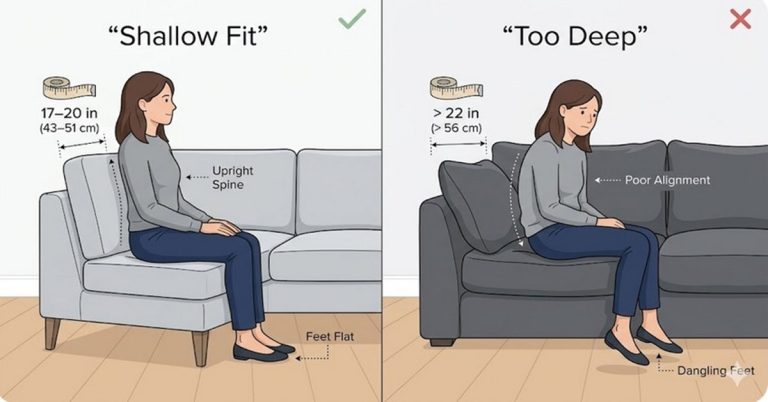
Seat depth is the horizontal distance from the front edge of the seat cushion to the base of the backrest. The ideal range for short people is 18 to 20 inches. Standard sofas run between 21 and 24 inches, which forces shorter users to either sit forward on the edge without back support, or slide all the way back and have the edge cut into the knees. A seat depth of 18 to 20 inches allows you to sit fully back against the cushion while maintaining proper leg position.
Factor Three: Cushion Compression Curve
This is one of the most underreported factors in sofa ergonomics. The compression curve describes how a cushion behaves over time under load. A sofa with high-resilience foam may feel firmer in the showroom but provides consistent support for hours. A sofa with soft memory foam or down-wrapped cushions may feel luxurious for the first 15 minutes but continues to compress further until you are sitting substantially lower than the listed specification. For short users who need precise height control, a consistent compression curve is essential. Test any sofa for a minimum of 20 minutes before buying, not just a brief sit during a showroom visit.
Factor Four: Seat Pitch
Seat pitch refers to the angle of the seat surface itself. Some sofas are designed with a slight backward tilt of 3 to 5 degrees, which encourages you to lean into the backrest. Others are perfectly flat or even have a slight forward angle. For short people, a mild backward pitch can actually improve comfort because it shifts weight toward the hips and away from the thigh edge. A flat or forward-pitched seat concentrates more pressure at the front edge, which is exactly where the circulation problem occurs. When testing sofas, pay attention to whether you feel pulled gently into the backrest or whether your torso feels propped up at the front.
Factor Five: Edge Support
Edge support describes the firmness of the seat cushion along the front edge, the part your thighs contact when seated. Sofas with weak or poorly constructed edges allow the foam to collapse at the perimeter, creating a slope that tips you forward and concentrates pressure exactly where it is most harmful. Sofas with firm, reinforced edges maintain consistent cushion height from center to edge, distributing thigh contact evenly. Check edge support by pressing down firmly along the front edge of any sofa you are considering. It should feel firm and stable, not spongy or yielding.
Standard vs. Petite-Friendly vs. Custom Sofas: A Detailed Comparison
| Feature | Standard Sofa | Petite-Friendly Sofa | Custom Sofa |
|---|---|---|---|
| Seat height (listed) | 17–19 inches | 15–17 inches | Made to order |
| Seat height (compressed) | 15.5–17.5 inches | 13.5–15.5 inches | Exact specification |
| Seat depth | 21–24 inches | 18–20 inches | Custom |
| Fit accuracy for short users | Low | Medium | High |
| Best for | Average height users | 5’1″–5’4″ range | Under 5’1″ or specific needs |
| Price range | Widest availability | Mid to upper range | Premium to luxury |
| Cushion options | Standard foam | Varies by brand | Full specification control |
Personalized Fit by Height Range
Because lower leg length varies even within height ranges, these are starting zones rather than precise prescriptions. Use them as a filter when shopping, then apply the formula to confirm.
Target: 13–15 inches
Floor and Japanese-style sofas are worth exploring. Standard petite sofas may still be slightly high after compression.
Target: 15–17 inches
The best-served zone. Most petite-labeled sofas and many mid-market options will work well here with careful measurement.
Target: modular or adjustable
Modular systems like Lovesac allow different seat heights per section. Ottoman additions give shorter users the foot support they need.
Best Sofa Types for Short People
Low-Profile Sofas
Low-profile sofas are designed with a reduced seat height and often a shallower depth, making them inherently more compatible with shorter frames. IKEA offers several models in the 15 to 16 inch range, and Article has built a reputation for Scandinavian-influenced designs that sit closer to the ground without sacrificing build quality. When shopping in this category, always confirm the compressed measurement and verify seat depth before purchasing.
Custom Sofas
For users under 5 feet tall or anyone whose lower leg measurement falls outside the standard petite range, a custom sofa is the most reliable solution. Companies like BenchMade Modern allow you to specify seat height, depth, cushion firmness, and leg height as separate variables. The upfront cost is higher, but the ergonomic precision eliminates the compromise that comes with every off-the-shelf purchase.
Modular Seating Systems
Modular systems are particularly useful for households with people of different heights. Lovesac Sactionals, for example, can be configured with varying depths and combined with footsacs to achieve the right foot support at any height. While the aesthetic is distinct, the functional flexibility is unmatched in the mass-market segment.
Floor and Japanese-Style Sofas
This category is underrated in Western markets. Floor sofas, also called legless or platform sofas, sit between 4 and 12 inches off the ground, making them naturally ideal for people under 5 feet tall. Japanese-style floor seating, whether a zabuton and low-back cushion system or a modern floor sofa frame, keeps the knee angle optimal because the seat is so low that foot contact is never an issue. The tradeoff is that rising from floor-level seating requires more effort, which may be a consideration for older users or anyone with knee or hip discomfort.
Step-by-Step: How to Find Your Ideal Sofa Seat Height
1. Measure your lower leg length.
Sit on a firm chair, feet flat on the floor, knees at 90 degrees. Measure from the floor to the back of your knee crease. This is your popliteal height
2. Apply the formula.
Subtract one inch from your popliteal height. The result is your target compressed seat height. If your measurement is 14.5 inches, you are looking for a sofa with a compressed seat height of 13.5 inches
3. Simulate the height before shopping.
Use a stack of firm books or a step stool to create a surface at your target height. Sit on it for 10 minutes. Note whether your feet are flat, your hips feel supported, and your thighs are free of pressure. Adjust by half-inch increments until it feels neutral.
4. Test posture in the store or on delivery.
When you sit on the sofa candidate, check four things immediately: feet flat without reaching, knees level with or just below hips, no pressure at the thigh edge, and the ability to sit fully back without the seat cutting behind the knee
5. Evaluate depth and backrest simultaneously.
A correct seat height paired with excessive depth still fails. Confirm you can sit all the way back while maintaining proper leg position. If you cannot reach the backrest without the seat edge contacting the back of your knee, the depth is too great.
Fixing a Sofa That Is Already Too Tall
If you already own a sofa that sits too high, there are several solutions depending on how much height reduction you need and how permanent a change you want to make.
Quick Fixes
A footrest or footstool is the simplest and most reversible solution. Positioning a footstool at the right height restores the foot-to-floor contact that a tall sofa removes, immediately improving the knee angle and eliminating thigh edge pressure. This works particularly well for temporary situations or rental properties where structural changes are not feasible.
Replacing soft cushion inserts with firmer high-density foam actually raises your effective sitting position, which seems counterintuitive. However, if cushion compression is the main issue, firmer foam means less sinkage and a more predictable sitting height closer to the listed specification.
Intermediate Fixes
Sofa legs are often replaceable. Most sofas attach legs via threaded bolts that accept standard leg sizes from furniture hardware suppliers. Replacing standard legs with shorter ones can reduce seat height by 1 to 3 inches depending on the original leg length. Removing casters and replacing them with rubber feet also eliminates 1 to 2 inches of height without any structural modification. These changes are semi-permanent but fully reversible.
Advanced Fixes
If cushion replacement and leg swapping are insufficient, the next step is replacing the foam core itself with a custom-cut insert at your target compression height. Upholstery suppliers can cut high-resilience foam to any dimension, and replacing the insert inside the existing cushion cover restores the sofa to near-custom specification. In rare cases, structural modification to the seat frame itself is possible, but this should only be undertaken by an experienced furniture restorer.
Important: Retail sofa height specifications almost always reflect the uncompressed cushion measurement. A sofa listed at 18 inches may sit closer to 16 inches under body weight. Always clarify which measurement is being quoted, and always test in person when possible.
Hidden Problems That Most Guides Overlook
Cushion sag is one of the most consequential long-term issues for sofa comfort. A sofa that fits perfectly when new can drift 1 to 2 inches lower in effective seat height after 12 to 24 months of regular use as foam cells break down. High-resilience foam maintains its loft far longer than standard polyurethane foam, making it a significantly better investment for anyone who needs precise height control.
Seat depth mismatch is often more immediately painful than seat height mismatch for short users, yet it receives far less attention in buying guides. A sofa with perfect height but 24 inches of depth forces you to choose between back support and thigh comfort. Neither option is adequate, and the resulting compromise posture causes more sustained discomfort than a seat that is simply one inch too high.
Visual design versus ergonomic design is a persistent tension in the furniture market. Sofas photographed beautifully in lifestyle settings are often designed around aesthetics, with deep cushions, low backrests, and dramatic proportions that look striking but perform poorly for extended sitting, particularly for shorter frames.
The Showroom vs. Real-Life Effect
The way a sofa feels during a brief showroom visit and how it performs during a three-hour evening session are two genuinely different experiences, and the gap is larger for short people than for any other group.
In a showroom, you sit for two to four minutes. The cushion has not yet compressed under sustained load. The ambient light and styling make the piece feel inviting. You stand up, consider the fabric, note the price, and move on. None of this tells you how the foam compression curve behaves at the 20-minute mark, whether the seat edge begins to restrict circulation after 45 minutes, or how your lower back responds to the seat pitch over a full evening.
Sofas that feel soft and welcoming in the first few minutes often fail short users after the 20-minute mark. The compression has pushed them into a position the showroom visit could never reveal. I always recommend sitting for at least 20 minutes on any sofa before committing, ideally in your typical sitting posture with your feet where they would actually rest at home. Sofia Crooks, Founder, SofiaCrooks.com
2026 Trends in Ergonomic Sofas for Short Sitters
AI-powered sizing tools: Several furniture brands are piloting body-dimension input tools that recommend seat height, depth, and firmness combinations based on user measurements rather than generic presets.
Adjustable seat height furniture: Mechanisms borrowed from office chair design are beginning to appear in sofa collections. It’s allowing seat height to be set within a range of 3 to 4 inches. This making a single piece functional across multiple body types.
Petite-specific product lines: Rather than marketing low-profile sofas as a stylistic choice. Brands are beginning to label and describe petite collections explicitly around ergonomic benefits, with published measurements that include both listed and compressed heights.
Smart cushion technology: Pressure-sensing cushion pads are available as aftermarket additions and are increasingly being integrated into new furniture. It’s providing real-time feedback on sitting posture and pressure distribution.
Common Mistakes Short People Make When Buying Sofas
- Choosing visual style over ergonomic dimensions and regretting it within the first week.
- Ignoring seat depth entirely and focusing only on seat height, leading to a sofa that is the right height but still uncomfortable.
- Not measuring lower leg length and instead guessing based on overall height, which can be off by 2 inches or more.
- Trusting labels that say “low-profile” without confirming the actual compressed seat height in writing.
- Skipping in-store testing or buying without a return policy when purchasing online.
- Failing to account for cushion compression, resulting in a sofa that sits 1.5 to 2 inches lower than the listed specification.
Pro Tips From a Dedicated Comfort Tester
- Sit on any candidate sofa for at least 10 minutes, preferably 20, before making a decision. The cushion needs time to compress and reveal its true sitting height.
- When in doubt between two heights, choose the slightly lower option. A seat that is slightly too low is correctable with a firm cushion pad. A seat that is too high is far harder to fix without structural changes.
- Prioritize firm, consistent support over initial softness. Softer materials feel better immediately but typically underperform over the first year of use for anyone who needs height precision.
- Always ask for the compressed seat height, not the listed measurement. If a brand cannot provide this information, test in person or factor in 1 to 1.5 inches of compression for soft foam construction.
- Consider buying a small footstool or ottoman at the same time as the sofa. Even a perfectly sized sofa benefits from foot support for very long sitting sessions, and the option to elevate your feet slightly improves circulation for everyone.
Conclusion:
The furniture industry defaults to average measurements that were never designed with shorter bodies in mind. The result is that millions of people who are under 5’4″ spend years in sofas that cause cumulative postural strain, poor circulation, and persistent discomfort that feels like a personal failing rather than a product design problem.
The solution is straightforward once you have the right information. Measure your lower leg length. Apply the formula. Test any candidate sofa under real conditions for at least 20 minutes. Verify the compressed seat height, not just the listed measurement. And consider depth, pitch, and edge support alongside height rather than treating height as the only variable that matters.
- Measure your lower leg length today and calculate your ideal seat height
- Use the formula: lower leg length minus 1 inch for your compressed seat target
- Test posture over 20 minutes, not just immediate comfort
- Choose sofas that fit your actual body, not the trend of the season
- Verify compressed height, seat depth, edge support, and seat pitch before committing
Your body deserves furniture that was built to its measurements, not the other way around.
Frequently Asked Questions
- What is the best sofa height for a person who is 5’2″?
For most people at 5’2″, the lower leg typically measures between 14.5 and 15.5 inches. Using the formula, the ideal compressed seat height is approximately 13.5 to 14.5 inches. Look for sofas listed at 15 to 16.5 inches that use firm foam, which will compress into that range under body weight.
- Is 17 inches too high for someone who is short?
It depends on the individual’s lower leg measurement. For someone at 5’4″ with a popliteal height of around 15 to 16 inches, 17 inches is borderline. For someone at 5’0″ or below, 17 inches is typically too high and will cause the feet to dangle or rest on the tips of the toes.
- Why do my feet not touch the floor when I sit on the sofa?
The sofa seat height exceeds your popliteal height. This is the most common ergonomic mismatch for shorter users. Solutions include adding a footrest, replacing the sofa legs with shorter ones, or switching to a lower-profile sofa that matches your measurements.
- Does cushion firmness affect the effective seat height?
Significantly. Soft memory foam or down-wrapped cushions can compress by as much as 2 to 3 inches under body weight, while high-resilience foam typically compresses by 0.5 to 1 inch. This means two sofas with the same listed height can have very different effective sitting heights depending on cushion composition.
- Are recliners a good option for short users?
Some recliners work well, particularly models with adjustable footrests that can extend to different lengths based on the sitter’s leg length. The challenge with standard recliners is that the seat height is often in the 18 to 20 inch range, which is too high for most short users. Look for petite-sized recliner models or brands that offer compact sizing.
- What is seat pitch and why does it matter?
Seat pitch is the angle of the seat surface. A slight backward tilt of 3 to 5 degrees guides weight toward the hips and reduces pressure at the thigh edge. A flat or forward-pitched seat concentrates pressure at the front, which is particularly problematic for shorter users whose thighs contact the edge more directly.
- What is the best sofa setup for long-term comfort for short people?
The ideal long-term setup combines a sofa with a compressed seat height matching your formula result, a seat depth of 18 to 20 inches, firm high-resilience foam cushions, reinforced edge support, and either natural foot-to-floor contact or a well-proportioned footstool. Lumbar cushion support can be added behind the lower back for extended sessions.
- Are floor sofas practical for everyday use?
For people under 5 feet tall, floor sofas can be an excellent ergonomic solution. The main practical consideration is the effort required to stand up from a very low position, which may be challenging for older users or those with knee or hip conditions. Modern floor sofa designs often include angled backrests and firm foam that make the experience more comfortable and functional than traditional floor cushion arrangements.