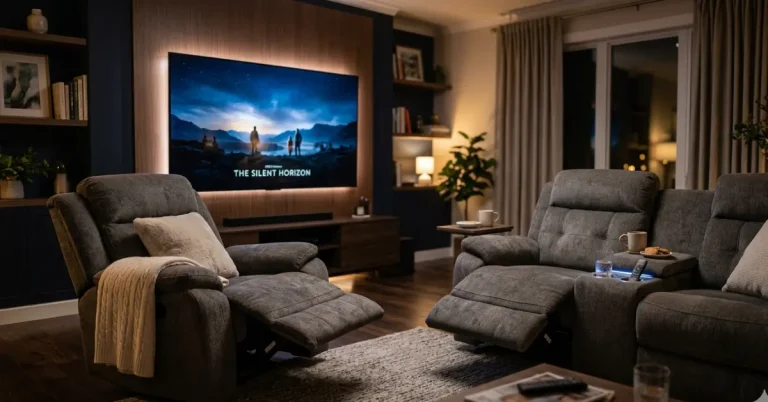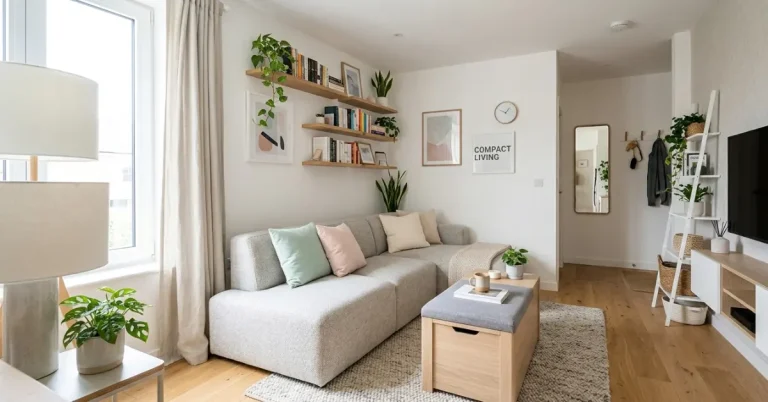
If you are under ~170 cm, most sofas you sit on are not designed for your body even expensive ones.
The issue is not softness or quality. It is proportion. Standard sofas are built around average or taller body measurements, which means the seat is often too deep, too high, or poorly aligned for shorter users.
The result is predictable:
your feet don’t fully reach the floor, your lower back loses support, and you start sliding or slouching without realizing it.
What looks comfortable in a showroom often becomes uncomfortable within minutes at home.
This guide breaks down exactly why that happens and what to do about it. You’ll learn:
- how to sit correctly on a sofa if you’re short
- which sofa dimensions matter most for short people
- what measurements to avoid
- how to test a sofa before buying
- and simple fixes if you already own one
The goal is not theory. It is fit.
Because a sofa should support your posture automatically not force you to adjust every few minutes.
Why sofas feel wrong for short people
Most sofas are not actually designed for short bodies. They are built around “average” proportions, which usually means taller users get the most natural fit.
When you sit down, the mismatch shows up immediately. Not dramatically at first, but in small physical details that accumulate into discomfort.
This is not about personal preference. It is about geometry.
Here is what usually goes wrong.
Seat depth is too large
Most modern sofas use deeper seating because it looks more luxurious in showrooms. Deep seats signal comfort visually. But visually comfortable does not mean physically supportive.
For shorter people, excessive seat depth creates a chain reaction:
- You cannot sit fully back while keeping your knees in a natural position
- Your lower back loses contact with the backrest
- You start sliding forward without noticing
- Your posture shifts into a semi-slouch
Over time, you stop sitting “on” the sofa and start sitting “in front of it.”
A comfortable seat should match your thigh length, not a design trend.
In ergonomic seating standards, seat depth is directly tied to lower limb support, not aesthetics. Most sofas ignore that principle entirely.
Internal reference: ergonomic seating principles
Seat height is too high
Seat height sounds like a small detail until your feet stop touching the floor properly.
For short users, this is often the first real discomfort trigger.
When seat height is too high:
- Feet hover or barely touch the floor
- Weight shifts unevenly onto the thighs
- The pelvis tilts slightly forward
- Sitting becomes unstable over time
You might not notice it consciously, but your body compensates immediately.
Instead of relaxing, your muscles stay partially engaged just to maintain balance.
A properly sized sofa allows full foot grounding. That single factor changes everything about long sitting comfort.
Backrest does not align with lower back
Most sofas look supportive from the outside. The problem is where that support actually lands.
Backrests are often designed for taller torsos, which shifts lumbar support higher than it should be.
For shorter users, this leads to:
- Lower back floating without support
- Upper back taking most of the pressure
- Neck and shoulders overworking to stabilize posture
- A subtle forward lean that becomes the default position
This is where fatigue builds slowly.
You don’t feel it instantly. You feel it after 20 to 30 minutes when your body starts asking for adjustment.
Good seating should support the natural S-curve of the spine, especially the lumbar region. If that point is missed, everything else breaks down.
Reference: OSHA ergonomic seating guidance highlights the importance of neutral spine alignment during prolonged sitting.
Feet do not fully ground
Foot contact is the foundation of stable sitting.
When your feet are not properly grounded, the entire posture loses structure.
This creates subtle but important effects:
- You shift weight between hips and thighs repeatedly
- You lean back more than necessary for stability
- You lose natural sitting balance
- You rely more on cushions or armrests for support
It might feel like “just a seating preference,” but it is actually a structural issue.
Without proper grounding, your body never fully settles into the sofa. It stays in a mild adjustment loop.
That is why some sofas feel tiring even when they look comfortable.
The real issue: mismatch, not comfort
When you combine all four problems, the pattern becomes clear.
It is not that sofas are uncomfortable.
It is that they are not built for your proportions.
- Too deep in the seat
- Too high from the floor
- Backrest placed for taller torsos
- No proper foot grounding
Once you notice this, most standard sofas start feeling slightly off, even expensive ones.
Comfort is not subjective here. It is structural fit.
And when the structure is wrong, no amount of styling or cushioning fully fixes it.

Why sofas are designed for average or tall body types
Most sofas are not designed around individual comfort. They are designed around averages. That sounds reasonable on paper, but in practice it creates a predictable mismatch for anyone outside that “middle range,” especially shorter users.
The goal for manufacturers is not perfect fit. The goal is broad usability.
And that changes everything
The “average height bias” in furniture manufacturing
Furniture design is heavily influenced by anthropometric data, but the problem is which data gets prioThe average height bias in furniture design
Furniture design starts with data. Anthropometric data to be specific. This includes measurements of human height, leg length, torso proportions, and sitting posture across populations.
But here is the problem. Most design standards lean heavily toward mid-range or slightly taller body types.
In practice, that means:
- Seat depth is calculated for longer thighs
- Seat height assumes longer lower legs
- Backrest positioning favors taller torsos
- Armrests align with higher elbow positions
Shorter users end up outside the intended design range without anyone explicitly deciding that.
It is not intentional exclusion. It is statistical convenience.
This is often called the “average user fallacy” in product design. One product is expected to serve too many body types at once, so it defaults to the middle.
The result is simple. The sofa fits “most people” but rarely fits anyone perfectly.
How global furniture standards ignore shorter users
There are ergonomic guidelines in furniture design, but they are broad, not strict.
International standards like ISO ergonomic recommendations provide ranges, not exact personalized measurements. That leaves manufacturers a lot of freedom in how they interpret comfort.
For sofas, that usually means:
- Seat height stays within a “safe average range”
- Seat depth is optimized for lounge appearance, not leg length
- Backrest angles prioritize visual comfort over spinal alignment
You can see this clearly in most global furniture catalogs. Whether you are looking at European, Scandinavian, or mass-market Asian furniture, the dimensions barely change.
That is because global furniture design is built for compatibility, not customization.
Even occupational ergonomics guidelines, like those referenced by the Occupational Safety and Health Administration (OSHA), focus more on workplace seating than relaxed furniture like sofas.
So sofas end up in a strange gap.
Not strict enough to be precision ergonomic furniture
Not flexible enough to be personalized seating
Just “good enough” for most users.
Why mass production limits customization
The biggest reason sofas don’t adapt to different body types is manufacturing reality.
Customization does not scale well.
Once a company starts producing sofas at volume, every variation increases cost:
- Different frame sizes require new tooling
- Multiple cushion dimensions slow down production lines
- Inventory becomes harder to manage
- Shipping and storage costs increase
So brands simplify.
They pick one or two “universal” dimensions and scale everything around them.
That usually means:
- One seat depth for the entire product line
- One seat height across multiple models
- Limited variation in backrest positioning
From a business perspective, this is efficient. From a user perspective, it creates inconsistency in comfort.
This is why two sofas from different brands often feel surprisingly similar in the same way. Not because they copied each other, but because they are built from the same constraints.
Even premium furniture brands often follow this logic. The difference is materials and design language, not core proportions.
What this means in real use
In a showroom, these design choices are invisible. Everything looks proportional, balanced, and comfortable.
But once you sit down, the limitations show up quickly:
- You adjust your posture without thinking
- You lean forward or backward to find support
- Your feet search for stable grounding
- Your lower back tries to “find” the right position
It feels like something is slightly off, even if you cannot immediately explain why.
That feeling is not random. It is the result of design systems optimized for averages, not individual fit.
What makes a sofa uncomfortable for short people?
What makes a sofa uncomfortable for short people
Most sofa discomfort for short people does not come from one single issue. It comes from a combination of small design mismatches that stack together.
Individually, they seem minor. Together, they affect posture, circulation, and how long you can sit without adjusting.
This is where geometry matters more than style or softness.
Seat depth forces constant posture adjustment
Seat depth is one of the most overlooked reasons sofas feel “off.”
For shorter users, deep seating changes how your body naturally rests.
Instead of sitting back comfortably, you end up in a loop:
- You sit back, but your knees feel unsupported
- You slide forward slightly without noticing
- You try to correct your posture repeatedly
- You eventually settle into a forward lean
This is not relaxation. It is compensation.
Most modern sofas use deeper seats because they look more inviting in showrooms. It creates a lounge effect. But that effect assumes longer legs and a larger sitting frame.
For shorter bodies, it breaks alignment.
A good reference point from ergonomic seating design is simple. Seat depth should match thigh length, not visual proportion or aesthetic preference.
Seat height disrupts foot stability
Seat height is where discomfort becomes immediate.
If your feet do not fully touch the floor, the sofa is already mismatched to your body.
For short people, higher seat platforms create predictable problems:
- Feet hover or touch only at the toes
- Pressure shifts into the thighs instead of being distributed
- Lower back loses natural support
- Sitting becomes less stable over time
You may not notice it consciously at first. But your body reacts quickly by tightening muscles to stabilize your position.
That is why even “soft” sofas can feel tiring after a while.
Comfort starts from the floor up. Without stable foot contact, the rest of the posture is compromised.
Backrest alignment misses the lower spine
Backrest design often assumes a taller torso than many users actually have.
That creates a subtle but important issue. The support lands in the wrong place.
Instead of supporting the lower back, the cushion contact shifts upward.
For shorter users, this leads to:
- Lower back floating without proper support
- Upper back taking more pressure than intended
- Shoulders rounding forward slightly
- Neck and upper spine doing extra work
The body adapts without you noticing. You lean forward a bit, or you shift your hips to find a better angle.
But the real issue is simple. The lumbar region is not supported where it needs to be.
Ergonomic seating principles used in occupational health, such as OSHA ergonomic guidance, consistently highlight neutral spine alignment as the baseline for long sitting comfort.
Sofas often miss this because they are not designed for structured posture. They are designed for relaxed posture. That difference matters more than it seems.
Armrest height creates shoulder tension
Armrests are often treated as a secondary feature. In reality, they directly affect upper body relaxation.
For shorter users, armrests are frequently too high relative to natural elbow position.
This creates subtle strain patterns:
- Shoulders stay slightly elevated
- Arms cannot fully relax without tension
- Upper back remains partially engaged
- Resting position feels unnatural over time
Instead of supporting relaxation, armrests become something you avoid using.
You might not notice it immediately, but after longer sitting sessions, your shoulders feel tighter than expected.
A properly sized armrest should allow elbows to rest naturally without lifting or dropping the shoulder line. When that alignment is off, comfort degrades slowly but consistently.
The combined effect: small mismatches become real discomfort
None of these issues alone makes a sofa unusable.
But together, they create a consistent pattern:
- You cannot fully relax into the seat
- Your posture keeps adjusting automatically
- Your body stays slightly active instead of resting
- Long sitting sessions feel more tiring than they should
This is why two sofas can feel very different even if they look similar in a showroom.
It is not about softness or brand. It is about whether the dimensions match your body proportions.
And for shorter users, that mismatch shows up more clearly because every small deviation in height, depth, or alignment has a bigger impact on posture stability.
Ergonomic explanation: how body proportions affect sofa comfort
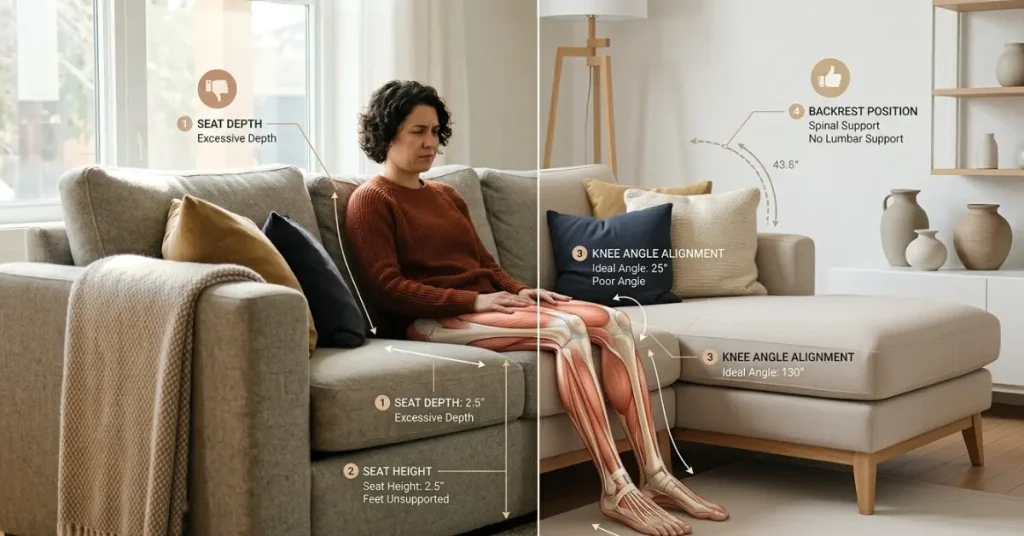
Most sofa discomfort is not about softness or material quality. It is about alignment. Ergonomics focuses on how the human body fits into a sitting system, and sofas often fail this test for shorter people.
Body proportions matter more than most buyers realize. Leg length, torso height, and hip position all determine whether a sofa supports you or fights against you.
When those proportions don’t match the furniture design, comfort breaks down quickly.
Ideal sitting posture vs real sofa posture
In an ideal ergonomic setup, your body should stay balanced without effort.
That means:
- Feet flat on the floor
- Knees slightly lower or level with hips
- Lower back supported naturally
- Shoulders relaxed, not lifted or rounded
This is the posture used in ergonomic seating research and office chair design standards like those outlined in occupational health guidelines from the OSHA ergonomic recommendations.
But on most sofas, especially deeper lounge designs, reality looks different.
Shorter users often end up with:
- Feet not fully grounded
- Hips sliding forward
- Lower back unsupported
- A slight backward slump or forward lean
This is not “relaxation posture.” It is compensation posture.
The body is constantly adjusting to stay stable on a seat that does not match its proportions.
And over time, that effort becomes fatigue.
Importance of 90-degree knee and hip angles
A proper sitting position relies heavily on joint alignment.
The most stable posture usually keeps:
- Knee angle close to 90 degrees
- Hip angle close to 90 degrees
- Spine naturally supported without forced leaning
This geometry distributes body weight evenly across the seat and legs.
When sofas are too deep or too high, those angles break down.
For shorter users, common issues include:
- Knees sitting higher than hips
- Legs extending forward unnaturally
- Pressure concentrating on thighs instead of full support
That imbalance changes how weight is carried through the body. Instead of being evenly supported, the lower back and thighs take excess load.
A sofa should not force you to “find balance” every time you sit down. If it does, the design is working against basic ergonomic principles.
Even industrial seating standards, such as those used in ISO ergonomic design references emphasize maintaining stable joint angles for prolonged sitting comfort.
How poor sofa fit affects circulation and posture
When sofa dimensions are wrong for your body, the effects go beyond discomfort. They affect how your body functions during rest.
Circulation is one of the first things impacted.
If feet don’t rest properly on the floor:
- Blood flow in the lower legs becomes less efficient
- You may feel mild numbness or pressure over time
- Shifting positions becomes more frequent
Posture also starts to adapt in unhealthy ways.
Common long-term patterns include:
- Slouching to compensate for missing back support
- Leaning to one side for balance
- Tucking legs or sitting cross-legged on deeper seats
- Relying heavily on cushions to “rebuild” support
These are not design features. They are survival adjustments your body makes to cope with poor fit.
And once those habits form, they follow you beyond the sofa. You start sitting that way on beds, chairs, and even floors.
The real issue is not just comfort in the moment. It is how repeated poor alignment reshapes sitting behavior over time.
A well-designed sofa should reduce effort, not increase it. If you constantly adjust your posture, the sofa is not ergonomic for your body type.
How to Sit Correctly on a Sofa When You’re Short (Step-by-Step)
Correct posture isn’t about a new sofa. It’s about knowing exactly what “correct” looks like for your body, then checking it every time you sit down.
1. Sit all the way back
Push your hips fully into the backrest, not the front edge of the cushion. If you have to slide forward to feel supported, that’s the seat depth talking, not your posture.
2. Check your knee angle
Knees should sit close to 90 degrees, roughly level with your hips. If your knees are higher than your hips, the seat is too low. If your legs are stretching out flat, it’s too deep.
3. Ground both feet fully
Feet flat on the floor, full contact, not just your toes. If you’re hovering or balancing on the balls of your feet, your lower back is already compensating for it.
4. Check lower back contact
Your lower spine should touch the backrest, not float above it. If you feel a gap at your lower back while your shoulders touch the cushion, the lumbar support is sitting too high for your torso.
5. Relax your shoulders and arms
Shoulders should drop naturally, elbows resting on the armrest without lifting. If your shoulders stay slightly raised, the armrest height is fighting your arm length.
If you can’t hit all five points on your current sofa, the issue isn’t your sitting habits. It’s the dimensions. See the fixes section below, or the sizing guide above, for what to change.
Before You Buy
The Short Person’s Sofa Fit Guide
A printable height-to-dimensions chart, self-measuring steps, and a shopping checklist — know your exact numbers before you shop.
Get the Guide — $9 →What sofa dimensions matter most for short people?
Most people shop for sofas based on look, color, or softness. That is where mistakes start. For short people, comfort is not visual. It is dimensional.
A sofa can look perfect and still fail completely in fit. The difference comes down to four measurements that control how your body interacts with the seat.
Ideal seat height (floor to seat)
Seat height is the first thing you feel, even if you don’t realize it.
For shorter users, the goal is simple: feet must rest flat on the floor without strain.
Typical sofa seat height ranges from 42 cm to 48 cm. That range often feels too tall for shorter individuals.
A more comfortable range is usually:
- Around 38 cm to 42 cm for shorter users
- Low enough to keep knees stable
- High enough to avoid sinking posture
If seat height is too high, you get:
- Dangling feet or toe contact only
- Pressure on thighs instead of full support
- Instability when sitting or standing
This is why many short users feel “off balance” on modern deep sofas.
The key principle is simple. If your feet don’t anchor you, the sofa is not working ergonomically.
Ideal seat depth (front to back)
Seat depth is where most sofas fail short users completely.
Deep seating looks luxurious. It photographs well. But functionally, it assumes longer legs.
For shorter people, the issue is immediate:
- You cannot sit fully back and still bend knees comfortably
- Your lower back loses contact with the backrest
- You end up sliding forward without noticing
Ideal seat depth for better fit is typically:
- Around 45 cm to 50 cm for shorter users
- Shallow enough to allow full back support
- Compact enough to maintain knee alignment
When seat depth is wrong, no amount of cushions can fully fix it. You are constantly repositioning instead of relaxing.
This is why many buyers feel regret after choosing oversized lounge sofas that looked comfortable in showrooms.
Backrest height and lumbar support position
Backrest design is often overlooked, but it directly controls spinal comfort.
For short people, the problem is not just height. It is where support lands.
Common mismatch issues:
- Lumbar support sits too high above lower back
- Upper back is supported, but lower spine floats
- Neck support feels irrelevant or misaligned
A good sofa should support the natural curve of the spine, especially the lower back region.
If lumbar support is too high, your posture shifts forward slightly. That creates long-term fatigue without obvious pain at first.
For better alignment:
- Backrest should meet lower back naturally
- Cushion curve should follow spinal shape
- Headrest (if present) should not force neck extension
This is where ergonomic seating principles used in occupational design standards become relevant. The focus is always on maintaining neutral spine alignment, not just surface comfort.
Cushion firmness vs sinking effect
Cushion softness is where many buyers get misled.
Soft sofas feel comfortable for the first few minutes. Then the problems begin.
For short people, overly soft cushions create:
- Excess sinking into the seat frame
- Loss of knee and hip alignment
- Difficulty standing up smoothly
- Increased slouching over time
The body drops below the intended ergonomic position, which changes every angle of support.
A better approach is balanced firmness:
- Firm enough to maintain structure
- Soft enough to reduce pressure points
- Stable enough to prevent deep sinking
Think of it this way. A sofa should support your body, not absorb it.
Many premium furniture designs now use multi-density foam layers to control this balance, especially in ergonomic-focused brands like those following modern Scandinavian furniture design principles.
The goal is not softness. The goal is controlled support with predictable posture.
If you sit down and slowly disappear into the sofa, it is working against your body proportions, not with them.
Common mistakes short people make when buying sofas
Most sofa regret does not come from bad quality. It comes from buying decisions made too quickly. Showrooms are designed to sell comfort visually, not ergonomically.
Short people are especially affected because proportions matter more than aesthetics. A sofa can look perfect and still feel completely wrong at home.
Here are the most common mistakes that lead to discomfort.
Choosing based on appearance instead of dimensions
This is the biggest trap.
A sofa that looks “soft, deep, and premium” often hides poor ergonomic fit for shorter users.
People usually focus on:
- Fabric texture
- Color matching with interiors
- Overall style (modern, luxury, minimal)
But ignore:
- Seat height
- Seat depth
- Backrest alignment
In real use, dimensions decide comfort, not design.
A visually appealing sofa can still cause:
- Hanging feet
- Slouched posture
- Constant repositioning
This is why showroom comfort often disappears within days at home.
A better buying mindset is simple. Measure first, admire second.
If dimensions are not listed clearly, that is already a warning sign.
Ignoring seat depth measurements
Seat depth is the silent dealbreaker.
Most buyers don’t even ask about it. They assume all sofas are similar.
That assumption is expensive.
For short people, deep seats create immediate problems:
- You cannot sit fully back without sliding
- Your knees lose proper support
- Your backrest becomes unreachable
You end up sitting “forward” most of the time without realizing it.
Typical mistake behavior:
- Trying sofas briefly instead of sitting properly
- Not checking full seated posture
- Assuming cushions will fix depth issues
They won’t.
Once seat depth is wrong, the sofa will always require adjustment from your body.
For reference, ergonomic seating discussions often emphasize matching seat depth to thigh length, not visual proportion. This principle is widely used in furniture ergonomics and occupational design research.
Not testing foot support while seated
This is the most overlooked step in furniture buying.
Most people sit casually in showrooms. They don’t test real posture.
But for short users, foot support is critical.
If your feet do not rest flat on the floor:
- Stability drops immediately
- Lower back takes more pressure
- Sitting becomes passive strain instead of rest
What you should actually do in a showroom:
- Sit fully back against the sofa
- Place both feet flat on the ground
- Check knee angle naturally
- Stay seated for at least 1–2 minutes
If you feel the urge to shift position quickly, that is already feedback from your body.
Many buyers ignore this and focus on softness instead. That is how “comfortable-looking” sofas turn into long-term discomfort at home.
A simple internal check: if your feet are floating even slightly, the sofa is not designed for your body proportions.
Good sofa buying is not about how it feels in the first 10 seconds. It is about how stable your body feels after a few minutes without adjusting.
How to choose a sofa if you are short
Buying a sofa when you are short is not about finding the “softest” or “trendiest” option. It is about control. Control over dimensions, posture, and how your body actually interacts with the seat.
Most sofas on the market are built for average proportions. So you have to actively filter for fit, not aesthetics.
Here is how to do it properly.
Look for shallow-seat sofas (compact depth designs)
Seat depth is the first filter.
If the sofa is too deep, everything else becomes harder to fix. Shallow-seat designs are simply more predictable for shorter users.
What to look for:
- Seat depth closer to 45–50 cm
- Clean, compact seating profile
- Backrest that you can actually reach while sitting fully back
Avoid sofas that feel like “loungers” unless you are significantly tall. Those are designed for stretched-out posture, not upright support.
In real life, shallow seats help you:
- Sit without sliding forward
- Keep lower back connected to the backrest
- Maintain natural knee positioning
This is where many ergonomic seating principles align with industrial furniture standards used in human-centered design, such as ISO-based ergonomic seating guidelines (https://www.iso.org/standard/57772.html).
If a sofa looks oversized in depth, trust that instinct. It usually is.
Choose firm cushions to prevent sinking
Soft cushions feel good in a showroom. That feeling doesn’t last.
For shorter users, sinking is a hidden problem. It breaks posture alignment instantly.
Firm cushions help maintain:
- Stable seat height after sitting down
- Consistent knee and hip alignment
- Predictable back support position
When cushions are too soft:
- You sink below ergonomic height
- Feet lift slightly or lose grounding
- Lower back loses structured support
That creates a lazy posture without you realizing it.
A good sofa should resist your weight slightly, not absorb it completely. Think support first, comfort second.
High-quality designs often use multi-density foam layers to balance firmness and comfort. This approach is common in modern ergonomic furniture design because it prevents posture collapse over time.
Test seated foot placement before buying
This step is non-negotiable, yet most people skip it.
Do not just sit. Test properly.
What you should check:
- Are both feet flat on the floor
- Are your knees at a natural angle
- Do you feel stable without shifting weight
- Can you stay seated comfortably for 2–3 minutes
If your feet dangle even slightly, that sofa is already mismatched.
Real-life scenarios where this matters:
- Watching TV for long periods
- Talking with guests
- Relaxing after work
- Reading or using a laptop
If you constantly adjust your legs, the sofa is forcing movement instead of supporting rest.
Good seating should feel stable immediately, not after “getting used to it.”
Consider modular or customizable sofas
This is where you gain control instead of compromise.
Modular sofas allow you to adjust:
- Seat depth through rearrangement
- Cushion positioning
- Armrest placement in some designs
Customizable sofas go even further. Some brands offer:
- Different seat heights
- Adjustable backrests
- Multiple cushion firmness options
This is especially useful if you are shorter, because it removes the “one-size-fits-all” limitation entirely.
Brands influenced by Scandinavian furniture design principles often prioritize modular layouts because they adapt better to different body types.
In real terms, modular sofas solve a simple problem:
Instead of your body adapting to the sofa, the sofa adapts to you.
That is the difference between “looks good” furniture and actually usable furniture.
Best sofa alternatives for short people
Not every sofa is worth forcing yourself to “adapt to.” If standard designs don’t fit your body proportions, switching categories is often the smarter move.
Short people usually benefit more from scaled-down seating solutions rather than full-size lounge sofas. The goal is simple. Better ground contact, better back support, less body strain.
Here are the most practical alternatives.
Loveseats and compact sofas
Loveseats are one of the most reliable options for shorter users.
They are naturally designed with:
- Shallower seat depth
- Smaller overall width
- More controlled proportions
This immediately improves posture alignment. You are not stretching to reach the backrest, and you are not floating in oversized seating space.
Real-world comfort benefits:
- Easier foot placement on the floor
- Better lumbar contact
- Less need for extra cushions
- More stable sitting position
Compact sofas also fit better in smaller living spaces, which often leads to better ergonomics by default.
Many modern furniture brands now design compact seating lines specifically for urban apartments, where space efficiency and body fit matter equally.
If you want a practical reference point, look at Scandinavian-style compact designs that prioritize proportion over bulk.
Japanese-style low seating furniture
Japanese-inspired seating changes the entire comfort equation.
Instead of forcing the body upward, it brings the seating level closer to the ground.
Common options include:
- Floor sofas
- Low wooden frame couches
- Tatami-style seating setups
This approach removes the seat-height problem completely.
Benefits for short users:
- Feet naturally grounded or folded comfortably
- No pressure from elevated seat height
- Relaxed spinal positioning closer to natural rest posture
In many cases, this style feels more natural because it reduces dependency on rigid furniture geometry.
The trade-off is clear. It is less formal seating, but more body-friendly.
Internal reference idea: pairing low seating with ergonomic floor cushions or lumbar support pillows can further improve posture stability.
Adjustable recliners with foot support
Recliners solve a different problem: alignment through adjustability.
Unlike fixed sofas, adjustable recliners let you control:
- Backrest angle
- Footrest extension
- Seating depth effect (indirectly through recline position)
For short people, this flexibility is a major advantage.
What makes them effective:
- Built-in foot support removes dangling feet issue
- Recline function reduces pressure on lower back
- Adjustable positions allow posture correction
However, not all recliners are equal. Cheap models often exaggerate softness without proper structural support, which leads to the same sinking problem found in standard sofas.
A good recliner should feel stable in every position, not just soft in one.
In real life, recliners work best for:
- Long TV sessions
- Relaxation after work
- Reading or passive rest
But they are not always ideal for structured sitting or social seating. That’s why many users combine recliners with compact sofas or loveseats for balance.
The key takeaway is simple. If standard sofas fail your body proportions, switching to purpose-built alternatives is not a downgrade. It is a correction.
Simple fixes to make an existing sofa more comfortable
Not every uncomfortable sofa needs to be replaced immediately. In many cases, the issue is adjustability, not total failure.
If the structure is decent, you can improve comfort by correcting posture alignment and filling ergonomic gaps. These fixes don’t change the sofa, but they change how your body interacts with it.
Here’s what actually works in real use.
Use lumbar and seat cushions
Cushions are not decoration here. They are structural corrections.
For short people, the main problem is often missing lower back and seat alignment. Cushions help fill that gap.
What to use:
- Lumbar cushions for lower back support
- Firm seat cushions to reduce sinking depth
- Thin back pillows to improve posture angle
The goal is not softness. It is alignment.
When placed correctly, lumbar support helps:
- Keep spine in a natural curve
- Reduce slouching without effort
- Improve long sitting comfort during TV or reading
Seat cushions also help adjust seat height slightly, which can improve foot grounding if the sofa is too deep or too low.
But there is a limit. If you are stacking too many cushions just to sit properly, the sofa itself is the real problem.
Add footrests or ottomans
Foot support is one of the most underrated comfort fixes.
For shorter users, feet not touching the floor properly creates instability. A footrest solves that immediately.
Options include:
- Dedicated ottomans
- Adjustable footstools
- Small padded benches
- Modular furniture cubes
What this changes in real life:
- Reduces pressure on thighs
- Improves lower back support indirectly
- Stabilizes sitting posture
- Makes long sitting sessions more relaxed
A simple ottoman can often correct what a poorly sized sofa cannot.
Many interior setups now treat ottomans as both functional and aesthetic pieces, especially in compact urban furniture layouts influenced by modern Scandinavian design principles.
The key idea is simple. If the floor doesn’t support you, add support artificially.
Adjust seating posture ergonomically
Sometimes the sofa is not fully wrong. The sitting habit is.
Even with imperfect furniture, posture adjustments can significantly reduce discomfort.
Basic corrections:
- Sit fully back, not on the edge
- Keep feet flat and stable when possible
- Avoid crossing legs for long periods
- Keep shoulders relaxed, not lifted forward
- Use backrest support instead of leaning forward
A proper sitting posture should feel effortless, not forced.
If you constantly shift position, your body is reacting to poor alignment. But small corrections can still reduce strain.
For example:
- Slight forward tilt of pelvis improves spinal alignment
- Even weight distribution reduces pressure points
- Avoiding slouching prevents long-term back fatigue
Ergonomic seating principles used in occupational health guidelines, such as those referenced by OSHA ergonomics standards emphasize one core idea: reduce continuous strain, not just temporary discomfort.
The reality is this. If you combine cushions, foot support, and proper posture, even an average sofa can become significantly more usable.
But if you still feel constant discomfort after these adjustments, the issue is not habits anymore. It is design mismatch.
Why most furniture brands still ignore short users
Furniture brands don’t usually design sofas with one specific group in mind. They design for scale. That changes everything.
Short users don’t get excluded intentionally. They get excluded structurally. Once you see how the system works, the pattern becomes obvious.
The result is consistent across most markets. Sofas are built for averages, not individuals.
Cost optimization in standardized sizing
Standard sizing is how furniture companies stay profitable.
It reduces complexity in every part of production:
- One frame size works for multiple models
- One cushion mold fits different collections
- One shipping system handles bulk inventory
- One showroom model represents the entire range
This keeps prices competitive. But it also locks design into a narrow range of body fit.
For short users, that creates predictable issues:
- Seat depth stays too large because resizing costs more
- Seat height is fixed to avoid manufacturing variation
- Backrest angles remain generic instead of adaptive
In practice, this means comfort is designed around efficiency, not ergonomics.
You can see this in almost every mass-market furniture catalog. Very few brands offer true proportional sizing. Most rely on “one size fits most” logic.
And in seating design, that logic always favors average proportions over edge cases.
Global design targeting average male height
Most sofa dimensions still trace back to global anthropometric averages.
The issue is not just “average height.” It is which average gets prioritized.
In many design datasets, especially those historically used in industrial furniture development, the reference point often aligns with:
- Average male body proportions
- Western ergonomic benchmarks
- Office seating standards adapted for home use
This creates a silent bias in design outcomes.
For short users, the effects are consistent:
- Feet do not ground properly on standard seat heights
- Seat depth extends beyond natural thigh length
- Armrests sit higher than relaxed elbow position
The sofa feels slightly “off” even when everything looks correct visually.
This mismatch is not always noticeable in marketing photos. It only shows up when you sit down and your body doesn’t align with the structure.
Even ergonomic references like ISO 9241-5 seating guidelines rely on population-based averages. That works for general usability. It does not guarantee individual fit.
And sofas are especially sensitive because they are used for long, relaxed sitting, not short, task-based seating.
Lack of inclusive ergonomic standards
Unlike office chairs or automotive seats, sofas are not tightly regulated for ergonomic precision.
There is no strict global requirement that forces brands to:
- Offer multiple seat heights for different body types
- Adjust seat depth based on leg length ranges
- Test lumbar alignment across diverse height groups
Instead, sofa design is guided by loose ergonomic principles and market preference.
That leads to predictable outcomes:
- Aesthetic design takes priority over posture support
- Comfort is judged visually instead of biomechanically
- One “standard sofa” is expected to serve all users
From a buyer perspective, this creates confusion. A sofa may feel comfortable in a showroom but fail at home because real use reveals the mismatch.
In real life, this means short users often end up adapting to furniture instead of furniture adapting to them.
And until inclusive ergonomic standards become stricter in consumer furniture design, most sofas will continue to reflect averages, not real human diversity.
Before You Buy
The Short Person’s Sofa Fit Guide
A printable height-to-dimensions chart, self-measuring steps, and a shopping checklist — know your exact numbers before you shop.
Get the Guide — $9 →Final takeaway:
Most people buy sofas backwards. They start with style, then comfort, then dimensions. That order is the reason many sofas feel wrong after a few days.
For short people, the reality is more strict. If the dimensions don’t match your body, nothing else will save the experience. Not cushions. Not fabric. Not brand reputation.
Good sofa buying is not emotional. It is technical first, emotional second.
What actually matters is fit.
Start with body alignment, not appearance. A sofa should support your natural posture without forcing adjustments. If you need to “fix” it every time you sit, it is already failing its job.
Focus on these non-negotiables:
- Seat height that allows full foot contact with the floor
- Seat depth that does not push you forward
- Backrest that meets your lower spine naturally
- Cushion firmness that prevents sinking into misalignment
These four factors decide whether a sofa works for your body or works against it.
Everything else is secondary.
In real life, you will feel the difference in simple moments:
- Sitting down without shifting position
- Watching TV without adjusting every few minutes
- Standing up without strain on knees or lower back
- Relaxing without thinking about posture
That is the real definition of comfort. Not softness. Not aesthetics. Stability.
Most furniture brands still design for averages. That is unlikely to change soon. So the responsibility shifts to the buyer.
If you want a practical reference point, ergonomic seating principles from occupational design standards like OSHA guidelines consistently emphasize one idea: reduce continuous body compensation.
That is the key.
A good sofa should disappear into the background of your comfort. You should not notice it. Your body should just work with it.
If you feel like you are constantly adjusting, the sofa is not the right fit. Simple as that.