
Most people begin evaluating furniture with a simple assumption: if you’re shorter, you need smaller furniture. That seems logical because height is the easiest body measurement to recognize. However, height only describes how tall a person is when standing. It does not explain how the body contacts, supports, and moves against furniture while sitting. Furniture never supports height directly. It supports individual parts of the body. Understanding this distinction is the foundation for choosing furniture that actually fits.
When people ask, “What are body proportions in the context of furniture?”, the useful answer is not an anatomy definition. In furniture ergonomics, body proportions describe the relationship between different body measurements such as leg length, torso length, arm length, hip width, and shoulder width and how those measurements interact with furniture dimensions. These relationships determine where your feet rest, whether your thighs are supported, how your back contacts the backrest, whether your arms comfortably reach the armrests, and how your weight is distributed across the seat. Furniture fit is therefore determined by the body’s proportions not by a single overall measurement.
The relationship works as a connected process rather than a single measurement:
Body Proportions → Body Contacts Furniture → Furniture Supports Body → Posture Changes → Comfort Changes
This process explains why furniture fit should be evaluated as an interaction between the body and the furniture rather than as a comparison between body height and furniture size. Every sitting experience begins where the body touches the furniture.
Why Height Alone Cannot Predict Furniture Fit
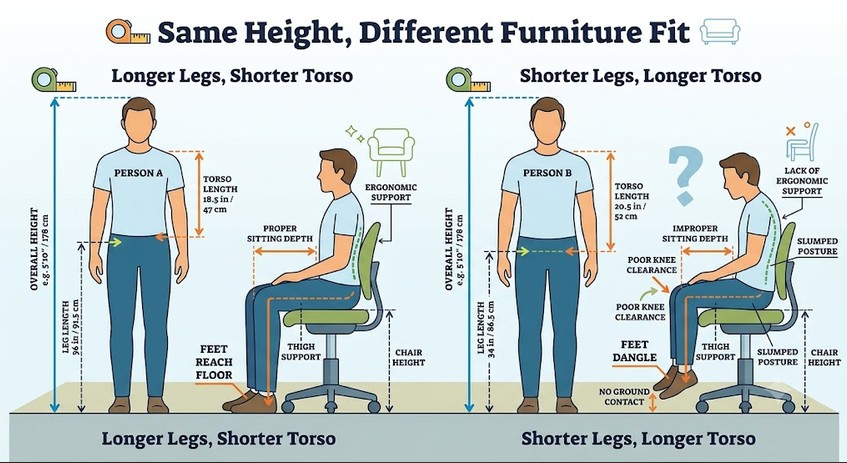
If height alone determined furniture fit, two people of the same height would experience the same chair in the same way. In reality, they often do not. One person may sit with both feet firmly on the floor while another person’s feet dangle. One may comfortably reach the backrest while another must slide forward to maintain balance. These differences occur even when their standing height is identical because their body proportions are different.
Height remains a useful reference because it describes overall body size and provides a general starting point for understanding human dimensions. The problem arises when height is treated as a predictor of furniture compatibility. Height cannot reveal how long the lower legs are, how much thigh support is needed, where the pelvis meets the seat, how high the backrest should support the torso, or how far the armrests should be from the shoulders and elbows. Those measurements—not overall stature—determine whether furniture supports the body correctly.
This is why using only height often leads to poor furniture decisions. Important body information is missing, so furniture dimensions are matched to an incomplete description of the user. The result is reduced support, compensatory sitting positions, and lower long-term comfort. Anthropometric research and ergonomic seating standards consistently evaluate seated body dimensions because furniture interacts with people while they are sitting, not while they are standing.
The better question therefore changes from:
“How tall is the person?”
to
“How is this person’s body proportioned relative to the furniture?”
That shift changes furniture selection from estimating size to evaluating ergonomic compatibility.
How Body Proportions Influence Furniture Interaction
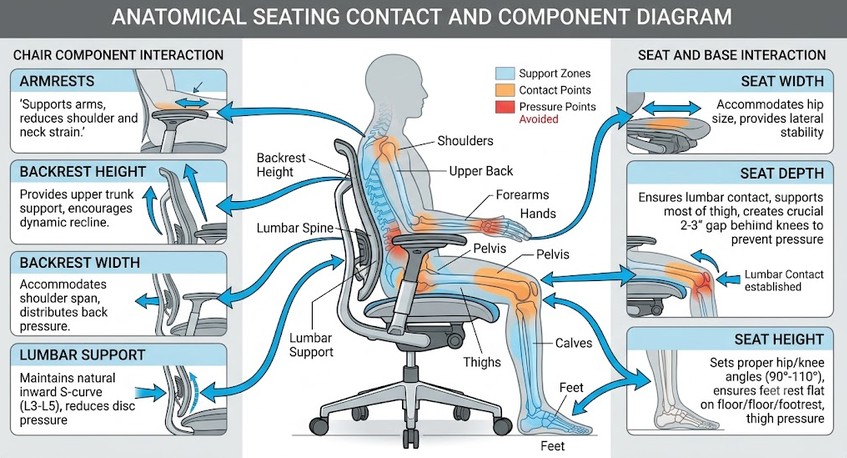
Furniture does not support the body as one solid object. It supports multiple body regions at the same time, and each region interacts with a different furniture dimension. While sitting, the feet contact the floor, the lower legs determine the relationship with seat height, the thighs interact with seat depth, the pelvis transfers body weight to the seat, the torso relies on the backrest, the shoulders require appropriate upper-body support, and the arms depend on correctly positioned armrests. Every contact point contributes to the overall sitting experience.
Because these contact points work together simultaneously, changing a single body proportion changes the entire interaction. A shorter lower leg alters foot support and knee position. A longer torso changes where the back meets the backrest. Different hip widths change how pressure is distributed across the seat. These are not isolated adjustments—they influence posture, stability, movement, and perceived comfort as a connected ergonomic system.
Rather than thinking about furniture as “large” or “small,” it is more accurate to evaluate how well its dimensions correspond to the body’s support zones. Furniture dimensions exist because different body regions require different kinds of support. Evaluating only one measurement—such as overall height or seat height—cannot predict how the entire body will interact with the furniture.
This relationship can be summarized as:
Body Proportions → Furniture Contact Points → Body Support → Postural Alignment → Comfort
Understanding this interaction provides a far more reliable way to predict furniture fit than relying on height alone. It also explains why two people who appear similar in size can have completely different experiences using the same chair or sofa.
The next step is identifying which specific body proportions influence furniture fit. Once the principle is established that proportions matter more than height, each body measurement can be examined to understand which furniture dimension it affects and why that relationship changes comfort and ergonomics.
The Body Proportions That Affect Furniture Fit
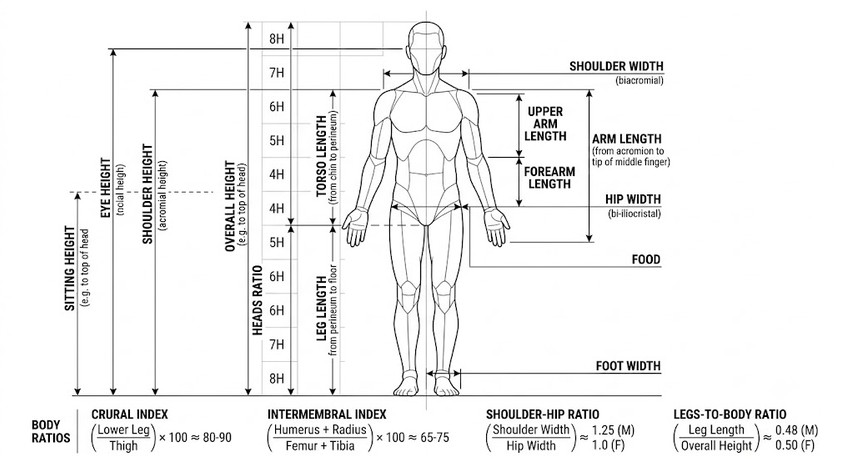
The previous sections established an important principle: furniture fits body proportions, not simply overall height. The next question is naturally, which body proportions actually determine furniture fit? The answer is not a single measurement. Every major furniture dimension corresponds to one or more body proportions because different parts of the body perform different functions while sitting. Understanding these relationships makes it possible to evaluate furniture systematically instead of relying on guesswork.
Rather than viewing the body as one measurement, it is more useful to think of it as a collection of functional dimensions. Some measurements determine whether your feet reach the floor, others influence back support, while others affect pressure distribution or arm reach. Together, these body proportions create the complete interaction between your body and the furniture.
The relationship can be understood as a continuous process:
Body Proportions → Individual Measurements → Furniture Dimensions → Body Support → Comfort
Each body proportion contributes differently to furniture fit, so they should be evaluated individually before being considered together.
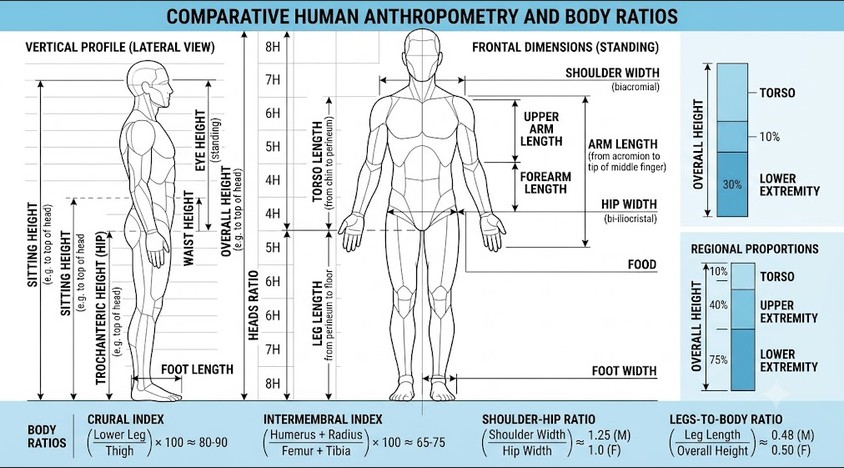
Height
Height provides a useful description of overall body size, but it should be treated as a starting point rather than a furniture measurement. Knowing that someone is 5’2″ or 5’8″ tells us their general stature, yet it reveals very little about how they will interact with a chair or sofa.
For furniture selection, height becomes meaningful only when interpreted alongside other body proportions. Two people with identical standing height may have different leg lengths, torso lengths, or shoulder widths, resulting in completely different seating requirements. Height therefore provides context, while body proportions provide prediction.
Instead of asking whether furniture suits a certain height, a better question is whether its dimensions match the body’s proportions. Height helps describe the user, but it cannot explain why one chair feels supportive and another does not.
Leg Length
Among all body proportions, leg length has one of the strongest influences on seating ergonomics because it determines how the lower body interacts with the chair.
When sitting, leg length influences whether the feet rest comfortably on the floor, whether the knees remain at a balanced angle, and whether the thighs receive adequate support. These interactions are controlled primarily by seat height and seat depth, making leg length far more useful than overall height when evaluating seating.
A person with shorter legs may encounter several problems even if a chair appears appropriately sized. If the seat is too high, the feet may not reach the floor comfortably, increasing pressure beneath the thighs and reducing stability. If the seat is too deep, the knees may not bend naturally while the lower back loses contact with the backrest. Neither problem results from height alone—they result from the relationship between leg length and furniture dimensions.
This explains why lower-body proportions influence much more than foot contact. They affect balance, posture, movement, and long-term comfort throughout the entire sitting experience.
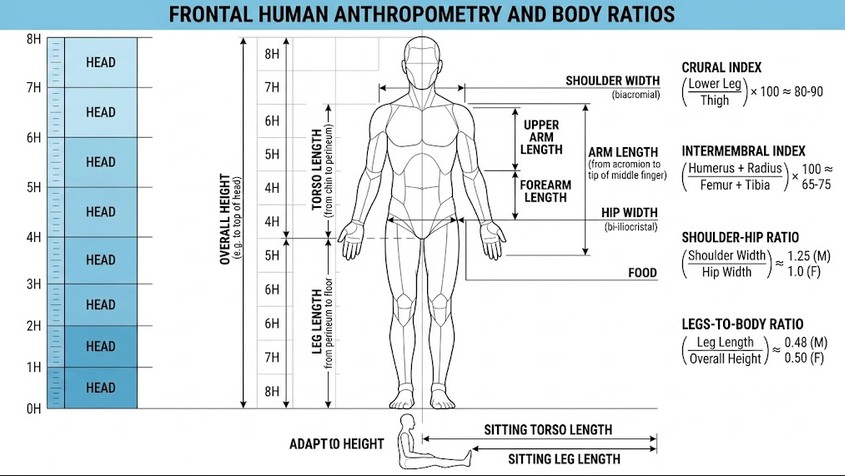
Torso Length
While leg length primarily determines lower-body support, torso length governs how the upper body interacts with the backrest.
The position of the lower back, shoulders, and upper spine depends on where the torso meets the chair. A backrest does not automatically provide good support simply because it is tall or well padded. Its effectiveness depends on whether its support zones align with the user’s torso.
Two people with identical height may experience the same backrest differently because their torso lengths differ. One person’s lumbar region may align perfectly with the chair’s support, while another person’s lower back sits above or below the intended support area. This difference changes posture, muscular effort, and long-term sitting comfort.
For this reason, torso length is a better predictor of backrest compatibility than standing height. It explains why chairs that appear identical can produce very different ergonomic outcomes for different users.
Arm Length
Furniture also depends on how comfortably users can reach, support, and position their arms during everyday activities.
Arm length influences where the elbows naturally rest, how easily the forearms reach armrests, and how comfortably the hands interact with desks, tables, keyboards, or other work surfaces. Proper reach allows the shoulders to remain relaxed while supporting natural movement.
When arm length is ignored, users often compensate by raising their shoulders, leaning forward, or extending their arms farther than necessary. These adjustments increase muscular effort and reduce comfort even if the seat itself feels supportive.
This is why armrests should not be evaluated independently. Their usefulness depends on whether they correspond to the user’s arm length and natural reach envelope.
Hip Width
Furniture supports body weight through the seat, making hip width an important determinant of seat width compatibility.
A seat that is too narrow concentrates pressure around the hips and restricts natural movement. However, an excessively wide seat can also reduce stability by allowing the body to shift laterally without adequate support. The objective is not to maximize space but to achieve balanced support across the seating surface.
Hip width therefore influences more than whether someone physically fits into a chair. It affects pressure distribution, sitting stability, repositioning, and overall ergonomic support.
Evaluating seat width through the lens of hip width provides a more reliable assessment than assuming wider seats are always more comfortable.
Shoulder Width
The upper body interacts with furniture through the shoulders, upper back, and arms. Shoulder width determines how comfortably the upper body fits within the backrest and armrest structure.
A backrest that is too narrow may restrict movement and reduce upper-body support, while one that is disproportionately wide may fail to stabilize the shoulders effectively. Similarly, the spacing between armrests should correspond to shoulder breadth so that the arms remain supported without forcing awkward positioning.
Shoulder width therefore influences upper-body stability rather than simply determining whether someone physically fits inside a chair. It helps explain why two users with similar height can experience completely different levels of shoulder comfort in the same furniture.
Each body proportion examined in this section contributes a unique part of the overall furniture interaction. Height provides context, leg length influences lower-body support, torso length governs back support, arm length determines reach, hip width affects pressure distribution, and shoulder width shapes upper-body stability. None of these measurements independently determines comfort. Instead, each controls a different furniture dimension.
The next step is to understand how these body proportions work together as a complete ergonomic system. Furniture never supports one body measurement in isolation—it supports multiple body regions simultaneously, and their combined interaction ultimately determines furniture fit and comfort.
How Body Proportions Work Together
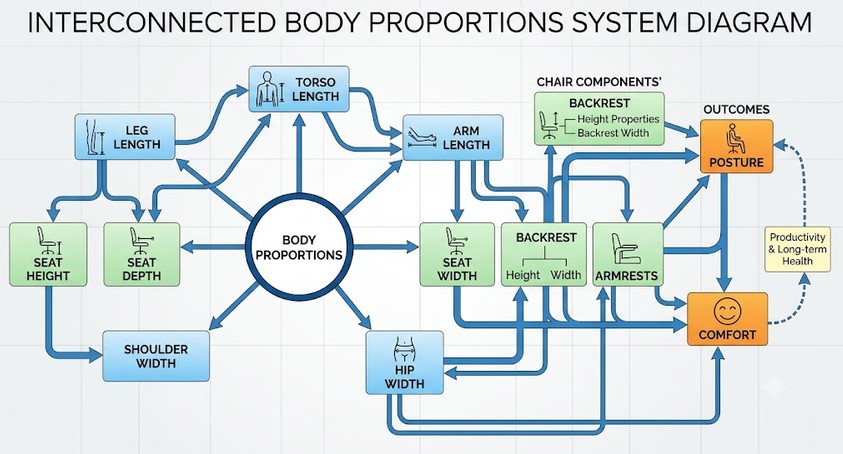
After identifying the individual body proportions that influence furniture fit, an important question remains: Is it enough to evaluate each measurement separately? The answer is no. Furniture does not interact with one body part at a time. Every moment you sit, multiple body regions contact the furniture simultaneously, creating a connected ergonomic system. Understanding this interaction explains why changing a single body proportion can affect the entire sitting experience.
Instead of thinking about furniture as a collection of independent dimensions, it is more accurate to think of it as a support system that must accommodate several body proportions at once.
Body Proportions → Combined Body–Furniture Interaction → Posture → Movement → Comfort
This systems perspective is what transforms individual measurements into meaningful furniture evaluation.
Why One Body Measurement Cannot Predict Furniture Fit
People often focus on one measurement when comparing furniture. Some look only at seat height, while others pay attention only to seat depth or overall chair size. Although each measurement is important, none can predict furniture fit on its own because every furniture dimension works alongside several others.
Consider seat height. Even when the height is appropriate for a person’s lower legs, the chair may still feel uncomfortable if the seat depth does not support the thighs or if the backrest fails to align with the torso. Likewise, a supportive backrest cannot compensate for armrests that force the shoulders into an awkward position. Every furniture dimension influences the others because every part of the body functions together while sitting.
The goal is therefore not to optimize a single measurement but to create balanced support across the entire body.
How Body Proportions Interact as a System
Body proportions work together because the body functions as an interconnected structure rather than as isolated segments. A change in one body measurement alters how the rest of the body interacts with the furniture.
For example, a person with relatively short legs and a longer torso may require a lower seat height while also benefiting from a taller or differently positioned backrest. Another person of the same height but with longer legs and a shorter torso may experience the opposite. Although both individuals share the same standing height, the combination of their body proportions produces different ergonomic requirements.
This relationship demonstrates why furniture fit should be evaluated through proportions rather than averages. The body is not assembled from independent measurements; its proportions determine how each support zone aligns with the furniture.
The interaction can be understood as a continuous chain:
Leg Length + Torso Length + Arm Length + Hip Width + Shoulder Width → Furniture Contact Points → Support Distribution → Sitting Posture → Comfort
Changing any one element changes the balance of the entire system.
Why Furniture Dimensions Must Work Together
Furniture dimensions are designed to support different regions of the body, but they achieve their purpose only when they function together.
Seat height influences foot support and lower-body stability. Seat depth affects thigh support and the ability to use the backrest correctly. Seat width determines pressure distribution around the hips, while the backrest supports the spine and upper body. Armrests assist the shoulders and arms during resting or working activities.
Evaluating these dimensions independently can produce misleading conclusions. A chair with an ideal seat height may still create discomfort if the backrest is positioned incorrectly. Likewise, generous seat width cannot compensate for inadequate leg support. Furniture fit emerges from the relationship between all supporting dimensions rather than from excellence in one specification.
This explains why comparing furniture by one measurement often leads to inconsistent results. The entire support system must be considered.
Why Body Ratios Matter More Than Individual Measurements
Looking only at body measurements answers how large individual body parts are. Looking at body ratios explains how those body parts relate to one another, which is far more valuable when predicting furniture compatibility.
Two people may share the same leg length but have different torso lengths. Others may have similar shoulder widths but different arm lengths. These proportional differences change where the body contacts the furniture and how support is distributed across multiple regions.
Body ratios therefore provide a more accurate framework for understanding furniture fit because they describe the relationship between measurements rather than treating each one in isolation. Furniture responds to these relationships throughout the entire sitting posture.
For this reason, anthropometric evaluation emphasizes proportional analysis instead of relying exclusively on individual dimensions. The objective is not simply to measure the body but to understand how its measurements work together during real furniture use.
Why Integrated Support Creates Better Comfort
Comfort is not created by one supportive feature. It emerges when multiple body regions receive balanced support at the same time.
When the lower body is stable, the pelvis can remain properly positioned. When the pelvis is supported, the spine can maintain a more natural alignment. Appropriate back support reduces unnecessary muscular effort, while correctly positioned armrests allow the shoulders to remain relaxed. Because each support zone influences the next, improving one area often enhances the performance of the entire seating system.
Conversely, a mismatch in one area can trigger compensatory adjustments elsewhere. Unsupported feet may change pelvic position. A shifted pelvis alters spinal alignment. Poor spinal alignment changes shoulder posture, which affects arm support and overall comfort. The resulting discomfort is often experienced throughout the body even though the original mismatch began with a single furniture dimension.
Understanding furniture fit as an integrated system explains why comfort should never be evaluated through isolated measurements. Effective furniture supports the body as a coordinated whole.
The next step is to examine why furniture fit differs between short people, even when they appear to have similar body sizes. Once body proportions are understood as an interconnected system, it becomes easier to see how natural human variation creates different furniture requirements for different individuals.
Why Furniture Fit Differs Between Short People
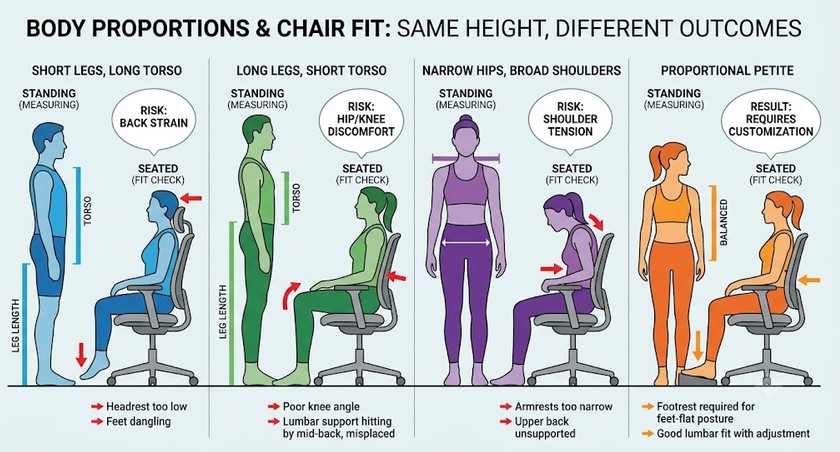
By this point, one principle should be clear: furniture fits body proportions, not height alone. A second misconception now needs to be addressed. Even among people who are considered “short,” furniture requirements are not identical. Sharing a similar height does not mean sharing the same body proportions, sitting posture, or support needs. Understanding this variation is essential because it prevents oversimplified furniture recommendations.
The more useful question is no longer, “How tall is this person?” Instead, it becomes, “How is this person’s body proportioned, and how does that affect furniture interaction?” Once that question is asked, it becomes clear why two people of the same height can experience the same chair very differently.
Why Two Short People Can Need Different Furniture
Standing height tells us very little about how the body is arranged. Two people who are both 5’2″ may have noticeably different leg lengths, torso lengths, arm lengths, hip widths, or shoulder widths. These differences change where the body contacts the furniture, how support is distributed, and which furniture dimensions become most important.
One person may have relatively shorter legs and a longer torso. They may require a lower seat height while also benefiting from a taller backrest that supports more of the upper body. Another person of the same height may have longer legs and a shorter torso. Their priority may shift toward seat depth and thigh support rather than backrest height. Neither chair is universally “better.” Each is simply better suited to a different set of body proportions.
This explains why height-based buying advice often produces inconsistent results. The same recommendation can work well for one short person while creating poor posture and discomfort for another because the recommendation ignores proportional differences.
Why Body Ratios Matter More Than Body Size
Furniture responds to how body measurements relate to one another, not simply to how large those measurements are. This relationship is best understood through body ratios.
Body ratios describe the balance between different body segments. For example, the relationship between leg length and torso length influences how a person sits, while the relationship between shoulder width and hip width influences how the upper and lower body are supported. These proportional relationships determine whether furniture dimensions work together to create balanced support.
Looking only at body size treats people with similar height as though they have similar ergonomic needs. Looking at body ratios recognizes that different proportional combinations create different furniture requirements, even when overall stature is the same.
This proportional perspective provides a more reliable explanation for furniture compatibility than height categories such as “short,” “average,” or “tall.”
Why Petite Body Types Are Not All the Same
The term petite is often used as though it describes a single body type, but from a furniture perspective it represents a wide range of proportional combinations rather than one standard set of measurements.
Some petite individuals have proportionally shorter legs. Others have shorter torsos, narrower shoulders, smaller hip widths, or different combinations of these characteristics. As a result, two people who both identify as petite may require different seat heights, backrest positions, armrest locations, or seat widths.
This distinction is important because furniture should respond to measurable body proportions rather than labels. A chair designed for “petite users” may improve fit for some individuals but still require evaluation against personal body measurements. The label alone cannot guarantee ergonomic compatibility.
Viewing petite body types through the lens of body proportions avoids replacing one oversimplification with another.
Why Human Variation Matters in Furniture Design
No single furniture design can perfectly match every body because human bodies naturally vary. Anthropometric research consistently shows variation across body dimensions even within groups of similar height. Furniture designers therefore work with measurement ranges rather than assuming one universal body shape.
For users, this means furniture should be evaluated based on compatibility rather than averages. A chair built around average measurements may provide excellent support for one person yet require adjustments or feel uncomfortable for another whose body proportions fall outside those assumptions.
Understanding natural variation also explains why adjustable furniture often improves comfort. Adjustability allows furniture dimensions to accommodate different body proportions instead of forcing different bodies to adapt to fixed dimensions.
Human variation is therefore not a design problem to eliminate—it is the reason ergonomic furniture exists in the first place.
Why Furniture Should Be Matched to Individuals Not Categories
People are often encouraged to shop according to broad categories such as “for short people,” “for petite users,” or “compact furniture.” While these categories can narrow the search, they should not replace measurement-based evaluation.
The most reliable approach is to compare personal body proportions with the furniture’s dimensions. Categories describe a likely audience, but measurements determine actual compatibility. Two products marketed to short users may produce very different results because their seat height, seat depth, backrest height, or armrest position differ.
The goal is therefore not to find furniture designed for a category of people. The goal is to find furniture whose dimensions support the unique combination of body proportions that defines an individual user.
This understanding marks an important shift in furniture selection. Instead of asking whether a product is made for short people, users can begin asking whether its dimensions match their own body proportions.
The next step is to apply this knowledge in practice by learning how to compare body proportions with furniture measurements before making a purchase. Once individual variation is understood, furniture selection becomes a structured evaluation process rather than a trial-and-error decision.
Applying Body Proportions to Furniture Selection
Understanding body proportions becomes valuable only when it improves real-world decisions. Up to this point, you have learned why body proportions matter, which proportions influence furniture fit, how those proportions work together, and why people of the same height often need different furniture. The next step is learning how to use this knowledge before buying or evaluating any piece of furniture.
Many purchasing decisions are driven by appearance, marketing claims, online reviews, or how comfortable a chair feels during a brief showroom test. While these factors may influence preference, they do not reliably predict long-term ergonomic fit. Comfort begins long before you sit down—it begins by determining whether your body proportions are compatible with the furniture’s dimensions.
A practical evaluation follows a repeatable process:
Measure Your Body → Identify Relevant Furniture Dimensions → Compare Measurements → Predict Body Contact Points → Evaluate Support → Predict Comfort
This framework shifts furniture selection from subjective impressions to measurable compatibility.
Matching Body Proportions to Furniture Measurements
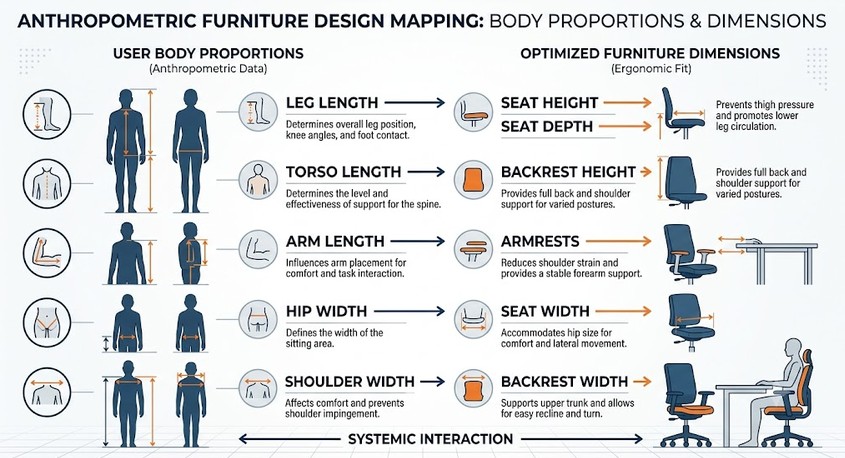
Every important furniture dimension exists because it supports a specific part of the body. Instead of treating furniture measurements as isolated specifications, they should be viewed as responses to particular body proportions.
For example, leg length primarily corresponds to seat height because it determines whether the feet can rest naturally on the floor and whether the knees maintain a balanced position. Leg length also influences how well seat depth supports the thighs without preventing the user from reaching the backrest comfortably.
Torso length primarily corresponds to backrest height and support zones. A backrest should align with the user’s torso so the lower back, mid-back, and upper body receive support where it is needed rather than above or below the intended contact areas.
Arm length influences armrest height and position. Proper alignment allows the forearms to rest naturally while minimizing unnecessary effort from the shoulders and upper back.
Hip width corresponds to seat width because it determines how body weight is distributed across the seating surface. Adequate width promotes balanced pressure distribution and allows comfortable movement without excessive restriction or instability.
Shoulder width influences the relationship between the upper body, backrest, and armrests. Proper upper-body support depends on furniture accommodating natural shoulder positioning rather than forcing the arms inward or outward.
Seen together, these relationships reveal an important principle: furniture dimensions are not arbitrary numbers. Each one exists to accommodate a particular body region. Understanding these correspondences allows furniture specifications to become meaningful instead of overwhelming.
Identifying Furniture Mismatches
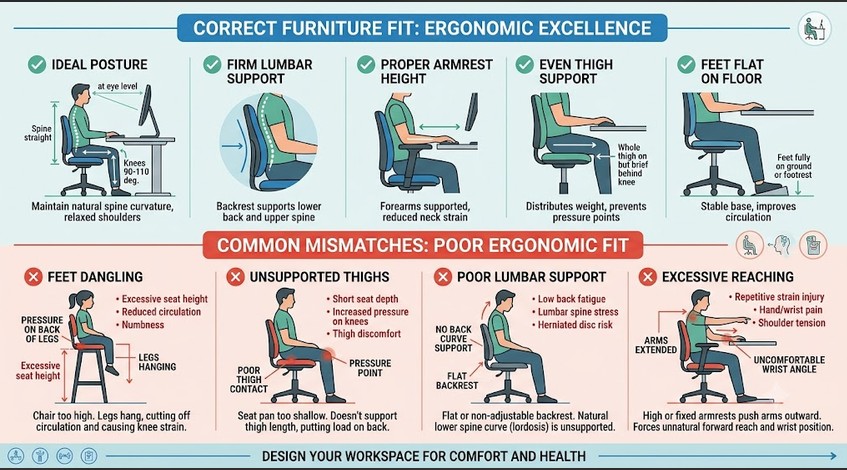
Knowing which measurements correspond to each other also makes it possible to recognize why furniture feels uncomfortable.
Discomfort rarely begins with the cushion itself. More often, it begins when a furniture dimension fails to match the body proportion it is intended to support. The body then compensates for the mismatch by adopting less efficient sitting positions.
For example, if the seat height exceeds what a person’s leg length can comfortably support, the feet may lose stable contact with the floor. The resulting imbalance increases pressure beneath the thighs and encourages postural adjustments throughout the rest of the body.
If the seat depth exceeds what the user’s leg length allows, the person may slide forward to reach the backrest or sacrifice lower-back support to keep the knees comfortable. Neither posture represents balanced ergonomic support.
Similarly, a mismatch between torso length and backrest height may leave important support zones misaligned, while poorly positioned armrests can force the shoulders to elevate or the arms to remain unsupported. Even seat width can influence comfort by concentrating pressure around the hips or reducing stability during movement.
These examples illustrate an important diagnostic principle: discomfort is often a symptom of dimensional incompatibility rather than poor cushioning or low product quality. By tracing discomfort back to specific body–furniture relationships, users can identify the underlying cause instead of relying on trial and error.
Using Body Proportions Before Buying Furniture
The most effective time to evaluate furniture is before making a purchase, not after discomfort appears.
Rather than beginning with product ratings or marketing descriptions, begin with your own body measurements. Once you understand your proportions, review the furniture specifications that correspond to those measurements. Compare the dimensions most likely to influence support, identify any obvious mismatches, and predict how your body will interact with the furniture before deciding whether it is likely to fit.
This evaluation method works regardless of furniture category. Whether comparing sofas, office chairs, recliners, dining chairs, or other seating, the underlying process remains the same because every piece of furniture must support the same body through the same ergonomic principles.
A systematic evaluation therefore becomes:
Know Your Body Measurements → Review Furniture Specifications → Compare Matching Dimensions → Identify Potential Mismatches → Predict Ergonomic Fit → Make an Informed Decision
This process does not guarantee that every chair will feel perfect, but it greatly reduces the likelihood of selecting furniture that is fundamentally incompatible with your body proportions. It also provides a consistent way to compare different products without relying solely on appearance, marketing language, or short showroom trials.
The next step is understanding why correct body–furniture matching influences posture, pressure distribution, stability, and long-term comfort. Once you know how to evaluate furniture, it becomes important to understand the ergonomic mechanisms that explain why good fit produces better comfort over time.
How Body Proportions Influence Comfort and Ergonomics
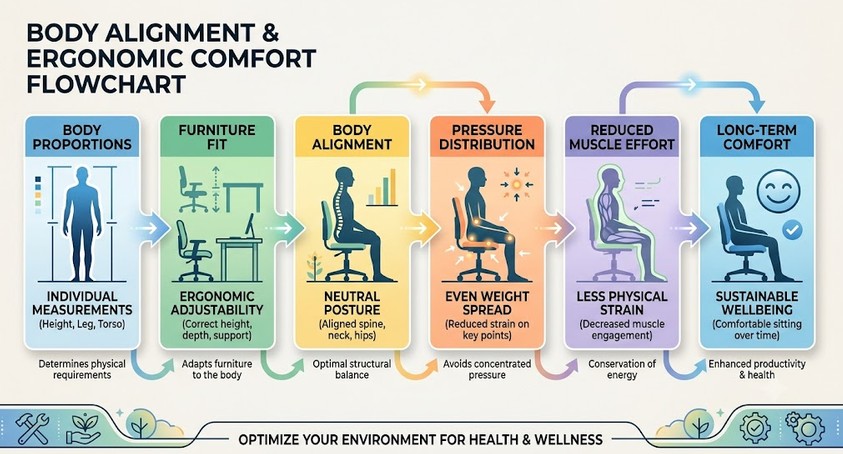
Understanding how to evaluate furniture is only half of the decision-making process. The remaining question is why those measurements matter once you begin sitting. Why does one chair remain comfortable for hours while another feels uncomfortable after only a short period? The answer is not simply the softness of the cushions, the price of the furniture, or the quality of the upholstery. Those factors influence perception, but ergonomic comfort is primarily the result of how well furniture supports the body’s proportions over time.
Comfort is therefore better understood as an outcome than as a feature. When furniture dimensions correspond to body proportions, the body remains aligned, pressure is distributed more evenly, movement requires less effort, and muscles perform fewer unnecessary compensations. These conditions allow the body to remain comfortable for longer periods because the furniture is supporting the body as intended.
The relationship follows a measurable sequence:
Body Proportions → Furniture Fit → Body Alignment → Pressure Distribution → Muscular Effort → Long-Term Comfort
Rather than asking whether a chair “feels comfortable,” it is more useful to ask whether its dimensions create the conditions that allow comfort to develop and be maintained.
How Body Proportions Affect Sitting Posture
Many people believe posture depends mainly on personal discipline or the habit of sitting up straight. In reality, posture is strongly influenced by the relationship between body proportions and furniture dimensions. Even someone who understands proper sitting posture cannot maintain it comfortably if the furniture does not support their body correctly.
When seat height corresponds to leg length, the feet can rest securely, providing a stable foundation for the lower body. Appropriate seat depth allows the thighs to remain supported while the pelvis stays close enough to the backrest for effective support. A backrest that matches torso length encourages the spine to maintain a more natural alignment without requiring constant muscular effort.
When these dimensions are mismatched, the body begins to compensate. Unsupported feet may encourage the pelvis to rotate. A rotated pelvis changes spinal alignment. As the spine adjusts, the shoulders and neck often compensate to maintain balance. These adjustments are not conscious decisions—they are natural responses to inadequate support.
Good posture, therefore, is not created simply by intention. It is largely created by furniture that allows the body’s proportions to remain properly supported throughout the sitting process.
How Body Proportions Influence Pressure Distribution
Every time you sit, your body weight is transferred through specific contact areas between your body and the furniture. The way this weight is distributed has a direct influence on long-term comfort.
When furniture dimensions correspond to body proportions, body weight is spread across multiple support zones rather than concentrated in a few small areas. Appropriate seat width accommodates hip width without excessive restriction or instability, while suitable seat depth allows both the thighs and pelvis to share the supporting load. This balanced distribution reduces localized pressure and allows the body to remain comfortable for longer periods.
When body proportions and furniture dimensions do not match, the contact area often becomes smaller than intended. Less contact area means the same body weight is supported by fewer regions, increasing pressure on those areas. This is one reason discomfort can develop even when cushions feel soft. The underlying issue is often not the material itself but the way the body is being supported.
Pressure distribution therefore depends more on dimensional compatibility than on cushioning alone. Cushions influence how support is delivered, but body proportions determine where support is needed.
How Body Proportions Affect Reach and Movement
Comfort is not limited to remaining still. Throughout normal sitting, people reach for objects, adjust their posture, change positions, and perform everyday activities. Furniture must therefore support movement as well as static sitting.
Body proportions influence how naturally these movements occur. Arm length affects whether armrests support the forearms without elevating the shoulders. Shoulder width influences how comfortably the upper body moves within the chair. Appropriate spacing allows reaching, repositioning, and changing posture without unnecessary muscular effort.
When these relationships are poorly matched, simple movements become less efficient. Users may lean forward to reach a desk, lift their shoulders to use the armrests, or repeatedly reposition themselves to find temporary comfort. Although each adjustment appears minor, repeated compensations increase muscular activity and gradually reduce overall comfort.
Good ergonomic design therefore supports natural movement rather than restricting it. Furniture should accommodate the body’s proportions during everyday activities, not only while sitting perfectly still.
How Proper Furniture Fit Improves Long-Term Comfort
The true test of furniture is not how it feels during the first few minutes but how well it continues supporting the body over time.
Many chairs feel comfortable initially because soft cushioning reduces the sensation of pressure. However, if the underlying dimensions do not match the user’s body proportions, the body gradually begins compensating for inadequate support. Small adjustments accumulate into muscular fatigue, uneven pressure distribution, and declining comfort as sitting time increases.
Proper furniture fit delays this process because the body requires fewer compensatory movements. Stable foot support helps maintain pelvic position. A balanced pelvis supports spinal alignment. Proper back support reduces unnecessary muscular effort, while appropriate armrest positioning allows the shoulders and arms to remain relaxed. Balanced pressure distribution reduces localized discomfort, and unrestricted movement allows the body to change position naturally without disrupting overall support.
These factors work together to create sustained comfort rather than temporary comfort. The difference is not simply how the chair feels when you first sit down but how effectively it continues supporting the body’s proportions throughout extended use.
This explains why expensive furniture is not automatically comfortable and why a brief showroom trial rarely predicts long-term satisfaction. The strongest predictor of lasting comfort is dimensional compatibility between body proportions and furniture measurements.
By understanding this relationship, comfort becomes something that can be evaluated systematically rather than guessed subjectively. Instead of asking whether furniture feels soft, readers can evaluate whether it supports posture, distributes pressure appropriately, allows natural movement, and minimizes unnecessary muscular effort. Those ergonomic outcomes are what ultimately determine long-term comfort.
The next section brings together everything covered throughout this page into reference tables, comparison charts, and visual guides that make these relationships easier to understand, remember, and apply when evaluating furniture in the future.
Body Proportion Reference Tables and Visual Guides
The previous sections explained why body proportions determine furniture fit, how individual body measurements interact with furniture, how to evaluate compatibility, and why proper matching improves ergonomic comfort.
Think of this section as a practical reference rather than a lesson. Whether you are evaluating a sofa, office chair, recliner, or dining chair, these summaries help connect body proportions, furniture dimensions, and ergonomic outcomes without repeating the detailed explanations covered earlier.
Reference Table: Body Proportions and Their Corresponding Furniture Dimensions
The first step in evaluating furniture is understanding which body proportion corresponds to which furniture measurement. Rather than viewing furniture specifications as isolated numbers, use them as indicators of how the furniture will support different regions of your body.
| Body Proportion | Primary Furniture Dimension | Primary Ergonomic Function | Common Furniture Types |
|---|---|---|---|
| Height | Overall furniture scale | General size reference | All seating |
| Leg Length | Seat height, seat depth | Foot and thigh support | Chairs, sofas |
| Torso Length | Backrest height | Spinal and upper-back support | Chairs, recliners |
| Arm Length | Armrest height and position | Reach and forearm support | Office chairs, sofas |
| Hip Width | Seat width | Pressure distribution | Chairs, sofas |
| Shoulder Width | Backrest width | Upper-body support | Recliners, lounge chairs |
This table reinforces an important principle established throughout the page: every important furniture dimension exists because it supports one or more specific body proportions.
Reference Table: How Body Proportions Influence Comfort
Furniture dimensions affect comfort only because they influence how the body is supported. The following table summarizes the ergonomic outcomes associated with each major body proportion.
| Body Proportion | Primary Ergonomic Effect | Comfort Outcome |
|---|---|---|
| Leg Length | Stable foot and thigh support | Improved sitting stability |
| Torso Length | Better spinal support | Reduced back fatigue |
| Arm Length | Natural arm positioning | Relaxed shoulders and forearms |
| Hip Width | Balanced pressure distribution | More even weight support |
| Shoulder Width | Proper upper-body support | Improved shoulder comfort |
Rather than creating comfort directly, body proportions influence how effectively furniture can provide ergonomic support. Comfort develops when these relationships remain balanced during prolonged sitting.
Furniture Evaluation Checklist
Once you know your body proportions, furniture can be evaluated through a consistent measurement-first process. The following checklist summarizes the decision framework introduced in the previous block.
| Evaluation Step | What to Compare | Purpose |
|---|---|---|
| Measure your body | Key body proportions | Establish your personal reference measurements |
| Review furniture specifications | Critical furniture dimensions | Identify available measurements |
| Compare body and furniture | Matching dimensions | Detect possible incompatibilities |
| Evaluate support zones | Contact points between body and furniture | Predict posture and pressure distribution |
| Assess overall compatibility | Combined body–furniture interaction | Estimate long-term ergonomic comfort |
This checklist replaces guesswork with a structured evaluation process that can be used across different furniture categories.
Integrated Body–Furniture Relationship Framework
Everything discussed throughout this page can be summarized as one continuous relationship rather than separate ideas.
Body Proportions → Body Ratios → Furniture Measurements → Furniture Fit → Sitting Posture → Pressure Distribution → Movement → Ergonomic Comfort → Better Furniture Decisions
Each stage depends on the previous one. Body proportions influence furniture measurements, those measurements determine furniture fit, furniture fit affects posture and movement, and those ergonomic outcomes ultimately determine long-term comfort.
Viewing furniture as a connected system helps explain why isolated measurements rarely predict comfort on their own.
Comparison Matrix: Common Body–Furniture Mismatches
When furniture feels uncomfortable, the underlying cause is often a mismatch between a body proportion and the furniture dimension designed to support it. The following matrix summarizes the most common relationships discussed throughout this article.
| Body Proportion | Common Furniture Mismatch | Typical Ergonomic Effect | Furniture Dimension to Review |
|---|---|---|---|
| Shorter leg length | Seat too high | Feet cannot rest comfortably | Seat height |
| Longer leg length | Seat too shallow | Reduced thigh support | Seat depth |
| Longer torso | Backrest too low | Incomplete upper-back support | Backrest height |
| Shorter arm length | Armrests positioned too far away | Increased reaching effort | Armrest position |
| Wider hips | Seat too narrow | Higher pressure around the hips | Seat width |
| Broader shoulders | Backrest too narrow | Restricted upper-body support | Backrest width |
Instead of treating discomfort as a mystery, this matrix encourages readers to trace symptoms back to measurable body–furniture relationships. That approach makes future furniture evaluations more systematic and more accurate.
Frequently Asked Questions About Body Proportions and Furniture Fit
The following questions address the remaining uncertainties that readers commonly have after learning how body proportions influence furniture fit. Rather than introducing new concepts, these answers reinforce the key relationships discussed throughout this guide and point you toward the next topics in your furniture selection journey.
Do body proportions matter more than overall height when choosing furniture?
Yes. Overall height provides only a general description of body size, while body proportions explain how your body actually interacts with furniture. Furniture supports individual body regions such as the legs, pelvis, torso, arms, and shoulders—not your standing height as a single measurement.
For this reason, body proportions are a more reliable predictor of furniture fit, ergonomic support, and long-term comfort than height alone.
Why can two people of the same height need different furniture?
People with identical standing heights rarely have identical body proportions. Differences in leg length, torso length, arm length, hip width, and shoulder width change where the body contacts the furniture and how support is distributed.
Because furniture dimensions interact with these individual body regions, two people of the same height may require different seat heights, seat depths, backrest heights, or armrest positions to achieve comparable comfort.
Which body measurement should I measure first?
Begin with the body measurement most closely related to the furniture dimension you want to evaluate.
For most seating, leg length is an effective starting point because it directly influences seat height and seat depth. Once that relationship is understood, evaluate torso length, arm length, hip width, and shoulder width to determine how the remaining furniture dimensions will support your body.
The goal is not to collect every measurement immediately but to compare the measurements most relevant to the furniture being evaluated.
Which furniture measurement is the most important?
There is no universally most important furniture dimension because each dimension supports a different body region.
Seat height influences foot support, seat depth affects thigh support, backrest height supports the torso, armrests influence reach, and seat width affects pressure distribution around the hips.
Instead of prioritizing one measurement, evaluate how the major furniture dimensions work together to support your overall body proportions.
Should I measure myself before buying furniture?
Yes. Measuring your body before comparing furniture specifications allows you to identify potential compatibility issues before purchasing.
Knowing your body proportions makes furniture measurements meaningful. Instead of relying on marketing descriptions such as “petite” or “compact,” you can determine whether the furniture’s dimensions correspond to your own body measurements.
This measurement-first approach reduces guesswork and improves purchasing decisions.
Can I improve furniture fit without replacing my furniture?
In many cases, yes. Minor adjustments can improve the relationship between your body proportions and existing furniture.
For example, a footrest may improve support if the seat is too high, while a lumbar cushion can reposition the lower back when backrest support is inadequate. Seat cushions, armrest adjustments, or ottomans may also improve body alignment depending on the specific mismatch.
These adjustments cannot completely change a furniture’s dimensions, but they can sometimes reduce the ergonomic effects of small incompatibilities. For larger mismatches, furniture designed around more appropriate dimensions is usually the better long-term solution.
Why do my feet dangle when sitting?
Feet commonly lose contact with the floor when seat height exceeds what your leg length can comfortably support.
Without stable foot support, pressure often increases beneath the thighs, pelvic stability decreases, and the body begins compensating through posture changes.
Rather than indicating poor sitting habits, dangling feet usually suggest that seat height should be evaluated first.
Why can’t I comfortably reach the backrest?
This often occurs when seat depth is greater than your body proportions allow.
If the seat is too deep relative to your leg length, you may need to choose between sitting fully against the backrest or keeping your feet comfortably positioned. Sliding forward to reach the floor usually reduces lower-back support, while sitting fully back may create discomfort around the knees.
Evaluating seat depth alongside leg length usually explains this problem.
Why do armrests feel too high or too far away?
Armrests should support the forearms without forcing the shoulders to elevate or the arms to extend unnaturally.
If armrests feel uncomfortable, the relationship between your arm length, shoulder width, and the armrest’s height or position should be reviewed. Proper arm support reduces unnecessary muscular effort and allows the upper body to remain relaxed during prolonged sitting.
Why does standard furniture often feel too large?
Most mass-produced furniture is designed around broad anthropometric ranges intended to accommodate a large portion of the population rather than every individual body type.
If your body proportions differ significantly from those assumptions, furniture dimensions such as seat height, seat depth, or backrest height may not align with your body correctly. The issue is often dimensional compatibility rather than furniture quality.
Understanding your body proportions makes it easier to identify which measurements create the mismatch.
Does being petite always mean needing smaller furniture?
No. “Petite” describes a broad range of body proportions rather than one standard body shape.
Two petite individuals may have different leg lengths, torso lengths, or body ratios, resulting in different furniture requirements. Labels such as “petite furniture” may narrow your options, but body measurements remain the most reliable method for evaluating compatibility.
Do body proportions change with age?
Body proportions generally remain relatively stable after physical maturity, although posture, flexibility, muscle mass, and mobility can change over time.
These changes may alter how the body interacts with furniture even when skeletal proportions remain similar. As a result, furniture that once felt comfortable may require adjustments or replacement as ergonomic needs evolve.
Are body proportions different for men and women?
Population-level anthropometric studies show average differences in body dimensions between men and women, but individual variation within each group is often greater than the differences between groups.
Furniture should therefore be evaluated according to the measurements of the individual rather than assumptions based on sex. Personal body proportions remain the strongest predictor of furniture compatibility.
Can body weight affect furniture fit if height stays the same?
Yes. Changes in body weight can influence how the body contacts furniture, particularly around the hips, thighs, and pressure-bearing areas.
Although height and skeletal proportions may remain unchanged, differences in body composition can alter pressure distribution and the amount of space required for comfortable support. Evaluating both body proportions and furniture dimensions provides a more complete assessment of fit.
Can one chair fit every short person?
No. Even within the same height range, people have different body proportions and therefore different ergonomic requirements.
A chair that provides excellent support for one short person may create poor posture or pressure distribution for another. The best furniture is determined by compatibility with individual body proportions rather than membership in a height category.
Should I prioritize seat height or seat depth?
Both dimensions should be evaluated together because they support different aspects of sitting posture.
Seat height primarily affects foot support and lower-body stability, while seat depth influences thigh support and access to the backrest. Focusing on only one dimension often overlooks how both measurements work together to produce balanced support.
How can I know if furniture will fit before buying?
The most reliable method is to compare your body proportions with the furniture’s published dimensions before making a purchase.
Begin by measuring the body proportions relevant to the furniture you are considering. Then compare those measurements with key specifications such as seat height, seat depth, seat width, backrest height, and armrest position. Finally, evaluate how those dimensions are likely to influence posture, pressure distribution, movement, and long-term comfort.
Using this systematic approach allows you to predict ergonomic compatibility more accurately than relying solely on appearance, marketing claims, online reviews, or a brief showroom test.
By reaching this point, you should now understand the complete body–furniture relationship: body proportions determine how furniture supports the body, that support influences posture and movement, and those ergonomic interactions ultimately determine long-term comfort. The next step is to explore the dedicated measurement guides and furniture-specific buying resources that examine each furniture dimension in greater depth.