For petite users, shallow couches are usually the better choice.
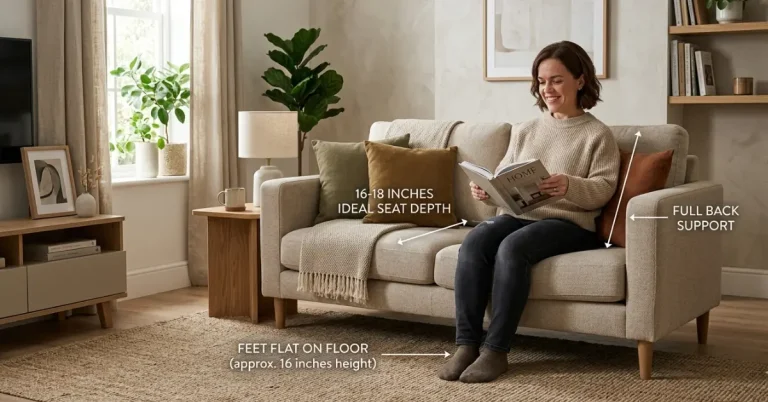
The key reason is seat depth. The ideal effective seat depth is 17–20 inches (43–51 cm), which allows your feet to rest flat on the floor and your knees to bend naturally at the edge of the seat. Most deep couches (22 inches or more) exceed this range, making them too large for shorter leg proportions.
When a couch is too deep, it often leads to slouching, poor lower-back support, and unstable posture.
In short: a couch fits correctly when it supports your body- not when your body has to adjust to it.
TL;DR (Petite Couch Fit)
- Ideal seat depth: 17–20 inches (43–51 cm) for most petite users
- Formula: Ideal depth = butt-to-knee length − 1–2 inches
- Deep couches (22″+): often cause slouching and poor back support
- Main issue: feet don’t stay flat → posture becomes unstable
- Quick fix: add firm lumbar pillows or cushions to reduce depth
- Bottom line: if your knees don’t reach the edge, the couch is too deep
It’s Not Deep vs Shallow- It’s Seat Depth Fit
Most people compare couches using labels like “deep” or “shallow.”
That’s the wrong approach.
What actually determines comfort especially for petite users- is effective seat depth.
Effective seat depth is the real, usable distance from the back cushion to the front edge after you sit down. It accounts for cushion compression, sink-in, and how your body settles into the seat.
This is why two couches with the same listed depth can feel completely different.
- A “21-inch” sofa with firm cushions may feel like 19 inches
- A “23-inch” sofa with soft cushions may feel even deeper than listed
The label doesn’t matter. The fit does.
Most guides ignore this and rely on manufacturer specs. But those numbers describe a static product not how it performs under real use.
For petite users, even a 1–2 inch difference in effective seat depth can determine whether:
- Your feet stay flat
- Your back stays supported
- Your posture remains stable
That’s why this guide focuses on seat depth fit, not marketing categories.
Because the right couch isn’t the one labeled “shallow.”
It’s the one that matches your body.
What Is Seat Depth?
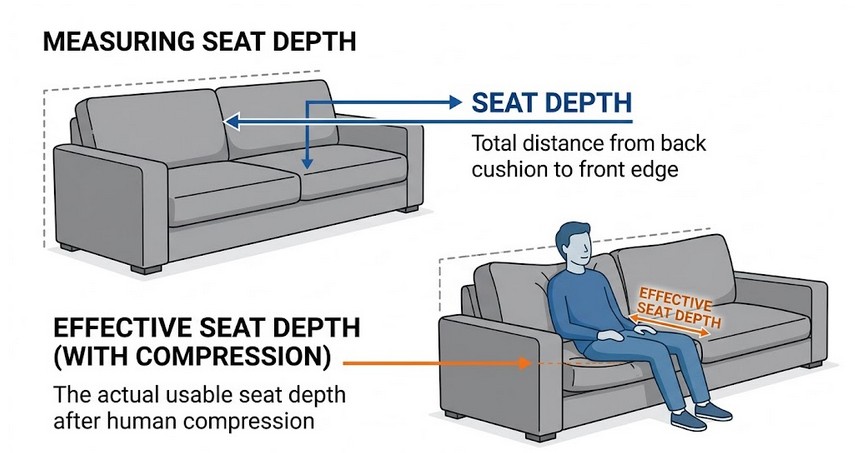
Seat depth is the horizontal distance from the front edge of a couch seat to the point where your lower back rests against the back cushion.
But that’s only part of the story.
What actually matters is effective seat depth. The usable sitting space after cushions compress under your body weight.
Here’s the key difference:
- Listed seat depth = manufacturer measurement (before use)
- Effective seat depth = real-world depth (after you sit down)
For example:
- A sofa listed at 22 inches may feel like 19–20 inches with firm cushions
- The same 22-inch depth may feel even deeper with soft, sink-in foam
This gap between listed and real depth is why many couches feel larger at home than they did in the showroom.
For petite users, this difference is critical.
Even a small increase in effective seat depth can mean:
- Feet no longer rest flat
- Knees don’t reach the edge
- Lower back loses support
Bottom line: Seat depth isn’t just a number. It’s how the couch fits your body in real use.
How to Calculate the Perfect Seat Depth
The most accurate way to choose a couch is to match the seat depth to your body not a generic size chart.
Here’s the exact method.
Step 1: Measure Your Butt-to-Knee Length
Sit upright against a wall or firm surface.
Measure from your lower back (butt) to the back of your knees.
This is your thigh length, and it determines how much seat depth you actually need.
Step 2: Subtract 1–2 Inches
This creates a small gap between the seat edge and your knees.
This gap is critical for:
- Proper blood circulation
- Natural knee bend
- Comfortable posture
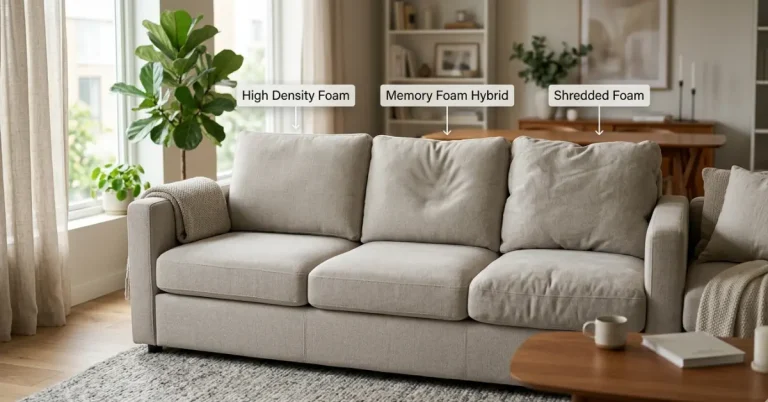
Step 3: Adjust for Cushion Firmness
- Soft cushions: subtract an extra ~1 inch (more sink-in)
- Firm cushions: no adjustment needed
- Medium cushions: minor adjustment if needed
The Formula
Ideal Seat Depth=Butt-to-Knee Length−(1 to 2 inches)
Example
- Butt-to-knee length: 19 inches
- Minus 1–2 inches: 17–18 inches
Your ideal seat depth = 17–18 inches
Key Insight
This method is more reliable than height-based recommendations because:
- Height doesn’t reflect leg length
- Body proportions vary significantly
- Seat depth is controlled by thigh length not total height
Bottom line: If you want the perfect couch fit, measure your body not the furniture.
Deep vs Shallow Couches (Petite User Comparison)
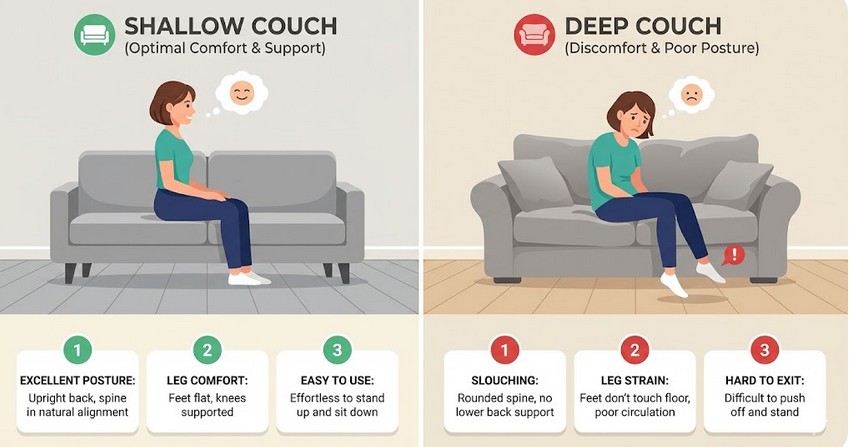
Now that you understand seat depth fit, the difference between deep and shallow couches becomes clear.
This isn’t about style. It’s about how each type supports (or fails to support) your body.
Shallow Couches (17–20 inches)
Best overall choice for petite users
Benefits
- Keeps feet flat on the floor
- Allows natural knee bend at the seat edge
- Maintains upright posture and lumbar support
- Easier to sit down and stand up
- More stable for working, reading, or daily use
Because the seat depth matches shorter leg length, your body stays supported without effort.
Best Use Cases
- Everyday sitting
- Small living spaces
- Working on a laptop
- Users with shorter legs or petite proportions
Deep Couches (22+ inches)
Designed for lounging not ergonomic fit
Problems for Petite Users
- Feet may not touch the floor
- Knees don’t reach the edge → poor leg support
- Causes slouching and forward sliding
- Reduces lower-back (lumbar) support
- Requires constant repositioning
The deeper the seat, the more your body has to compensate.
When They Work
Deep couches can still work if:
- You prefer lounging or lying down
- You sit with legs tucked or curled
- You use firm lumbar pillows to reduce depth
- The cushions are firm enough to limit sink-in
Key Takeaway
Shallow and deep couches serve different purposes:
- Shallow couches = posture, support, daily use
- Deep couches = lounging, relaxation, occasional use
For petite users, comfort depends on fit not preference.
Why Deep Couches Feel Uncomfortable for Petite Users
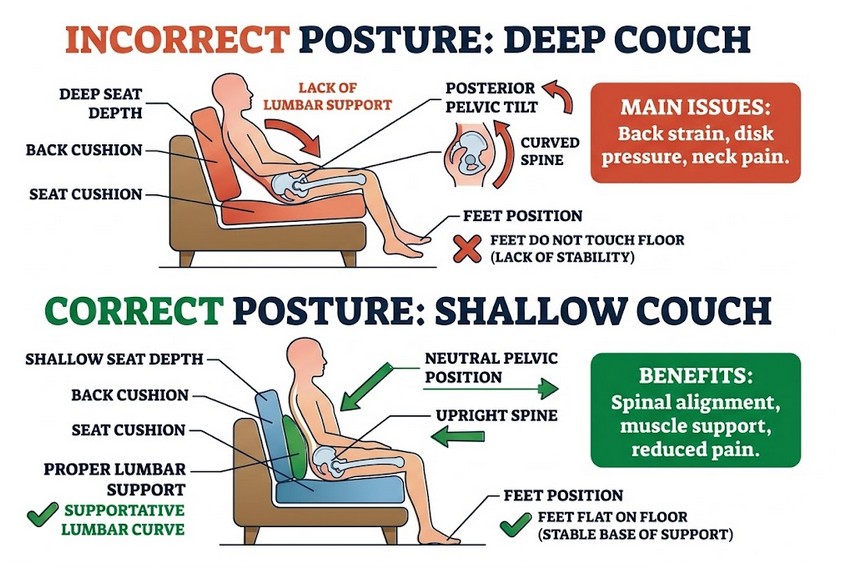
Deep couches don’t just “feel off”. They change how your body sits.
For petite users, even a few extra inches of seat depth can disrupt natural alignment and force the body into compensation patterns.
Here’s what’s actually happening.
1. Posterior Pelvic Tilt (The Root Problem)
When the seat is too deep, your hips slide forward to reach the backrest.
This causes the pelvis to rotate backward known as posterior pelvic tilt.
- The natural curve of your lower spine flattens
- Your posture shifts from upright to slouched
- Your body loses its stable base
This is the starting point of most couch discomfort.
2. Loss of Lumbar Support
As the pelvis tilts, your lower back pulls away from the back cushion.
- The lumbar curve is no longer supported
- Muscles must work harder to hold position
- Fatigue builds over time
Instead of the couch supporting your spine, your body has to support itself.
3. Feet Not Touching the Floor
Deep seats push your body backward, making it harder for your feet to stay grounded.
- Feet may dangle or slide forward
- Thighs lose proper support
- Pressure shifts unevenly across hips and lower back
Without stable foot contact, your entire sitting posture becomes unstable.
Why This Matters
These issues don’t always show up immediately.
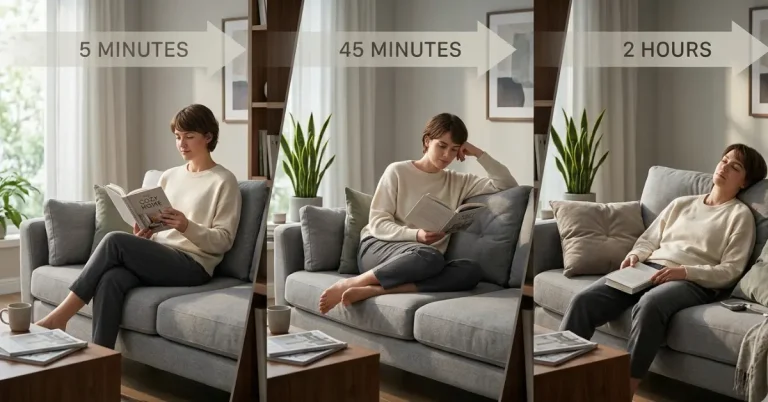
At first, a deep couch may feel soft and comfortable. But after 20–30 minutes:
- You start sliding forward
- You adjust your position repeatedly
- You feel tension in your lower back or hips
These are not random discomforts. They are biomechanical responses to poor seat depth fit.
Deep couches are not inherently bad.
They become uncomfortable when their seat depth exceeds your body’s natural proportions.
For petite users, proper comfort comes from alignment – not cushion softness or size.
How to Know If a Couch Fits You (3-Step Test)
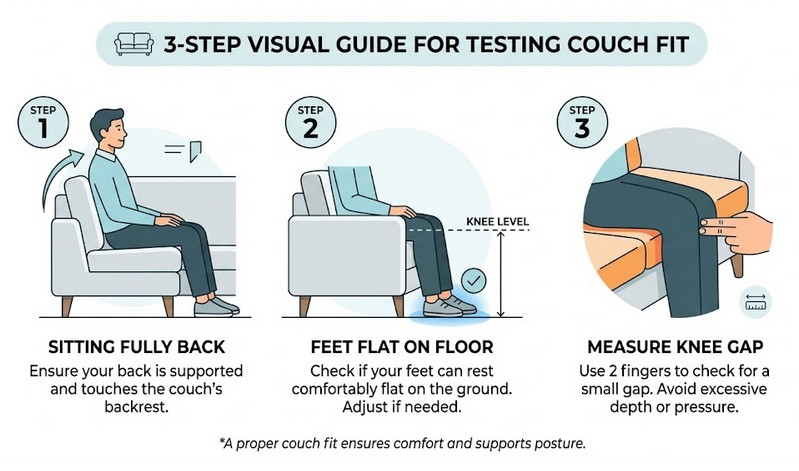
Most people test a couch for 30 seconds and decide.
That’s a mistake.
If you want a couch that actually fits your body, you need to test it the right way. This simple 3-step method will tell you immediately if the seat depth is correct.
Step 1: Sit Fully Back (The Sit Test)
Sit all the way back so your lower back touches the back cushion.
- Do not perch on the edge
- Do not lean forward
- Sit in a natural upright position
This reveals the couch’s true seat depth not a compensated position.
Step 2: Check Your Feet (The Foot Test)
Look at your feet while sitting fully back.
- Feet flat on the floor → good fit
- Feet dangling → seat is too deep
- Feet sliding forward → lack of support
If your feet aren’t stable, your posture won’t be either.
Step 3: Measure the Knee Gap (The 2-Finger Rule)
Slide your fingers between the seat edge and the back of your knees.
- 1–2 fingers of space → perfect fit
- More than 2 fingers → couch is too deep
- No space → couch is too shallow
This is the fastest way to check seat depth accuracy.
What This Test Tells You
If a couch passes all three steps:
- Your seat depth matches your body
- Your spine stays supported naturally
- You won’t need to adjust your posture constantly
If it fails even one step:
The couch may feel okay at first but it won’t stay comfortable over time.
Pro Tip
Stay seated for at least 10–15 minutes while testing.
Real discomfort doesn’t show up instantly—it builds over time.
The right couch should feel just as comfortable after 15 minutes as it did in the first 15 seconds.
Ideal Seat Depth by Body Type
Not all petite users need the exact same seat depth. The real difference comes from body proportions, especially leg length.
Use this table to find your most accurate range:
| Body Type (Seated Proportion) | Ideal Seat Depth |
|---|---|
| Short legs | 17″–19″ |
| Balanced proportions | 18″–20″ |
| Longer legs (within petite height range) | 19″–21″ |
The key idea: seat depth should match how far your knees are from your lower back not your overall height.
Even within “petite” users, a 2–3 inch difference can completely change posture stability.
Signs Your Couch Is Too Deep
Most people don’t realize their couch is the problem—they just feel discomfort and assume it’s normal.
But deep couches create very specific compensatory behaviors. If you notice any of the following, your seat depth is likely too large for your body.
Perching on the Front Edge
You naturally start sitting closer to the edge of the seat instead of fully back.
- This reduces effective seat depth
- Helps your feet reach the floor
- Happens when full-back sitting feels unstable
This is your body trying to correct poor fit.
Curling or Tucking Your Legs
You may start sitting with your legs folded or tucked instead of resting flat.
- Reduces strain from dangling feet
- Avoids pressure from excessive seat depth
- Often happens during relaxed use
This is a compensation for poor lower-body support.
Sliding Forward Over Time
Even if you start sitting correctly, you gradually shift forward.
- Loss of lumbar support causes forward drift
- Pelvis rotates backward → body moves to rebalance
- You end up sitting away from the backrest
This is one of the clearest signs of excessive seat depth mismatch.
Key Insight
If your couch forces you to constantly adjust your position, it’s not supporting your posture. It’s fighting it.
Comfort isn’t how a couch feels at first. It’s how your body behaves after 20–30 minutes of sitting.
How to Fix a Couch That Is Too Deep
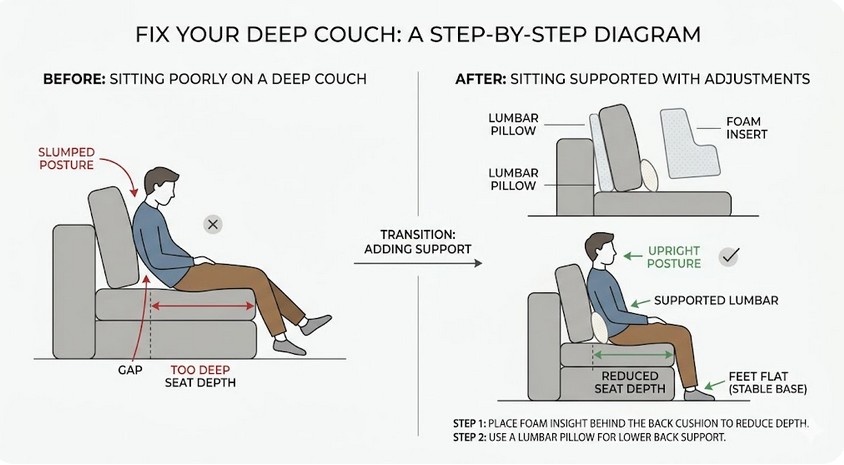
A couch that is too deep isn’t always a bad purchase. You just need to correct how your body sits in it.
The goal is to reduce effective seat depth so your posture stays supported without needing to replace the sofa.
Here are the most effective fixes.
1. Add Lumbar Pillows (Fastest Fix)
Placing a firm lumbar pillow behind your lower back pushes your body slightly forward.
- Reduces effective seat depth
- Restores natural spinal curve
- Improves lower-back support
This is the simplest and most immediate correction.
2. Use Foam Inserts (Structural Fix)
High-density foam inserts can be placed behind or under seat cushions.
- Limits how far you sink into the couch
- Prevents posterior pelvic tilt
- Creates a firmer, more controlled seating surface
This works best for sofas that feel “too soft + too deep.”
3. Adjust Cushion Position (Geometry Fix)
Sometimes the issue is not the couch itself, but how the cushions are arranged.
- Push back cushions slightly forward
- Add support behind loose cushions
- Prevent cushions from sliding backward over time
This subtly reduces usable seat depth without changing the furniture.
Key Insight
You’re not trying to make the couch smaller. You’re trying to realign your body within it.
When lumbar support, firmness, and positioning are corrected, even a deep sofa can become usable for petite users.
What to Look for in a Couch for Petite Users
Choosing the right couch upfront is far easier than fixing a bad one later.
For petite users, the right sofa must match body proportions and posture mechanics, not just style or size.
Here’s what actually matters.
1. Seat Depth (Most Important Factor)
Look for an effective seat depth of 17–20 inches.
- Ensures feet stay flat on the floor
- Supports natural knee bend at the edge
- Prevents slouching and forward sliding
This is the single most important measurement for petite comfort.
2. Cushion Firmness
Cushion density directly affects how the couch behaves under your body weight.
- Firm cushions → maintain shape, reduce sink-in
- Soft cushions → increase effective seat depth over time
Firmer is usually better for posture stability.
3. Back Support Design
The backrest determines whether your spine stays aligned.
- Tight or structured back cushions → consistent support
- Loose cushions → shifting support and posture drift
Good back support prevents slouching during long sitting sessions.
4. Adjustability
Adjustable designs help fine-tune fit after purchase.
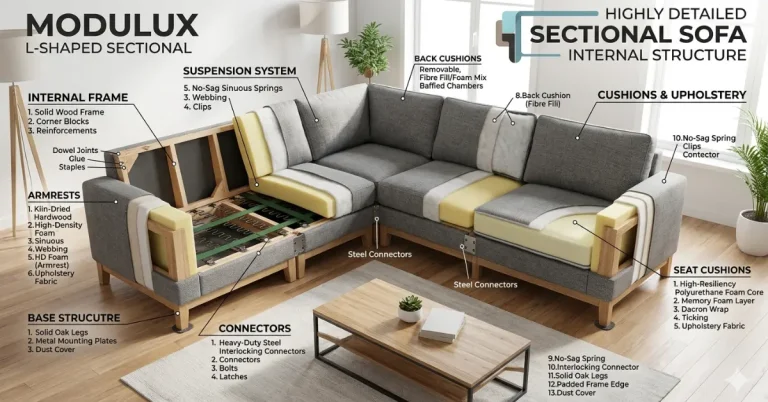
- Removable cushions
- Modular seating systems
- Adjustable lumbar support options
Flexibility is key when multiple body types use the same couch.
Key Insight
The best couch for petite users is not the softest or deepest. It’s the one that maintains consistent ergonomic alignment over time.
If the couch matches your body proportions from the start, you won’t need to fix it later.
Which Couch Brands Work Best for Petite Users?
Different furniture brands don’t just differ in style—they differ in seat depth philosophy and cushion design. That’s why some sofas naturally work better for petite users than others.
This isn’t about reviews or quality. It’s about design tendencies that affect effective seat depth.
IKEA
IKEA sofas tend to be more structured and compact compared to luxury lounge brands.
- More consistent seat firmness
- Generally closer to mid-range seat depth
- Less sink-in compared to ultra-soft sofas
Tendency: More predictable effective seat depth, which often works better for shorter users.
West Elm
West Elm designs often prioritize modern lounge aesthetics.
- Frequently deeper seat profiles
- Softer cushioning for relaxed lounging
- Designed for visual comfort and casual use
Tendency: Deeper seating, which may feel oversized for petite users unless supported with cushions or inserts.
Burrow
Burrow focuses on modular, adjustable seating systems.
- Configurable layouts and cushion setups
- More control over seating depth feel
- Designed for flexible living spaces
Tendency: Adaptable seat depth experience, making it easier to fine-tune fit for different body types.
Key Insight
No brand is universally “best.”
What matters is how each design controls:
- Seat depth
- Cushion compression
- Postural stability over time
Always evaluate the model’s effective seat depth, not just the brand name.
Why Couches Feel Good in Stores but Bad at Home
Many people only realize a couch doesn’t fit after they’ve already bought it. This happens because showroom comfort is not real-world comfort.
The difference comes down to three hidden factors.
1. Short Testing Time
In stores, you typically sit for only a few minutes.
- No time for posture fatigue to appear
- No sustained pressure on spine or hips
- Comfort is judged too quickly
A couch is tested in a state where problems haven’t yet shown up.
2. Cushion Compression Over Time
New cushions behave differently than used ones.
- Foam compresses under long-term use
- Back cushions soften and shift
- Effective seat depth increases after repeated sitting
A couch that feels “perfect” initially can feel deeper and less supportive at home.
3. Real-Use vs Showroom Use
At home, sitting behavior changes completely.
- Longer sessions (30–120 minutes)
- Relaxed postures (slouching, leaning, shifting)
- Repeated daily use reveals ergonomic flaws
This is where seat depth mismatch becomes obvious.
Key Insight
Showrooms measure instant comfort, not sustained ergonomic performance.
A couch isn’t truly tested until you’ve sat on it long enough for your body to stop adjusting and start reacting.
Quick Decision Checklist
Before you buy any couch, run this quick test. If it fails even one point, the seat depth is likely not right for your body.
1. Feet Flat?
Sit all the way back and check your feet.
- Feet flat on the floor = good fit
- Feet dangling or sliding = seat is too deep
Your feet should feel naturally grounded, not forced into position.
2. Knees Aligned?
Look at where your knees land relative to the seat edge.
- Knees naturally bend at the edge = correct depth
- Knees don’t reach edge = couch is too deep
This is one of the strongest indicators of proper seat depth fit.
3. Back Supported?
Check your lower back contact with the back cushion.
- Lower back fully supported without effort
- You need to lean, slouch, or adjust constantly
If your back isn’t naturally supported, the geometry is wrong.
Final Rule
If all three conditions are met, the couch fits your body.
If even one fails, the effective seat depth is not aligned with your proportions.
Final Verdict: Deep vs Shallow Couches
Here’s the simple truth.
For petite users, shallow couches are the better choice in most cases.
The ideal effective seat depth is 17–20 inches (43–51 cm). This range supports proper posture by keeping feet flat, knees naturally bent, and the lower back fully supported.
Deep couches (22 inches or more) are designed for lounging, not ergonomic fit. While they may feel comfortable at first, they often lead to slouching, poor lumbar support, and unstable seating posture for shorter users.
The key difference is not comfort it’s fit.
Bottom line:
- Shallow couches = better posture + daily comfort
- Deep couches = lounging-focused, often mismatched for petite users
If your goal is long-term comfort, choose the couch that matches your body not the one that looks the most luxurious.
Frequently Asked Questions
What seat depth is best for petite users?
The ideal seat depth for petite users is 17–20 inches (effective seat depth). This allows proper knee bend, flat foot contact, and stable lower-back support.
Is 22 inches too deep for petite users?
Yes, in most cases 22 inches or more is too deep for petite users. It often causes slouching, feet not touching the floor, and reduced lumbar support unless modified with cushions or inserts.
Can deep sofas work for petite users?
Yes, but only with adjustments. Deep sofas can be made more suitable using:
- Lumbar pillows
- Foam inserts
- Firmer cushion setups
These help reduce effective seat depth and improve posture alignment.
How do I measure seat depth correctly?
Measure from the back cushion to the front edge of the seat.
For accuracy, also test the effective seat depth by sitting down and checking how the cushions compress under your body weight.
Always test while seated, not just using product specifications.