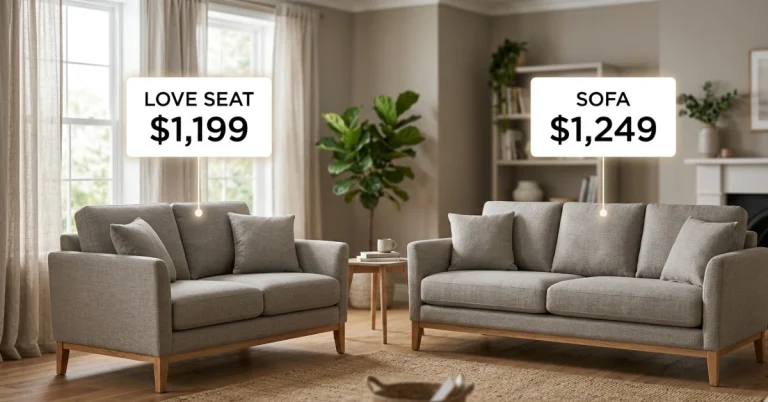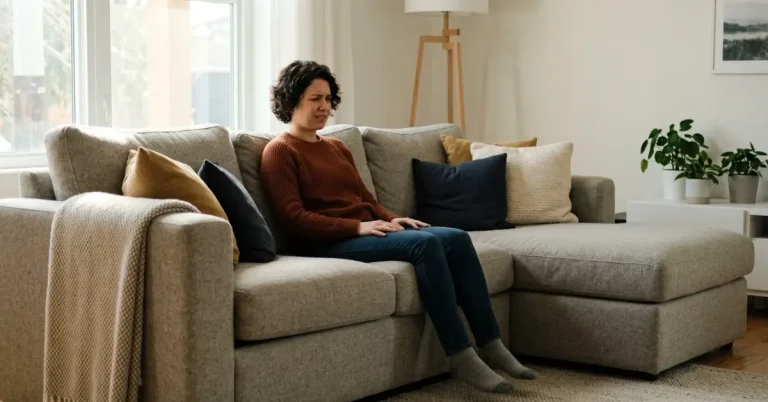
Most sofas are designed for people around average height. If you’re shorter, that mismatch shows up fast.
Feet don’t touch the floor. Knees sit too high. Your lower back floats with no support. You slide forward just to feel grounded.
That constant adjustment? It turns into real discomfort over time. Tight hips. Sore lower back. Bad posture you didn’t sign up for.
Brands love to say “deep, lounge-worthy seats.” Sounds great. Feels terrible when your legs can’t support you.
Here’s the fix.
These 7 sofas are actually suited for shorter bodies. Not based on hype. Based on seat depth, height, and real sitting ergonomics.
If you want a sofa that supports you instead of forcing you to adapt, keep reading.
1. The Real Problem
Why Most Sofas Hurt Short People
Most sofas are not built with shorter bodies in mind. They are scaled for average or taller users, and that creates immediate ergonomic issues.
Start with seat depth.
Typical sofas come with a seat depth between 22 and 25 inches. That sounds generous. In reality, it pushes shorter users into a bad sitting position.
You sit back and your feet lift slightly off the ground. Or you sit forward to plant your feet, and your back loses support.
Neither is stable. Both lead to fatigue.
Seat height adds another problem.
If the seat is too high, your feet can’t rest flat. Pressure shifts to your thighs. Circulation suffers. Your posture starts to collapse without you noticing.
Then there’s lumbar support.
Most deep sofas leave a gap between your lower back and the cushion. That gap forces you to slouch just to feel contact. Over time, that turns into stiffness and lower back pain.
Here’s what most people miss.
Seat depth matters more than overall sofa depth.
A sofa can look compact from the outside but still feel too deep when you sit. What matters is where your body actually lands and whether your back and feet are supported at the same time.
The 3 Measurements That Actually Matter
This is where most buying guides get lazy. They talk about style, fabric, and color. None of that fixes discomfort.
Focus on these three.
1. Seat depth
The most important factor
- Ideal range: 19 to 21 inches
- Allows your back to rest fully while your feet stay flat
- Reduces the need to scoot forward or use extra pillows
Anything deeper starts to work against you.
2. Seat height
Controls how grounded you feel
- Ideal range: 17 to 18 inches
- Keeps your feet flat on the floor
- Prevents pressure buildup under your thighs
Too high feels unstable. Too low strains your knees when standing up.
3. Back support type
Impacts posture more than you think
- Tight back cushions offer consistent support
- Loose cushions shift and compress over time
- Less shifting means better spinal alignment
If you sit upright for reading, working, or conversation, tight back designs usually perform better.
Now add a layer most people ignore.
Cushion firmness changes how deep a sofa feels.
Soft cushions compress under your weight. That effectively increases seat depth. A 21-inch seat can feel like 23 inches once you sink in.
Firmer cushions hold their shape. They keep you positioned where the design intended.
2. Who This Guide Is For
This guide is not for everyone. It’s built for a specific type of buyer who keeps running into the same problem.
Height range
- 4’10” to 5’6”
- Anyone below average height who struggles to sit comfortably on standard sofas
You’ll benefit if you deal with
- Lower back pain from unsupported sitting
- Feet not touching the ground on most couches
- Constant shifting to find a stable position
Your living situation matters too
- Smaller apartments where oversized sofas feel overwhelming
- Compact living rooms that need better proportion and scale
- Multi-use spaces where posture matters more than lounging
Your sitting style
- You prefer upright seating
- You read, work, or watch TV without slouching
- You want support, not a sink-in experience
If that sounds familiar, you’re in the right place.
These 7 sofas actually fit shorter bodies. Not based on marketing claims, but on real dimensions and how they perform in everyday use.
3. Quick Comparison Table
This is where real decisions happen. Not marketing.
| Sofa | Seat Depth | Seat Height | Support Level | Best For |
|---|---|---|---|---|
| Burrow Nomad | ~22” | ~17” | Medium-firm | Daily posture-friendly use |
| West Elm Andes | ~20–21” | ~17–18” | Firm | Upright comfort |
| IKEA KIVIK Loveseat | ~20” | ~17” | Medium | Budget reliability |
| Article Sven | ~21” | ~17” | Medium-firm | Style + balance |
| Joybird Eliot | Custom | ~17–18” | Adjustable | Personalized fit |
| La-Z-Boy Collins | ~21” | ~18” | Firm | Back support |
| Apt2B Melrose | ~21” | ~17–18” | Medium-firm | Small apartments |
Most buyers skip this and regret it later. Short users especially feel the difference within minutes of sitting.
4. TOP 7 SOFAS FOR SHORT PEOPLE WITH BACK SUPPORT
Most sofas in the US are still built around one assumption: average-height users in large living rooms. That creates the classic mismatch. Seat too deep. Back too far. Feet dangling. Lower back losing contact with support.
Shorter users feel it immediately. You sit down and your body has to adjust to the sofa, instead of the sofa fitting your body.
For shorter frames, the formula is simple:
Shallow to medium seat depth (18–21 inches) plus firm lumbar support plus a compact frame width.
Anything deeper than that starts pushing your posture forward. Over time, that turns into slouching, even if the sofa looks “comfortable” in a showroom.
1. Burrow Nomad Sofa – Best overall for short people
This is one of the few modern sofas that actually respects proportion.
Burrow Nomad Sofa is modular, but more importantly, it avoids the oversized “sink-in lounge trap” that dominates US furniture design.
Why it works for short people
The seat depth sits in a controlled range. It is not overly deep like cloud sofas. That keeps your lower back in contact with the cushion without forcing you forward.
The back support is firm enough to maintain posture for longer sitting sessions.
It feels designed for real apartments, not showroom spaces.
Key specs
- Seat depth: ~22 inches
- Seat height: ~17 inches
- Support: Medium-firm foam
- Type: Modular sofa
Comfort analysis
Upright sitting feels natural. You don’t need extra pillows.
For lounging, it still holds shape instead of collapsing.
Pros
- Balanced posture support
- Works for small to medium apartments
- Doesn’t over-soften over time
Cons
- Slightly deeper than ideal for very short users under 5’2”
- Not the cheapest option
2. West Elm Andes Sofa – Best premium compact comfort
This is where design meets controlled ergonomics.
West Elm Andes Sofa keeps proportions tighter than most luxury sofas, which matters more than people realize.
Why it works for short people
Seat depth stays closer to the ideal range, and the back cushions do not collapse easily. That means your spine actually stays supported instead of sinking backward.
Key specs
- Seat depth: ~20–21 inches
- Seat height: ~17–18 inches
- Support: Firm structured cushions
- Type: Premium apartment sofa
Comfort analysis
Better for upright sitting than lounging.
You feel “placed” in the sofa, not swallowed by it.
Pros
- Strong posture support
- Premium build quality
- Works well in compact living rooms
Cons
- Price is high
- Not designed for deep lounging comfort
3. IKEA KIVIK Loveseat – Best budget ergonomic option
This is one of the most practical choices in the US market for shorter users.
Why it works for short people
The proportions are controlled and predictable. You don’t get the oversized depth problem common in modern couches.
It also responds well to lumbar pillows if needed.
Key specs
- Seat depth: ~20 inches
- Seat height: ~17 inches
- Support: Medium foam
- Type: Loveseat
Comfort analysis
Firm enough for daily use without collapsing posture.
Not luxury, but consistent.
Pros
- Affordable
- Reliable sizing
- Easy to maintain
Cons
- Basic aesthetic
- Cushion firmness can vary slightly over time
4. Article Sven Sofa – Best mid-century balance
This one is popular for design, but it also performs well for body proportion when used correctly.
Why it works for short people
The seat depth is controlled enough to avoid excessive forward sliding. The back cushions give decent structure without being overly soft.
Key specs
- Seat depth: ~21 inches
- Seat height: ~17 inches
- Support: Medium-firm
- Type: Mid-century sofa
Comfort analysis
Balanced between sitting and lounging.
Not overly rigid, not overly soft.
Pros
- Strong aesthetic appeal
- Good balance of comfort and structure
- Works in modern apartments
Cons
- Slightly deep for very short users
- Cushions soften over time
5. Joybird Eliot Sofa – Best customizable fit for short people
This is where customization actually matters.
Why it works for short people
You can adjust seat depth and cushion firmness. That changes everything for shorter users because most sofas fail exactly on those two factors.
Key specs
- Seat depth: Custom
- Seat height: ~17–18 inches
- Support: Adjustable firmness
- Type: Custom sofa
Comfort analysis
Can be tuned for upright posture or softer lounging depending on configuration.
Pros
- Adjustable design
- Better ergonomic control
- Fits different body sizes
Cons
- Expensive
- Requires configuration decisions upfront
6. La-Z-Boy Collins Sofa – Best lumbar support
This is not about trends. It is about structure.
Why it works for short people
La-Z-Boy focuses on real lumbar alignment. That matters more than plush comfort for shorter users with back strain.
Key specs
- Seat depth: ~21 inches
- Seat height: ~18 inches
- Support: Firm lumbar-focused
- Type: Traditional sofa
Comfort analysis
Very stable for upright sitting. Less forgiving for lounging.
Pros
- Excellent back support
- Durable structure
- Good for long sitting sessions
Cons
- Not modern in style
- Firm feel may not suit lounge preference
7. Apt2B Melrose Sofa – Best compact apartment fit
This is designed specifically for small US living spaces.
Why it works for short people
Proportions are scaled correctly for apartments. It avoids the oversized seating trend.
Key specs
- Seat depth: ~21 inches
- Seat height: ~17–18 inches
- Support: Medium-firm
- Type: Apartment sofa
Comfort analysis
Balanced enough for daily use without posture collapse.
Pros
- Compact design
- Good for small rooms
- Easy integration into apartments
Cons
- Limited styling options compared to premium brands
- Cushion firmness is average
Key Takeway
Short people don’t need softer sofas. They need correctly sized sofas.
The difference comes down to inches, not branding.
If the seat is too deep, posture breaks. If the back is too soft, alignment disappears. If the frame is too large, your body becomes secondary to the furniture.
The best sofas here all share one thing.
They respect proportion first. Comfort comes after that.
5. Types of sofas
Instead of treating all sofas equally, you group them by how they solve the short-user problem. Here’s the type of sofa that solve your problems.
1. Apartment-Size Sofas (Best overall category)
Smaller scale equals better ergonomics. This is the safest category for most short users in the US because proportions are naturally reduced compared to full-size sectionals.
These sofas usually fix the two biggest issues:
- Seat depth that is too extreme
- Frame width that overwhelms smaller bodies
Example:
- Burrow Nomad Sofa
Seat depth ~22 inches → slightly deep but balanced by firm cushions and modular support - Apt2B Melrose Sofa
Seat depth ~21 inches → better fit for shorter legs in compact living rooms
Why this category works:
- Designed for apartments, not oversized homes
- More predictable seat geometry
- Easier to maintain posture without extra pillows
Tradeoff:
- Not as plush as oversized “cloud” sofas
- Slightly less lounging comfort, more upright sitting focus
2. Shallow Seat Sofas (Best for posture control)
Designed specifically for shorter reach and upright sitting alignment. This is the most important category for people with back discomfort.
When seat depth stays closer to 18–20 inches, the body stops sliding forward. That keeps lumbar support in contact naturally.
Example:
- West Elm Andes Sofa
Seat depth ~20–21 inches → firm structure keeps spine aligned - La-Z-Boy Collins Sofa
Seat depth ~21 inches → strong lumbar support reduces slouching
Why this category works:
- Better back contact without cushions
- More natural knee-to-back alignment
- Reduces forward slouching over time
Tradeoff:
- Less “sink-in” comfort
- Can feel firm for casual lounging
3. Mid-Range Balanced Sofas (Best everyday use)
This is the “safe middle” category. Not too deep, not too firm. Works for short users who want one sofa for everything.
These are usually the most realistic long-term purchase options in the US market.
Example:
- Article Sven Sofa
Seat depth ~21 inches → balanced support and comfort - Joybird Eliot Sofa
Custom seat depth → can be tuned for shorter body proportions
Why this category works:
- Balanced upright + lounge usability
- Works for daily TV use and casual sitting
- Better adaptability than fixed-design sofas
Tradeoff:
- Requires careful configuration (especially Joybird)
- Slight variation in firmness over time
4. Budget Compact Sofas (Best under $1000–$1200)
This category prioritizes correct proportions over luxury materials. For short users, this often works better than expensive oversized sofas.
IKEA dominates this space because sizing is consistent and predictable.
Example:
- IKEA KIVIK Loveseat
Seat depth ~20 inches → reliable compact geometry
Why this category works:
- Affordable entry point
- Predictable sizing across models
- Easier to replace or upgrade later
Tradeoff:
- Basic aesthetics
- Cushion durability is average compared to premium brands
5. Premium Ergonomic Sofas (Best lumbar support)
This category is for people who prioritize back health over style trends.
The focus is not softness. It is structural alignment.
Example:
- La-Z-Boy Collins Sofa
Built-in lumbar support → reduces long-term strain - West Elm Andes Sofa
Structured cushioning → maintains posture over time
Why this category works:
- Strong back alignment support
- Designed for longer sitting sessions
- Better for users with existing back discomfort
Tradeoff:
- Less relaxed lounge feel
- Higher price point
6. Custom Fit Sofas (Best personalized ergonomics)
This is where you solve the short-person problem properly by adjusting the sofa to the body instead of adapting the body to the sofa.
Example:
- Joybird Eliot Sofa
Adjustable seat depth and firmness
Why this category works:
- Custom seat depth solves mismatch problem directly
- Can optimize for height, posture, and sitting style
- More precise than mass-market sizing
Tradeoff:
- Higher cost
- Requires upfront configuration decisions
6. Sofas That LOOK Good But Are Terrible for Short People
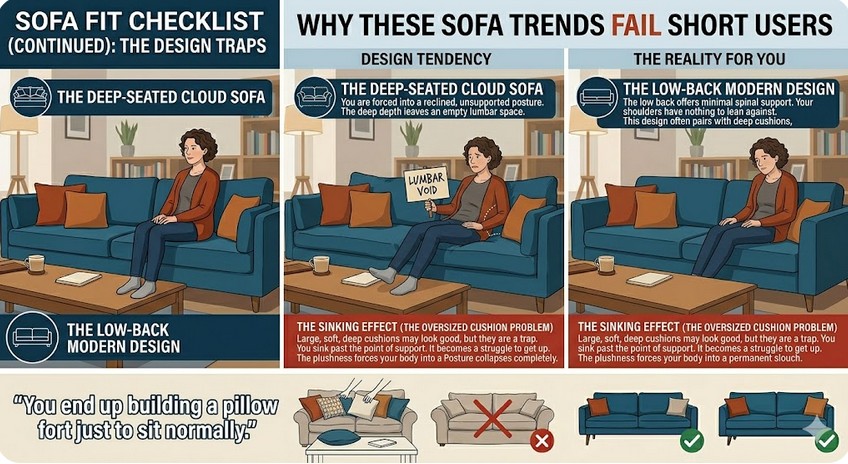
A lot of sofas in the US market are designed to photograph well, not to sit well. That gap matters more when you’re shorter.
These are the usual offenders:
- Deep sectionals that look luxurious in showrooms
- “Cloud sofas” that prioritize sinking over support
- Low-back modern designs that ignore lumbar alignment
On paper, they sell comfort. In reality, they create posture problems within minutes.
1. Deep sectionals
These are the most misleading for short users.
The seat depth is often excessive, pushing well beyond what a shorter frame can use properly. Instead of sitting in the sofa, you end up sitting on the edge of it.
What happens in real life:
- Feet don’t stay grounded comfortably
- Lower back loses contact with the backrest
- You constantly shift position to feel supported
They look premium. They behave oversized.
2. Cloud sofas
These are popular in modern US living rooms because they look soft and inviting. The problem is exactly that softness.
They collapse under your body weight instead of supporting it.
For shorter users, that means:
- No stable sitting height
- No consistent lumbar contact
- A slow slide into a reclined slump
They are designed for lounging, not posture.
3. Low-back modern designs
These are the aesthetic-first sofas.
They assume relaxed posture is enough support. It isn’t.
For shorter people, low backs often sit below shoulder line, which removes any meaningful upper back or lumbar guidance.
What you feel:
- Floating upper back
- No anchor point for posture
- Increased slouching without noticing it
Real user reality
This is where expectations break.
What it looks like in photos:
- Clean lines
- Minimal design
- Luxury aesthetic
What it feels like after 10 minutes:
- Constant repositioning
- Pillow stacking for basic comfort
- Lower back fatigue building slowly
👉 Real sentiment from users is consistent:
“You end up building a pillow fort just to sit normally.”
That line shows the real issue. It’s not about softness or style. It’s about fit. When geometry is wrong, comfort becomes manual work.
If you’re short, ignore how a sofa looks in staging photos.
Focus on three things only:
- Seat depth under control
- Firm enough back support
- Proportions that match your body, not average sizing
Everything else is secondary.
7. How to Choose the Right Sofa (Decision Framework)
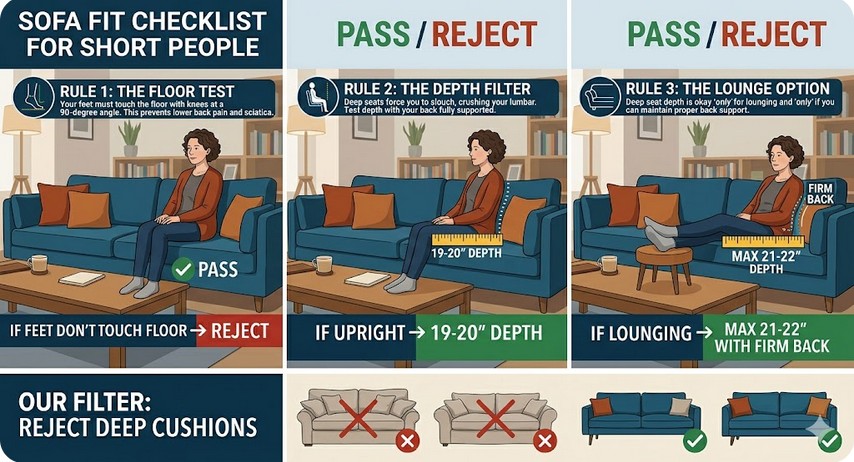
This is where most people get it wrong. They choose based on looks, price, or brand reputation, then adjust their body to fit the sofa later.
For shorter users, that approach fails fast.
Use this instead. No guesswork.
Sofa decision checklist for short people
If you sit upright most of the time → choose 19–20” seat depth
This keeps your lower back in contact with the backrest without forcing you to lean forward. It’s the safest range for posture.
If you like lounging or leaning back → max 21–22” seat depth (only with firm back support)
Deeper seating only works if the backrest is structured enough to stop sinking. Otherwise, you slide into a reclined posture without support.
If your feet don’t touch the floor comfortably → reject immediately
This is non-negotiable. Once your feet hang or hover, your lower back compensates. That’s where long-term discomfort starts.
If you need pillows just to sit normally → the sofa is too deep
A good sofa should support you without “setup work.”
If you feel yourself sliding forward within minutes → seat depth is wrong for your height
This usually means the sofa is designed for taller users.
8. Where to buy the best sofas for short people?
This is where most buyers lose money. The US market is especially misleading because product listings often emphasize style and “overall depth,” not usable seating geometry.
Where to shop (realistic approach)
Online stores
- Better selection of compact sofas
- Easier comparison of seat depth and dimensions
- Risk: misleading photos and staged proportions
Showroom shopping
- Best for testing real seat depth and posture
- You immediately feel if the sofa fits your frame
- Risk: limited compact models on display
Best approach:
Use online research to shortlist, then physically test if possible.
Always check this before buying
Seat depth (not overall depth)
This is the most important number for short people. Overall depth includes armrests and structure that don’t affect seating comfort.
A sofa can look compact but still have a deep seat that forces slouching.
Measure your body (this step is ignored too often)
Most people measure sofa dimensions. Fewer measure themselves.
You should measure:
- Back to knee length
- Sitting height from floor to back support point
- Foot contact comfort when seated
This tells you whether a sofa will naturally fit your posture or force adjustment.
The most common mistake in the US market
People confuse overall depth with seat depth.
- Overall depth = sofa footprint (includes arms and back structure)
- Seat depth = actual usable sitting area
Only seat depth determines posture fit.
This is why many sofas that look “compact” still feel too deep when you sit down.
Final buying mindset
A good sofa for short people is not about softness or luxury.
It’s about alignment.
If the proportions are right:
- You sit naturally
- Your feet stay grounded
- Your lower back stays supported
If the proportions are wrong:
- You adjust your body constantly
- Comfort becomes temporary
- Posture breaks over time
9. Frequently Asked Questions
These are the questions people actually search before buying, especially in the US market where sofa sizing is inconsistent across brands.
What seat depth is best for short people?
The most reliable range is 19 to 21 inches of seat depth.
Below 19 inches can feel too tight for lounging. Above 21–22 inches usually pushes shorter users into a slouched or forward-sitting position.
The goal is simple:
Your back should naturally touch the backrest without your knees lifting or your body sliding forward.
If you need pillows to “fix” the depth, the sofa is already too deep.
Are deep sofas bad for your back?
They are not automatically “bad,” but they are often mismatched for shorter users.
Deep sofas force your body into compensating positions:
- Sliding forward to reach the backrest
- Losing lumbar contact
- Sitting with unsupported lower back
Over time, that creates fatigue and posture strain.
For taller users, deep sofas can feel relaxing. For shorter users, they often turn into slouch traps.
Can I fix a sofa that’s too deep?
You can adjust it, but you cannot fully correct geometry problems.
Common fixes include:
- Adding firm lumbar pillows
- Using seat cushions to reduce effective depth
- Positioning yourself more upright consciously
But here’s the reality:
These are workarounds, not solutions.
If the seat depth is significantly too large, you will always be adjusting instead of sitting naturally.
The better solution is buying the correct depth from the start.
What is the best sofa height for a 5’2” person?
For most users around 5’2”, the ideal seat height is 17 to 18 inches.
This allows:
- Feet to stay flat on the floor
- Knees to form a natural angle
- Lower back to stay stable without pressure
Lower than 17 inches can feel too low and hard to rise from. Higher than 18.5 inches can start lifting the feet or changing leg posture.
Seat height matters as much as depth, but it is often ignored in buying decisions.
10. Conclusion
Most people shop for sofas the wrong way. They focus on color, fabric, or how it looks in a staged room.
That’s not what determines comfort.
For shorter users, the difference between a good sofa and a bad one comes down to a few inches of geometry.
Seat depth. Seat height. Back support.
That’s it.
Reframe the decision
The best sofa isn’t the most expensive one.
It’s the one that fits your body without forcing adjustments.
If you have to fix it with pillows, change your posture, or “learn to sit differently,” it’s not a good fit.
Simple rule to follow
Measure first. Buy second.
Not the other way around.
Because once the sofa is in your living room. You don’t adapt to it once you adapt to it every day.