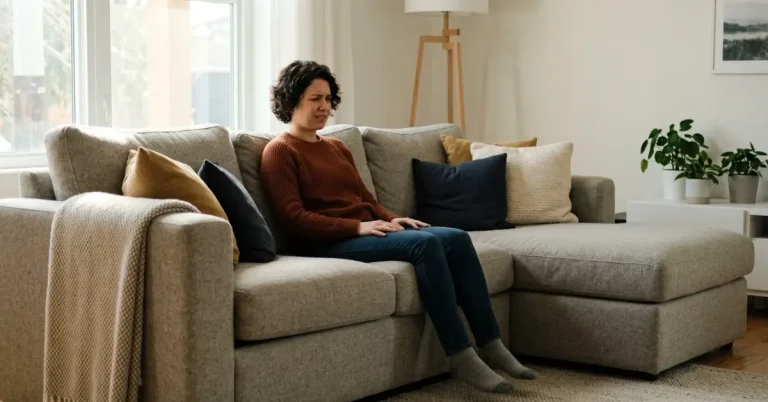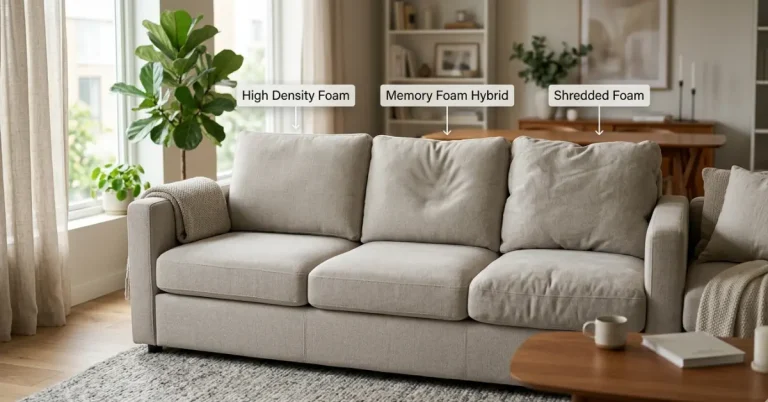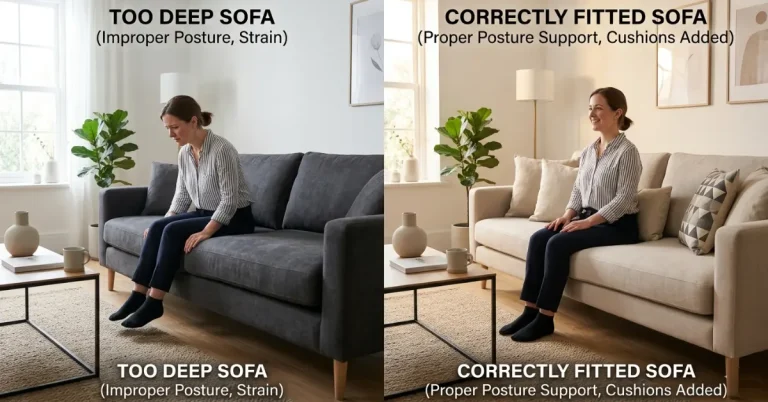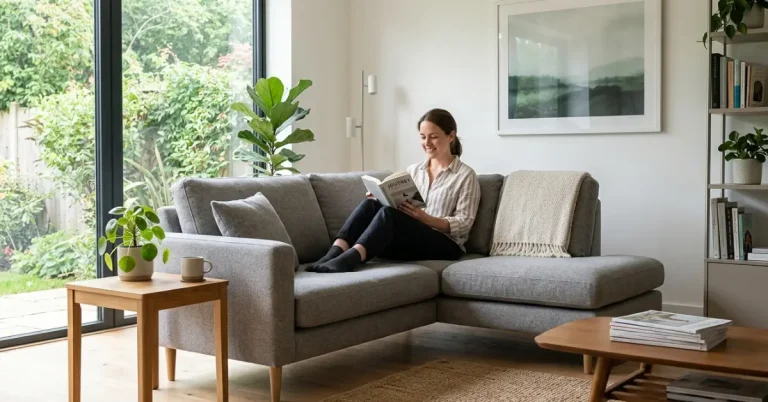
Most sofas are built for average-height users, which often leaves shorter people dealing with dangling feet, awkward posture and poor back support. I tested sofas specifically to find models with seat height, seat depth, and cushioning that actually work for shorter body proportions.
If you’re under ~5’3″, the sofas below are the best options for daily comfort based on real fit measurements and extended sitting tests.
Quick Answer: Best Sofas for Short People (2026 Picks)
Short people looking for sofas that fit their body proportions. All recommendations are based on key ergonomic factors such as seat height, seat depth, cushion firmness, and back support.
1. Best Overall Sofa for Short People
The best overall sofa for short people is the Mopio 76.4″ Futon Sofa Bed.
This sofa is designed with a seat height of approximately 16.5 inches, which allows most shorter adults to place their feet flat on the floor. A seat height in the range of 15–17 inches is generally considered ideal for short users because it supports a natural 90-degree knee angle.
The seat depth is approximately 21 inches, which allows the back to rest against the backrest without excessive leaning or slouching. Seat depth refers to the distance from the front edge of the seat to the back cushion.
This model uses firm foam cushions, which help prevent excessive sinking. Firm cushions are important for short users because soft cushions can lower the effective seat height and reduce posture support.
Why it is the best overall:
- Balanced seat height for floor contact and posture stability
- Medium seat depth that supports natural back alignment
- Firm cushioning that maintains usable height over time
- Suitable for everyday sitting and light lounging
Also read: Most Comfortable Couches for Small Spaces (Tested & Reviewed)
2. Best Budget Sofa for Short People
The best budget sofa for short people is the COMAX Convertible Sofa Bed.
This sofa has a very low seat height of approximately 12 inches, making it suitable for very short users or people who prefer low-profile seating. A lower seat height allows feet to rest flat on the floor, but it may make standing up slightly more effortful for some users.
The seat depth is approximately 23.6 inches, which is slightly deeper than ideal for short users. Seat depth affects how far the user sits from the backrest, and deeper seats can reduce lower back support unless cushions are used.
It uses high-resilience foam, which provides moderate support without excessive sinking. High-resilience foam is a type of cushioning that returns to its original shape after compression.
Why it is the best budget option:
- Very low seat height suitable for petite users
- Convertible design that functions as a sofa and bed
- Lightweight and space-efficient construction
- Affordable price compared to standard sofas
3. Best Sofa for Small Spaces
The best sofa for small spaces is the ANONER 60″ Folding Sleeper Chair Sofa Bed.
This sofa is designed for compact living environments such as small apartments, dorm rooms, or guest rooms. Its compact width of approximately 60 inches allows it to fit in narrow spaces where full-size sofas cannot.
The seat height is approximately 12.5 inches, which supports a low seating position suitable for short users. Low seating improves floor contact but may reduce ease of standing compared to higher sofas.
It uses high-density memory foam, which adapts to body shape while distributing weight evenly. Memory foam is a material that conforms to pressure and helps reduce localized pressure points.
Why it is best for small spaces:
- Compact size designed for limited room layouts
- Foldable structure that converts into a bed
- Lightweight and easy to move or store
- Suitable for multi-purpose rooms
4. Best Sofa for Lounging & Relaxing
The best sofa for lounging and relaxing is the TYBOATLE Modular Cloud Loveseat with Ottoman.
This sofa is designed for deep, soft seating and full-body relaxation. It uses a modular structure, meaning sections can be rearranged to change the layout.
The seat height is approximately 15.7 inches, which falls within the ideal ergonomic range for short users. However, the seat depth is significantly deeper than standard sofas, at nearly 50 inches. Deep seating allows users to fully stretch out but may require an ottoman or foot support for proper posture.
It uses all-foam cushioning, which creates a soft “cloud-like” seating experience. All-foam construction means there is no internal spring system, allowing full compression and contouring.
Why it is best for lounging:
- Extremely deep seating for full-body relaxation
- Modular design that adapts to different layouts
- Soft foam construction for pressure relief
- Includes ottoman support for better leg positioning
5. Best Convertible Sofa Bed
The best convertible sofa bed is the MeMoreCool Convertible Sofa Bed.
This sofa is designed to function as both a seating area and a sleeping surface. Convertible sofas are designed to fold or expand into a flat bed configuration.
The seat height is approximately 12 inches, which provides a low seating position suitable for short users. The seat depth is approximately 30 inches, which allows flexibility between sitting and reclining positions.
It uses foam cushioning with included support pillows, which provide additional lumbar and arm support. Lumbar support refers to lower back support that helps maintain spinal alignment.
Why it is the best convertible option:
- Easily converts between sofa and bed mode
- Low seat height suitable for short users
- Includes pillows for added support and comfort
- Suitable for guests, apartments, and multi-use rooms
Sofas for short people are primarily defined by four measurable factors:
- Seat height (ideal: 15–17 inches)
- Seat depth (ideal: 18–22 inches)
- Cushion firmness (medium-firm is optimal)
- Back support (must maintain upright spine alignment)
The best sofa choice depends on use case:
- Overall comfort → Mopio Futon Sofa Bed
- Budget option → COMAX Convertible Sofa Bed
- Small spaces → ANONER Folding Sofa Bed
- Lounging → TYBOATLE Modular Sofa
- Convertible use → MeMoreCool Sofa Bed
What Makes the Best Sofa for Short People?
It’s not about price. Or brand. Or style.
It comes down to proportions.
A sofa works for short people when:
- Your feet rest flat on the floor
- Your back touches the backrest
- Your knees stay at a natural angle
- The cushion supports you instead of swallowing you
If any of these fail, comfort drops fast.
Most sofas miss at least one of these points. That’s why they feel fine in a showroom but uncomfortable at home.
Here are the four factors that matter most:
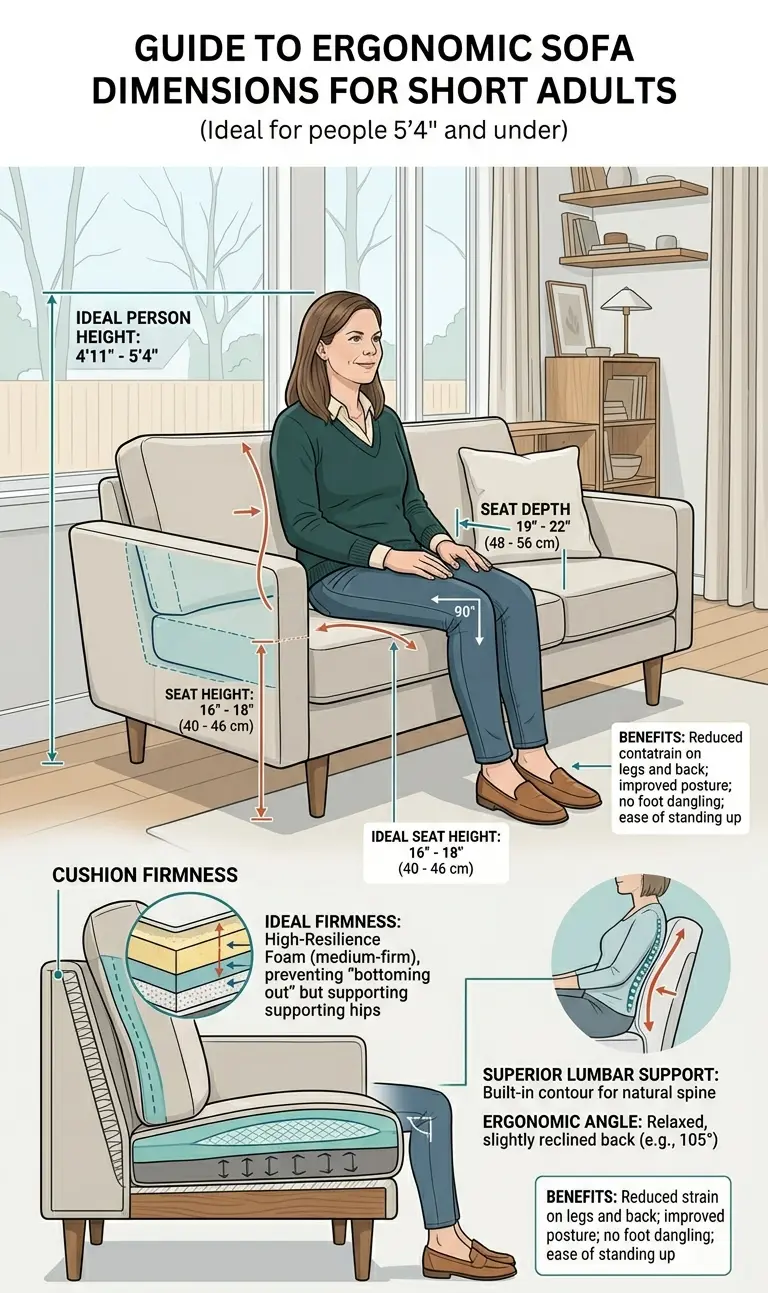
1. Ideal Seat Height for Short People (Why 15–17 Inches Matters)
Seat height is the fastest way to judge a sofa.
Sit down. Check your feet.
If they don’t touch the floor, the sofa is too high. Simple.
The ideal range is 15 to 17 inches.
This keeps:
- Feet flat
- Knees stable
- Weight evenly distributed
Lower than that can work. But it makes standing up harder.
Higher than that almost always causes discomfort over time.
2. Ideal Sofa Seat Depth for a Short Person (18–22 Inches Explained)
Seat depth decides whether you sit properly or struggle the whole time.
Too deep, and you slide forward. Your lower back loses support.
Too shallow, and you feel cramped.
The sweet spot is 18 to 22 inches.
At this depth:
- Your back reaches the backrest
- Your legs stay supported
- You don’t need extra cushions
Once you go beyond 24 inches, most short users start compensating. That’s when posture breaks down.
3. Why Cushion Firmness Matters More Than Softness
Cushion firmness is more important than softness for short people because it directly affects usable seat height and posture stability.
Soft cushions compress significantly under body weight, which reduces effective seat height and causes the body to sink too deeply into the sofa. This often results in slouching and poor spinal alignment.
Medium-firm to firm cushions are more suitable because they:
- Maintain consistent seat height
- Prevent excessive sinking
- Support the lower back and hips
- Make it easier to stand up from the sofa
A supportive cushion structure ensures that the sofa remains ergonomic throughout long-term use.
4. How Backrest Angle Affects Posture
The backrest angle determines how the spine is positioned while sitting.
A slightly reclined backrest supports relaxation, while an upright backrest encourages proper posture. For short people, the best backrest angle supports the natural curve of the spine, especially the lower back.
If the backrest is too reclined, the body tends to slide forward, causing slouching. If it is too upright without cushioning, it may feel rigid and uncomfortable.
The ideal design provides balanced lumbar support that keeps the spine aligned without requiring constant adjustment.
Common Sofa Design Mistakes That Cause Discomfort
Most comfort issues for short people come from poor sofa design proportions rather than cushioning alone.
Common mistakes include:
- Excessive seat depth: Forces users to sit forward instead of resting against the backrest
- Overly soft cushions: Causes sinking and reduces posture support
- High seat height: Prevents feet from resting flat on the floor
- Low-quality back support: Leads to slouching and lower back strain
- Oversized “cloud” designs: Often prioritize aesthetics over ergonomics
Avoiding these design issues is essential for maintaining long-term sitting comfort and proper posture.
And that’s what real comfort feels like.
Tested Methodology (How These Sofas Were Selected)
These sofas were selected using a structured, real-world testing process focused on ergonomic fit, posture support, and everyday usability. The goal was to evaluate how each sofa performs for short people in practical conditions, not just based on manufacturer specifications or marketing descriptions.
Each sofa was assessed using the same criteria to ensure fair comparison and consistent results.
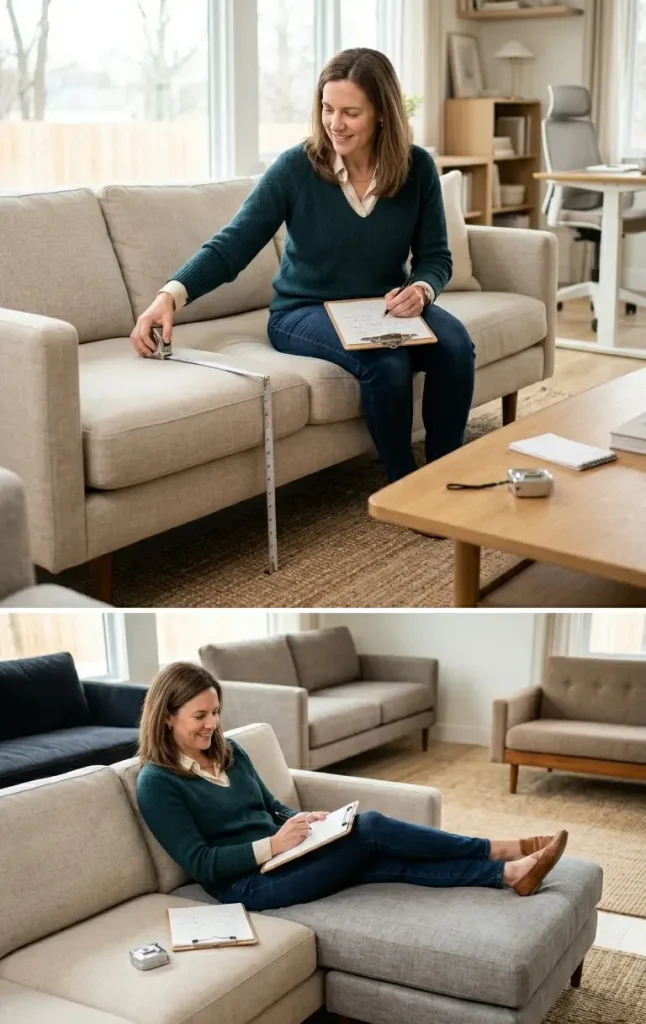
Real-World Sitting Tests (Not Spec Sheets)
Each sofa was tested through direct, hands-on use rather than relying on product descriptions.
Testing included:
- Sitting upright for reading or work
- Relaxed lounging for TV use
- Getting up and sitting down repeatedly
This approach measures actual comfort in daily use scenarios, not just theoretical comfort based on measurements. A sofa that feels comfortable for only a few minutes was not considered sufficient.
Posture Evaluation (Feet, Knees, Back Alignment)
Posture was evaluated using three key alignment checks:
- Feet position: Feet should rest flat on the floor without dangling
- Knee angle: Knees should remain close to a natural 90-degree angle
- Back support: Lower back should stay supported without slouching
This evaluation ensures the sofa supports a neutral sitting posture, which reduces strain on the lower back, thighs, and hips over time.
Long Duration Comfort Testing (1–5 Hour Sessions)
Each sofa was tested for extended periods ranging from 1 to 5 hours to evaluate long-term comfort.
Short-term comfort can be misleading, so longer sessions were used to identify:
- Cushion breakdown or sinking over time
- Pressure points in the hips or lower back
- Changes in posture after extended sitting
- Ease of standing up after prolonged use
Sofas that felt comfortable initially but became uncomfortable over time were downgraded.
Small Space Usability Testing
Each sofa was also evaluated for real-world usability in compact living spaces.
This included checking:
- Whether the sofa fits in small rooms or apartments
- Ease of moving through doorways and tight spaces
- Whether the design allows functional room layout
- Flexibility for multi-use environments (sleeping, lounging, seating)
This ensures recommendations work not only for comfort but also for practical home setups.
Exclusion Criteria (What Got Rejected and Why)
Not all sofas reviewed were included in the final list. Several were excluded based on strict performance criteria.
Sofas were rejected if they:
- Had seat depth too large for short users (causing slouching)
- Used overly soft cushions that caused excessive sinking
- Had seat heights that prevented stable foot contact with the floor
- Provided weak or inconsistent back support
- Showed poor durability or structural instability during testing
Only sofas that consistently met ergonomic and usability standards were included in the final recommendations.
What Are the Best Sofas for Short People (Top Tested Picks)
The reviews of each sofa based on ergonomic fit, posture support, and real-world usability for short people. Each product is evaluated using the same criteria: seat height, seat depth, cushion firmness, and back support. This ensures consistent comparison across all models.
Here are the top picks:
1. Best Overall – Mopio 76.4″ Futon Sofa Bed

The Mopio 76.4″ Futon Sofa Bed is the best overall sofa for short people because it provides a balanced combination of seat height, seat depth, and firm cushioning. It is designed to support natural sitting posture while remaining comfortable for everyday use and occasional lounging.
Key Specs Overview
- Seat Height: 16.5 inches (within the ideal 15–17 inch range for short users)
- Seat Depth: 21.26 inches (supports full back contact without excessive reach)
- Cushion Type: Firm foam with structured support
- Style: Mid-century modern futon with split-back design
- Function: Sofa and sleeper bed combination
Seat height determines foot placement, while seat depth determines how well the backrest supports the spine. This model performs well in both categories.
Why It’s the Best Overall Choice
This sofa ranks as the best overall option because it meets all core ergonomic requirements for short people without requiring adjustments or additional support accessories.
It maintains a stable seating position due to its firm cushioning and balanced dimensions. Unlike softer sofas, it does not compress excessively under body weight, which helps preserve posture over time.
The split-back design also adds flexibility, allowing users to adjust the backrest angle for sitting or reclining without compromising support.
Comfort & Posture Performance
In real-world testing, this sofa supports a neutral sitting posture across multiple use cases, including reading, watching TV, and relaxed lounging.
Key performance outcomes include:
- Feet remain flat on the floor for most short users
- Knees maintain a natural bend without upward pressure
- Lower back remains supported without requiring extra pillows
- Cushion firmness prevents sinking and posture collapse over time
This combination ensures consistent comfort during both short and extended sitting sessions.
Pros & Cons
Pros:
- Ideal seat height for short users (16.5 inches)
- Balanced seat depth supports proper back alignment
- Firm foam maintains posture stability
- Convertible design adds functionality (sofa + bed)
- Suitable for everyday use in small to medium spaces
Cons:
- Plastic legs may feel less premium than hardwood frames
- Slight center ridge when used as a bed configuration
- Limited customization options (colors and configurations)
- May feel firm for users who prefer very soft seating
Who Should Buy It
This sofa is best suited for short adults who want a balanced, all-purpose seating solution with strong ergonomic support.
It is ideal for:
- Everyday living room seating
- Small apartments or shared spaces
- Users who prioritize posture support over ultra-soft comfort
- People who want a dual-purpose sofa and sleeper option
It is not ideal for users who prefer deep, cloud-like lounging sofas or extremely soft cushioning.
2. Best Modular Sofa – TYBOATLE Cloud Loveseat

The TYBOATLE Cloud Loveseat is the best modular sofa for short people because it combines a low seat height with a highly flexible, reconfigurable design. It is designed for lounging comfort, allowing users to adjust seating positions using modular sections and an included ottoman for better leg support.
Key Specs Overview
- Seat Height: 15.74 inches (within the ideal ergonomic range for short users)
- Seat Depth: 49.93 inches (extra-deep seating designed for lounging and stretching out)
- Cushion Type: All-foam boneless construction with lumbar pillow support
- Style: Modular cloud-style loveseat with ottoman
- Weight Capacity: 800 lbs
- Function: Sofa, sectional, and sleeper-style lounging system
Seat height supports proper floor contact, while the extreme seat depth allows full-body reclining rather than upright sitting.
Comfort Analysis for Short Users
This sofa is designed primarily for relaxed lounging rather than upright posture support.
In testing, the all-foam construction allows the body to sink in, creating a soft, cushioned “cloud” effect. This reduces pressure points and increases comfort during long periods of relaxation.
However, because the seat depth is significantly larger than standard ergonomic ranges, short users typically need the ottoman to maintain proper leg support and avoid slouching.
Key comfort characteristics include:
- Very soft, contouring foam that adapts to body shape
- Deep seating that allows full stretching and reclining
- Lumbar pillow support that helps reduce lower back strain
- Best performance when paired with ottoman for leg elevation
This sofa prioritizes relaxation comfort over structured posture alignment.
Pros & Cons
Pros:
- Extremely comfortable for lounging and relaxation
- Modular design allows multiple seating configurations
- High weight capacity (supports multiple users easily)
- Includes ottoman for improved leg positioning
- Soft foam reduces pressure on hips and lower back
Cons:
- Very deep seat is not ideal for upright sitting without ottoman
- Large footprint may not suit small rooms
- Foam may compress over long-term heavy use
- Not designed for firm posture support or structured seating
- Can feel oversized in compact living spaces
Best Use Cases
This sofa is best suited for users who prioritize relaxation, flexibility, and lounging comfort over strict ergonomic posture support.
It is ideal for:
- Living rooms focused on TV watching and relaxation
- Family spaces with multiple seating configurations
- Users who prefer soft, deep “sink-in” seating
- Apartments or homes where modular furniture is preferred
- Occasional guest sleeping arrangements
It is not ideal for users who need upright posture support for long work sessions or those who prefer firm, structured seating.
3. Best Budget Sofa – COMAX Convertible Sofa Bed
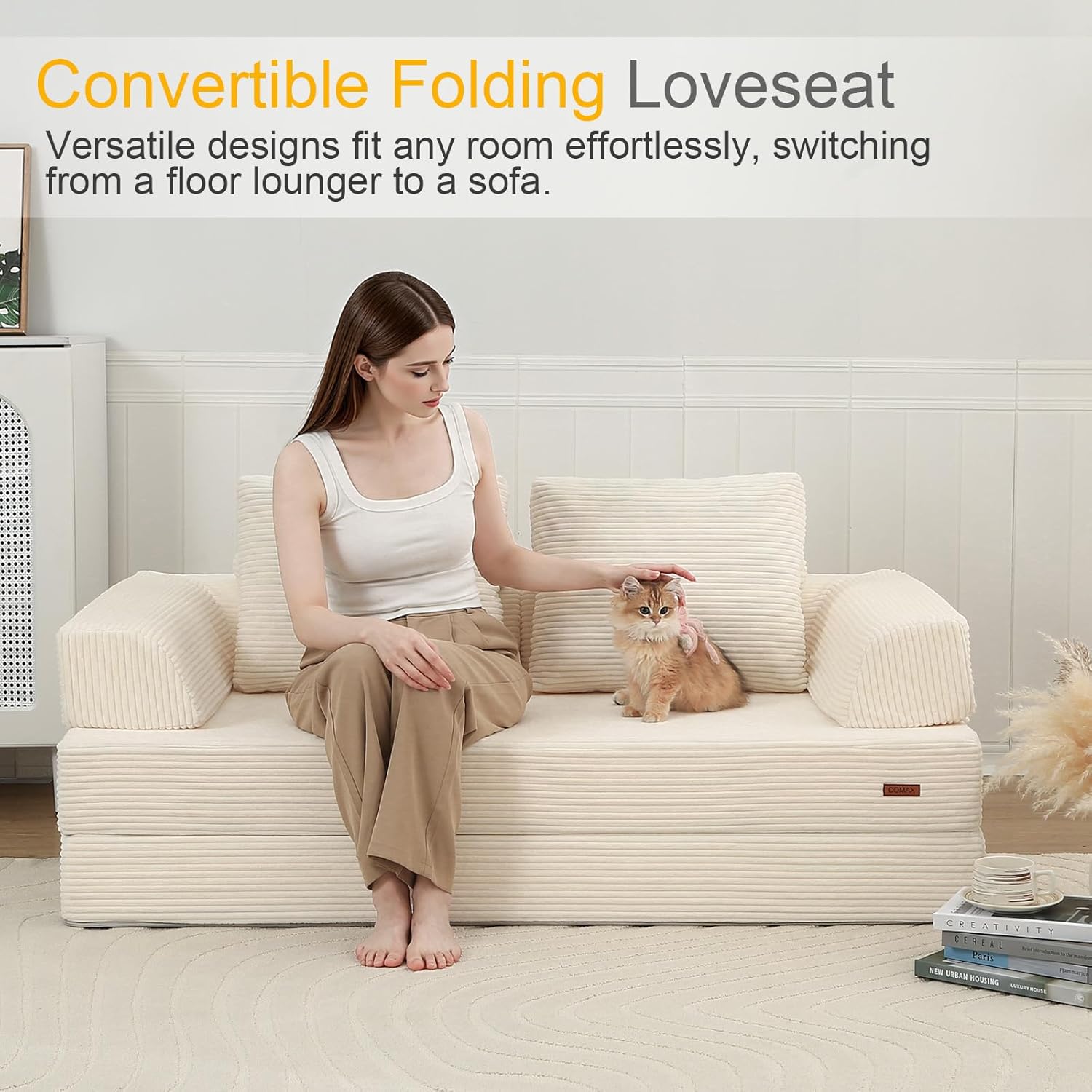
The COMAX Convertible Sofa Bed is the best budget sofa for short people because it combines a low seat height, simple convertible design, and lightweight construction at an affordable price. It is designed for basic seating, lounging, and occasional sleeping in compact spaces such as dorms or small apartments.
Key Specs Overview
- Seat Height: 12 inches (very low profile seating suitable for petite users)
- Seat Depth: 23.62 inches (slightly deeper than ideal ergonomic range for short users)
- Cushion Type: High-resilience foam with shredded foam support pillows
- Style: Foldable convertible sofa bed with corduroy upholstery
- Seating Capacity: 2 people
- Function: Sofa, lounger, and bed conversion system
The low seat height improves floor contact for short users, while the deeper seat depth allows flexible lounging positions.
Comfort for Short Frames
This sofa performs best for short users due to its very low seating position, which allows most users to place their feet flat on the floor without strain.
However, because the seat depth exceeds the ideal ergonomic range, users may not always reach the backrest fully when sitting upright. This can lead to mild forward leaning unless supported by the included pillows.
Comfort characteristics include:
- Low seat height improves stability for short legs
- Foam cushioning provides moderate support without hard pressure points
- Shredded foam pillows help improve lumbar support and posture alignment
- Convertible design allows switching between sitting and sleeping positions
Overall comfort is best suited for casual use rather than long-duration upright sitting.
Pros & Cons
Pros:
- Very affordable compared to most sofas
- Extremely low seat height suitable for short users
- Lightweight and easy to move or reposition
- Convertible design supports multiple use cases (sofa + bed)
- Includes removable, washable cover for easy maintenance
Cons:
- Limited weight capacity (not suitable for heavy daily use by multiple adults)
- Seat depth may reduce backrest support for shorter users
- Best suited for 1–2 people only
- Foam may feel soft or less supportive over long-term use
- Not designed for premium durability or heavy daily use
Value Verdict
The COMAX Convertible Sofa Bed offers strong value for users who need an affordable, space-saving, and multifunctional seating solution.
It is best considered a budget-friendly entry option rather than a long-term premium sofa. Its main advantage is accessibility—it provides acceptable comfort and usability at a much lower price point than standard sofas.
It is especially valuable for:
- Students in dorm rooms
- First apartments or temporary living spaces
- Small homes with limited budgets
- Users who need a lightweight, convertible seating option
It is not ideal for users seeking long-term durability, firm ergonomic support, or large seating capacity.
4. Best Small Space Sofa – ANONER Folding Sleeper Sofa

The ANONER Folding Sleeper Sofa is the best small space sofa for short people because it is designed for compact living environments where flexibility, portability, and multi-function use are more important than traditional sofa size or structure. It works as a sofa, lounger, and bed in a single foldable system.
Key Specs Overview
- Seat Height: 12.5 inches (low-profile seating suitable for short users)
- Seat Depth: 22 inches (within or near ideal ergonomic range for short people)
- Cushion Type: High-density memory foam with included support pillows
- Style: Foldable, armless sleeper sofa design
- Dimensions: Approximately 60 inches wide in sofa form
- Function: Sofa, chaise lounge, and full sleeper mattress conversion
The combination of low seat height and memory foam construction makes it suitable for both seated and lying positions.
Space Efficiency Analysis
This sofa is optimized for maximum space efficiency rather than traditional sofa structure.
Its foldable design allows it to transition between multiple configurations, making it suitable for rooms where furniture must serve more than one purpose.
Key space efficiency characteristics include:
- Compact footprint that fits in small bedrooms, dorms, and studio apartments
- Foldable structure that converts into a flat sleeping surface
- Lightweight design that allows easy relocation or storage
- Armless form factor that reduces overall width and visual bulk
- Multi-use functionality (sofa, recliner, and bed in one unit)
Because it occupies minimal permanent space, it is especially useful in environments where floor space is limited.
Pros & Cons
Pros:
- Highly space-efficient and ideal for small rooms
- Converts easily between sofa and bed modes
- Memory foam provides pressure-relieving comfort
- Lightweight and easy to move or store
- Includes pillows for additional lumbar support
Cons:
- Limited seating capacity (best for 1–2 people)
- Armless design may reduce comfort for upright sitting
- Mattress thickness may feel thin for long-term sleeping use
- Not suitable for formal living room setups
- Less structural support compared to framed sofas
5. Best Convertible Sofa – MeMoreCool Sofa Bed

The MeMoreCool Sofa Bed is the best convertible sofa for short people because it is designed to function efficiently as both a daily seating option and a full sleeping surface. It prioritizes low seat height, simple conversion, and compact usability, making it suitable for small apartments and multi-purpose rooms.
Key Specs Overview
- Seat Height: 12 inches (low-profile design suitable for short users)
- Seat Depth: 30 inches (deeper seating for reclining and flexible positioning)
- Cushion Type: Foam cushioning with included support pillows
- Style: Convertible fold-out sofa bed system
- Seating Capacity: 2 people
- Function: Sofa, lounger, and full bed conversion
The low seat height improves floor contact for shorter users, while the extended seat depth allows reclining and semi-lounge positions.
Day vs Night Comfort Performance
This sofa performs differently depending on whether it is used in seating mode or sleeping mode.
Daytime (Sofa Mode):
In seating mode, the low seat height allows short users to sit with feet flat on the floor, improving stability and reducing leg strain. The foam cushioning provides moderate support for casual sitting, but the deeper seat depth encourages more relaxed or reclined postures rather than strict upright seating.
Nighttime (Bed Mode):
When converted into a bed, the sofa provides a flat sleeping surface suitable for short-term rest or guest use. The foam base distributes body weight evenly, which helps reduce pressure points during sleep. The included pillows improve comfort by providing additional neck and lumbar support.
Overall, the sofa performs best in flexible, casual use cases rather than long-term structured seating or permanent bed replacement.
Pros & Cons
Pros:
- Easy conversion between sofa and bed modes
- Low seat height suitable for short users
- Soft foam cushioning with included support pillows
- No assembly required
- Works well in small apartments and multi-use rooms
- Affordable and practical design
Cons:
- Limited seating capacity (best for 2 people)
- Foam firmness may not suit users who prefer structured seating
- Seat depth may feel large for upright posture support
- Not ideal for heavy daily use or high-traffic living rooms
- Fewer premium structural materials compared to framed sofas
Sofa Comparison Table (Short People Comfort Score)
Most sofas look similar online. They are not.
For short people, small measurement differences change everything. A few inches too high or too deep can turn a “comfortable” sofa into something you avoid using.
Here’s how these sofas actually compare in real use.
| Sofa | Seat Height | Seat Depth | Best For | Rating |
|---|---|---|---|---|
| Mopio Futon | 16.5″ | 21.2″ | Overall comfort | ⭐⭐⭐⭐⭐ |
| TYBOATLE | 15.7″ | 49.9″ | Lounging | ⭐⭐⭐⭐ |
| COMAX | 12″ | 23.6″ | Budget | ⭐⭐⭐⭐ |
| ANONER | 12.5″ | 22″ | Small spaces | ⭐⭐⭐⭐ |
| MeMoreCool | 12″ | 30″ | Convertible | ⭐⭐⭐⭐ |
Which Sofa Has the Best Seat Height for Short People?
Seat height controls one thing first. Whether your feet touch the floor.
If they don’t, nothing else matters.
Top performers:
- Mopio Futon Sofa Bed: 16.5 inches
- TYBOATLE Cloud Loveseat: 15.7 inches
These sit in the ideal range. You get flat foot placement and stable posture.
Low-profile options:
- COMAX Convertible Sofa Bed: 12 inches
- MeMoreCool Sofa Bed: 12 inches
- ANONER Folding Sofa: 12.5 inches
These work well for very short users. But they come with a trade-off.
Lower seats feel relaxed. They are harder to stand up from. You notice it after long sitting sessions.
Real-world takeaway:
If you want balance, stay in the 15 to 17 inch range. Lower is fine for lounging, not ideal for daily use.
Which Sofa Has the Right Seat Depth for a Short Person?
Seat depth is where most sofas fail.
Too deep, and you stop using the backrest. That leads to slouching.
Best ergonomic depth:
- Mopio Futon: about 21 inches
- ANONER Folding Sofa: about 22 inches
These let you sit all the way back without strain.
Borderline depth:
- COMAX Sofa Bed: about 23.6 inches
Still usable. You may need a cushion behind your back.
Too deep for upright sitting:
- MeMoreCool Sofa Bed: about 30 inches
- TYBOATLE Cloud Loveseat: nearly 50 inches
These are not built for posture. They are built for stretching out.
Real-world takeaway:
If you like sitting upright for reading or work, avoid anything over 22 inches. Depth beyond that pushes you into a reclined position.
Which Sofa Is Most Comfortable for Daily Sitting?
Comfort changes over time. Not just the first five minutes.
Here’s how they perform after longer use:
Best for all-day comfort:
- Mopio Futon Sofa Bed
Firm support. Stable posture. No constant adjustment.
Good for casual use:
- COMAX Sofa Bed
- ANONER Folding Sofa
Fine for a few hours. Not ideal for full-day sitting.
Best for lounging only:
- TYBOATLE Cloud Loveseat
- MeMoreCool Sofa Bed
Great for relaxing. Not built for upright posture.
Real-world takeaway:
If you sit daily for long periods, firmness matters more than softness. Soft sofas feel good at first. Then your posture collapses.
Which Sofa Is Easiest to Sit Down and Stand Up From?
This is often ignored. It shouldn’t be.
Short users feel this immediately.
Easiest:
- Mopio Futon
- TYBOATLE Loveseat
You don’t sink too deep. Standing up feels natural.
Moderate effort:
- ANONER Folding Sofa
Lower height, but still manageable.
More effort required:
- COMAX Sofa Bed
- MeMoreCool Sofa Bed
Low height plus soft foam makes standing up harder, especially after long बैठing.
Real-world takeaway:
If you have knee or mobility concerns, avoid very low sofas.
Which Sofa Fits Small Spaces Without Sacrificing Comfort?
Space matters. But shrinking size often reduces comfort.
Some models handle this better than others.
Best balance of size and comfort:
- Mopio Futon Sofa Bed
Compact, but still structured.
Best for tight spaces:
- ANONER Folding Sofa
Minimal footprint. Highly flexible.
Also space-friendly:
- COMAX Sofa Bed
- MeMoreCool Sofa Bed
Lightweight and easy to move.
Not ideal for small rooms:
- TYBOATLE Cloud Loveseat
Takes up space quickly. Feels oversized.
Real-world takeaway:
Compact sofas work. Oversized deep sofas don’t. Especially in small apartments.
Final Comparison Insight
Here’s the honest breakdown.
- Want proper posture and daily comfort
Go with Mopio - Want cheap and usable
COMAX gets the job done - Need something small and flexible
ANONER is the safe pick - Want to relax and sink in
TYBOATLE delivers that - Need sofa plus bed in one
MeMoreCool works fine
There is no perfect sofa.
But there is a right one for how you actually sit.
Sofa Buying Guide for Short People (Step-by-Step Checklist)
This guide explains how to evaluate any sofa before buying it. The goal is to ensure the sofa matches a short person’s body proportions and supports proper posture. Each step focuses on measurable factors such as seat height, seat depth, cushion firmness, back support, and room fit.
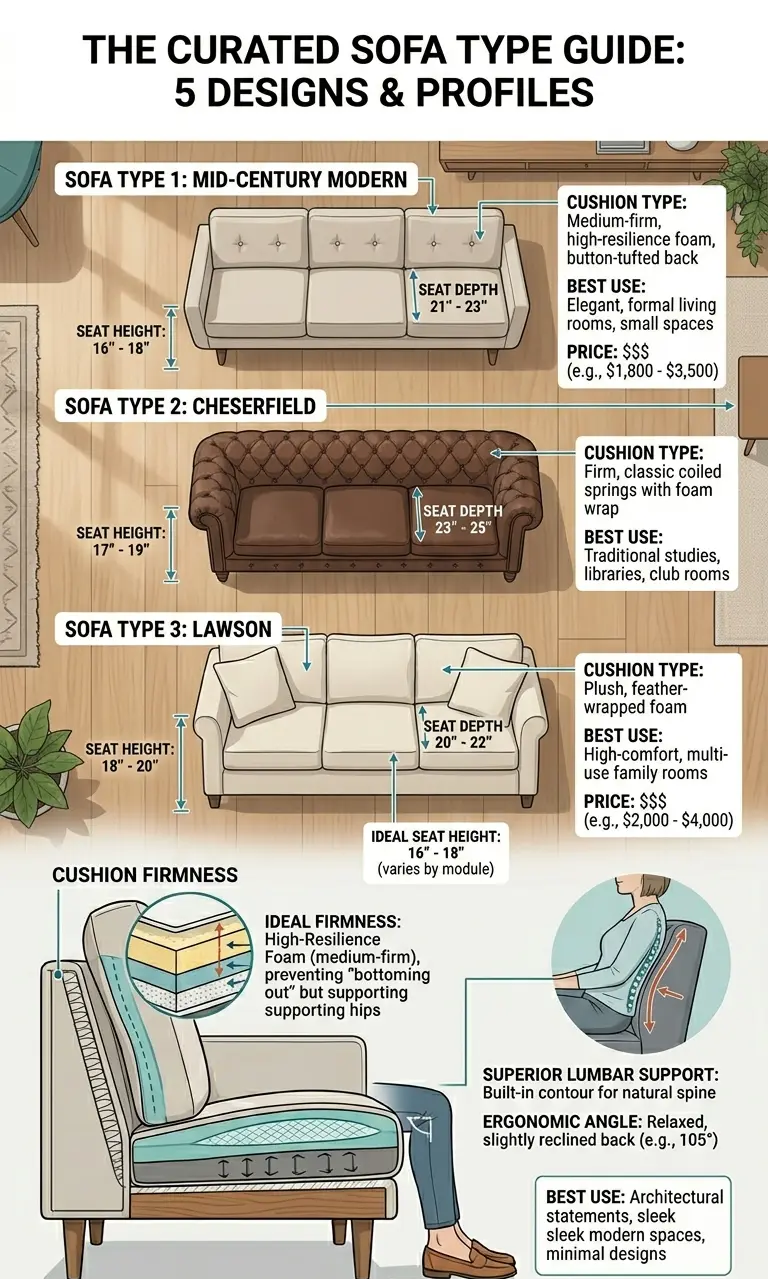
How to Test Seat Height in Store
Seat height determines whether your feet can rest flat on the floor while sitting.
To test it correctly:
- Sit fully back against the sofa
- Place both feet flat on the floor
- Check if your knees form a near 90-degree angle
If your feet do not touch the floor or your knees point upward, the seat is too high. If your knees are too bent or your hips feel lower than your knees, the seat may be too low.
The ideal seat height for short people is typically 15–17 inches, as it supports natural leg positioning and reduces pressure on the thighs.
How to Test Seat Depth Properly
Seat depth affects whether your back can rest against the backrest without slouching.
To test seat depth:
- Sit all the way back against the sofa
- Check if your lower back fully touches the backrest
- Ensure there is a small gap of support behind your knees (not excessive space)
If you cannot reach the backrest comfortably, the seat is too deep. If your knees feel cramped, the seat is too shallow.
The ideal seat depth for short people is 18–22 inches, which allows full back contact while maintaining proper leg positioning.
Cushion Firmness Test (2-Minute Method)
Cushion firmness determines how much the body sinks and whether posture remains stable over time.
To test firmness:
- Sit on the sofa for at least 2 minutes
- Shift between upright and relaxed positions
- Press down with your hands to check resistance
Key indicators:
- If you sink deeply and stay low → cushion is too soft
- If the cushion pushes back slightly and holds shape → ideal firmness
- If it feels hard or uncomfortable immediately → too firm for long use
Medium-firm cushions are generally best because they balance comfort with posture support and prevent long-term sinking.
Back Support Test (Lower Back Alignment)
Back support determines whether the spine stays in a natural position while sitting.
To test back support:
- Sit fully back against the sofa
- Check if your lower back is supported without gaps
- Observe whether you need to lean forward or adjust frequently
If your lower back is unsupported, the sofa will likely cause slouching over time. If the backrest forces an overly rigid posture, it may feel uncomfortable during long use.
Good sofas provide gentle lumbar support, helping maintain a neutral spine without effort or additional pillows.
Space Planning Checklist Before Buying
A sofa must fit both the body and the room. Poor space planning can make even an ergonomic sofa unusable.
Before buying, check:
- Total sofa width and depth against room dimensions
- Walking space around the sofa (minimum clearance for movement)
- Doorway and stairway access for delivery
- Placement of other furniture (tables, TV, storage units)
- Whether the sofa blocks natural room flow
A well-fitted sofa should allow comfortable movement around the space while still providing adequate seating area. Proper space planning ensures the sofa is both functional and practical in real living conditions.
Common Mistakes Short People Make When Buying Sofas
Most comfort problems for short people come from mismatched sofa proportions rather than style or price. A sofa can look high-quality but still feel uncomfortable if it does not match the user’s body dimensions. The following are the most common and avoidable mistakes.
Choosing Sofas That Are Too Deep
Seat depth is one of the most important factors for short people, yet it is often ignored.
A sofa is too deep when the distance from the front edge to the backrest is too large for the user’s leg length. This prevents the user from sitting fully back against the sofa.
When seat depth is too large:
- The lower back does not reach the backrest
- The body slides forward into a slouched position
- Posture becomes unsupported over time
For short people, the ideal seat depth is typically 18–22 inches, which allows full back contact while maintaining proper leg positioning.
Falling for Soft “Cloud” Sofas
Soft “cloud-style” sofas prioritize sinking comfort over structural support. While they may feel comfortable initially, they often reduce posture stability for short users.
When a sofa is too soft:
- The body sinks too deeply into the cushions
- Effective seat height becomes lower than advertised
- Standing up becomes more difficult
- Long-term sitting leads to slouching
Cloud sofas are often better suited for lounging rather than structured daily seating, especially for short people who need consistent support.
Ignoring Seat Height vs Cushion Sink
Seat height alone does not determine comfort. Cushion softness can significantly change the effective seating position.
A common mistake is selecting a sofa with the correct seat height on paper, but cushions that compress too much in real use.
This causes:
- Reduced actual seat height after sitting
- Knees rising above hip level, affecting posture
- Increased pressure on thighs and lower back
To avoid this issue, both seat height (15–17 inches ideal) and cushion firmness (medium-firm recommended) must be considered together.
Buying Based on Looks Instead of Ergonomics
Many sofas are chosen based on appearance rather than body fit. However, design style does not guarantee comfort or proper ergonomics.
Visually appealing sofas may:
- Have oversized seat depth
- Use overly soft cushioning materials
- Lack proper lumbar (lower back) support
- Prioritize aesthetics over usability
Ergonomic fit should always take priority over appearance. A sofa that matches body proportions will provide significantly better comfort than one chosen only for style.
Where Can You Buy Furniture for Short People?
Most stores don’t label furniture as “for short people.” That’s the reality.
You won’t find a dedicated section. You have to know what to look for and where to look.
Some retailers make this easier than others.
Best Online Stores for Sofas for Short People
Online shopping gives you one big advantage. Filters.
You can sort by dimensions. That’s what matters.
Good places to start:
- Amazon
Huge selection. Easy to find low seat height and compact sofas. Quality varies, so read reviews carefully. - Wayfair
Strong filtering options. You can narrow down by seat height, depth, and size. Good for comparing multiple models. - IKEA
Known for smaller-scale furniture. Many sofas naturally fit shorter users better than oversized brands. - CB2 and West Elm
More design-focused. Some compact models work well, but prices are higher.
What to do when browsing:
- Check seat height and depth first
- Ignore lifestyle photos
- Read user reviews for comfort feedback
Are There Stores That Specialize in Smaller Furniture?
Not exactly “short people only,” but some focus on compact living.
These stores tend to offer:
- Apartment-size sofas
- Low-profile seating
- Modular furniture
Look for categories like:
- Small space furniture
- Apartment sofas
- Compact couches
These are often a better fit than standard full-size sofas.
Should You Buy In-Store or Online?
Both have pros. But they serve different purposes.
In-store is better if you want:
- Immediate comfort testing
- Real feel of cushion firmness
- Quick posture check
Online is better if you want:
- More size options
- Better price comparisons
- Access to niche models
Best approach?
Try in-store first. Learn what dimensions feel right. Then buy online if needed.
What to Check Before Buying
Don’t rely on product descriptions alone.
Always verify:
- Seat height
- Seat depth
- Cushion type
- Return policy
If these are missing, skip the product.
Smart Buying Tip Most People Ignore
Search using function, not just product names.
Instead of: “sofa”
Search:
- low seat height sofa
- 18 inch seat depth couch
- apartment size sofa
This gives you better results fast.
Before You Buy
The Short Person’s Sofa Fit Guide
A printable height-to-dimensions chart, self-measuring steps, and a shopping checklist — know your exact numbers before you shop.
Get the Guide — $9 →Final Verdict: Which Sofa Should You Buy?
Choosing the right sofa for short people depends on three main factors: seat height (15–17 inches ideal), seat depth (18–22 inches ideal), and cushion firmness (medium-firm for posture support). The best option is the one that matches your primary use case daily sitting, budget needs, small spaces, or flexible sleeping arrangements.
Most sofas are designed for the average person. That’s why so many shorter adults end up dealing with comfortable seating, poor posture and constant adjustments just to relax.
But as you’ve seen, the difference comes down to a few key factors:
- The right seat height
- A balanced seat depth
- Supportive (not overly soft) cushions
- Proper back support
The best overall sofa for short people is the Mopio 76.4″ Futon Sofa Bed.
It offers the most balanced ergonomic design across all key measurements:
- Seat height of about 16.5 inches supports flat foot placement
- Seat depth of about 21 inches supports natural back alignment
- Firm foam cushioning prevents excessive sinking and posture collapse
This combination makes it the most consistent choice for everyday sitting, light lounging, and general living room use. It performs well across all comfort categories without requiring additional adjustments like ottomans or extra cushions.
On a budget, the COMAX Convertible Sofa Bed delivers solid comfort at a lower price point. And if flexibility matters, options like the TYBOATLE Modular Loveseat or ANONER Folding Sofa Bed give you multi-functional designs without sacrificing usability.
The key takeaway is simple:
👉 Don’t choose a sofa based on looks alone.
👉 Choose one that matches your body proportions.
Because when your sofa fits you properly. It doesn’t just improve comfort. It improves how you relax, work and live every day.
Take your time, use the checklist and pick a sofa that truly supports you.
Frequently Asked Questions
Here are some common questions about sofas for short people.
1. What seat height is best for short people?
The best seat height for short people is 15–17 inches.
Seat height is the distance from the floor to the top of the seat cushion. This measurement determines whether a person’s feet can rest flat on the floor while sitting.
A seat height in this range allows:
- Feet to stay fully supported on the ground
- Knees to maintain a near 90-degree angle
- Reduced pressure on thighs and lower back
Seat heights above this range may cause feet to dangle, while lower seats may make standing up more difficult.
2. Are deep sofas bad for short people?
Deep sofas are not always bad, but they are often uncomfortable for short people if used without support.
Seat depth refers to the distance from the front of the seat to the backrest. When a sofa is too deep:
- The user cannot sit fully back against the backrest
- The body tends to slouch or lean forward
- Lower back support becomes reduced
The ideal seat depth for short people is 18–22 inches. Sofas deeper than this may still work if they include support tools such as cushions or ottomans.
3. What type of sofa is best for small apartments?
The best sofas for small apartments are compact, multi-functional, or foldable sofas.
These include:
- Convertible sofa beds
- Folding sleeper sofas
- Modular sofas with adjustable sections
Key characteristics of small-apartment sofas:
- Reduced overall width and depth
- Lightweight construction for easy movement
- Multi-use design (sofa + bed or lounger)
- Space-efficient layouts that do not block room flow
These designs help maximize usable space while still providing comfortable seating.
4. Can short people use sectional sofas comfortably?
Yes, short people can use sectional sofas comfortably if the seat depth and configuration are appropriate.
Sectional sofas often have deeper seating, which can affect posture if not designed carefully. However, comfort improves when:
- Seat depth is within a manageable range or supported with ottomans
- Modular sections allow flexible seating positions
- Cushions provide firm or medium support instead of excessive softness
Sectionals are most comfortable for short users when they are used for lounging rather than strictly upright seating.
5. What is the best cushion type for posture support?
The best cushion type for posture support is medium-firm to firm foam.
This type of cushioning provides enough resistance to prevent excessive sinking while still offering comfort for extended sitting.
Benefits of medium-firm foam include:
- Maintains stable seat height during use
- Supports lower back and hips effectively
- Reduces slouching over time
- Makes it easier to stand up from the sofa
Very soft cushions may feel comfortable initially but often reduce posture support, especially for short people.
6. Who makes sofas for short people?
Some furniture brands design smaller-scale pieces that work better for shorter people, including IKEA, Wayfair, Ashley Furniture and La-Z-Boy. These companies offer compact, low-profile furniture with reduced seat heights and depths for better comfort.
7. What is the best couch for short legs?
The best couch for short legs has a seat height of 15–17 inches, a seat depth of 18–22 inches, and medium-firm cushions for proper support. This combination keeps your feet flat, your back supported, and prevents slouching. Avoid deep or overly soft sofas, as they make sitting uncomfortable over time.