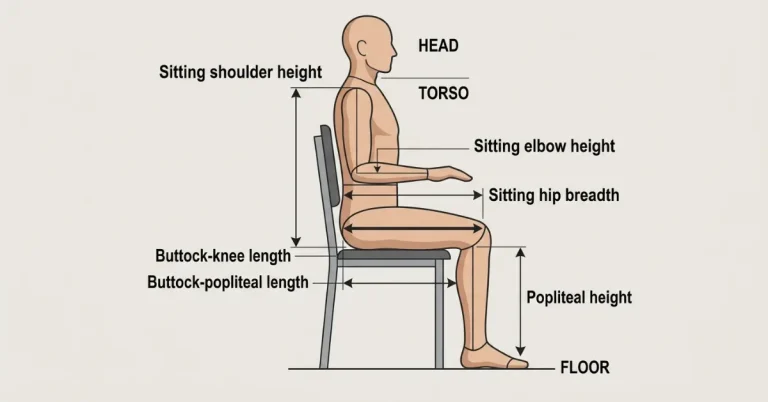
Comfort on a sofa is not a fixed property. It’s a time-based interaction between body proportions, cushion geometry, and posture drift. For a 5’2” person, the experience after two hours often differs significantly from the first five minutes, not because the sofa “becomes worse,” but because the body stops compensating.
Understanding this requires shifting from a static idea of comfort (this sofa is soft) to a dynamic model: how alignment, pressure, and support change over time.
1. The First 10 Minutes: “Fitting” Through Compensation
At the beginning, most sofas feel acceptable because the body actively adapts:
- The pelvis rotates slightly to find a stable position
- Feet may dangle or be tucked, depending on seat height
- The spine self-corrects using core muscles
- Cushion softness temporarily masks mismatches in depth or height
For a 5’2” person, the most common early compensation is shorter femur length vs. standard seat depth. Many sofas are designed for average adult proportions. So the sitter often leans back before their knees are fully supported or perches forward to avoid “swallowing” into the seat.
2. 30–60 Minutes: Micro-Adjustments Begin
As muscle engagement decreases, small discomfort signals start to appear:
- Feet no longer provide stable grounding if they don’t fully reach the floor
- Lower back begins to lose lumbar contact, especially on deeper sofas
- The body shifts frequently to restore circulation
- Thigh pressure becomes noticeable if seat depth is too long
This is where seat depth mismatch becomes critical. A deep sofa forces a shorter person into one of two suboptimal positions:
- Slouching (pelvis tucked under, spine rounded)
- Perching forward (loss of back support)
Both reduce long-term comfort efficiency.
3. Around 2 Hours: Support Failure Becomes Noticeable
After sustained sitting, comfort is no longer about softness. It becomes about load distribution stability.
Common sensations include:
Pressure concentration
- Increased load under thighs due to cushion compression
- Isolated pressure points at the tailbone or mid-thigh
- Reduced circulation in legs if feet are unsupported
Postural collapse
- Pelvic tilt becomes fixed rather than adjustable
- Lower back loses structured support, especially if lumbar depth is too shallow or too deep
- Shoulders round forward as compensation for hip instability
“Settled-in discomfort”
This is the key phase: the sofa feels less like it is supporting the body and more like the body is “holding itself up inside the sofa.”
4. Why 5’2” Changes the Equation
Height alone is not the issue. It’s proportional geometry:
- Shorter femur length → seat depth often too large
- Lower popliteal height (knee-to-floor distance) → feet may not anchor
- Pelvic-to-backrest mismatch → lumbar support hits too high or too low
A sofa designed for average proportions assumes:
- Feet planted on floor
- 90–100° knee angle
- Back fully contacting lumbar zone
At 5’2”, even small deviations (2–4 inches of seat depth or height mismatch) amplify over time because the body must continuously self-correct.
5. Sofa Types and Time-Based Comfort Differences
Not all sofas degrade comfort in the same way over time:
Deep, soft sofas
- Comfortable initially
- Accelerate slouching after ~45–90 minutes
- Increase pelvic rotation and lumbar loss
Firm, shallow-seat sofas
- Less “sink-in” comfort at first
- More stable posture over long sitting periods
- Better pressure distribution for shorter users
Memory foam-heavy cushions
- Slow response creates “locked-in” posture
- Can trap the body in suboptimal alignment over time
Structured cushion + firm frame sofas
- Encourage frequent micro-adjustments
- Maintain more consistent spinal alignment over long durations
6. A Practical 2-Hour Evaluation Method (Real-World Test)
To approximate real comfort (not showroom comfort), simulate the time factor:
- Sit normally for 10 minutes (no adjustment)
- Observe where your body naturally shifts after 20–30 minutes
- Note whether feet remain supported without strain
- After 60 minutes, check:
- Are you still sitting the same way?
- Is your lower back still contacting support?
- At 90–120 minutes:
- Identify first point of discomfort (not overall discomfort)
Key insight: the first failure point matters more than average comfort.
7. The Core Insight
A sofa is not experienced as a static object. It behaves more like a support system that either maintains or degrades alignment over time.
For a 5’2” person, the critical question is not:
Is this sofa comfortable?
But instead:
Does this sofa allow my body to stay passively supported without increasing effort over time?
At two hours, the difference becomes clear: either the sofa continues doing the work or the body starts doing it instead.
What People Are Really Trying to Understand (Before Sofa Details)
what does a sofa feel like for a 5’2” person after 2 hours of sitting”?
It looks like a furniture comparison question. But the actual information need is not about sofas in isolation. It is about how bodily comfort changes when time is added as a variable.
The real intent is predictive: what will my experience become after I stop actively adjusting and start passively staying in one position?
1. This isn’t about sofas it’s about sustained comfort under constraint
A sofa is only the environment. The real subject is sustained seated load on a specific body shape without active movement.
Once sitting extends beyond the initial adjustment phase, three systems start to matter more than surface comfort:
- Postural stability (does the spine maintain alignment without effort?)
- Pressure distribution over time (do contact points remain tolerable as cushions compress?)
- Passive support continuity (does the body need to “re-engage” muscles to stay comfortable?)
For a 5’2” person, these dynamics are amplified by proportion mismatches common in standard furniture design. Especially seat depth and backrest positioning. The key issue is not whether the sofa can be sat on comfortably, but whether it allows the body to remain supported without increasing muscular compensation over time.
2. Why early comfort is a misleading signal
Most people evaluate comfort within the first few minutes of sitting. This window is dominated by immediate sensory feedback:
- Cushion softness and surface feel
- Initial sense of relaxation or relief
- First-pass posture adjustment (leaning back, sinking in, perching forward)
However, this early phase is not predictive of long-duration comfort because it ignores material and biomechanical drift:
- Foam compression reduces support height over time
- Pelvis gradually rotates as micro-adjustments decrease
- Lumbar contact can weaken as seating position settles
- Thigh and lower-back pressure redistributes unevenly under static load
As a result, what feels “good at first” may not remain structurally supportive after 60–120 minutes of inactivity.
This is the core gap in many comfort judgments: short-term sensory comfort is not equivalent to sustained mechanical support.
3. The hidden question: stability after adjustment stops
Underneath the surface query is a more precise uncertainty:
Will my body stay supported without needing constant correction?
That question becomes especially relevant for shorter users because standard furniture design assumes average anthropometrics, including:
- Feet fully grounded on the floor
- Knee angle near 90 degrees
- Backrest alignment matching lumbar curvature
When those assumptions don’t fully hold, the body compensates through small, repeated adjustments, shifting hips, repositioning feet or altering spine curvature. Individually these changes are minor, but over time they accumulate into fatigue and perceived discomfort.
So the real variable being tested is not “comfort at rest,” but comfort stability over time without active control.
How Sofa Comfort Actually Changes Over Time
Comfort is often described as a fixed property either a sofa is comfortable or it isn’t. But that framing breaks down under real conditions of use. Sitting is not static; it is a time-based interaction between body weight, posture, and material response.
A sofa does not deliver a single “comfort state.” It produces a progression of comfort behavior over time, shaped by how cushions compress, how posture stabilizes, and how the body reduces active adjustment.
For a 5’2” person, this progression can become more noticeable because small proportional mismatches (seat depth, foot reach, back support height) don’t always show up immediately. They emerge through sustained sitting rather than initial contact.
1. 0–10 minutes: Initial contact and surface comfort
In the first minutes, comfort is dominated by surface-level sensory feedback.
- Cushions feel soft or firm based on immediate compression
- Seat depth feels acceptable before full weight distribution occurs
- Posture is still exploratory, with frequent small shifts
- The body is actively “testing” positions without committing to one
This phase is often mistaken for true comfort, but it only reflects early contact behavior, not sustained support.
Crucially, nothing in the system has stabilized yet:
- Foam has not fully compressed under load
- Pressure distribution is not yet settled
- Postural muscles are still actively correcting position
This is why early impressions are highly unstable as predictors of long-term comfort.
2. 10–60 minutes: Stabilization and compensation
As time increases, the system transitions from exploration to settled posture.
- Cushion materials compress and reach a more stable load state
- The body reduces movement and adopts a primary sitting position
- Weight distribution becomes more fixed across hips, thighs, and lower back
At this stage, comfort depends less on softness and more on alignment efficiency. How well the sofa supports the body without requiring correction.
For a 5’2” person, this is where geometry becomes more visible:
- If seat depth is too long, the pelvis may rotate backward or forward to compensate
- If feet do not fully ground, lower-leg support becomes passive rather than stable
- If lumbar contact is misaligned, the spine begins to self-support rather than rest
These adjustments are usually subtle and unconscious. They appear as:
- slight repositioning of hips
- occasional leaning or shifting
- redistribution of weight between backrest and seat
The key indicator of comfort in this phase is not sensation, but stability with minimal adjustment frequency.
3. 60–120 minutes: Load accumulation and fatigue emergence
After extended sitting, small inefficiencies begin to compound.
Cushion compression is now sustained rather than initial, meaning:
- pressure is redistributed into fewer contact points
- support surfaces may feel flatter or less structured
- “soft comfort” can turn into concentrated load zones
At the same time, the body’s passive support system begins to degrade:
- lower back muscles take on more stabilizing work
- legs shift intermittently to restore circulation
- posture becomes less naturally self-correcting
This phase is not defined by sudden discomfort, but by a shift in control:
comfort becomes something the body has to actively maintain, rather than something the sofa passively provides.
For shorter users, this can occur more noticeably when:
- seat depth forces posterior pelvic tilt
- feet lack consistent grounding
- backrest support sits outside the natural lumbar zone
The result is not necessarily pain. It is increased effort required to remain comfortable.
The full picture: comfort as a time-based system
Across all phases, comfort is not a single state but a transition:
- Initial phase: perception-driven comfort (surface response)
- Stabilization phase: geometry-driven comfort (alignment efficiency)
- Extended phase: endurance-driven comfort (fatigue resistance)
What changes is not only how the sofa feels, but what the body is doing to remain comfortable.
This is why short observations often fail to predict long-term experience: they capture only the earliest segment of a process that is fundamentally dynamic.
Why Height (5’2”) Changes the Experience More Than People Expect
Height is often treated as a simple descriptive detail in furniture discussions, but in practice it functions as a proportional variable that reshapes how seating support behaves over time.
The key misunderstanding is assuming that “comfort” scales uniformly with body size. It doesn’t. Most sofas are built around average anthropometric assumptions, meaning they encode expectations about leg length, seat depth tolerance, and foot-to-floor contact.
When a person is shorter than those assumptions, the experience typically does not become obviously wrong. It becomes less stable under sustained sitting conditions. That instability appears gradually, not immediately, and is most visible in how often the body needs to adjust.
1. Seat depth is not a comfort feature it is a leg support geometry problem
Seat depth is usually described as a single measurement, but functionally it determines how the lower body is supported in a static posture over time.
For a 5’2” person, deeper seat designs can create a subtle mismatch between:
- the natural resting length of the thighs
- the position of the backrest contact point
- the point where the knees can comfortably bend without compression
Instead of producing a clearly “wrong” sitting position, this mismatch produces a hybrid posture:
- part supported by the backrest
- part stabilized by active muscle engagement
- part floating due to incomplete leg contact
At first, this is not noticeable. The body adapts by finding a workable position. But over time, that adaptation becomes effort.
The important shift is this:
The sofa is no longer fully supporting the posture. The body is partially completing the support system.
2. Foot contact is a low-visibility stability anchor
Foot contact is often underestimated because it does not feel like a primary comfort factor. However, it plays a structural role in postural load distribution.
When feet are fully grounded:
- weight can be distributed across a stable vertical chain (feet → hips → backrest)
- the pelvis remains easier to stabilize without muscular effort
- micro-adjustments are reduced because balance has a fixed reference point
When foot contact is partial or absent:
- the lower body loses a stabilizing base
- the pelvis becomes more dependent on seat geometry for balance
- load shifts upward into hips and lower back
For shorter users, the effect is usually not dramatic in isolation. Instead, it appears as increased repositioning frequency over time, especially during longer sitting sessions.
This is why comfort can remain acceptable initially, but gradually require more active maintenance.
3. Why shorter users appear to “move more” on sofas
Frequent repositioning is often interpreted as discomfort or restlessness, but in ergonomic terms it is more accurately described as a search for equilibrium under imperfect support conditions.
When seating geometry does not naturally align with body proportions. The body does not remain static. It continuously tests alternative configurations:
- shifting pelvis position to regain back contact
- adjusting leg angle to reduce pressure concentration
- leaning or rotating slightly to redistribute load
- alternating between slouched and upright micro-postures
These are not preference-driven behaviors. They are corrective responses to uneven support distribution over time.
The key distinction is between:
- initial fit (does it feel acceptable at first?)
- sustained stability (does it remain efficient without correction?)
Shorter users are not inherently less comfortable. They are often operating in a system where small geometric mismatches accumulate into higher adjustment demand over time.
4. The underlying principle: comfort is the absence of required negotiation
Across all of these factors, the most important pattern is not about specific sofa features. It is about system behavior over time.
A well-matched seating system is not one that feels best at the start. It is one that requires the least continuous adjustment to remain usable.
For a 5’2” person, the critical question becomes:
Does the seating setup allow the body to remain passive, or does it require ongoing micro-corrections to maintain balance?
That difference determines whether comfort remains stable or slowly turns into managed effort.
The Real Comfort Drivers (Not Just “Soft vs Firm”)
Reducing sofa comfort to a simple “soft vs firm” comparison works only in the first few seconds of contact. It fails once time becomes part of the equation.
That’s because sofa comfort over a longer sitting period is not a static property. It is a behavioral system involving materials, posture, and time-dependent load changes. What matters is not how a sofa feels at the moment of sitting, but how it continues to support the body after 30, 60, or 120 minutes.
In practice, comfort is shaped by a small set of interacting drivers that determine whether support remains stable or gradually degrades.
1. Cushion behavior over time: compression is a structural change, not a sensation
Cushions are often treated as passive surfaces, but under sustained load they behave dynamically.
When a person sits:
- foam cells compress and redistribute internal air and pressure
- the seating surface gradually conforms to body shape
- initial firmness decreases as the load stabilizes
At first, this creates a feeling of comfort because the body “settles in.” However, over time, that same settling can reduce structural support consistency.
The critical distinction is between:
- initial conformity (feels supportive quickly)
- sustained support geometry (holds posture over time)
If the cushion continues to compress without maintaining shape integrity, the body sinks into a position that may no longer align with the backrest or leg support zones.
For shorter users, this effect becomes more noticeable because even small changes in seat depth or hip position can alter overall posture alignment more quickly.
2. Backrest alignment: support is only useful if it stays aligned
Backrests are typically evaluated based on immediate comfort whether they “feel good” when first leaned against. But long-term comfort depends on whether the backrest maintains consistent spinal alignment under changing seat conditions.
As cushions compress and posture settles:
- the pelvis position can shift slightly backward or forward
- the angle of spinal contact changes
- the lumbar support zone may drift above or below the natural curve
At first, the body compensates without awareness:
- subtle leaning adjustments
- redistribution of upper-body weight
- small changes in torso angle
Over time, these compensations increase because the support system is no longer self-correcting. The backrest still exists, but it no longer aligns cleanly with the body’s resting geometry.
This is where comfort changes state: from passive support to active postural maintenance.
3. Hip angle: the hidden variable behind fatigue accumulation
Hip angle is one of the least visible but most influential factors in seated comfort because it determines how load is distributed across the entire lower body chain.
When hip angle is naturally supported:
- weight distributes evenly across thighs and lower back
- the pelvis remains relatively stable
- muscle activity stays low
When hip angle is slightly misaligned:
- load shifts toward either the lower back or thighs
- small postural corrections become necessary
- static sitting becomes progressively more tiring
These changes are not immediately perceptible as “discomfort.” Instead, they appear as:
- increased shifting frequency
- subtle leaning or repositioning
- gradual onset of fatigue without a clear cause
For a 5’2” person, hip angle sensitivity increases when seat depth and cushion compression interact. A deeper seat or changing sink depth can quietly rotate pelvic position over time, altering the entire posture chain without obvious visual change.
4. The combined system: comfort is stability under change
When viewed together, these drivers form a single pattern:
- cushions determine how the surface changes under load
- backrest alignment determines whether posture remains structurally supported
- hip angle determines whether load distribution stays efficient or becomes fatiguing
None of these factors matter only at the moment of sitting. They matter because they change behavior over time.
This leads to a more accurate definition of comfort:
Comfort is not how a sofa feels initially, but how little it requires the body to actively maintain position as time passes.
Once time is included, simple categories like “soft” and “firm” are no longer sufficient. They describe material feel, but not long-duration support performance, which is what actually determines the experience.
What 2 Hours of Sitting Actually Reveals
Two hours of sitting doesn’t introduce a sudden change in comfort. What it does is remove the influence of initial conditions fresh posture, recent movement and early sensory novelty. After enough time, the experience stabilizes into something more accurate: a real-world interaction between body mechanics, material behavior, and time under load.
At this stage, comfort is no longer judged by how a sofa feels initially, but by how consistently it supports the body when both have fully settled into their default states.
1. Micro-adjustments: the earliest measurable signal of instability
One of the most reliable indicators of long-duration seating behavior is the emergence of micro-adjustment patterns.
These include:
- small hip repositioning
- subtle leg shifts or crossings
- slight leaning left or right
- periodic re-centering of the torso
Individually, these movements are insignificant. They rarely register as conscious discomfort. However, collectively they indicate that the body is repeatedly correcting for minor imbalances in support.
From a biomechanical perspective, micro-adjustments serve one purpose: restoring temporary stability without interrupting activity.
The key insight is not the movement itself, but its frequency. An increase in correction frequency suggests that the seating system is no longer maintaining equilibrium passively, and the body is compensating more often to preserve a neutral position.
2. When comfort transitions from sensation to maintenance
In early sitting, comfort is primarily sensory:
- softness is perceived
- posture feels “fine”
- support is evaluated passively
This is a low-effort phase where the nervous system is responding to immediate contact rather than long-term load distribution.
After extended sitting, that changes.
Comfort becomes less about sensation and more about postural upkeep. Instead of noticing how the sofa feels, you begin to notice the effort required to remain still and comfortable in it.
This transition is subtle because nothing external changes in a single moment. Instead, the internal demand shifts:
from passive experience → to ongoing maintenance of position
That shift is often what people later describe as “it was comfortable at first, but not for long,” even though no discrete failure point occurred.
3. Postural adaptation and the onset of fatigue
The human body is designed to adapt continuously to maintain comfort, especially in static positions. These adaptations are usually efficient at first:
- minor pelvic tilts to maintain balance
- small spinal adjustments to preserve alignment
- intermittent leg repositioning to regulate pressure
For a period, these changes are automatic and low-cost in terms of effort.
However, over time, two things begin to change:
- Adaptation frequency increases
The body needs to adjust more often to maintain the same level of comfort. - Recovery between adjustments decreases
Each correction provides less lasting stability than before.
This is where fatigue begins to emerge not as a sharp discomfort signal, but as a gradual increase in the effort required to remain neutral.
Fatigue in this context is not pain. It is the accumulation of repeated micro-corrections that no longer feel fully effortless.
4. The system-level interpretation: sitting as continuous correction
At the two-hour mark, the experience is best understood not as “being seated,” but as a continuous correction loop between three systems:
- the body adjusting posture
- the cushion responding to sustained load
- the seating geometry defining available support options
When these systems remain aligned, sitting feels passive and low-effort. When they drift out of alignment over time, the body compensates more frequently, and comfort becomes increasingly active rather than automatic.
This is why long-duration sitting reveals something that short observation cannot:
comfort is not a static property. It is the rate at which stability can be maintained without increasing correction effort.
Why Showroom Testing Often Misleads People

Showroom testing feels decisive because it compresses the entire evaluation into a short window. You sit down, notice how the sofa feels, and form an impression almost immediately. The problem is that this impression is based on conditions that no longer exist after you’ve been sitting for a while.
Short tests capture the start of the comfort curve, not the behavior of the system over time. And in seating, the start is often the least representative phase.
1. Why 2–5 minutes only captures “initial comfort”
In the first few minutes, your body is still in an active adjustment state.
- posture is not fully settled
- cushion materials have not fully compressed
- weight distribution is still shifting
- muscle engagement is still helping stabilize position
During this period, comfort is heavily influenced by surface-level signals:
softness, firmness, texture, and immediate support feel.
This creates what can be called perception-based comfort—a snapshot shaped by novelty and short-term adaptation rather than sustained load behavior.
The key limitation is simple:
nothing has been held long enough to reveal how support changes once the system stabilizes.
As a result, a sofa that feels excellent at 3 minutes may behave differently once compression and posture settling reach equilibrium.
2. The missing variable: time under compression
What showroom testing cannot replicate is sustained mechanical loading.
Once you extend sitting time, several things begin to happen:
- foam compresses and reaches a more stable deformation state
- pressure redistributes across new contact zones
- initial “bounce” or resistance changes into a fixed support profile
- posture stops actively exploring and becomes static
This matters because comfort is not determined at peak softness or peak firmness. It is determined at steady-state behavior.
Most quick tests never reach this steady state. They only show how the sofa behaves during the transition into it.
In practical terms, you are not evaluating the sofa’s real comfort. You are evaluating its initial response curve not its long-duration equilibrium.
3. Why your body behaves differently after settling in
Your body does not remain in the same mode throughout sitting. It transitions through distinct phases.
In the beginning:
- you are actively adjusting posture
- muscles help stabilize alignment
- movement is frequent but low-cost
After settling:
- posture becomes more fixed
- muscle activity decreases
- the body relies more on external support
This shift changes everything.
Once you are fully settled, small imperfections in support geometry become more important because:
- there is less active correction from the body
- pressure distribution becomes more constant
- misalignments are no longer “tested,” they are “held”
For shorter users, this can make differences in seat depth or backrest alignment more noticeable after settling, even if they were not obvious during the first few minutes.
The key point is:
showroom behavior reflects an active body. real-world comfort depends on a settled body.
And those two states do not experience the same sofa in the same way.
What Actually Tends to Work Better for Shorter Users (Without Over-Generalizing)
The more accurate framing is not what is best, but what reduces the likelihood of comfort degradation over time under sustained sitting.
That shift matters because comfort is not a fixed attribute of a sofa. It is an outcome that emerges from how a particular body interacts with a particular seating system over duration.
Instead of absolutes, what you actually see are reliable patterns of reduced friction.
1. Sofas that reduce unsupported leg extension
One of the most consistent long-duration discomfort triggers is incomplete lower-body support.
When the legs are not fully and naturally supported:
- the pelvis becomes less stable
- the lower back compensates for balance
- weight distribution shifts upward into smaller contact areas
Importantly, this does not always feel problematic at first. Early sitting often feels fine because the body is still actively adjusting and “forgiving” minor mismatches.
The issue appears later, when the posture settles:
unsupported leg extension becomes a structural imbalance that the body has to continuously correct.
For shorter users, the key variable is not a specific sofa category, but whether the seating allows the lower body to remain relaxed without requiring ongoing repositioning to feel grounded.
In practical terms, better outcomes tend to come from seating that avoids forcing the legs into a partially floating or over-extended resting state during long sits.
2. Designs that maintain posture stability over time
Long-duration comfort is less about how a sofa feels at the start and more about whether it maintains a stable support geometry as conditions change under load.
Stability does not mean stiffness. It means:
- the body can settle into a position
- that position remains viable as materials compress
- and no repeated corrections are needed to preserve alignment
When stability is high, sitting feels “neutral” for longer periods. When stability is low, the body begins to manage the seating experience through small adjustments.
For shorter users, instability is often introduced subtly:
- minor seat depth mismatch
- gradual cushion compression
- slight backrest misalignment relative to resting posture
Individually, these are small. Together, they increase the frequency of micro-corrections, which is what ultimately defines long-duration comfort loss.
So the useful distinction is not “soft vs supportive,” but:
does the seating maintain a consistent support relationship after it has fully compressed and settled?
3. Why “best sofa” depends on duration, not appearance
Most sofa evaluations are made in a compressed time window—visual impression, short sit test, or initial comfort feel. These inputs are real, but incomplete.
They capture first-state performance, not steady-state performance.
Once duration becomes part of the evaluation, the definition of “best” changes:
- A sofa that feels immediately comfortable may degrade as support geometry shifts under load
- A sofa that feels less impressive initially may remain more stable after prolonged sitting
- Two people can legitimately disagree because they are effectively evaluating different time slices of the same system
This is why “best” cannot be treated as a fixed property. It depends on:
- how long the sofa is used per session
- how static the sitting posture is
- how sensitive the user is to gradual support drift
In other words:
the quality of a sofa is not only what it is made of, but how consistently it supports a body that is no longer actively adjusting.
And once time is included, appearance and first impressions become secondary signals not primary indicators of long-term comfort performance.
The Most Common Misread of Sofa Comfort
Sofa comfort is often discussed as if it were a simple, immediately readable property: soft versus firm, comfortable versus uncomfortable, good versus bad. That framing feels intuitive because it matches how first impressions work.
But the most common error in judging comfort is not misunderstanding sensation. It’s evaluating a time-dependent experience at the wrong moment in its lifecycle.
Comfort is not misread because it is subjective. It is misread because it is usually observed before it has stabilized.
1. Mistaking first impression for long-term comfort
The first few minutes of sitting create a strong but incomplete dataset.
During this phase:
- cushions are at their least compressed state
- posture is still actively adjusting
- the body is exploring stable positions
- support structures have not reached equilibrium under load
This produces what feels like a reliable judgment point, but it is actually a transient interaction phase, not a steady state.
The key limitation is that early comfort reflects entry behavior, not sustained performance. It captures how a sofa receives the body, not how it supports it over time.
As sitting continues, that initial signal may weaken or change entirely. A sofa that feels immediately supportive can lose alignment consistency, while one that feels neutral may prove more stable once compression and posture settling are complete.
The difference only becomes visible when the system is allowed to reach equilibrium.
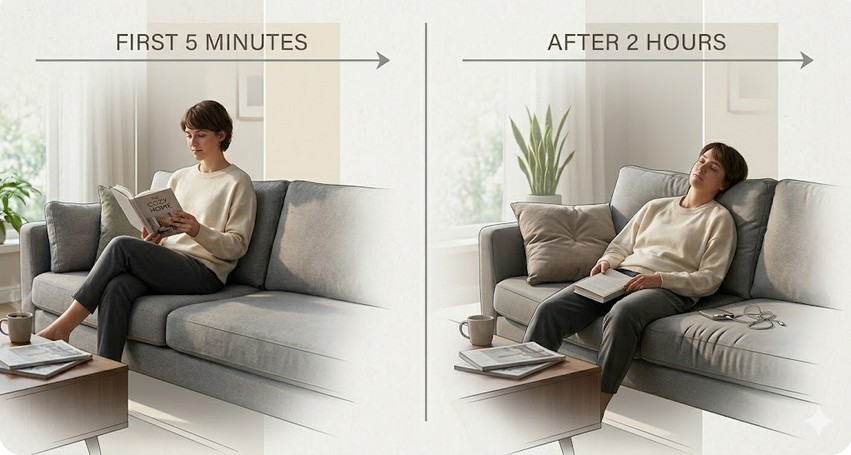
2. Overvaluing softness as a proxy for comfort
Softness is one of the most immediate and cognitively accessible signals in seating evaluation. It provides instant feedback, which makes it easy to overinterpret as a full representation of comfort.
However, softness is only a surface-level response characteristic, not a measure of sustained support behavior.
As time increases:
- foam compression changes the effective support profile
- deeper sink-in can reduce postural structure
- weight distribution becomes less even across contact zones
This means softness can diverge from long-duration comfort in both directions:
- very soft seating may lose structural support under sustained load
- moderately firm seating may maintain more consistent posture geometry
The key distinction is:
softness describes initial resistance; comfort depends on how that resistance behaves after it has been continuously loaded.
Over longer sessions, the relevant question is not “how soft does it feel?” but “does it maintain a stable support shape after compression?”
3. Ignoring how posture changes over time
Sitting is not a fixed posture. It is a continuously regulated stability process.
Even when the body appears still:
- micro-adjustments redistribute pressure
- pelvic angle shifts slightly to maintain balance
- leg position changes to regulate comfort and circulation
- spinal alignment subtly adapts to changing support conditions
These adjustments are normally low-effort and barely noticeable in short durations. However, over time, they form a pattern that reflects how much active correction the body is required to perform.
When this dynamic is ignored, comfort is treated as a static property rather than a maintenance condition.
For shorter users, posture drift can become more apparent when seating geometry does not naturally maintain alignment. Small mismatches in seat depth or back support positioning may not matter initially, but they can increase the frequency of corrective movement during longer sitting periods.
The result is not immediate discomfort, but a gradual shift from passive sitting to active posture management.
The core misread
Across all three patterns, the underlying issue is consistent:
- evaluation happens too early
- attention focuses on surface-level signals
- time-dependent behavior is not included in judgment
This produces a mismatch between perceived comfort and sustained comfort behavior.
Once time is introduced as a variable, comfort stops behaving like a fixed impression and starts behaving like a system that evolves under load.
And in that system, early signals are not wrong they are simply incomplete snapshots of a process that has not yet stabilized.
Final Thoughts
Sofa comfort is often treated as a fixed property: something a product either “has” or “doesn’t have,” something that can be reliably judged within the first moments of sitting. That framing is efficient, but it misrepresents how comfort actually behaves under real use.
Comfort is not a static condition. It is a time-dependent process.
It begins at the moment of contact softness, firmness, initial support but it does not stay in that state. It evolves as the system settles: cushions compress under sustained load, posture stabilizes, and the body reduces active adjustment. What feels neutral at the start may drift in one direction, while what feels slightly imperfect may stabilize more effectively over time.
Nothing needs to “change” about the sofa for this to happen. The change is in the interaction between body, material, and time.