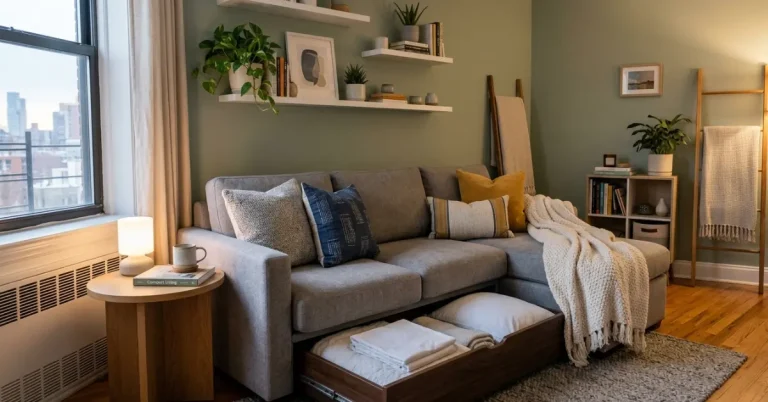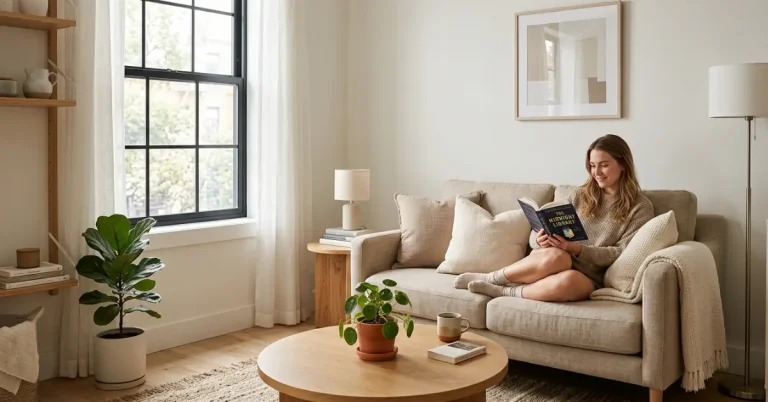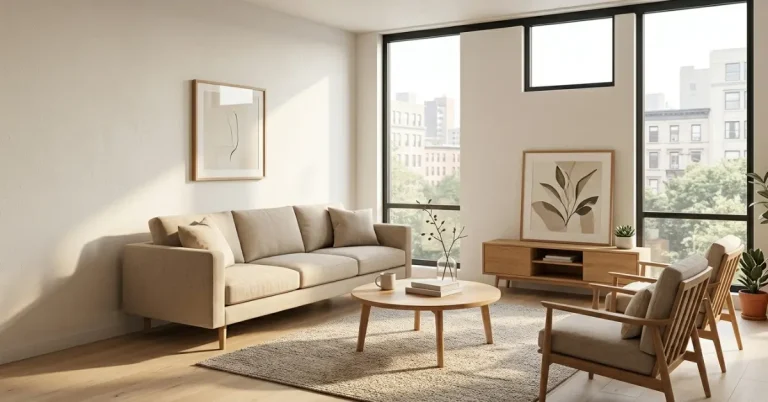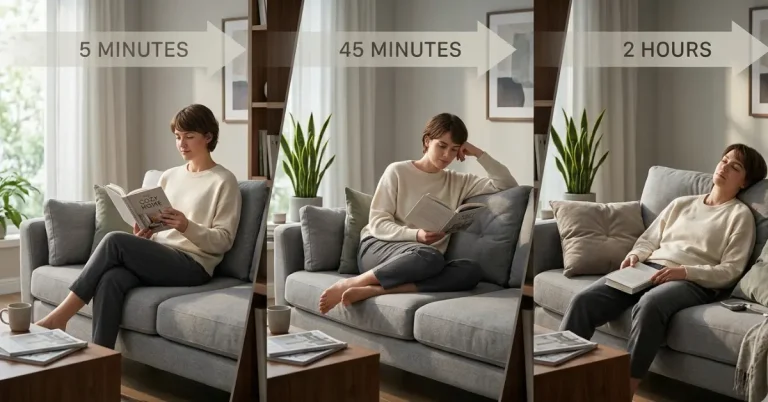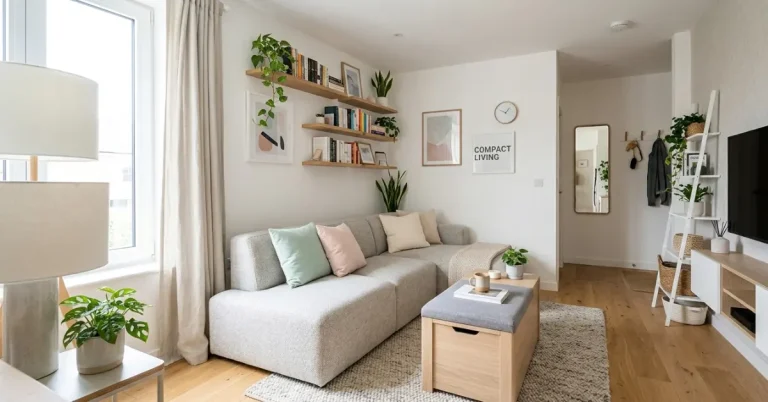
Yes, but only if the sectional actually fits your body. Most standard sectionals are built for average to taller users, which means they often feel too deep, too tall, or too soft for shorter people. The result is slouching, dangling feet, and constant readjusting. That is not comfort.
Best case scenario, you choose a compact sectional with a shallow seat and firm cushions. Your feet stay flat, your back stays supported, and you can sit for hours without shifting around. It feels natural.
Worst case scenario, you buy a deep, oversized sectional because it looks good in the showroom. At home, your lower back hurts, your legs never fully rest, and getting up feels like a workout. It turns into something you avoid sitting on.
The difference comes down to fit, not style. If the dimensions match your height, a sectional can be one of the most comfortable seating options you own. If they don’t, it quickly becomes a daily frustration.
The 3 Key Fit Rules for Short People (Quick Checklist)
Most sectionals fail short people for one simple reason. Poor fit. Not style. Not price. Fit.
If a sectional does not meet these three rules, it will not feel comfortable long term. Test these every time you sit down.
Feet Flat on the Floor
This is non-negotiable. If your feet hang or barely touch, the seat is too deep or too high.
When your feet are flat:
- Your weight distributes evenly
- Your legs relax naturally
- You stop sliding forward every few minutes
Real-life check. Sit all the way back. If you need to scoot forward to plant your feet, the sectional is too big for you.
This is where most deep sectionals fail. They look inviting, but they push shorter users into awkward positions.
Knees at a 90-Degree Angle
Your knees should bend naturally. Not stretched out. Not pulled up.
When the angle is right:
- Pressure stays off your lower back
- Blood flow stays normal in your legs
- Sitting feels stable, not strained
If your legs stick straight out, the seat depth is too long.
If your knees sit too high, the seat height is too low or too soft.
Quick test. Sit back and look at your knees. If they do not form a relaxed right angle, something is off.
Back Fully Supported
A sectional should support your entire back without effort. No leaning. No stacking pillows just to sit upright.
Proper back support means:
- Your lower back touches the cushion
- Your shoulders rest comfortably
- You are not slouching after five minutes
This is where soft, deep sectionals trick buyers. They feel cozy at first. Then your posture collapses.
Real-life scenario. You sit down to watch TV. Ten minutes later, you are adjusting pillows or leaning forward. That is a bad fit.
Quick Reality Check Before You Buy
If a sectional fails even one of these rules, expect daily discomfort.
Good fit feels boring in the showroom.
Bad fit feels amazing for five minutes.
Choose based on how you sit after 30 minutes, not how it feels in the first 30 seconds.
Exact Measurements That Matter (With Ideal Ranges)
Most sectional buying mistakes start with guessing. People focus on style first and measurements later. That is backwards. Comfort for short people is almost entirely determined by a few key dimensions.
If you understand these numbers, you can predict comfort before you even sit down.
Ergonomic standards from Ergonomic seating guidelines (NIOSH) show a consistent pattern. Proper seating is not about softness or design. It is about alignment between seat height, depth, and body proportions.
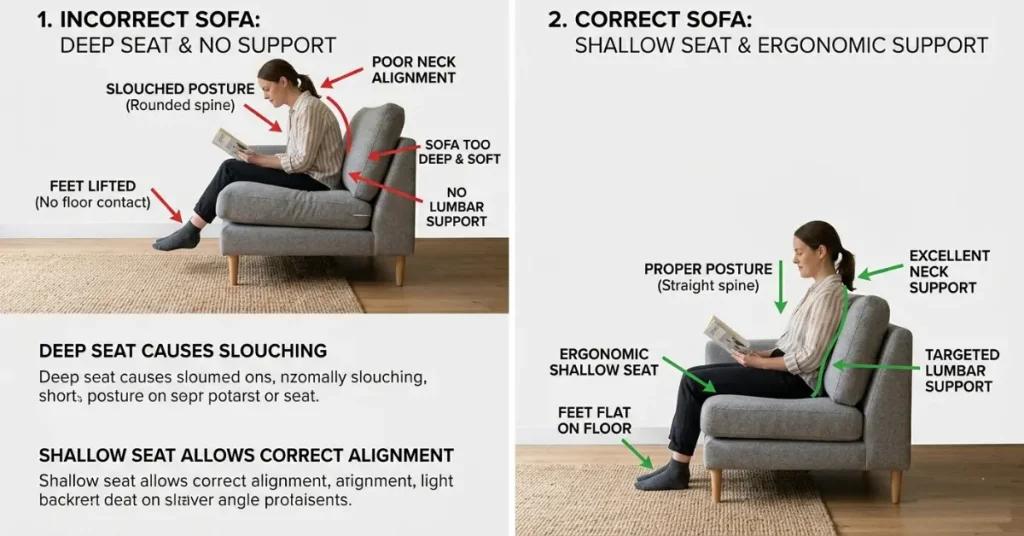
1. Seat Depth (Most Important Factor)
This is the biggest deal breaker.
Seat depth is the distance from the back cushion to the front edge. Too deep, and your feet lift off the floor. Too shallow, and it feels cramped.
Ideal range for short people:
- 19 to 21 inches
What happens outside this range:
- 22 inches or more feels too deep for most shorter users
- You end up slouching or perching on the edge
Real-life scenario. You sit back to relax, but your legs stretch out instead of bending. After ten minutes, your lower back starts to complain.
If you only check one measurement, check this one.
2. Seat Height
This controls whether your feet stay grounded.
Seat height is measured from the floor to the top of the cushion.
Ideal range for short people:
- 16 to 18 inches
What happens when it is wrong:
- Too high and your feet dangle
- Too low and your knees rise uncomfortably
Quick test. Sit down and notice your feet. If they do not rest flat without effort, the height is off.
Many modern sectionals sit lower for a lounge look. That style does not always work in real life.
3. Cushion Firmness
This one gets overlooked, but it changes everything.
Soft cushions feel great for a minute. Then you sink. That increases seat depth and ruins your posture.
What to look for:
- Medium to firm support
- Cushions that hold shape when you sit
Why it matters:
- Keeps your hips level
- Prevents that “stuck” feeling when standing up
- Maintains proper back alignment
Real-life scenario. You sit down and slowly slide backward without noticing. That is a softness problem, not just a size issue.
4. Backrest Angle
Most people never check this. They should.
The angle of the backrest affects how upright or relaxed you sit.
Ideal setup for short people:
- Slightly upright, not overly reclined
- Enough support to keep your spine neutral
What goes wrong:
- Deep reclined backs push you into a slouch
- You lose lower back support quickly
Quick check. Sit back and relax. If your shoulders roll forward or your lower back lifts away from the cushion, the angle is too laid back.
These four measurements decide everything:
- Seat depth controls leg comfort
- Seat height controls stability
- Cushion firmness controls posture
- Backrest angle controls long-term support
Get these right, and most sectionals will feel good.
Get them wrong, and even an expensive sofa will feel like a bad purchase.
The “Sit Test” Method (How to Instantly Know if It Fits)
Most sectionals feel good for the first 30 seconds. That is not useful. What matters is how your body reacts after a few minutes of real sitting, not showroom impressions.
This is where most buyers get misled. Soft cushions and staged pillows hide the real seating geometry.
Research from furniture ergonomics research (Harvard Health Publishing) highlights a simple truth. Comfortable seating is not judged instantly. It is judged by how long your posture can stay neutral without effort or adjustment.
That is exactly what the sit test checks.
Step 1: Sit All the Way Back
Do not perch on the edge. Sit fully back with your hips touching the back cushion.
Now check your feet.
- Are they flat on the floor without effort
- Are your legs relaxed, not stretched
If your feet lift or you feel pulled forward, the seat depth is too long.
Step 2: Check Your Knee Position
Look at your knees.
- They should form a natural right angle
- Your thighs should feel supported, not floating
If your legs stick straight out, the sectional is too deep.
If your knees sit too high, the seat may be too low or too soft.
This step reveals problems fast.
Step 3: Stay Still for 2 Minutes
Most people skip this. They should not.
Sit in a normal position like you would at home. No adjusting. No shifting.
Pay attention to what your body does.
- Do you start sliding forward
- Do you feel pressure in your lower back
- Do you reach for a pillow without thinking
If you cannot stay comfortable for two minutes, it will not work for two hours.
Step 4: Test Getting Up
This is where bad sectionals get exposed.
Lean forward and stand up naturally.
- Was it easy
- Did you have to push hard with your arms
- Did you feel stuck in the cushion
If standing up feels like effort, the seat is too low, too deep, or too soft.
Step 5: Try a Real-Life Position
Do not just sit upright. Use it like you would at home.
- Lean back like you are watching TV
- Sit slightly sideways
- Rest your arm on the armrest
Notice what happens.
If you lose back support or start slouching, the design is not working for your height.
Step 6: Ignore the Styling
Pillows, throws, and showroom setup can hide problems.
Remove a pillow if needed. Sit on the actual cushion.
You are buying structure, not decoration.
Final Reality Check
A good sectional feels normal right away. No adjusting. No fixing.
A bad one feels great for a few seconds, then your body starts compensating.
Trust what happens after a few minutes, not the first impression.
Best Sectional Designs for Short People (Ranked)
Not all sectionals are built the same. Some are clearly designed with taller users in mind. Others actually work for shorter frames.
Here are the designs that consistently perform better. Ranked by real comfort, not showroom appeal.
#1 Compact Sectionals
This is the safest choice for short people.
Compact sectionals are built with smaller proportions. That usually means:
- Shorter seat depth
- Lower seat height
- Tighter overall dimensions
Why they work:
- Your feet stay grounded
- Your back stays supported without effort
- You can sit fully back without sliding forward
Real-life scenario. You sit down after a long day and everything just lines up. No shifting. No pillows needed.
What to watch:
- Some brands label sofas “compact” but keep deep seats
- Always check actual measurements, not just the name
If you want fewer surprises, start here.
#2 Modular Designs
Modular sectionals give you control. That is a big advantage.
You can mix and match pieces to create a setup that fits your body, not just your room.
Why they work:
- You can choose shallower seats
- You can avoid oversized chaise sections
- You can adjust layout over time
Real-life scenario. One seat feels perfect, another feels too deep. With modular, you can swap or reconfigure instead of living with it.
What to watch:
- Not all modules have the same depth
- Some sets still lean toward lounge-style proportions
Modular is a smart choice if you are picky about fit. And you should be.
#3 Firm Cushion Sectionals
Firmness does more than people think.
A slightly firm sectional keeps you supported and prevents that sinking feeling that makes seats feel deeper than they are.
Why they work:
- Keeps your posture upright
- Makes it easier to stand up
- Maintains consistent seat height over time
Real-life scenario. You sit down and stay in place. You are not slowly sliding backward or adjusting every few minutes.
What to watch:
- Ultra-firm can feel stiff if the depth is already shallow
- Soft cushions may feel comfortable at first but fail after longer use
If you are short, avoid anything described as “sink-in” or “cloud-like.”
#4 Low-Depth Chaise Sectionals
Chaise sectionals can work, but only if the main seats are not too deep.
The chaise itself is not the problem. It actually helps because you can stretch your legs.
Why they work:
- Gives you a lounging option without forcing it
- Reduces pressure on your legs when extended
- Works well for relaxing or watching TV
Real-life scenario. You shift from upright sitting to stretching out without fighting the seat depth.
What to watch:
- Many chaise sectionals still have deep main seats
- If the standard seats do not fit, the chaise will not fix it
Think of the chaise as a bonus, not a solution.
The best sectional for a short person is not about style. It is about proportion.
- Compact designs reduce guesswork
- Modular setups give flexibility
- Firm cushions improve support
- Low-depth chaise adds comfort if the base fit is right
Get the foundation right first. Everything else is secondary.
Worst Sectional Types for Short People
Some sectionals look incredible in showrooms but fail completely in real homes, especially for shorter people. The problem is not just size. It is how the design forces your body into unnatural positions.
These are the types that usually cause regret after purchase.
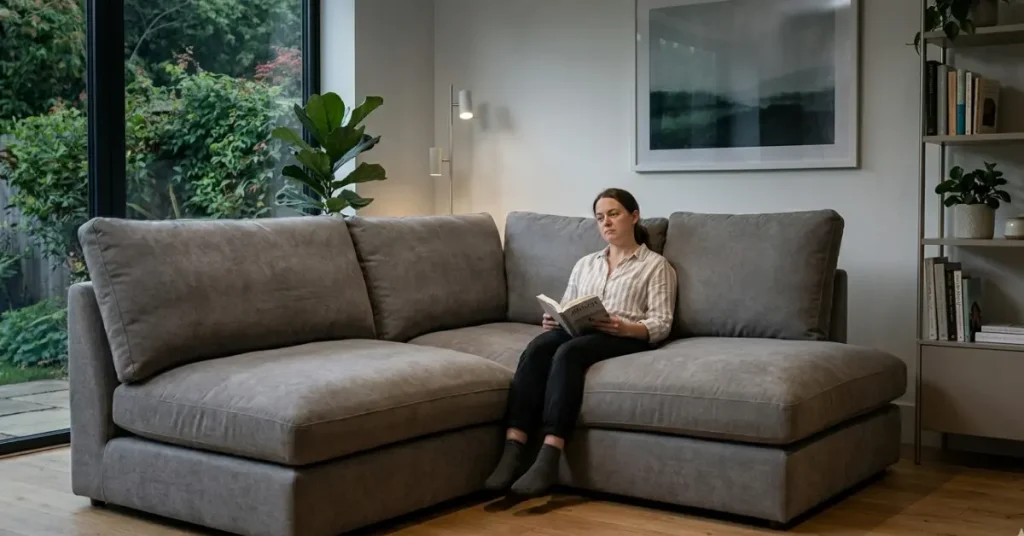
#1 Deep Lounge Sectionals
These are built for stretching out, not sitting properly.
The seat depth is often excessive, which pushes shorter users into a constant recline. Your feet barely stay grounded, and your lower back loses support fast.
Real-life scenario. You sit down thinking it feels luxurious. Ten minutes later, you are sliding forward just to sit upright.
Why they fail:
- Seat depth is too long for proper posture
- Encourages slouching instead of support
- Makes feet placement awkward or unstable
They work for lounging. Not for everyday sitting.
#2 Oversized Luxury Sectionals
These are the statement pieces. Big, bold, and visually impressive. But comfort for short people is rarely part of the design goal.
Everything is scaled up:
- Wider seats
- Taller backs
- Deeper cushions
Real-life scenario. You feel like the furniture is swallowing you. Instead of sitting comfortably, you are adjusting constantly just to find balance.
Why they fail:
- Built for visual impact, not ergonomic fit
- Hard to reach proper back support
- Armrests often sit too high or too far away
They look expensive. That is often their best feature.
#3 Ultra-Soft Sink-In Sofas
These feel amazing for about five minutes. Then your body disappears into them.
The cushions compress too much, which increases seat depth instantly. For short people, that means your knees rise, your feet lose contact, and your posture collapses.
Real-life scenario. You sit down expecting comfort. Instead, you sink so deep you struggle to get back up without pushing off the arms.
Why they fail:
- Cushion collapse changes seat geometry
- Hard to maintain upright posture
- Standing up requires extra effort
Soft is not the same as supportive. This category proves it.
These sectional types share the same issue. They prioritize style, scale, or softness over actual human fit.
For short people, that mismatch shows up quickly:
- Feet not grounded
- Poor lower back support
- Constant shifting while sitting
If a sectional feels like you are adjusting more than relaxing, it is not the right design.
Real-Life Use Cases
A sectional should not just look good in your living room. It should actually work in daily life. That is where most sizing problems show up for short people. Different activities expose different comfort issues.
#1 Watching TV
This is where seat depth becomes obvious fast.
You sit down expecting to relax. Instead, you notice your legs stretching forward or your back losing support within minutes.
What matters here:
- Feet should stay flat without effort
- Your back should rest naturally against the cushion
- You should not need extra pillows just to sit upright
Real-life scenario. You start a show and slowly shift forward every few minutes because the seat is too deep. That constant adjustment ruins the experience.
A properly fitted sectional disappears under you. You stop thinking about it entirely.
#2 Working on a Laptop
More people use sectionals as casual workspaces than they admit. That is where fit becomes critical.
If the sectional is too deep or too soft, your posture breaks quickly. You end up leaning forward, straining your shoulders, or propping yourself up with cushions.
What matters here:
- Stable seat height so your elbows sit naturally
- Firm enough cushion to avoid sinking
- Back support that keeps your spine aligned
Real-life scenario. You try to answer emails and end up repositioning every ten minutes because your body keeps sliding or collapsing into the seat.
Sectionals that are too lounge-focused fail badly here.
#3 Napping or Lounging
This is where most sectionals feel good at first. But comfort can be misleading.
Deep or overly soft sectionals seem perfect for naps, but they often create awkward sleeping positions for shorter people.
What matters here:
- Enough space to stretch without losing support
- Cushion that does not collapse under body weight
- A surface that does not force your knees upward
Real-life scenario. You lie down expecting a quick rest. Instead, you wake up with stiff legs or a sore back because your body sank into uneven angles.
Interestingly, compact or modular sectionals often outperform oversized ones here. Less drama, more actual comfort.
Different activities expose different flaws.
- TV watching exposes seat depth problems
- Laptop use exposes posture issues
- Napping exposes cushion and support failures
If a sectional only feels good in one position, it is not truly comfortable. Real comfort works across all three without constant adjustment.
Sectional vs Sofa vs Loveseat (Short Person Comparison)
Short people do not need more furniture options. They need the right proportions. The difference between a sectional, sofa, and loveseat is not just size. It is how your body fits into it every day.
Here is how they actually compare in real use, not showroom appeal.
#1 Comfort Score
Comfort is not about softness. It is about how naturally your body sits without effort.
- Loveseat: High comfort for short people when well-made. Easy to sit upright. Less wasted space.
- Standard Sofa: Medium comfort. Can work, but seat depth often runs long.
- Sectional: Variable. Either very comfortable or completely mismatched depending on size and depth.
Real-life truth. A smaller loveseat often feels better than a large sectional that does not fit your body.
#2 Space Efficiency
This is where differences become obvious in small or medium living rooms.
- Loveseat: Most efficient. Fits tight spaces without overwhelming the room
- Sofa: Balanced. Works in most layouts
- Sectional: Least efficient. Takes the most space and often dictates room layout
Short people often overlook this. A massive sectional can dominate a room and still feel uncomfortable to sit in.
If the furniture controls the room more than you do, it is probably too big.
#3 Ergonomic Fit
This is the most important category for comfort over time.
- Loveseat: Best natural fit for shorter frames. Shallow seats and better back alignment
- Sofa: Depends heavily on design. Some work well, many are too deep
- Sectional: Most inconsistent. Great if sized correctly, frustrating if oversized
Real-life scenario. You sit on a loveseat and feel immediately supported. No shifting. No adjusting. Just sitting.
Then you try a sectional and spend the first five minutes trying to “fix” your position.
That tells you everything.
Each option has a clear personality.
- Loveseats prioritize fit and control
- Sofas balance flexibility and size
- Sectionals prioritize layout and lounging space
For short people, the winner is not about popularity. It is about how little you have to adjust after sitting down.
If you are constantly fixing your position, the furniture is working against you.
How to “Fix” a Sectional That’s Too Big
Sometimes you already bought the sectional, and returning it is not realistic. That is where adjustments matter. You cannot change the frame, but you can change how your body interacts with it.
The goal is simple. Reduce depth, improve support, and stop your body from sinking into the wrong position.
#1 Pillows Strategy (Placement Science)
Most people throw pillows randomly. That does not fix anything. Placement matters more than quantity.
Use pillows to:
- Reduce seat depth
- Support your lower back
- Prevent sliding forward
Best approach:
- Place a firm pillow behind your lower back
- Add a smaller cushion near the mid-back if needed
- Avoid oversized decorative pillows that push you forward
Real-life scenario. Without support, you sink too deep and start slouching. With correct pillow placement, the seat suddenly feels shallower and more controlled.
Think of pillows as structural tools, not decoration.
#2 Ottoman Positioning
An ottoman can completely change how a sectional feels for short people.
Used correctly, it shortens effective seat depth and improves leg positioning.
What works:
- Place it close enough to support your feet naturally
- Align it with the edge of the sectional seat
- Match height so your knees stay level
Real-life scenario. Instead of dangling or stretching, your legs finally rest in a neutral position. The sectional feels smaller instantly.
What does not work is pushing the ottoman too far away. That just recreates the same problem at a distance.
#3 Cushion Swaps
This is the most overlooked fix.
If your sectional feels too deep or too soft, cushions are often the reason.
Better options:
- Replace soft cushions with medium-firm inserts
- Add firmer seat toppers if available
- Avoid overly plush or memory-foam-heavy layers
Why it matters:
- Firmer cushions reduce sinking
- They effectively reduce seat depth
- They improve posture without changing the frame
Real-life scenario. You stop sliding backward every time you sit. Standing up becomes easier. The whole sectional feels more controlled.
Soft cushions may look luxurious, but they often create the worst seating geometry for shorter users.
You cannot redesign a sectional, but you can correct how it behaves.
- Pillows fix posture and back support
- Ottomans fix leg alignment
- Cushion swaps fix seat depth and stability
If you still feel like you are fighting the sofa after these changes, the issue is not setup. It is the wrong sectional for your body.
Room Size + Body Size: Finding the Right Balance
A sectional can fail even when it fits your body. The other half of the equation is the room. When scale is wrong, everything feels off. Too large and it dominates. Too small and it feels awkward and disconnected.
Short people often focus only on seat comfort. That is a mistake. Room proportion changes how comfortable a sectional feels in real life.
#1 Avoiding Visual Overwhelm
A sectional that is too large for the room does more than crowd the space. It changes how you feel when you sit on it.
Big frames, wide arms, and long chaises can make you feel physically smaller in the room. That matters more than people expect.
What usually goes wrong:
- The sectional takes over the entire visual field
- Walking space becomes tight or blocked
- You feel “swallowed” when sitting down
Real-life scenario. You sit on the sofa and notice more furniture than room. It does not feel relaxing. It feels cramped, even if the seat itself is soft.
A well-scaled sectional should feel present, not overpowering. You should still see the room around you.
#2 Proportion Guidelines
Good fit is not just about your height. It is about matching furniture scale to both your body and your space.
Simple guidelines that actually help:
- Leave clear walking space around the sectional
- Avoid designs that touch multiple walls unless the room is large
- Choose lower-profile backs for smaller rooms
- Match sectional depth to both your height and room depth
For short people, proportion matters even more. Oversized furniture exaggerates height differences and makes seating feel less natural.
Real-life scenario. A compact sectional in a small room feels balanced and easy to use. A large sectional in the same room feels like it is taking control of the space.
The goal is simple. You should fit into the room, not fight the furniture inside it.
Pro Tips Most Furniture Stores Won’t Tell You
Most showroom advice is designed to sell comfort in the moment. Not long-term comfort at home. That gap is where buyers regret their purchase.
If you are short, these details matter more than style, color, or brand.
Why Deeper Isn’t Always Better
Deep seating is often sold as “luxury.” In reality, it is just oversized for many body types.
For short people, extra depth creates problems fast:
- Feet stop reaching the floor properly
- Lower back loses contact with support
- You end up sliding forward to compensate
Real-life scenario. You sit back expecting relaxation, but your body keeps drifting into an awkward recline. You start fixing your position every few minutes without realizing it.
Deeper does not mean more comfortable. It often means less control over your posture.
Hidden Specs to Check Online
Most furniture stores do not emphasize the numbers that actually decide comfort. They highlight fabric, color, and style because those sell faster. The real difference shows up in the measurements.
Stores do not highlight the most important numbers clearly. You need to find them yourself.
Check these before buying:
- Seat depth (not just overall depth)
- Seat height from floor to cushion
- Cushion fill type (foam density matters)
- Backrest angle if listed
International sizing principles based on anthropometric body measurement data (ISO standards overview) show a consistent pattern across furniture design. When seating is not aligned with human body proportions, comfort breaks down quickly, no matter how expensive the piece looks.
Real-life insight. Two sectionals can look identical online. One fits perfectly. The other feels completely wrong. The difference is usually just 2 to 3 inches in seat depth.
Small numbers change everything.
Why Showroom Testing Can Be Misleading
A showroom is not real life. It is staged comfort.
What makes testing unreliable:
- Cushions are brand new and uncompressed
- You sit for less than a minute
- Pillows are arranged for aesthetics, not support
- You are not in your normal posture
Real-life scenario. A sectional feels amazing in the store. You buy it. At home, after 20 minutes, your posture starts collapsing.
That is the gap most people miss. Comfort needs time, not just first impression.
Final Verdict: Who Should and Shouldn’t Buy a Sectional
There is no universal answer. It depends entirely on fit and expectations.
You SHOULD buy a sectional if:
- You choose compact or modular designs
- You can match seat depth to your height
- You prioritize lounging and flexible seating
- You are willing to measure carefully before buying
You SHOULD AVOID a sectional if:
- You prefer upright, structured seating most of the time
- You dislike deep or soft furniture
- Your space is small and already feels crowded
- You want something that “just works” without adjustments
Sectionals are not the problem. Poor sizing is.
If the proportions match your body, a sectional can be extremely comfortable. If they do not, no amount of styling or cushions will fix it.
For short people, the smartest decision is not bigger furniture. It is better-fitting furniture.
Bonus: Best Layout Ideas for Short People Using Sectionals
A sectional can work beautifully for short people, but layout decides whether it feels supportive or overwhelming. The same sofa can feel completely different depending on placement.
The goal is simple. Improve reach, reduce visual bulk, and keep seating proportions aligned with your body.
#1 Small Living Room Setups
Small rooms punish oversized layouts quickly. If the sectional is too large or poorly placed, the space feels tighter and harder to use.
What works better:
- Choose compact or apartment-size sectionals
- Keep at least one side open instead of wall-to-wall placement
- Avoid blocking natural walking paths
Real-life scenario. You place a large sectional in a small room and suddenly every movement feels restricted. Even sitting down feels like navigating around furniture.
A better setup keeps breathing room around the sofa. That makes the seating feel lighter and more usable.
#2 Corner Optimization
Corners are where sectionals usually perform best, but only if the proportions are right for your height.
Good corner setup ideas:
- Place the longer side along the main wall
- Keep the chaise on the less crowded side of the room
- Avoid pushing the sectional too far into walking space
Why this works:
- It frees up central floor area
- It reduces visual clutter for shorter frames
- It creates a natural seating zone without forcing posture adjustments
Real-life scenario. You sit in a well-placed corner sectional and feel contained in a good way. Not trapped, just supported.
Bad corner placement does the opposite. It makes the room feel heavy and closed in.
#3 Multi-Functional Layouts
For short people, flexibility matters. A sectional should not lock you into one seating position or one use case.
Smarter multi-functional setups:
- Pair sectional with a small ottoman for foot support
- Use modular pieces that can shift for different needs
- Keep one side open for easy entry and exit
Why this matters:
- You can adjust seating depth indirectly
- You improve posture options without replacing furniture
- You avoid feeling stuck in one fixed layout
Real-life scenario. One day you are watching TV, the next you are working or hosting. A flexible layout adapts without forcing your body into awkward positions.
Layout is not just decoration. It directly affects comfort.
- Small rooms need breathing space
- Corners should guide, not trap, the seating
- Multi-functional layouts give you control over comfort
For short people, the right layout can make an average sectional feel great. The wrong layout can make even an expensive one feel wrong every day.
Frequently Asked Questions
1. Are sectionals too big for short people?
Not always, but many standard sectionals are oversized. Short people should look for compact or apartment-sized options with reduced seat depth.
2. What seat depth is best for short people?
A seat depth of 19–21 inches is generally more comfortable for shorter individuals, allowing feet to stay flat on the floor.
3. Can short people sit comfortably on deep sectionals?
Deep sectionals can be uncomfortable without support. Adding pillows or sitting forward can help, but it’s not ideal long-term.
4. Is a chaise sectional good for short people?
Yes, chaise lounges can be comfortable since they allow leg extension, but the seat depth of the main section still matters.
5. Are modular sectionals better for short people?
Yes, modular designs allow customization, making it easier to create a layout that fits shorter proportions.
6. What seat height is ideal for short people?
A seat height between 16–18 inches is typically more comfortable for shorter users.
7. Do firmer cushions help short people?
Yes, firmer cushions provide better support and make it easier to sit upright and stand up.
8. Should short people avoid sectionals altogether?
No, but they should choose carefully. The right dimensions and design make a big difference.
9. Are loveseats better than sectionals for short people?
Loveseats are often more proportionate and may be more comfortable in smaller spaces.
10. How can I test if a sectional fits my height?
Sit fully back and check if your feet touch the floor and your knees bend naturally. If not, it may be too deep or high.