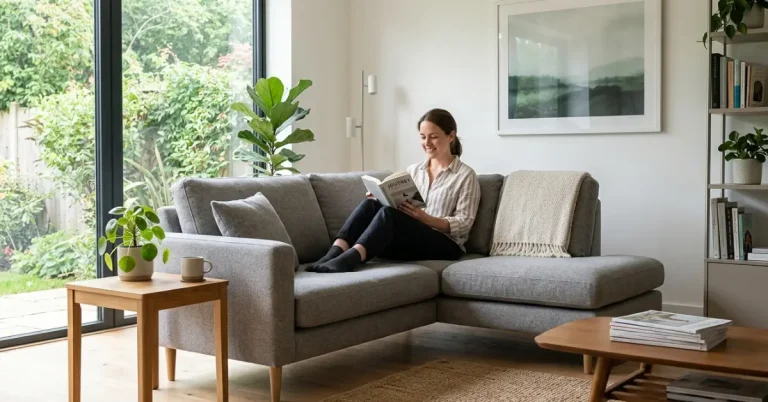
If you’re under 5’4″, there’s a good chance your sofa wasn’t designed with you in mind.
Most sofas are built around average body measurements. That sounds reasonable until you sit down and realize your feet are dangling, your lower back has no support, and you’re constantly shifting around to get comfortable.
The problem isn’t always the quality of the sofa.
In many cases, the dimensions simply don’t match your body.
A deep seat might feel luxurious in a showroom. At home, it can force you to sit forward or stuff pillows behind your back just to maintain decent posture.
Sound familiar?
Many shorter adults deal with the same issues:
- Feet that don’t fully touch the floor
- Lower back pain after sitting for a while
- Neck and shoulder tension
- Constant slouching
- Pressure behind the knees
- Feeling swallowed by oversized cushions
The frustrating part is that people often assume they need a new sofa.
Sometimes that’s true.
Often, it isn’t.
A few targeted changes can dramatically improve comfort without replacing the entire couch. Something as simple as reducing seat depth, adding proper lumbar support, or using a footrest can make a sofa feel like it was custom-built for your height.
In this guide, you’ll learn why many sofas feel uncomfortable for shorter people. How to identify the specific problem with your couch and which modifications actually work.
We’ll also cover affordable products, upholstery upgrades, and the key features to look for if you’re planning to buy a new sofa in the future.
Before spending thousands on new furniture, it’s worth seeing what a few smart adjustments can do.
Why Standard Sofas Are Uncomfortable for Short People

Most sofas are not built for short adults. They are built for averages.
That small detail changes everything.
What looks comfortable in a showroom often falls apart in real use. The proportions are off. The support points miss your body. You end up adjusting yourself instead of the sofa working for you.
Modern Sofas Are Designed for Average-Sized Adults
Furniture manufacturers typically design around median body measurements.
That usually means:
- Taller seat depth
- Higher backrests
- Larger overall frame proportions
It works fine if you’re around average height.
But if you’re under 5’4″, the geometry changes. Your legs are shorter. Your torso sits differently in the frame. The sofa no longer aligns with how your body actually rests.
You notice it immediately:
- You sit too far forward or too far back
- Your posture feels unstable
- You start adding pillows just to “fit” the seat
This is not about comfort preferences. It is about mismatch in scale.
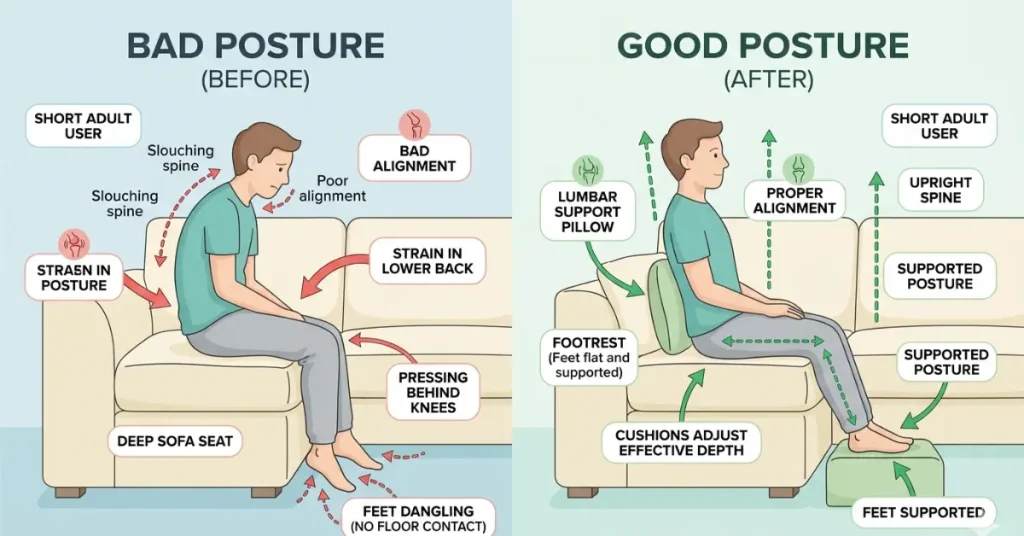
Deep Seats Push Your Back Away From Support
Deep seating has become a modern design trend. It looks relaxed and lounge-friendly.
But for shorter people, it often creates the opposite experience.
When the seat is too deep:
- Your back no longer reaches the backrest naturally
- You end up sliding forward to plant your feet
- Your lower spine loses support
You might think adding more cushions solves it. Sometimes it helps, but often it just shifts the problem.
You are still fighting the seat depth.
The result is familiar:
- Slouched posture within minutes
- Pressure in the lower back
- Constant repositioning
A sofa should hold your posture. Not force you to create one.
Feet Hanging Off the Floor Creates Poor Posture
This is one of the most overlooked problems.
When your feet do not touch the floor properly:
- Your thighs carry uneven pressure
- Your lower back compensates
- Your posture tilts backward or forward unnaturally
Even a slight gap between feet and floor changes how your body relaxes.
Over time, you feel it:
- Tight lower back muscles
- Restlessness while sitting
- Fatigue after short periods
Some people instinctively tuck their feet or sit sideways to compensate. That is your body trying to fix a design problem.
A sofa without proper foot support stops being neutral. It becomes stressful.
Oversized Armrests and Backrests Can Cause Neck Strain
Bigger is not always better in sofa design.
High armrests and tall backrests can push your shoulders and neck into awkward positions, especially for shorter users.
Common issues include:
- Shoulders slightly elevated while resting
- Neck pushed forward when leaning back
- No natural resting position for arms
Instead of relaxing, your upper body stays engaged.
You may notice:
- Neck stiffness after watching TV
- Shoulder tension without heavy activity
- A constant urge to adjust sitting position
This often gets misdiagnosed as “bad posture.” In reality, it is poor furniture proportion.
A sofa should support your frame naturally. Not force your body into adaptation mode.
How to Tell If Your Sofa Doesn’t Fit Your Body
Most people assume sofa discomfort is normal.
It is not.
A well-fitting sofa should feel neutral the moment you sit down. No adjusting. No searching for support. No stacking pillows just to survive a Netflix session.
If you constantly have to “fix” your sitting position, something is off.
Signs Your Sofa Is Too Large for You
Some issues show up immediately. Others build over time.
If your sofa doesn’t fit your body, you’ll usually notice a combination of these:
- Your feet don’t touch the floor
You end up dangling or tucking your legs. Neither is natural for long sitting. - You need pillows behind your back
This is your body compensating for excessive seat depth or poor lumbar support. - Your knees don’t bend comfortably
Your legs feel stretched or unsupported, especially on deeper sofas. - You experience lower back pain after sitting
This is one of the clearest signs the seat depth or cushion angle is wrong for your frame. - You constantly shift positions to stay comfortable
You sit forward, then lean back, then move again. That is not relaxation. That is adjustment fatigue.
Individually, these issues might seem minor.
Together, they point to one thing. The sofa is not designed for your body proportions.
Quick Self-Assessment Checklist
Use this simple check before assuming the sofa is “just uncomfortable.”
Sit normally for 10 to 15 minutes without adjusting anything.
Then ask yourself:
- Do my feet rest naturally on the floor or feel suspended
- Is my lower back supported without extra pillows
- Do I feel pressure behind my knees
- Am I leaning forward without noticing
- Do I feel the need to reposition repeatedly
If you answer “yes” to more than two of these problems, the sofa is not fitting you properly.
This is not about personal preference.
It is about mismatch between furniture dimensions and body size.
And once you see it, you cannot unsee it.
Measure Your Sofa Before Making Changes
Most people skip this step.
They jump straight to buying cushions or blaming the sofa. That usually leads to trial and error.
A better approach is simple. Measure first. Then fix.
Small differences in dimensions decide whether a sofa supports your body or fights it.
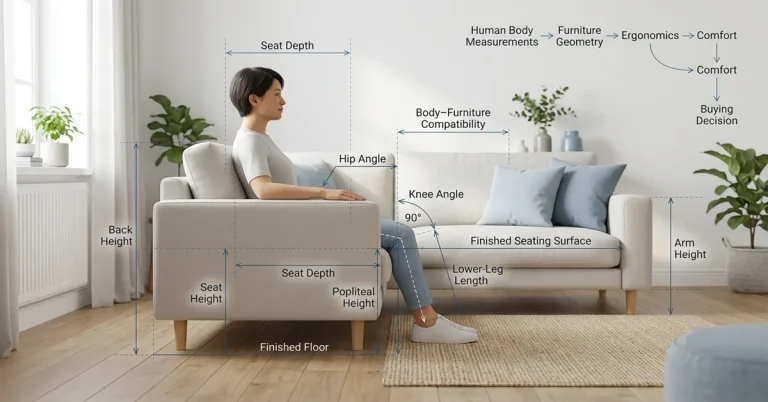
How to Measure Seat Depth
Seat depth is one of the biggest comfort factors for shorter adults.
Here’s how to measure it properly:
- Place a tape measure at the back cushion
- Measure straight to the front edge of the seat
- Do not include throw pillows or loose cushions
What you are looking for is usable seating depth, not showroom depth.
If the seat is too deep, your back loses contact with the backrest. That is where slouching starts.
For most short adults, anything beyond 21 inches starts to feel oversized.
How to Measure Seat Height
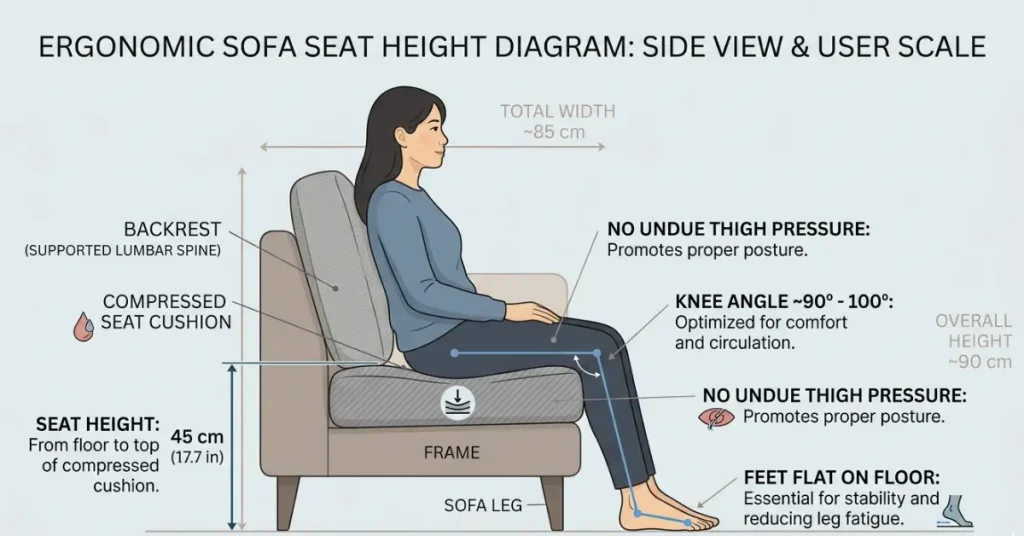
Seat height affects how your feet and knees align.
Measure from the floor to the top of the seat cushion while it is compressed under your body weight.
This detail matters.
A cushion can look fine when empty but drop significantly when you sit.
If the seat is too high, your feet dangle. If it is too low, your knees sit above your hips and strain your lower back.
The goal is balance, not height alone.
How to Measure Armrest Height
Armrests are often ignored, but they influence upper body tension.
Measure from the floor to the top of the armrest.
Then sit and check your natural arm position.
Your shoulders should stay relaxed. Not lifted. Not forced downward.
If armrests are too high, they push your shoulders upward. If too low, your arms hang without support.
Neither position is neutral.
How to Measure Back Height
Back height affects head, neck, and upper spine support.
Measure from the seat cushion to the top of the backrest.
Then compare it with your sitting posture.
A backrest that is too tall can push your head forward. Too low and your upper back loses support completely.
Shorter users often need moderate back height that supports the mid-back without forcing posture changes.
Sofa Measurement Worksheet
Use this as a quick reference before you modify anything.
| Measurement | Your Sofa | Recommended for Short Adults |
|---|---|---|
| Seat Depth | 19–21 inches | |
| Seat Height | 17–18 inches | |
| Arm Height | Lower profile preferred | |
| Back Height | 30–36 inches |
Write your actual measurements in the left column.
Then compare honestly.
If more than one dimension is off, that is usually the source of discomfort. Not the cushions. Not the fabric. The structure itself.
Ideal Sofa Dimensions for Short People
There is no perfect sofa for everyone.
But there are clear dimension ranges that work better for shorter adults. Once you understand these, shopping and modifying becomes much easier.
The goal is simple. Reduce strain. Improve support. Stop constant adjusting.
Best Seat Depth for Petite Adults
Seat depth is the biggest factor in comfort.
For most short adults, the sweet spot is:
- 19 to 21 inches
Anything deeper starts to change how your body sits. You lose contact with the backrest. You slide forward. You compensate with pillows.
It might feel “luxurious” in a store. But at home, it often turns into slouching within minutes.
If you already own a deep sofa, this is usually the first thing to fix.
Best Seat Height for Proper Leg Support
Seat height controls how your entire lower body behaves.
A good range for shorter users is:
- 17 to 18 inches from floor to compressed cushion
This keeps your feet grounded and your knees in a neutral position.
Too high, and your legs dangle slightly. That creates pressure under the thighs. Too low, and your hips sink too deep, which stresses your lower back.
The right height should feel invisible. You sit down and stop thinking about your legs.
Why Cushion Firmness Matters
Soft cushions are often overrated.
They feel comfortable at first. Then you sink. Then posture collapses.
For short people, firmness plays a bigger role than most realize:
- Firmer cushions keep seat height stable
- They prevent excessive sinking into deep seats
- They help maintain contact with the backrest
You don’t need a rock-hard sofa. You need controlled support.
If you feel like you are “fighting the cushion” after a few minutes, it is usually too soft for your body type.
Features That Improve Comfort for Shorter Users
Some sofa designs naturally work better for smaller frames.
Look for these features when buying or modifying:
- Shallow or medium seat depth instead of oversized lounge seating
- Firm or medium-firm cushions that hold shape
- Lower backrests that support mid-back without pushing the head forward
- Compact frame proportions instead of oversized modular designs
- Adjustable cushions or removable inserts for customization
Modular sofas can also help. Not because they are trendy, but because you can control spacing and support more precisely.
A good sofa for a shorter person is not about luxury. It is about proportion.
When the dimensions match your body, comfort stops being something you “fix” and starts being something you just experience.
Quick Fixes vs Permanent Sofa Modifications
Not every sofa problem needs a big solution.
Some issues can be fixed in minutes. Others require structural changes or professional work.
The key is knowing which category your problem falls into. Spending money in the wrong place is what most people do first.
Quick Fixes ($20–$100)
These are the fastest ways to improve comfort without changing the sofa itself.
They work best when the frame is fine but the support is wrong.
Lumbar Pillows
A simple fix with immediate impact.
They fill the gap between your lower back and the sofa.
Useful when:
- You slump forward without support
- Your lower back feels strained after sitting
Not perfect, but effective for small adjustments.
Bolster Pillows
More flexible than standard cushions.
You can place them behind your back, under your knees, or at your side.
Useful when:
- You need adjustable support
- You constantly shift positions to get comfortable
They don’t fix structure, but they help you work around it.
Seat-Depth Cushions
One of the most important fixes for short adults.
They reduce the usable depth of the seat so your back can actually reach the backrest.
Useful when:
- Your sofa feels too deep
- You slide forward while sitting
This is often the closest thing to “resizing” a sofa without altering it.
Footrests
Simple but often overlooked.
They stabilize your lower body when your feet don’t reach the floor properly.
Useful when:
- Your legs dangle slightly
- You feel pressure under your thighs
Without foot support, posture breaks down fast.
Wedge Cushions
They change your sitting angle instead of just adding softness.
Useful when:
- You tend to slouch
- You need better hip alignment
They create a slight forward tilt that improves spinal positioning without effort.
Permanent Fixes ($200–$1,000+)
These solutions change the structure or core materials of the sofa.
They are worth it when quick fixes stop working or the sofa is fundamentally oversized.
Foam Replacement
Replacing old or overly soft foam changes everything.
You get:
- Better seat firmness
- More stable height
- Less sinking over time
This is often the first real upgrade in upholstery work.
Cushion Rebuilding
This goes deeper than swapping foam.
It adjusts layers, density, and support zones.
Useful when:
- One cushion collapses faster than others
- You need customized firmness
It brings the sofa closer to your body instead of forcing adaptation.
Seat-Depth Reduction
A structural upholstery modification.
It physically shortens the usable seating area.
Useful when:
- The sofa is consistently too deep
- Cushions alone do not solve the problem
This is one of the most effective long-term fixes for shorter users.
Professional Reupholstery
The most complete solution.
It can combine multiple fixes:
- Adjust seat depth
- Replace foam
- Rebuild cushions
- Improve support zones
It makes sense when:
- The frame is solid
- The comfort issue is consistent and long-term
- You want the sofa to finally fit your body instead of working around it
It is not a cheap fix. But it can turn an unusable sofa into a properly fitted one.
9 Ways to Modify a Sofa for a Short Person
Most sofas feel uncomfortable for short adults for one simple reason. The body doesn’t match the furniture proportions.
You don’t always need a new sofa. You need better alignment between your body and where you sit.
These are the most practical fixes that actually change comfort.
1. Add a Lumbar Support Pillow
This is one of the fastest ways to fix slouching and lower back strain.
Shorter users often lose contact with the backrest because the seat is too deep or too soft. A lumbar pillow restores that missing support.
Benefits:
- Stabilizes lower back support
- Reduces slouching during long sitting sessions
It works best when your sofa feels like it pushes you too far forward or leaves your back unsupported.
Recommended product
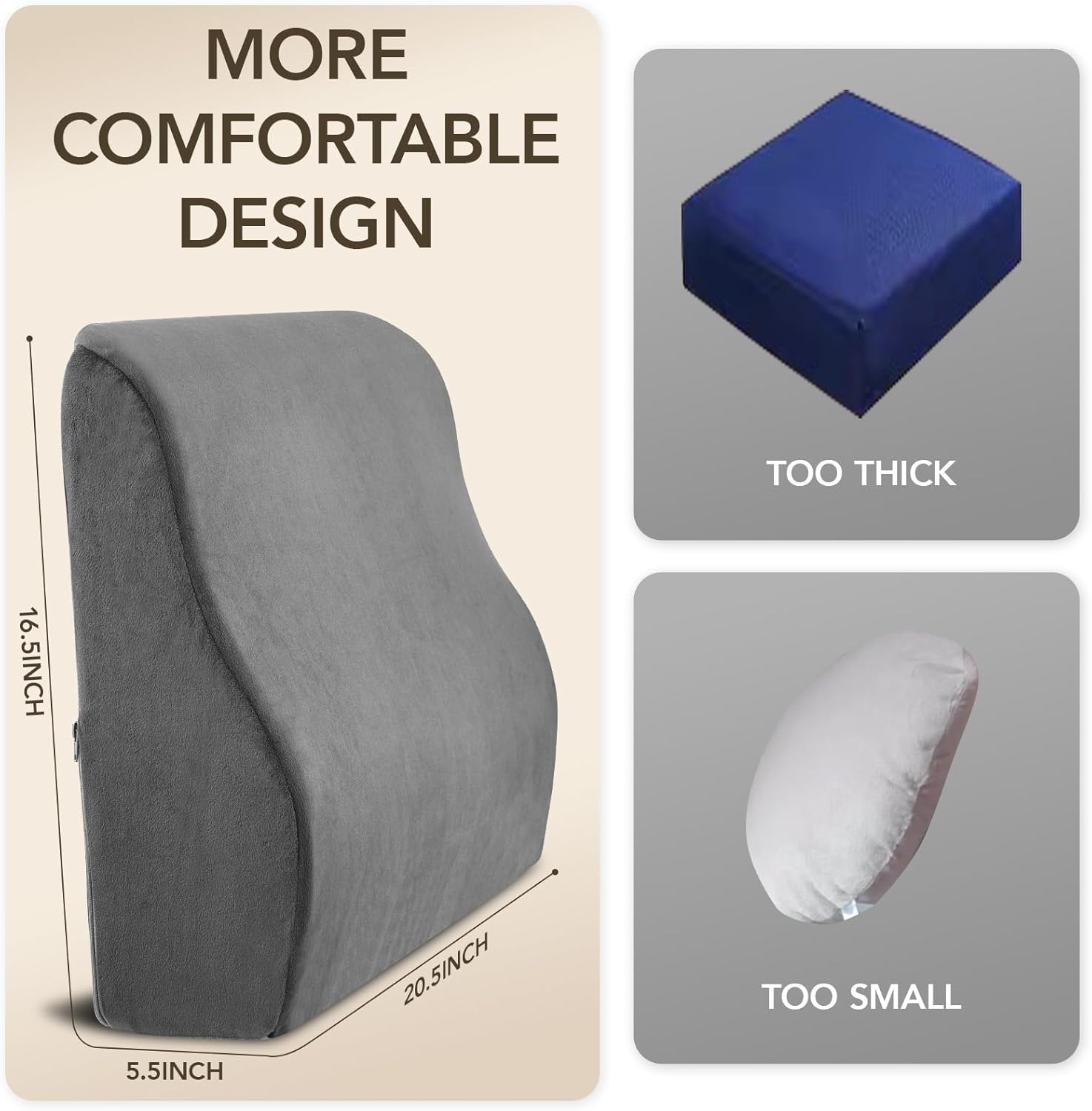
SofGlowly Lumbar Support Pillow for Recliner
This lumbar pillow is built for real back support, not just softness.
Key design details that matter:
- Dual-layer memory foam construction for balanced comfort and structure
- Soft gel foam layer that adapts to your back shape without collapsing
- Firm support core that prevents sinking over time
- Ergonomic curved shape that follows spinal alignment
- Non-slip base so it stays in place on sofas and recliners
- Breathable velvet cover that feels soft and is easy to remove and wash
It also offers full lower back coverage, which matters if you tend to sit upright for reading, TV, or long conversations. Smaller lumbar pillows often miss that support area completely.
In real use, it helps when:
- Your sofa back feels too far away
- You keep adjusting your posture without realizing it
- Your lower back gets tired even after short sitting periods
It doesn’t change your sofa. It changes how your body interacts with it.
That is the point.
2. Use a Seat Depth Reduction Cushion
Most short people don’t struggle with sofas because of softness alone.
They struggle because the seat is too deep.
When your body sits too far back, your lower back loses contact with support. That’s when slouching starts. Not because you want to, but because the sofa forces it.
A seat depth reduction cushion fixes that alignment problem.
Benefits:
- Brings your body closer to the backrest
- Reduces slouching
- Improves natural sitting posture without effort
It works by shortening the usable seating space so your back can actually reach support instead of floating forward.
Recommended product
Heavy Duty Couch Cushion Support for Sagging Cushions
This is not a soft filler. It is a structural support board designed to correct seat depth and sagging at the same time.
It’s built for people who are tired of sinking into their sofa and constantly adjusting position.

Key details that matter in real use:
- Engineered wood construction for firm, stable support
- 8mm thick panels that prevent bending under body weight
- Anti-skid surface that keeps it locked in place under cushions
- Designed to eliminate the “falling into the sofa” feeling
- Works under existing cushions without changing sofa appearance
It installs in seconds. No tools. No modification.
Just slide it under the cushions and the seating surface becomes noticeably firmer and flatter.
In practical terms, it helps when:
- Your sofa feels too deep and you sit too far back
- You keep adding pillows but still slide forward
- Your lower back never fully connects to the backrest
It is especially useful for sofas that are structurally fine but ergonomically wrong for shorter users.
Not a comfort upgrade. A correction to how the sofa supports your body.
3. Place a Bolster Pillow Behind Your Back
Not every sofa needs a structural fix.
Sometimes the issue is simply missing support in the right place. Shorter users often end up floating in deep seats with no natural back contact. A bolster pillow fills that gap without changing the sofa itself.
It is one of the simplest ways to stabilize your sitting position.
Benefits:
- Affordable fix
- Adjustable support
It works especially well when you need flexible positioning instead of a fixed correction.
Recommended product
5 STARS UNITED Knee Pillow for Back Sleeping
This bolster-style memory foam pillow is designed for body support, but it translates well to sofa use because of its shape and firmness.
It is not oversized. That matters. You want targeted support, not bulk.

Key features that matter in real use:
- Memory foam core that adapts without collapsing
- Half-moon shape that supports natural alignment
- Removable and washable soft knit cover
- Compact size that fits easily behind the lower or mid back
- Multi-use design for knees, legs, or lumbar positioning
In a sofa setup, it works best when you need to stop sliding backward or when your lower back needs a light anchor point.
It helps in situations like:
- You feel like you are sinking too far into the seat
- Your back needs just a small lift to feel supported
- You keep shifting positions to stay comfortable
It is not a full replacement for proper lumbar support.
But it is a practical fix when you want quick improvement without modifying the sofa itself.
Simple tool. Clear result.
4. Add a Footrest
Feet support is one of the most overlooked parts of sofa comfort.
Shorter adults often sit on sofas where their feet either barely touch the floor or hover slightly. It does not feel like a big issue at first. Then the discomfort builds up.
Lower back tension. Restless legs. Constant shifting.
A footrest fixes that by giving your lower body a stable base.
Benefits:
- Keeps feet supported
- Improves circulation
It also helps your posture without forcing you to think about it. When your feet are stable, your whole body relaxes more naturally.
Recommended product
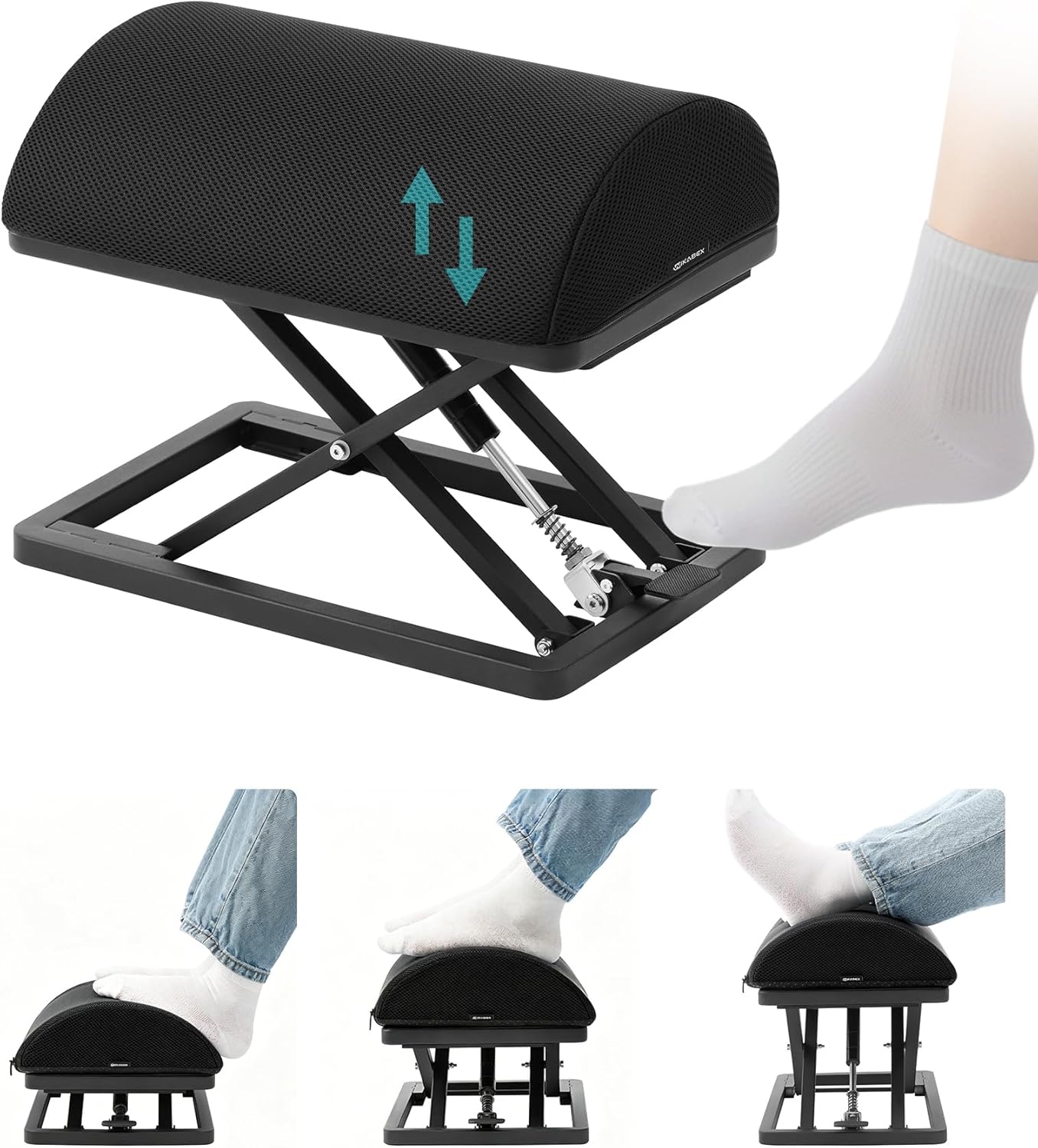
Truly Infinite Height Adjustable Footrest
This is not a basic stool-style footrest. It is an adjustable ergonomic support designed for people who change positions throughout the day.
It stands out because of one thing. Control.
You are not locked into a single height or angle. You adjust it based on how you sit.
Key features that matter in real use:
- Height adjustable from 2.7″ to 13.1″ for precise leg positioning
- Step-to-adjust system so you can change height without bending down
- Carbon steel frame for stability and long-term durability
- Non-slip base that keeps it steady on hard floors
- Ergonomic foam cushion that supports feet in multiple angles
- Removable washable cover for easy cleaning
In practice, it works well when:
- Your feet don’t fully reach the floor while sitting on a sofa
- You feel pressure building under your thighs
- Your legs start feeling restless during long sitting sessions
It also helps more than people expect with circulation. Once your feet are supported, your lower body stops compensating.
This is a small change that often produces a noticeable difference in comfort within minutes.
Not a luxury add-on. A basic correction for lower-body support.
5. Use a Wedge Cushion
Wedge cushions are not just about softness.
They change how you sit. Instead of sinking flat into a sofa, your body gets a slight forward tilt that improves alignment.
For shorter adults, that angle often matters more than extra padding.
Benefits:
- Creates a more ergonomic sitting angle
It reduces the need to constantly adjust your posture. You sit down, and your body naturally stays more upright without effort.
6. Replace Soft Cushions With Firmer Foam
Soft sofa cushions feel comfortable at first.
Then you sink. Then your posture collapses. That is the pattern.
Shorter users feel this more because sinking increases seat depth and removes back support.
Benefits:
- Prevents sinking
- Improves posture
Firmer foam restores structure. It keeps your sitting height stable and prevents the “falling into the sofa” feeling that soft cushions create.
It is one of the most underrated fixes for long-term comfort.
7. Rebuild the Seat Cushion
This is a step beyond simple replacement.
Rebuilding means adjusting layers of foam, density, and support zones instead of swapping a single cushion.
It gives you control over how the sofa behaves under your body.
Benefits:
- Custom comfort
- Longer-lasting solution
It works best when one-size-fits-all cushions no longer solve the problem. You start shaping the sofa around your body instead of adapting to it.
Most people only consider this after trying multiple quick fixes. At that point, it usually makes sense.
8. Reduce Seat Depth Through Upholstery Modifications
This is a structural change, not a surface fix.
Instead of working around deep seating, you physically reduce usable seat depth so your back can actually reach support.
That is the real issue for many short adults. Not softness. Not cushions. Distance.
Benefits:
- Permanent fit improvement
Once done correctly, it changes how the sofa fits your body entirely. No more sliding forward. No more stacking pillows.
It is one of the most effective long-term corrections, but also one of the most involved.
9. Have the Sofa Professionally Reupholstered
At some point, DIY fixes stop being enough.
If the frame is good but the comfort is consistently wrong, professional reupholstery becomes the final option.
This is not about making the sofa “look new.” It is about making it actually fit your body.
When it’s worth the investment:
- The sofa frame is still solid and high quality
- Multiple comfort issues exist at the same time
- You have already tried quick fixes without lasting improvement
- You want seat depth, firmness, and support fully customized
A good upholsterer can adjust:
- Seat depth
- Cushion firmness
- Foam density
- Back support positioning
It is the most complete solution. Also the most expensive.
But in some cases, it is the only one that truly resets comfort instead of patching it.
The Best Fix Based on Your Problem
Most sofa discomfort doesn’t come from one issue.
It comes from a mismatch between your body and the sofa’s dimensions. The fastest way to fix it is to stop guessing and match the solution to the symptom.
Here’s how to break it down.
1. My Feet Don’t Touch the Floor
This is more common than people think, especially with deeper or higher sofas.
When your feet are unsupported, your lower body loses stability. That tension travels straight to your back.
You end up shifting constantly without realizing why.
Recommended solutions:
- Footrest
- Wedge cushion
A footrest gives your legs a stable base so your body can relax. A wedge cushion helps adjust your sitting angle so your weight distributes more naturally.
If your legs feel like they are “floating,” start here.
2. My Sofa Is Too Deep
Deep seating looks comfortable but often works against shorter users.
Your back cannot reach the support point, so your body compensates by leaning forward or stacking pillows.
Neither lasts long.
Recommended solutions:
- Seat-depth cushion
- Bolster pillow
A seat-depth cushion shortens the usable seating area so your back connects properly. A bolster pillow adds flexible support where your body needs it most.
If you constantly feel like you are sliding into the sofa, this is the issue.
3. My Lower Back Hurts
Lower back pain usually means missing or weak lumbar support.
Soft cushions and deep seats force your spine into a slouched position over time.
It does not feel dramatic at first. Then it becomes a pattern.
Recommended solutions:
- Lumbar support pillow
- Firmer cushions
A lumbar pillow restores spinal alignment. Firmer cushions prevent your body from sinking into a collapsed posture.
If your back feels tired after even short sitting sessions, this is where to start.
4. I Keep Sliding Forward
This usually happens when the seat angle is too soft or too flat.
Your body keeps trying to find stability but never settles.
So you keep adjusting.
Recommended solutions:
- Wedge cushion
- Foam replacement
A wedge cushion changes your sitting angle so your posture stays more upright. Foam replacement restores structure so the seat doesn’t compress unevenly.
If you notice constant micro-adjustments while sitting, this is the fix.
5. My Sofa Is Old but I Want to Keep It
Some sofas are still structurally fine but feel wrong ergonomically.
In these cases, surface fixes stop being enough.
You are no longer fixing comfort. You are rebuilding it.
Recommended solutions:
- Cushion rebuilding
- Reupholstery
Cushion rebuilding lets you adjust firmness and support without replacing the sofa. Reupholstery goes further by modifying seat depth, foam layers, and overall structure.
If you like the sofa but never feel truly comfortable on it, this is the long-term solution.
Best Products for Making a Sofa More Comfortable for Short People
Not every sofa problem needs a new sofa.
In most cases, the fix comes down to a few well-chosen support products that correct posture, depth, and alignment.
Below are the most practical options based on real comfort issues short adults face.
Comparison Table
| Product | Best For | Price Range | Best Choice |
|---|---|---|---|
| Lumbar support pillow | Lower back pain, slouching | Low | SofGlowly Lumbar Support Pillow for Recliner |
| Seat depth cushion / support board | Deep sofas, sliding forward | Low–Mid | Heavy Duty Couch Cushion Support for Sagging Cushions |
| Bolster pillow | Flexible back or leg support | Low | 5 STARS UNITED Knee Pillow for Back Sleeping |
| Footrest | Feet not touching floor, leg pressure | Mid | Truly Infinite Height Adjustable Footrest |
| Wedge cushion | Slouching, poor sitting angle | Low–Mid | 4PCS Orthopedic Bed Wedge Pillow |
| Replacement foam option | Sagging cushions, posture collapse | Mid | Frienda 6 Pack Upholstery High Density Foam Cushion |
Best Lumbar Support Pillow
If your lower back hurts or you find yourself slouching, start here.
A proper lumbar pillow restores the missing curve in your spine and reduces pressure during long sitting sessions.
Best choice:
SofGlowly Lumbar Support Pillow for Recliner
It works well for sofas where the back support feels too far or too soft. It keeps your posture from collapsing without forcing you to sit stiff.
Best Seat Depth Cushion
Deep sofas are one of the biggest problems for short people.
You sit too far back. Your spine loses contact. You start sliding forward.
A seat depth support board fixes that structural gap.
Best choice:
Heavy Duty Couch Cushion Support for Sagging Cushions
It creates a firm, level seating base that reduces sinking and brings your body closer to the backrest.
Best Bolster Pillow
Bolster pillows are the flexible option.
They are not structural fixes. They are positioning tools.
Best choice:
5 STARS UNITED Knee Pillow for Back Sleeping
It works behind the back, under the knees, or for side support depending on how you sit. Useful when you constantly shift positions.
Best Footrest
If your feet don’t touch the floor, everything else becomes harder.
A footrest stabilizes your lower body and reduces pressure on your thighs and lower back.
Best choice:
Truly Infinite Height Adjustable Footrest
Adjustable height makes it more practical than fixed stools, especially for different sitting positions.
Best Wedge Cushion
Wedge cushions correct posture by changing your sitting angle.
Instead of sinking flat, your body tilts slightly forward into a more aligned position.
Best choice:
4PCS Orthopedic Bed Wedge Pillow
Good for slouching and sofas that feel too soft or too flat at the same time.
Best Replacement Foam Option
When cushions collapse, no pillow will fully fix the problem.
You need structure back in the seat.
High-density foam restores firmness and prevents long-term sinking.
Best Choice
Frienda 6 Pack Upholstery High Density Foam Cushion
Best used when:
- Sofa cushions feel uneven
- Sitting height keeps changing
- Multiple quick fixes are no longer enough
This is not a decorative upgrade. It is a structural reset for your sofa seating.
Common Mistakes Short People Make When Fixing an Uncomfortable Sofa
Most sofa discomfort doesn’t come from one big failure.
It comes from small wrong decisions repeated over time. People try to fix comfort, but they often fix the wrong thing.
Here are the mistakes that show up again and again.
Buying Larger Throw Pillows Instead of Support Pillows
Bigger pillows feel like an easy solution.
They are not.
Throw pillows are designed for decoration, not spinal alignment. They collapse too easily and shift around when you sit.
So you end up adjusting them constantly without real support.
If your lower back hurts, decorative pillows won’t fix it. You need structured support, not fluff.
Ignoring Foot Support
This is one of the most overlooked problems.
If your feet don’t rest properly, your entire posture breaks down from the bottom up.
People usually focus on cushions and forget the foundation.
That leads to:
- Pressure under thighs
- Lower back tension
- Constant repositioning
A simple footrest often solves more than stacking pillows ever will.
Choosing Extremely Soft Cushions
Soft cushions feel comfortable for a few minutes.
Then you sink.
And once you sink, your posture collapses without you noticing.
For shorter users, this is even worse because seat depth effectively increases when you sink deeper into the sofa.
The result is predictable:
- Slouching
- Back fatigue
- Loss of support contact
Comfort should feel stable, not sinking.
Following Furniture Trends Instead of Ergonomics
Deep, oversized sofas look good in modern interiors.
But design trends don’t care about body proportions.
What looks relaxed in photos often creates poor posture in real use, especially for shorter adults.
A sofa should fit your body first. Style comes second.
Otherwise you end up decorating discomfort.
Replacing the Sofa Before Trying Simple Fixes
This is the most expensive mistake.
Many people assume the sofa is “bad” when it is just poorly adjusted for their body.
In reality, small changes often fix the issue:
- Lumbar support
- Firmer cushions
- Footrest
- Seat depth correction
A full replacement should come after these are tested, not before.
Because once you understand the real issue, you often realize the sofa was not the problem. The setup was.
Before You Buy a New Sofa, Try These Fixes First
A new sofa sounds like the clean solution.
But most of the time, the real issue is not the sofa itself. It is how the sofa is supporting your body right now.
Before you spend hundreds or thousands, test a few targeted fixes. You might not need a replacement at all.
Add lumbar support
Start with the lower back. That is where most discomfort begins.
A lumbar support pillow restores the natural curve of your spine and reduces slouching without changing your sofa.
If your lower back feels tired after short sitting sessions, this is the first fix to try.
Reduce seat depth
Deep seats are a hidden problem for short adults.
They push your body too far back, breaking contact with proper support.
A seat depth cushion or support board shortens the usable seating area and improves posture immediately.
Support your feet
If your feet are not stable, your posture will never feel right.
A footrest keeps your lower body aligned and reduces pressure on your thighs and lower back.
This is one of the simplest fixes, but also one of the most effective.
Upgrade cushions
Soft cushions collapse over time and change how the sofa behaves.
Firmer foam or replacement inserts restore structure and stop sinking.
If you feel like you are constantly adjusting your position, this step matters more than you think.
Test changes for two weeks
Do not judge the sofa after one sitting.
Your body needs time to adapt to better support.
Try your adjustments for at least two weeks before deciding if anything else is needed.
Most people stop too early and miss the improvement entirely.
Buying a New Sofa? What Short People Should Look For
If you have tried fixes and still feel uncomfortable, then it is time to shop smarter.
The goal is not a bigger or trendier sofa.
It is a sofa that matches your body proportions from day one.
Seat Depth Matters More Than Overall Sofa Size
This is the most important dimension.
A sofa can look small but still be too deep. Or look large and still fit well.
For shorter adults, seat depth determines posture more than anything else.
If this is wrong, nothing else matters.
Look for Lower Seat Heights
Seat height affects leg support and circulation.
Too high and your feet dangle. Too low and your hips sink too deeply.
A balanced height keeps your body stable without forcing adjustments.
Choose Firmer Seat Cushions
Soft cushions are a common trap.
They feel good at first but collapse under weight.
Firmer cushions maintain structure and keep your posture consistent throughout sitting.
Consider Apartment-Size Sofas
Smaller sofas are not a downgrade.
They are often better proportioned for shorter users.
Apartment-size or compact sofas usually have more balanced seat depth and height ratios.
Modular Sofas Can Be Easier to Customize
Modular designs give you flexibility.
You can adjust spacing, depth, and layout depending on your comfort needs.
For shorter adults, this control can make a noticeable difference compared to fixed oversized designs.
It is not about trends.
It is about fit.
Best Sofa Types for Short Adults
Not all sofas are built with the same proportions.
Some naturally work better for shorter adults because of scale, depth, and structure. Others look great but create long-term discomfort.
Here are the types that usually fit better.
Loveseats
Loveseats are often the safest starting point.
They are smaller, tighter, and usually better proportioned than full-size sofas.
For shorter adults, that usually means:
- Less excessive seat depth
- Easier back support alignment
- Better overall posture without extra cushions
They also force less “spread out” sitting, which helps your spine stay supported.
If most full sofas feel too deep, loveseats are worth serious consideration.
Apartment Sofas
Apartment sofas are designed for smaller living spaces, but they also tend to fit smaller bodies better.
They usually come with more controlled proportions.
What you typically get:
- Moderate seat depth
- Lower overall bulk
- More balanced cushion sizing
They are a practical middle ground. Not too small. Not oversized.
For many short adults, this is where comfort finally starts to feel natural instead of forced.
Compact Sectionals
Sectionals are usually associated with oversized lounging.
But compact versions can work surprisingly well when proportions are controlled.
They are useful when:
- You want flexibility in seating positions
- You share the sofa with others
- You still need some lounging space without extreme depth
The key is avoiding overly deep chaise sections. That is where short users usually run into problems.
Modular Sofas
Modular sofas give you control instead of fixed design.
You can adjust layout, spacing, and sometimes even depth depending on the configuration.
That flexibility matters when standard sofas do not match your body.
They work well for:
- Custom comfort setups
- Mixed-height households
- People who keep adjusting cushions and seating positions
They are not automatically comfortable. But they are adaptable, which is often more important.
Petite-Scale Sofas
Petite-scale sofas are specifically designed for smaller body proportions.
This is where most comfort issues get solved at the design level instead of through fixes.
You typically see:
- Reduced seat depth
- Lower seat height
- Smaller backrest proportions
These sofas are not just smaller versions of regular models. They are proportionally adjusted.
If standard sofas always feel oversized, this category is worth prioritizing over everything else.
Frequently Asked Questions
Can a sofa be made less deep?
Yes, but it depends on the approach.
You cannot physically shrink the frame without upholstery work. But you can reduce usable seat depth.
Seat depth cushions or support boards move your body forward so your back actually reaches support.
In many cases, that is enough to fix posture without modifying the sofa itself.
What is the ideal seat depth for a short person?
For most short adults under 5’4″ (163 cm), the comfortable range is usually:
- 19 to 21 inches
Beyond that, many people start losing back contact and slouching without realizing it.
The key is not just the number. It is whether your back can stay supported without extra effort.
Are deep sofas bad for posture?
Not always.
But they often are for shorter adults.
Deep seats push your body away from the backrest. That leads to slouching, sliding forward, and increased lower back strain over time.
It is not the depth alone. It is how your body interacts with it.
Is reupholstery worth it?
It can be.
Especially if the sofa frame is still solid but the comfort is completely wrong.
Reupholstery allows real structural changes:
- Seat depth adjustment
- Foam replacement
- Cushion rebuilding
- Support redesign
It is expensive, but it can turn a “wrong fit” sofa into a properly matched one.
How can I make my couch more comfortable without buying a new one?
Start with targeted fixes:
- Add lumbar support for lower back pain
- Use a seat depth cushion for deep seating
- Add a footrest if your feet do not touch the floor
- Upgrade cushions if they are too soft or collapsing
- Try a wedge cushion to improve posture angle
Most discomfort comes from missing support, not the entire sofa being unusable.
What type of sofa is best for petite adults?
The best options usually have balanced proportions, not oversized styling.
Look for:
- Petite-scale sofas
- Apartment sofas
- Loveseats
- Well-designed modular sofas
The key factors are seat depth, seat height, and cushion firmness. Size alone does not guarantee comfort.
Conclusion
Most sofa discomfort for short adults comes down to one issue. Poor proportions.
Deep seats, soft cushions, and missing foot support all push the body out of alignment. That is why slouching, back pain, and constant shifting are so common.
The important part is this. You usually do not need to replace the sofa immediately.
Simple modifications like lumbar support, firmer cushions, seat depth correction, and footrests often solve the problem faster and cheaper than expected.
If those fixes are not enough, then it makes sense to look at better-proportioned sofas designed for smaller body sizes.
Start with adjustments first. Upgrade only when you actually need to.
Before You Buy
The Short Person’s Sofa Fit Guide
A printable height-to-dimensions chart, self-measuring steps, and a shopping checklist — know your exact numbers before you shop.
Get the Guide — $9 →