Disclosure: This article may contain affiliate links. If you purchase through these links, we may earn a small commission at no extra cost to you. We only recommend products we believe can genuinely help solve the problems discussed in this article.
If your feet don’t fully touch the floor when you sit on a sofa. The seat is too high for your body no matter what the product label says.
For people between 5’0″ and 5’4″, even a 1–2 inch difference in seat height can change how your knees, hips and lower back feel after just 20 minutes of sitting.
This guide gives you the exact sofa height range that keeps your posture stable, your feet grounded, and your body comfortable long-term.
Quick Comparison Table
Best Sofa Seat Height for 5’0″–5’4“
| Your Height | Ideal Seat Height | What to Watch For |
|---|---|---|
| 5’0″ | 16–18 inches | Avoid deep, soft cushions that sink too much |
| 5’2″ | 17–18.5 inches | Balance between firmness and comfort matters |
| 5’4″ | 17–19 inches | Slight flexibility depending on cushion type |
Important: Always subtract 1–2 inches from the listed seat height to account for cushion compression when you sit.
Why It Matters (Tight + Impactful)
Sofa height isn’t just about comfort. It directly affects your posture, circulation, and how easily you can stand up.
When the seat is too high your feet hang slightly. It putting pressure under your thighs and reducing stability. When it’s too low or too soft your hips drop below your knees, which leads to slouching and lower back strain.
For shorter users, these issues show up faster because standard sofas are built around average or taller body proportions.
Ergonomic Explanation
Furniture designers don’t guess seat height. They base it on human body measurements (anthropometry) used in ergonomic standards like BIFMA guidelines and global design data.
The key principle is simple:
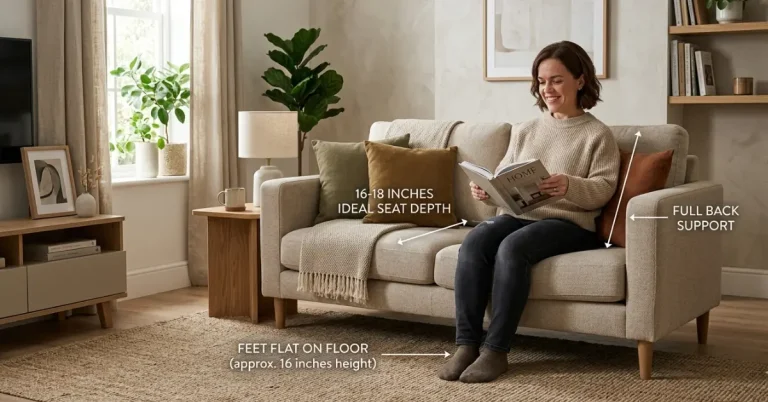
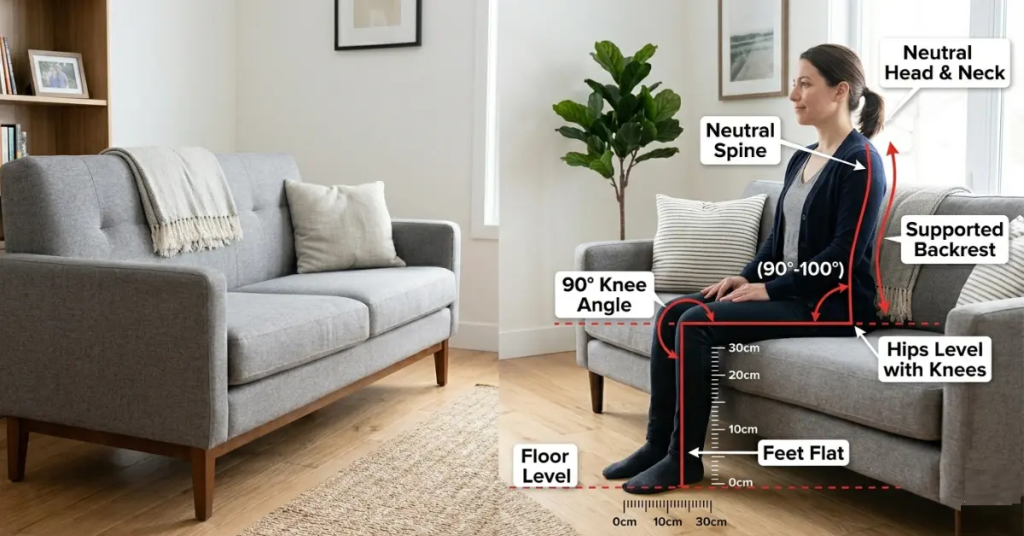
- Your feet should rest flat on the floor
- Your knees should form roughly a 90° angle
- Your hips should be level with or slightly above your knees
This alignment keeps your spine in a neutral position and distributes body weight evenly.
For people between 5’0″ and 5’4″, average lower leg length (floor to knee) typically falls between 16 and 18.5 inches. That’s why most ergonomic seating recommendations fall within this range.
Once cushion compression is factored in, the “real” sitting height becomes even more important than the listed number.
The Exact Sofa Seat Height Range for Petite Users (Backed by Ergonomics)
Sofa seat height is measured from the floor to the top of the seat cushion when uncompressed. That detail matters more than most buyers realize.
Here’s the real ergonomic breakdown:
- 16–18 inches for 5’0″ users
- 17–19 inches for 5’2″–5’4″ users
- 20+ inches often causes posture strain for petite users
1. Best Sofa Height for 5’0″
At 5’0″, most standard sofas sit too high for proper alignment.
Ideal range: 16–18 inches (before compression)
At this height:
- Feet stay fully grounded
- Knees remain at a natural angle
- Standing up requires less effort
Anything above 18 inches often causes your legs to hang slightly, which leads to pressure under the thighs and reduced stability over time.ar stool. It feels minor at first, but long sitting sessions make it obvious.
2. Best Sofa Height for 5’2″
At 5’2″, you have slightly more flexibility, but standard sofas can still feel too tall or too deep.
Ideal range: 17–18.5 inches
This range:
- Maintains a stable seated position
- Supports a natural knee-to-hip alignment
- Works well with medium-firm cushions
If the sofa is too soft, even this range can feel lower after sitting, so cushion firmness becomes a key factor here.
3. Best Sofa Height for 5’4″
At 5’4″, you’re close to the lower end of “standard” sizing, but fit still depends on proportions—not just height.
Ideal range: 17–19 inches
Within this range:
- You get better flexibility across different sofa styles
- Slightly higher seats can still work if cushions are firm
- Posture remains stable without excessive sinking
However, once you go above 19–20 inches, most users in this height range start to lose full foot contact, especially on deeper sofas.
Why 20+ inches causes posture strain
This is where many people make a buying mistake.
A sofa above 20 inches often creates three problems:
- Feet don’t fully touch the floor
- Thighs press downward at an angle
- Lower back loses proper support
The result is subtle but real:
You either sit forward constantly or slide down into awkward positions. Over time, that leads to knee fatigue and lower back tension.
It’s especially noticeable on deep, soft sofas where you sink even further after sitting.
The Seat Height Formula (Simple Way to Get Your Perfect Fit)
Most guides give ranges. That’s helpful but not precise.
If you want a sofa that actually fits your body, use this:
Ideal Sofa Seat Height = Lower Leg Length − Cushion Compression
Here’s how to apply it in real life:
- Sit on a flat chair with your feet fully on the floor
- Measure from the floor to the back of your knee
- Subtract 1–2 inches depending on cushion softness
Example:
- Floor to knee = 18 inches
- Cushion compression = 1.5 inches
- Ideal sofa height ≈ 16.5–17 inches
Why this works:
This formula is based on ergonomic seating principles used in standards like BIFMA, where seat height is matched to popliteal height (the distance from floor to knee).
Instead of guessing, you’re matching the sofa to your actual body proportions.
“Effective Seat Height” vs “Listed Seat Height” (Critical Buying Insight)
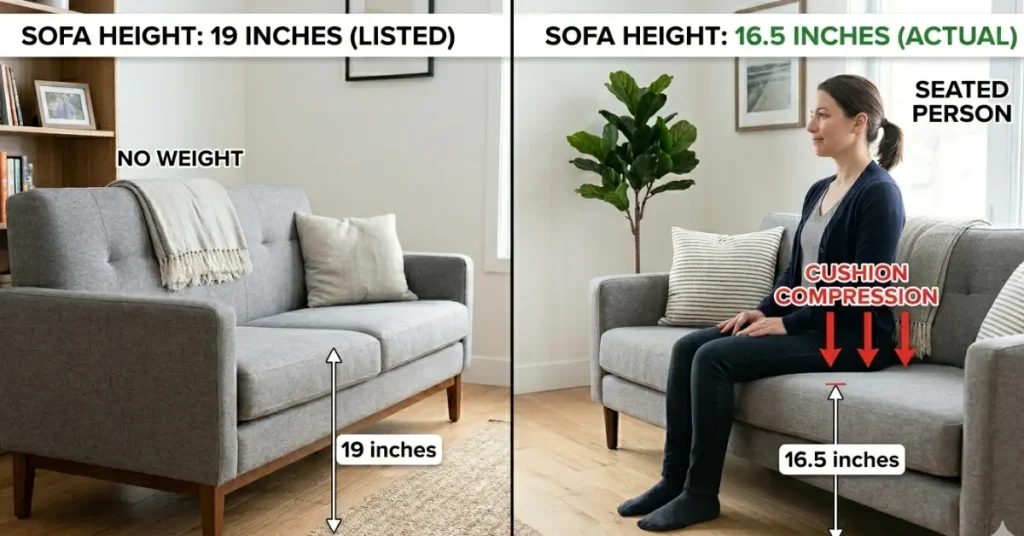
Most people shop sofas using the number on the product page. That number is misleading more often than buyers realize.
What you sit on is not what you see on the spec sheet.
Cushion compression reduces height by 1–3 inches
A sofa’s listed seat height is measured when nothing is on it. No body weight. No compression. No real use.
The moment you sit down, physics takes over.
Typical reality:
- Firm foam cushions: drop about 1 inch
- Medium-soft cushions: drop 1–2 inches
- Plush or feather-filled cushions: drop 2–3 inches
That means a “19-inch sofa” can quickly behave like a 16–17 inch seat after you actually use it.
For petite users, that difference is not minor. It decides whether your feet sit flat or hang slightly off the ground.
Soft sofas behave lower over time
There’s another issue most buyers miss: long-term sag.
A new sofa feels different in month one versus month twelve.
What changes over time:
- Cushion foam loosens
- Fabric and fill settle unevenly
- Seating depth feels deeper
- Seat height gradually drops
Soft, overstuffed sofas are the biggest offenders here. They often feel comfortable in a showroom but turn into low, sinking seating after regular use.
This is where posture problems start showing up:
- You sink lower than expected
- Knees rise slightly above hips
- Lower back loses support
- Getting up becomes more effortful
It’s not dramatic. It’s gradual. That’s why people don’t connect the discomfort to seat height.
Always measure after sitting compression
Here’s the practical rule most furniture guides skip.
Don’t trust the catalog number. Test the real sitting height.
When checking a sofa, do this:
- Sit down normally, don’t hover
- Let your weight fully settle
- Check where your feet land
- Notice knee angle after 10–15 seconds
You’re not measuring the sofa. You’re measuring how it behaves under your body.
If your feet stop fully touching the floor after compression, the sofa is effectively too high or too soft for your frame.
This is especially important for petite users between 5’0″ and 5’4″, where even a 1–2 inch shift changes posture comfort noticeably.
A good sofa doesn’t just look right. It holds its shape the way your body actually needs it to.
The Perfect Sitting Posture Test (Used by Designers)
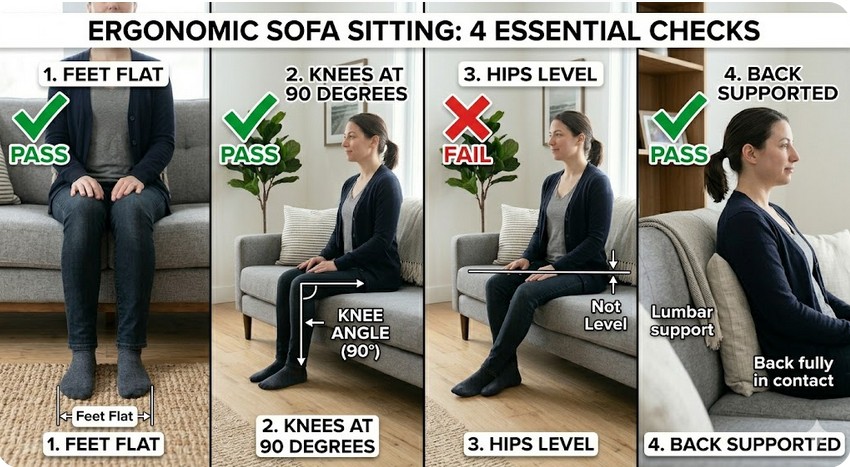
Furniture designers don’t guess comfort. They test it against body alignment. A sofa either supports posture or slowly breaks it down.
This simple test tells you which one you’re dealing with.
Sit down normally and check these four points. No adjusting, no forcing posture.
1. Feet flat on floor
Start with your feet.
They should rest fully on the floor without effort. Not just toes. Not hovering.
If your feet dangle even slightly, the sofa is too high or too deep for your frame.
For shorter users (5’0″–5’4″), this is the first failure point in most standard sofas.
Flat feet means:
- Better circulation in legs
- Less pressure under thighs
- Easier standing without pushing off
If this part fails, everything else becomes compensation.
2. Knees at ~90° angle
Now look at your knees.
They should form a natural right angle or slightly open angle. Not sharp. Not tucked upward.
If your knees sit higher than your hips, the sofa is effectively too low or too soft. If they drop too far down, the seat is too high.
This angle matters more than people expect. It directly affects:
- Lower back pressure
- Hip alignment
- Long sitting comfort
Most “comfortable” sofas fail here quietly.
3. Hips slightly higher or level with knees
This is where posture stability comes from.
Your hips should not sink below your knees. That position forces your pelvis to tilt backward, which leads to slouching.
What you want instead:
- Level hips for relaxed sitting
- Slightly higher hips for upright support
If you feel yourself sliding backward or curling into the sofa, the geometry is off. Not your posture.
This is especially common in deep lounge-style sofas.
4. Back fully supported without slouching
Now check your back.
You should feel full contact with the backrest without needing to lean forward or adjust constantly.
Good support feels simple:
- Lower back is held naturally
- Upper back isn’t straining forward
- No need to “find comfort” repeatedly
If you’re constantly shifting position, the sofa is not aligned to your body proportions. It’s forcing adaptation instead of offering support.
5. No forward sliding after 30 seconds
Sit still.
If you start sliding:
- Seat is too deep
- Cushion is too soft
- Back angle is misaligned
Best Sofa Depth + Height Combinations for Shorter Users
Seat height alone doesn’t decide comfort. Depth changes everything. A sofa can have the right height and still feel wrong if the seat is too deep.
For shorter users, especially in the 5’0″ to 5’4″ range, the combination matters more than any single number.
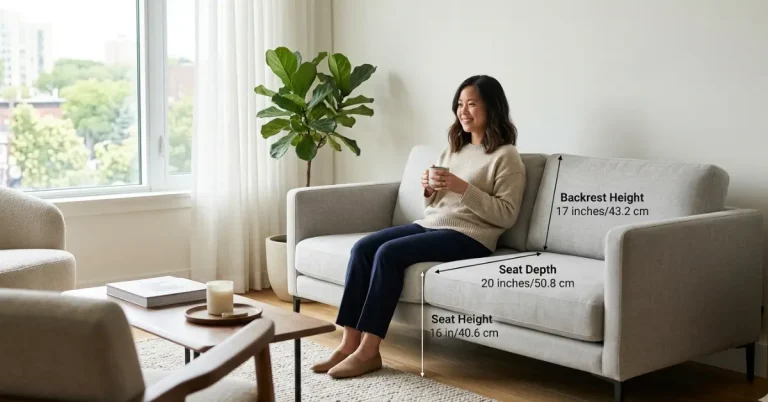
17–18 inch height + 20–22 inch depth (ideal combo)
This is the most balanced setup for petite proportions.
It works because it keeps your body aligned without forcing adjustment.
What this combo gets right:
- Feet stay grounded without strain
- Knees maintain a natural bend
- Backrest is reachable without leaning forward
- Sitting doesn’t turn into a constant posture correction exercise
It’s stable. Not overly deep. Not overly upright. Just predictable comfort.
If you’re unsure where to start, this range is the safest bet in most modern sofa designs, including Scandinavian-style and compact urban furniture.
Why deep sofas force sliding/slouching
Deep sofas look luxurious. They feel great for lounging at first. Then reality shows up.
When seat depth goes beyond what your legs can support:
- Your feet don’t anchor properly
- You start sliding forward to avoid stretching
- Your lower back loses contact with the backrest
- You end up slouching without realizing it
It becomes a compensation posture. You’re always adjusting, shifting, or pulling yourself upright.
For shorter users, this is even more noticeable. The body simply doesn’t have the leg length to “fill” the seat depth correctly.
That’s why deep sectional sofas often feel comfortable for lying down but awkward for actual sitting.
How lumbar cushions fix moderate mismatch
Not every sofa mismatch is a dealbreaker. Sometimes the depth is slightly off, not extreme. That’s where lumbar support helps.
A good lumbar cushion changes how your body interacts with the sofa:
- Pushes your lower back forward into alignment
- Reduces the feeling of sitting too far back
- Helps bridge extra seat depth
- Improves upright posture without forcing stiffness
But there’s a limit.
Lumbar cushions can correct mild depth issues. They cannot fix a sofa that is fundamentally too deep or poorly proportioned.
If you find yourself stacking multiple cushions just to sit normally, the sofa isn’t wrong in detail. It’s wrong in design for your body size.
Best Sofas for 5’0″–5’4″ (Real Examples That Work)
The sofas below are selected based on the ergonomic ranges covered in this guide-specifically 17–19 inch seat height, 20–22 inch seat depth and firm to medium-firm cushioning that limits excessive sinking.
Each option is evaluated based on how it performs for petite users in real sitting conditions, not just listed specifications.
1. Lifestyle Solutions Grayson Sofa
Seat Height: 17 inches
Seat Depth: 20.5 inches
Best For: 5’0″–5’2″ users who need grounded foot contact and stable posture
Why it fits this guide:
- Sits directly in the ideal petite seat height range (16–18 inches)
- 20.5-inch depth allows proper backrest contact without forcing you forward
- Firm cushion profile reduces post-sit sinking (important for maintaining knee–hip alignment)
This is one of the closest matches to the “effective seat height” principle explained earlier. For shorter users, it helps maintain flat feet positioning without compromising back support.
Potential limitation:
- May feel slightly low or relaxed for users closer to 5’4″ depending on cushion compression over time

2. HONBAY Modular Sleeper Sofa
Seat Height: 18.1 inches
Seat Depth: 20.5 inches
Best For: 5’2″–5’4″ users who want flexibility (sofa + sleeper)
Why it fits this guide:
- Balanced seat height stays within ergonomic limits for most petite users
- Medium-firm cushioning helps maintain posture during longer sitting sessions
- Modular structure allows adjustments to seating arrangement and depth feel
This is a strong option if you want functionality without going into oversized sectional territory.
Potential limitation:
- Larger footprint may feel bulky in very small rooms

3. Studio Living Lexington Sofa
Seat Height: 18.5 inches
Seat Depth: 20.1 inches
Best For: 5’2″–5’4″ users who prefer firmer, upright seating
Why it fits this guide:
- Slightly higher seat height still works for taller end of petite range
- Firm cushion system supports neutral spine positioning
- Moderate depth prevents excessive slouching or sliding
This is closer to the “upper safe limit” of your recommended range, but still within ergonomic tolerance.
Potential limitation:
- May feel slightly tall for users around 5’0″

4. Studio Living Harrington Sofa
Seat Height: 18.9 inches
Seat Depth: 20.5 inches
Best For: 5’3″–5’4″ users who want a traditional sofa look
Why it fits this guide:
- Seat height sits at the upper end of the recommended ergonomic range
- Structured cushion design helps reduce deep sinking
- Good balance between decorative design and functional seating support
This works better for users closer to average petite height rather than very short frames.
Potential limitation:
- At 18.9 inches, shorter users may experience reduced foot grounding

5. Mid-Century Modern Loveseat Set
Seat Height: 18.9 inches
Seat Depth: 20.87 inches
Best For: Small apartments and compact living rooms
Why it fits this guide:
- Compact proportions make it easier to maintain posture alignment
- Moderate depth supports upright seating rather than deep lounging
- Works well in spaces where full-size sofas feel oversized
This is more of a space-optimization choice than a pure ergonomic leader.
Potential limitation:
- Not ideal as a primary lounging sofa for larger households

Quick takeaway
If you are between:
- 5’0″–5’2″ → Grayson or HONBAY
- 5’2″–5’4″ → Lexington or Harrington
- Small space priority → Mid-century loveseat set
Material & Cushion Type Impact on Comfort
Seat height numbers don’t tell the full story. Cushion material changes how that number actually feels in real use.
Two sofas can both be 18 inches high and feel completely different once you sit down. The difference is inside the cushion.
Foam vs feather vs hybrid cushions
Each cushion type behaves differently under body weight. This is where most buyers underestimate the impact.
Foam cushions (Best for posture stability)
- Firm and structured
- Hold their shape longer
- Keep seat height more consistent
- Better for posture support
Best for: 5’0″–5’2″ users who need stable support and minimal sinking.
Feather-filled cushions (Soft but inconsistent)
- Soft and plush on first contact
- Compress heavily under body weight
- Feel lower after sitting for a few minutes
- Require constant repositioning
Trade-off: Comfortable for lounging, but often too low after sitting especially for shorter users.
Hybrid cushions (foam + feather mix)
- Balanced softness and structure
- Moderate sinking with controlled support
- More forgiving for casual lounging
- Still needs quality foam core to work well
Best for: 5’2″–5’4″ users who want softness without losing structure.
How softness changes ergonomic geometry
Softness is not just about comfort. It directly changes how your body aligns with the sofa.
Here’s what actually happens when a sofa gets softer:
- Seat height effectively drops
- Knees rise slightly above hips
- Pelvis tilts backward
- Lower back loses structured support
At first, it feels like sinking into comfort. After 20–30 minutes, posture starts breaking down.
This is why a soft 19-inch sofa can behave like a 16–17 inch seat in real use.
For shorter users, this shift is even more noticeable because there’s less leg length to compensate for the drop.
Long-term sinking effect explanation
New sofas lie. Not intentionally, but structurally.
Over time, cushions compress permanently. This is called “settling,” and it changes everything about comfort.
What changes after months of use:
- Foam loses bounce
- Seating area becomes uneven
- Depth feels deeper than original
- Effective seat height reduces further
The result is gradual discomfort that most buyers don’t connect back to the original purchase decision.
Soft materials accelerate this process. Feather-heavy cushions are the most unpredictable long term.
If a sofa already feels borderline low in the showroom, it will almost always feel lower after a year of real use.
That’s the part people regret later. Not how it looked. How it slowly changed.
Best Sofa Styles for Petite Users
Not every sofa style is built with petite proportions in mind. Some designs just happen to work better because their geometry is tighter, lower, and more controlled.
If you’re between 5’0″ and 5’4″, style matters less than structure. But certain styles consistently reduce comfort problems without much effort.
1. Scandinavian minimal sofas (low profile)
Scandinavian designs are popular for a reason. They’re not trying to be oversized or overly plush.
What they usually get right:
- Lower seat height with clean proportions
- Firm, supportive cushions
- Shallow to moderate seat depth
- Simple frames that don’t overwhelm the body
These sofas often feel “easy” to sit in. Not because they’re soft, but because they don’t fight your posture.
For petite users, this style reduces the need for constant adjustments. You sit down and your body aligns naturally without sinking too far.
The only downside is they can feel slightly firm at first. But that firmness is exactly what keeps posture stable.
2. Mid-century modern sofas (balanced height)
Mid-century modern designs are one of the most reliable options for shorter users. They sit in a sweet spot between comfort and structure.
What stands out:
- Moderate seat height (usually 17–19 inches)
- Slightly angled backrests for natural support
- Controlled seat depth, not overly deep
- Tapered legs that visually and physically lift proportion
This style avoids extremes. It doesn’t sink like oversized lounge sofas, and it doesn’t sit too low like floor-based designs.
For everyday use, it’s one of the most predictable choices. You don’t have to “learn” how to sit on it. It just works.
3. Compact apartment sofas with upright seating
These are designed for small spaces, but they also happen to suit petite body proportions well.
Key traits:
- Narrower seat width
- Firmer cushions for structure
- Upright back support instead of deep lounging angles
- Controlled seat depth to prevent sliding
They’re not built for stretching out. They’re built for sitting properly.
That’s actually the advantage here. For shorter users, overly deep or soft sofas often create posture problems. Compact upright designs remove that issue entirely.
The trade-off is clear: less lounging luxury, more functional comfort.
But if you care about posture, ease of standing, and consistent support, this category performs better than most oversized “comfort” sofas on the market.
Across all three styles, the pattern is consistent. The best sofas for petite frames don’t try to be oversized comfort pieces. They prioritize proportion structure and controlled depth.
What Most Guides Don’t Tell You (Advanced Buying Insights)
Most sofa guides stop at seat height and depth. That’s only half the story. Real comfort changes once the sofa is inside your actual living space.
Small environmental details quietly shift how a sofa feels under your body. Ignore them, and even a “perfect” seat height can feel wrong.
Floor type changes perceived height
The floor under your sofa changes how high you actually sit.
It sounds minor, but it isn’t.
Here’s what happens in real use:
- Sofas on thick carpet feel lower
- Sofas on hardwood or tile feel higher
- Rugs create uneven perceived seat height
- Soft flooring increases sinking effect
A sofa that feels perfect in a showroom can feel noticeably lower once placed on a plush rug. That matters a lot for shorter users who are already working with tight ergonomic margins.
If you’re between 5’0″ and 5’4″, assume flooring will shift your comfort range by at least a small margin. Sometimes enough to move a borderline sofa into the “too low” category.
Armrest height affects standing leverage
Most people ignore armrests until they need them.
But armrest height directly affects how easily you stand up.
Here’s what actually matters:
- Too low: no leverage when pushing up
- Too high: shoulders feel strained when resting arms
- Balanced height: natural push support when rising
For petite users, this becomes even more important. You often rely slightly more on armrests to transition from sitting to standing, especially on deeper or softer sofas.
If the armrests are too low, you lose mechanical advantage. You end up pushing harder through your legs, which adds knee pressure over time.
A good sofa doesn’t just support sitting. It supports getting up without effort.
Seat edge shape matters for leg circulation
The front edge of the seat is one of the most overlooked comfort factors.
Most buyers never notice it in a showroom. You feel it after 20 minutes of sitting.
Different edge shapes change comfort in very real ways:
- Sharp edges press into the back of the thighs
- Flat hard edges restrict blood flow over time
- Rounded or waterfall edges reduce pressure points
For shorter users, this becomes even more sensitive because your legs contact more of the seat front area relative to body size.
If the seat edge is poorly designed, you may feel:
- Tingling in legs
- Constant need to shift position
- Early discomfort even on “soft” sofas
Good ergonomic sofas often use a slightly curved or softened front edge. It’s a small design detail, but it directly affects how long you can sit comfortably without adjusting.
These are the details most guides skip. Not because they’re unimportant, but because they only show up when the sofa is already in your home. That’s exactly when it’s hardest to fix.
Final Decision Framework (Quick Checklist)
At this point, you don’t need more theory. You need a simple way to decide if a sofa actually fits your body.
Forget showroom comfort. Forget styling. Focus on how your body behaves when you sit down and stay there.
Use this as your final filter before buying.
Seat height under 19 inches
This is the first gate.
If the seat height is above 19 inches, most petite users (5’0″–5’4″) will feel immediate imbalance.
What you’re aiming for:
- 16–18 inches for shorter frames around 5’0″
- 17–19 inches for 5’2″–5’4″ range
Anything higher starts pushing your body into a lifted, unsupported position. It looks fine. It feels off after a few minutes.
Feet fully touching floor
This is non-negotiable.
Sit normally. Don’t adjust your posture. Don’t lean forward.
Your feet should:
- Rest flat on the floor
- Stay relaxed without stretching
- Not rely on tip-toes or pressure
If your feet are not fully grounded, the sofa is already mismatched. That’s where discomfort starts, even if everything else looks “right.”
No thigh pressure
Now check under your legs.
You shouldn’t feel compression or pressure at the back of your thighs. That usually means one of two things:
- Seat height is too high
- Seat edge is too hard or poorly shaped
When thigh pressure exists, circulation drops slowly. You won’t notice it immediately, but you will feel it during longer sitting sessions.
A properly sized sofa disappears under your legs. No pressure points. No awareness.
No forward sliding
This is the real test most buyers miss.
Sit back naturally and stay still for a minute.
If you notice yourself sliding forward, something is off:
- Seat depth may be too deep
- Cushion may be too soft
- Backrest angle may not match your posture
Sliding isn’t just discomfort. It’s your body correcting bad geometry. You’ll keep fixing your position without realizing it.
A well-fitted sofa holds you in place without effort. No constant adjustment. No “finding comfort” every few minutes.
If a sofa passes all four checks, it’s not just comfortable. It’s proportioned correctly for your body.
If even one fails, don’t rely on styling or softness to compensate. Those don’t fix geometry. They only mask it temporarily.
FAQ: Sofa Height for 5’0″–5’4″
What is the best sofa height for a 5’2″ person?
Most 5’2″ users are comfortable in the 17–18.5 inch range, depending on cushion firmness. Softer cushions may require slightly higher listed heights to compensate for compression.
Is a 20-inch sofa too high for short people?
In most cases, yes. A 20-inch seat height often prevents feet from resting flat on the floor for users under 5’4″, which can lead to poor posture and leg discomfort.
How do I measure sofa seat height correctly?
Measure from the floor to the top of the seat cushion without weight, then subtract 1–2 inches to estimate real sitting height after compression.
What if my sofa is slightly too deep?
A lumbar cushion can help if the depth mismatch is small (1–2 inches). It brings your back forward and improves posture. Larger mismatches are harder to fix.
Are softer sofas bad for petite users?
Not necessarily—but they require careful height selection. Soft sofas compress more, which can lower the effective seat height and affect posture over time.
Does cushion firmness matter more than height?
They work together. Height sets your leg position, while firmness determines how much that height changes after sitting. Both need to be balanced for proper support.