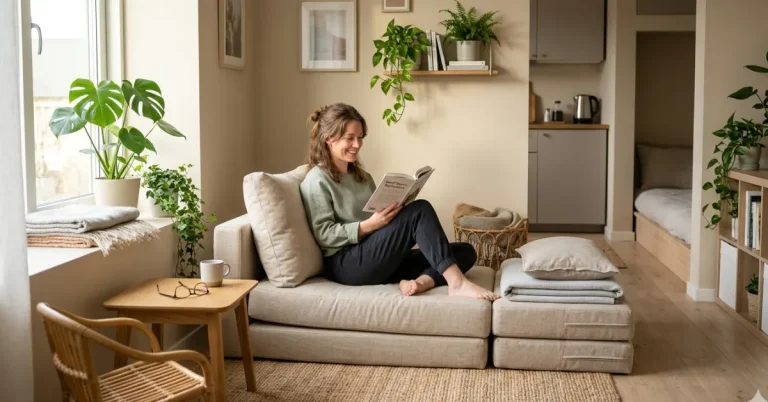
If you’re under 5’5”, most sofas aren’t built for your body and you feel it the second you sit down.
Your feet don’t quite touch the floor. Your lower back loses contact. You shift, adjust, grab a pillow… and never feel fully supported.
The frustrating part? It’s not obvious why.
Most people assume it’s the cushion, the fabric, or the “feel” of the sofa. But the real problem is something almost nobody talks about: seat depth.
That one measurement quietly decides whether you sit comfortably or spend years unconsciously compensating for a sofa that doesn’t fit.
This isn’t about style or trends. It’s about whether your sofa supports your body or slowly works against it every single day.
Here’s exactly what works and what doesn’t.
TL;DR: Regular Seating vs Deep Seating for Short People
If you’re under about 5’5”, this is what actually matters when choosing a sofa.
- Best seat depth for short people: 19–22 inches
- Deep seating (23–27”) often causes:
- A gap behind your lower back
- Feet that don’t fully touch the floor
- Slouching without realizing it
- Regular seating = better daily comfort and posture
- Deep seating works only if:
- You sit curled up or sideways
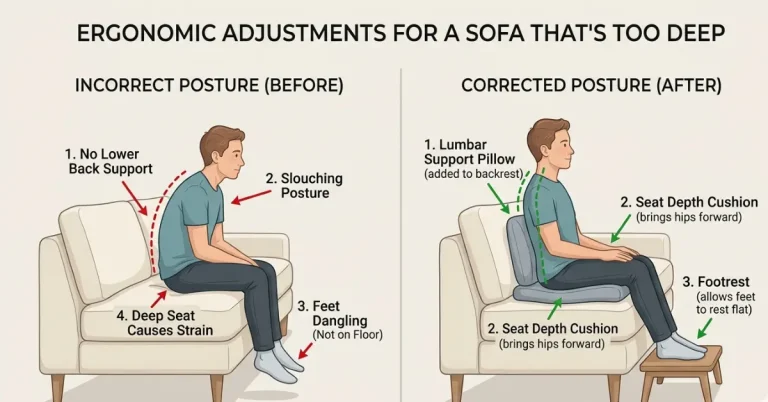
- You use lumbar pillows or an ottoman
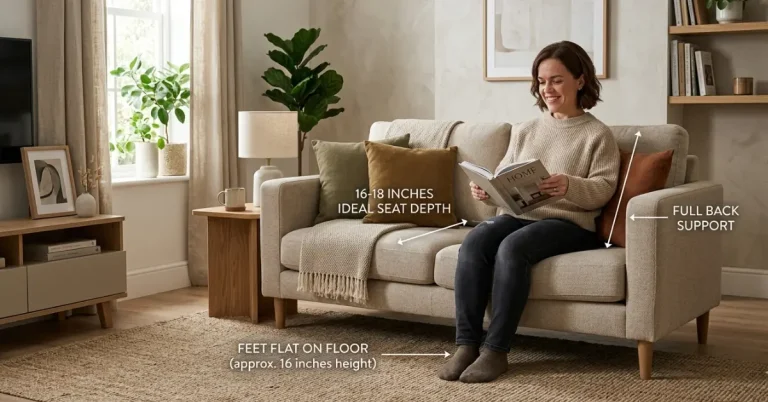
- Golden rule: Back touches + feet flat + knees at 90°
Why seat depth matters more than you think
Most people shop by looks first. Big mistake.
Seat depth decides how your body sits every single day. Not the color. Not the fabric.
If the seat is too deep, you don’t sit back properly. You perch. You slide. You keep adjusting. It gets old fast.
Shorter users feel this immediately. Taller people barely notice.
What actually happens on a deep sofa
You sit down. It feels soft. Spacious. Comfortable.
Give it five minutes.
Your lower back starts floating away from the cushion. Your legs stretch out. Your feet barely stay planted.
Now your body compensates:
- You slouch forward
- Or you tuck your legs under
- Or you grab a pillow
None of that is real support. It’s a workaround.
Brands like West Elm and Article often sell deeper sofas that look great online, but shorter buyers frequently run into this exact issue.
Why regular seating just works
Regular seating doesn’t try to be impressive. It just fits.
You sit down and:
- Your back touches the cushion naturally
- Your feet stay flat without effort
- Your knees bend the way they should
No adjusting. No sliding. No pillows needed.
That’s what daily comfort actually feels like.
When deep seating can still make sense
Deep sofas aren’t wrong. They’re just not built for upright sitting.
They work if your habits match the design.
You might still like deep seating if:
- You sit cross-legged most of the time
- You stretch out or lie down often
- You always use an ottoman
In those cases, depth becomes a feature, not a problem.
The simple test most buyers skip
Next time you try a sofa, don’t just sit for a few seconds.
Do this instead:
- Sit all the way back
- Wait at least 2 minutes
- Notice what your body does
If you start shifting or sliding, the seat is too deep.
Simple as that.
Quick Answer Box
Which is better for short people?
Regular seating is better because it supports upright posture and proper leg positioning.
Shorter adults tend to sit more comfortably when their back can fully contact the cushion and their feet stay grounded without effort.
Can short people use deep seating?
Yes, but only with adjustments like lumbar pillows, firmer cushions, or an ottoman.
Without support, deep seating often pushes the body into a reclined position that doesn’t naturally fit shorter legs or torso proportions.
It can work, but it needs correction to feel right.
What seat depth is too deep?
Anything over 22–23 inches is typically too deep for people under 5’5”.
At that point, most shorter users lose proper back contact or end up sliding forward without realizing it.
The sofa starts to look comfortable but stops working for daily sitting.
Definitions That Actually Matter
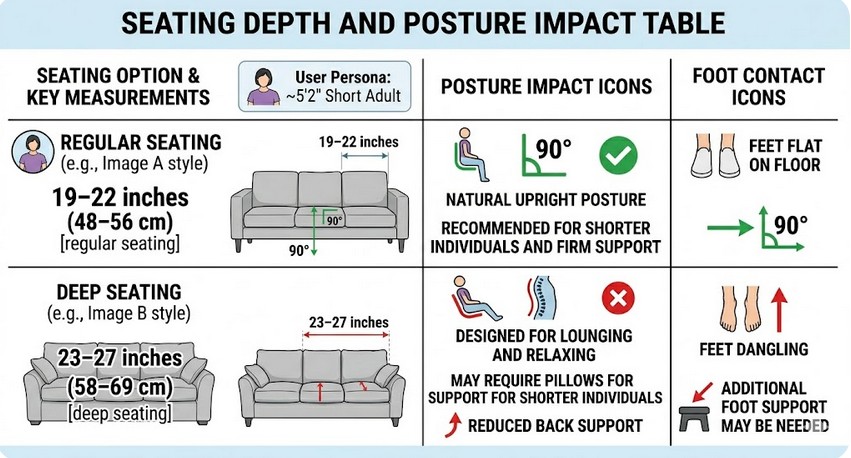
What is Regular Seating?
Regular seating sofas typically have a seat depth of 19–22 inches. They are designed for upright sitting where your back fully meets the cushion and your feet stay flat on the floor.
This setup supports natural spinal alignment and reduces pressure on your lower back during everyday use.
For shorter adults, this is usually the “just fits right” range. You sit down and don’t need to adjust your body to stay comfortable.
Brands like IKEA often design many of their compact sofa lines around this range because it works well for apartment living and mixed-height households.
What is Deep Seating?
Deep seating sofas usually have a seat depth of 23–27 inches. They are built for lounging, stretching out, and relaxed sitting positions rather than upright posture.
The extra depth shifts your body backward, which can feel cozy at first but often reduces lower back support for shorter users.
This style is common in lounge-focused designs from brands like West Elm and CB2, where comfort is aimed more at reclining than structured sitting.
For shorter people, deep seating often means:
- Less contact between back and cushion
- Feet not fully grounded
- A tendency to slide forward over time
It works, but only when your sitting style matches the design.
The Real Problem: Body Proportions > Height
Why is height alone misleading when choosing sofa seat depth?
Height is the most common shortcut people use when shopping for sofas. It also leads to the most wrong decisions.
Two people at the same height can sit very differently.
At 5’4”, for example:
- One person may have longer legs and a shorter torso
- Another may have shorter legs and a longer torso
That difference completely changes how a sofa feels.
This is why some shorter users love deep seating while others feel like they are sliding off it. Height alone doesn’t tell the full story of how your body actually sits.
What is the most accurate measurement for sofa fit?
If you want a sofa that truly fits, you need to look at butt-to-knee length, not height.
Here’s the simple way to measure it:
- Sit flat against a wall
- Keep your back straight and legs forward
- Measure from the wall to the back of your knees
That number tells you how much seat depth your body can actually support.
A practical rule:
- Ideal sofa seat depth = your butt-to-knee length minus 2–3 inches
This small adjustment matters. It prevents your legs from floating or your body from sliding forward over time.
Why do most guides skip this measurement?
Most sofa buying guides focus on general height ranges because it is easier to explain. It looks clean on paper.
But it doesn’t reflect real sitting behavior.
That is where buyers get misled:
- A “recommended” sofa still feels too deep
- Or feels fine in the store but uncomfortable at home
- Or requires constant pillow adjustments just to sit normally
This is the gap most competitors ignore.
And it is usually the reason people regret their sofa purchase later.
The Ergonomic Science Behind Sofa Comfort
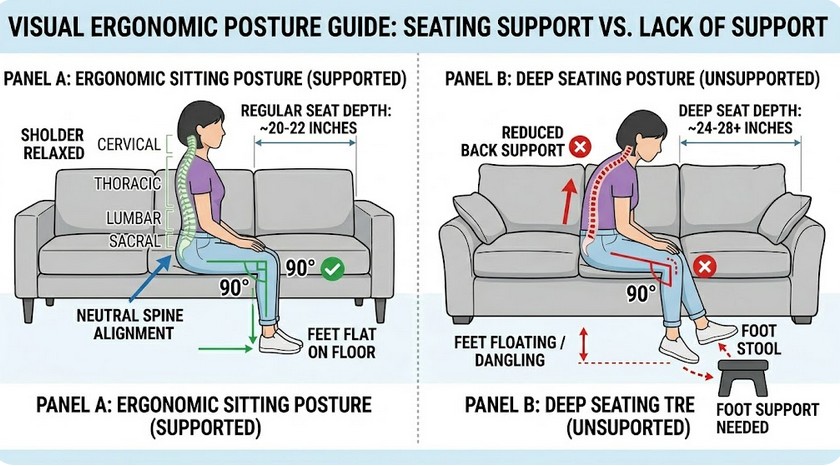
What are the ideal sitting angles for a comfortable sofa?
Good sofa comfort is not random. It follows simple body mechanics that most furniture ignores.
The ideal sitting position looks like this:
- Knees: about 90 degrees
- Hips: slightly higher than knees
- Feet: fully grounded on the floor
When these three align, your body stays balanced without effort. You are not leaning forward or collapsing backward. You are just sitting.
For shorter adults, this setup matters even more because small changes in depth or height quickly throw the whole posture off.
Why do deep sofas break ergonomics for shorter people?
Deep seating changes how your body distributes weight. It looks relaxed, but it often forces your spine into an unhealthy position.
Here is what actually happens:
- Posterior pelvic tilt starts to pull your lower back under
- The natural lumbar curve loses support
- Your upper body compensates by slouching or leaning forward
Over time, this increases spinal load without you noticing it. That is why people often say deep sofas feel fine at first, then “somehow uncomfortable later.”
It is not the sofa changing. It is your posture adapting to a shape that does not fully fit your body.
Brands like American Chiropractic Association often emphasize neutral spine alignment for seated posture because it reduces long-term strain on the lower back and hips.
What do experts actually focus on in sofa ergonomics?
Ergonomic specialists rarely talk about “softness” first. They focus on alignment.
The key idea is simple:
- Your spine should not be forced into a curve to match the furniture
- Your body should rest in a neutral position with minimal muscular effort
That is why seat depth matters more than cushion feel.
A sofa can look comfortable and still create poor posture patterns if it pushes your body away from this neutral alignment.
Visual Fit Test (Step-by-Step You Can Do in 2 Minutes)
What is the 3-point comfort check for sofa fit?
Most people judge a sofa in the first 10 seconds. That is not enough.
Use this simple 3-point check instead:
- Back fully touches cushion
- Feet stay flat on the floor
- Knees bend naturally at about 90 degrees
If all three happen at once, the sofa is structurally a good match for your body.
If even one fails, especially foot contact or back support, the seat depth is likely wrong for your proportions.
This is the fastest way to filter out sofas that look good but don’t actually fit.
What is the 2-minute slide test and why does it matter?
A sofa can feel fine at first and still fail in real use.
Here is the test:
- Sit normally and stay still for 2 minutes
- Do not adjust your position
- Watch what your body does naturally
If you start sliding forward or repositioning your hips, the seat is too deep for your body.
That sliding is your body trying to fix bad geometry. It should not happen on a well-fitting sofa.
Shorter users notice this more quickly because their legs cannot counterbalance extra depth.
How can you simulate sofa depth at home before buying?
You do not need a showroom to test fit. You can simulate it at home with basic items.
Try this method:
- Use a bed or flat surface as your base
- Stack pillows behind you to create different “seat depths”
- Mark reference depths like 20”, 22”, and 24” using tape
Then sit in each setup and observe:
- Where your back naturally lands
- Whether your feet stay grounded
- How your hips feel after a minute
This hack reveals something most stores won’t tell you: small changes in depth completely change comfort for shorter bodies.
It is simple, but surprisingly accurate when comparing regular seating vs deep seating for short people.
Regular vs Deep Seating (Comparison Table)
How do regular seating and deep seating actually compare for short people?
Most sofa advice stays vague. This is where it gets specific.
Below is a practical breakdown of how regular seating vs deep seating for short people performs in real use, not just in showrooms.
| Factor | Regular Seating | Deep Seating |
|---|---|---|
| Seat Depth | 19–22 inches | 23–27 inches |
| Posture | Upright and naturally aligned | Reclined or slouched over time |
| Back Support | Strong and consistent for shorter users | Often weak because the back doesn’t fully connect |
| Daily Use | Works well for long sitting sessions like reading, TV, or working | Better for lounging, not structured sitting |
| Customization Need | Low, usually fits as-is | High, often needs pillows or ottoman support |
What does this table actually mean in real life?
Regular seating behaves like a stable chair with softness. You sit down and your body just works with it.
Deep seating behaves more like a lounge bed. It feels great at first, but it quietly changes your posture the longer you sit.
For shorter adults, that difference shows up quickly:
- Feet position becomes inconsistent
- Lower back loses contact with support
- You end up constantly adjusting your sitting position
Brands like Article often design cleaner, shallower profiles that naturally align closer to regular seating, while deeper lounge-focused models from brands like West Elm prioritize relaxation over posture.
Which one actually makes daily life easier?
If you sit on your sofa every day for more than a few hours, regular seating is usually the safer choice.
Deep seating is not “bad,” but it is conditional. It works best when:
- You are not sitting upright for long periods
- You prefer curling up or stretching out
- You are okay adjusting your setup with pillows or support pieces
The real deciding factor is not comfort at first sit. It is comfort after 30 minutes without thinking about your posture.
Hidden Factors of Regular Seating vs Deep Seating for Short People
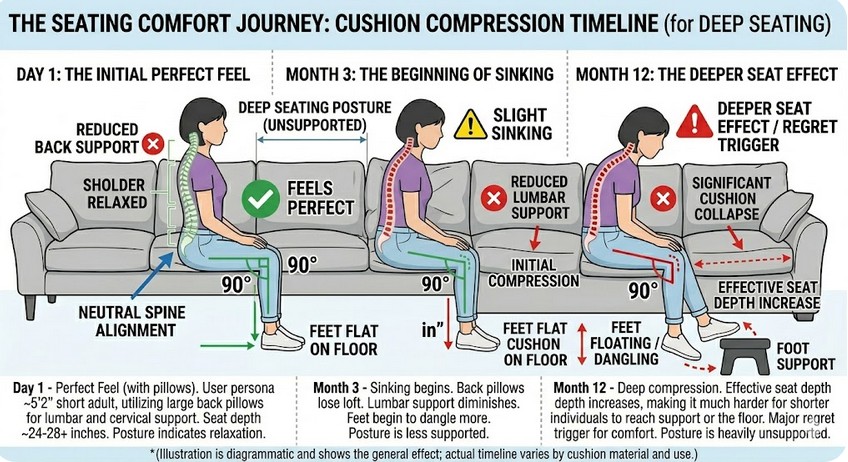
Most sofa guides stop at seat depth numbers. That is only part of the story.
What actually changes comfort over time is how the sofa behaves after you start using it daily. That is where most buyers get surprised.
What is cushion compression and why does it change sofa depth over time?
Cushions do not stay the same.
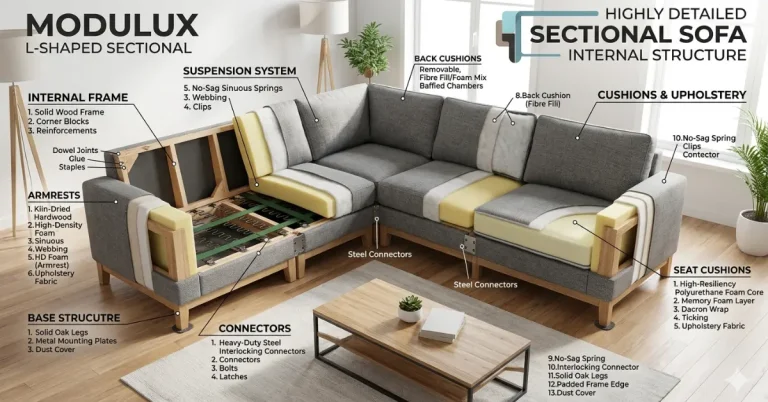
Over time, foam and filling compress under body weight, which makes the seat feel deeper than it originally was.
This is especially noticeable in sofas from brands like West Elm and CB2 where softer comfort-focused cushions are common.
What happens in real life:
- The seat slowly sinks lower
- Your hips drop deeper into the frame
- Your legs stretch out more than they used to
A sofa that felt “just right” in the showroom can feel too deep after 6–12 months of regular use.
Why do removable vs fixed back cushions matter for seat depth?
This detail gets ignored, but it directly affects how a sofa fits your body.
- Removable cushions = you can adjust depth slightly by repositioning them
- Fixed backs = depth is locked in and cannot be corrected
For shorter users, that flexibility matters more than most people realize.
A fixed-back sofa might look clean and modern, but if it is even slightly too deep, there is no easy fix. You are stuck with that geometry every time you sit down.
What is seat slope (pitch) and how does it affect comfort?
Seat pitch is the angle of the seating surface.
Even a small backward tilt can make a sofa feel deeper than the numbers suggest.
Here is what it does:
- Pushes your hips backward
- Encourages a reclined posture
- Reduces active lower back support
So two sofas with the same measured depth can feel completely different depending on angle.
This is why showroom testing is misleading. You are not just sitting on depth. You are sitting on geometry.
How does fabric and fill type change how deep a sofa feels?
Materials matter more than most buyers expect.
- Down-filled cushions
- Softer feel
- More sinking over time
- Often feels deeper than advertised
- High-density foam cushions
- Firmer support
- More stable seat depth
- Better for maintaining posture consistency
Shorter users usually feel the difference faster because sinking reduces already-limited leg positioning space.
This is why two sofas with identical measurements can feel completely different after a few months of use.
When Deep Seating Is Actually the Better Choice
Deep seating gets a bad reputation in discussions about regular seating vs deep seating for short people. But it is not the enemy. It just depends on how you actually sit.
If your lifestyle matches the design, deep seating can feel better than regular seating.
When does deep seating work if you sit cross-legged or curl up?
Some people never sit in a formal upright position on a sofa. They curl, lean, or sit sideways.
In that case, deeper seating becomes useful:
- It gives you space to shift positions
- It supports lounging angles instead of strict posture
- It feels less restrictive for relaxed sitting styles
Shorter users who rarely sit “straight on” often prefer this setup, even if it is technically deeper than recommended.
Is an ottoman enough to make deep seating work better?
Yes, but only if you actually use it consistently.
An ottoman changes the equation:
- It supports your legs so they are not dangling
- It reduces pressure on the lower back
- It helps balance a deeper seat depth
Without it, deep seating can feel like you are floating backward. With it, the same sofa can feel much more controlled and comfortable.
Brands like Article often pair modular sofas with ottomans for exactly this reason, especially in lounge-focused layouts.
When is deep seating better if you prioritize lounging over posture?
This is where deep seating honestly wins.
If your sofa is mainly for:
- Movie nights
- Napping
- Stretching out after work
Then depth is not a problem. It becomes an advantage.
You are not fighting for upright alignment. You are intentionally relaxing into the space.
But here is the key point most guides skip:
Deep seating works when posture is not the goal. If you expect upright sitting, it fails quickly.
What are hybrid sofa depths and why are they becoming popular?
Hybrid sofas sit around 22–23 inches of seat depth. They are the middle ground between regular seating and deep seating.
This range is gaining popularity because it:
- Works for mixed-height households
- Supports both sitting and lounging
- Reduces extreme posture issues for shorter users
You will see this design direction more often in modular systems from brands like West Elm, where flexibility matters more than strict categories.
For many buyers, hybrid depth is the safest compromise when they cannot decide between regular and deep seating.
Best Sofa Types for Short People (With Real Brands)
Not every sofa category works the same for shorter adults. Some are naturally more forgiving. Others quietly create posture problems you only notice after living with them.
Here’s how the main types actually perform in real use.
What are the best shallow sofas for short people?
Shallow sofas are usually the safest choice if you are comparing regular seating vs deep seating for short people.
They typically stay within the 19–22 inch seat depth range, which supports natural posture without forcing adjustments.
Good examples include:
Why they work:
- Feet stay grounded without effort
- Back naturally connects to the cushion
- Less need for extra pillows or fixes
These are not luxury statement pieces. They are function-first sofas that simply fit more body types without friction.
When should you consider custom depth sofas?
Custom depth sofas are for people who already know standard sizing does not work for them.
Instead of forcing a one-size approach, you adjust the seat depth to match your body proportions.
Brands that offer this level of control include:
Why this matters:
- You can fine-tune seat depth to your exact comfort range
- Better alignment between leg length and cushion depth
- Less compromise between lounging and upright sitting
This option is especially useful if you fall between categories, where regular seating feels slightly shallow and deep seating feels too large.
Are apartment and mid-century sofas better for shorter people?
In many cases, yes. And not by accident.
Apartment sofas and mid-century designs were originally built for tighter living spaces, which naturally leads to more controlled proportions.
What makes them work:
- Shorter seat depths
- More upright frame structure
- Less exaggerated lounging angles
You will often find that these styles unintentionally align better with shorter users because they prioritize structure over oversized comfort.
They are not designed for sprawling. They are designed for sitting properly in smaller spaces, which happens to match shorter body proportions more closely.
This is one reason many buyers end up preferring them after struggling with oversized modern lounge sofas.
Step-by-Step Buying Framework
Most people buy a sofa backward. They pick style first, then try to “make it work.” That’s how you end up with something that looks great but feels wrong every single day.
This framework flips that process.
How do you measure your body for the right sofa depth?
Start with your actual sitting posture, not your height.
Focus on two measurements:
- Butt-to-knee length
- Lower leg height (floor to knee when seated)
Sit naturally against a wall when measuring. No slouching. No stretching.
This matters because seat depth is really about where your knees land in relation to your hips. Not your overall height.
If this step is wrong, everything after it fails.
How do you set your ideal sofa seat depth range?
Once you have your measurement, you can set a realistic target.
Simple rule:
- Ideal seat depth = your measurement minus 2–3 inches
This small buffer keeps your body slightly engaged instead of stretched out.
It prevents:
- Feet floating off the floor
- Hips sliding forward
- Lower back losing contact with support
This is the difference between “it fits” and “I’m always adjusting it.”
How do you filter sofa options online without wasting time?
Don’t browse blindly. Most listings hide useful data unless you know where to look.
Use structured filters and specs from:
- Wayfair filters for seat depth and dimensions
- Amazon product specifications and Q&A sections
Focus only on:
- Seat depth (ignore styling first)
- Seat height
- Cushion type
If a listing does not clearly show seat depth, skip it. That is usually a red flag for poor fit transparency.
How do you test a sofa properly before buying?
Showroom sitting is misleading if you rush it.
Sit like you actually would at home:
- Sit all the way back
- Relax your posture
- Stay still for at least 2 minutes
Watch what your body does without effort.
If you start shifting forward or propping yourself up, that sofa is not right for your proportions, even if it “feels fine” at first.
If you are shopping online, simulate this using pillows or bed surfaces before committing.
Why should you check cushion firmness and return policy last?
Because both determine long-term comfort, not just first impression.
Cushion firmness changes how seat depth behaves:
- Softer cushions = deeper feel over time
- Firmer cushions = more stable posture support
Return policy matters because even good measurements can feel slightly different in real life.
Shorter buyers often only realize this after a few days of use, not during the first sit.
A flexible return window is not a bonus. It is protection against mismatch.
Real Buyer Scenarios for Regular Seating vs Deep Seating
Numbers and measurements matter, but real decisions usually come down to how a sofa feels after a normal day of use. These scenarios show what actually changes when short buyers adjust seat depth correctly.
What happens when a 5’1” buyer switches from deep seating to a shallower sofa?
A common issue at this height is losing full foot contact on deeper sofas.
In this case:
- The buyer was using a deep seat sofa (around 24–25 inches)
- Sitting felt fine at first, but daily use caused lower back strain and constant shifting
- Feet rarely stayed flat on the floor
The change:
- Switched to a 21-inch seat depth
The result was immediate:
- Feet stayed grounded without effort
- Back naturally stayed in contact with the cushion
- No more sliding forward during long sitting sessions
The key difference was not softness or design. It was geometry that finally matched body proportions.
Can a 5’4” buyer make deep seating work comfortably?
Yes, but only with intentional adjustments. Without them, deep seating usually forces constant posture corrections.
In this case:
- The sofa had a deeper seat, closer to lounge-style proportions
- The buyer liked the look and didn’t want to replace it
Instead of changing the sofa, they adapted it:
- Added a lumbar pillow for lower back support
- Used an ottoman to support leg positioning
The result:
- The sofa shifted from awkward deep seating to a more controlled hybrid setup
- Upright sitting became possible for daily use
- Lounging still felt natural when needed
Brands like West Elm often design modular layouts where this kind of adjustment is common, especially in lounge-focused collections.
What these real cases actually prove
The pattern is consistent.
Shorter buyers rarely struggle because sofas are “bad.” They struggle because the seat depth does not match their body mechanics.
Once that mismatch is fixed:
- Comfort improves quickly
- Posture stops feeling forced
- The sofa finally supports how they actually sit, not how it looks in a showroom
It usually comes down to one thing: whether the furniture fits the body, or whether the body has to adapt to the furniture.
Common Mistakes That Lead to Regret
Most sofa regret does not come from bad quality. It comes from small decisions that seem harmless at the start but completely change comfort later.
Here are the mistakes that show up again and again, especially when comparing regular seating vs deep seating for short people.
Why does ignoring seat depth cause so many problems?
This is the biggest one.
People focus on color, shape, or brand, and skip the actual measurement that controls comfort.
What happens:
- The sofa looks perfect online
- It arrives and feels “off”
- You start adjusting your posture constantly
Seat depth is not a detail. It is the foundation of how the sofa fits your body.
Why do Instagram sofas often lead to bad buying decisions?
Aesthetic-first buying is a trap.
Social media tends to push oversized, lounge-heavy sofas that look great in photos but are not designed for proper sitting posture.
What usually happens:
- Deep, oversized seating becomes the default trend
- Shorter users assume it will still work for them
- Reality feels very different after a few days
Brands like CB2 often feature this style heavily, which is fine visually but not always practical for smaller body proportions.
Why is confusing total depth with seat depth a costly mistake?
This is a technical mistake that leads to the wrong expectations.
- Total depth = back of sofa to front frame
- Seat depth = actual sitting area
Many buyers see a large number and assume it reflects sitting space. It does not.
You can easily end up with:
- A sofa that looks compact overall
- But feels extremely deep when sitting
This is one of the most common reasons people misjudge fit.
Why can overly soft cushions make seating worse?
Soft does not always mean comfortable.
With very soft cushions:
- You sink deeper than expected
- Your hips drop below ideal alignment
- Seat depth effectively increases over time
For shorter users, this often turns a “normal” sofa into a deep-seating experience without warning.
It feels great at first, then gradually stops supporting posture.
What happens when you don’t account for cushion wear?
Most people only test sofas when they are new. That is the problem.
Over time:
- Cushions compress
- Support weakens
- Seat geometry changes
A sofa that fit well on day one may feel completely different after months of use.
This is especially noticeable in softer lounge-focused designs from brands like West Elm, where comfort is prioritized over long-term firmness.
If you are short, this shift matters more because even small depth changes affect leg and back positioning quickly.
What all these mistakes have in common
They all come down to one thing: focusing on appearance or first impression instead of actual sitting mechanics.
A sofa does not fail suddenly. It fails slowly, through small mismatches that add up every time you sit down.
Pro Tips Most Furniture Stores Won’t Tell You
Most furniture showrooms are built to sell volume, not to match your body perfectly. That gap is where buying mistakes happen.
These are the details that experienced buyers quietly rely on.
Why should you always sit all the way back on a sofa?
This sounds simple, but most people sit incorrectly when testing sofas.
They perch near the front edge.
That completely distorts how the sofa feels.
Instead:
- Sit all the way back
- Let your back fully contact the cushion
- Relax your posture like you would at home
Only then can you judge if the seat depth actually fits you.
If you don’t do this, even a deep sofa can feel “fine” in the store and fail at home.
Why does seat depth matter more than width?
Width looks impressive. Depth determines comfort.
Width only affects how many people can sit.
Depth affects how your entire body aligns:
- Where your feet land
- How your back is supported
- Whether you slide forward or stay stable
For shorter users, this difference is critical. A wide sofa that is too deep will still feel wrong. A narrow sofa with the right depth will feel better instantly.
Why are firmer cushions better for shorter users?
Soft cushions are often mistaken for comfort.
But for shorter people, they can quietly create problems:
- You sink too far into the seat
- Your legs extend more than ideal
- Your posture collapses over time
Firmer cushions hold your body in a more predictable position. That stability is what actually improves comfort over long sitting sessions.
Brands like IKEA often use firmer foam constructions in many of their compact models for this reason.
Why should you add pillows instead of buying a deeper sofa?
This is one of the simplest but most ignored strategies.
Instead of increasing sofa depth, you can:
- Use a lumbar pillow for lower back support
- Add a side cushion to adjust sitting angle
- Use an ottoman to support your legs
This approach lets you fine-tune comfort without committing to a sofa that may be too large for your frame.
It is more flexible, and in many cases more effective than upsizing.
Why is showroom feel misleading when buying a sofa?
New sofas almost always feel better in stores.
Why?
- Cushions are brand new and fully firm
- No compression from repeated use
- No real-life sitting time has changed the structure
After a few weeks, the feel changes.
That is why showroom comfort is not a reliable indicator of long-term experience.
This is especially noticeable in soft lounge-focused models from brands like West Elm, where initial comfort does not always reflect how the sofa behaves over time.
The real test is not how it feels for 2 minutes. It is how it feels after 2 hours.
2026 Trends & Insights (Unique Differentiation)
Sofa buying is changing fast. In 2026, it is less about guessing and more about precision fit. That shift is especially important for shorter users who have historically been ignored by “one-size” furniture design.
Here’s what is actually changing in the market.
Are adjustable-depth modular sofas the future of seating?
Yes, and they are growing quickly.
Instead of fixed dimensions, modular systems let you change seat depth based on your setup.
Key idea:
- You can build shallow seating for upright use
- Or extend sections for lounging
This flexibility is becoming more common in brands like Lovesac, where modular pieces are designed to adapt rather than force a single posture.
Why this matters for short people:
- You are no longer locked into one seat depth
- You can correct comfort issues without replacing the sofa
- The same sofa can work for multiple sitting styles
It is not just a design trend. It is a correction to years of fixed, average-based furniture sizing.
How are AI fit tools changing sofa shopping?
Retailers are starting to move away from guesswork.
AI-driven tools now use body inputs like:
- Height
- Sitting posture preferences
- Leg-to-torso ratios
Then they recommend seat depth ranges instead of generic sofa sizes.
This changes the buying process completely.
Instead of asking “What sofa looks good?”
It becomes “What sofa fits my body?”
For shorter buyers, this removes a lot of uncertainty that used to lead to poor fit decisions, especially when comparing regular seating vs deep seating for short people.
What does inclusive furniture design actually mean in 2026?
For a long time, sofas were designed around an “average” body profile that did not reflect real population diversity.
That is starting to shift.
Inclusive design now focuses on:
- Multiple seat depth options within the same model
- Better support for smaller and larger body types
- More attention to posture variation, not just aesthetics
This is not just marketing language anymore. It is slowly becoming a competitive necessity for furniture brands.
The key change is simple:
Furniture is moving from “fit most people” to “fit different people intentionally.”
And for shorter users, that shift is long overdue.
Alternatives If You Already Bought the Wrong Sofa
A lot of people only realize the seat depth problem after the sofa is already in their living room. That does not mean you are stuck with it.
You usually have two paths. Quick adjustments or more permanent corrections.
What are the quickest fixes for a sofa that feels too deep?
If the sofa feels off but you are not ready to replace it, start with simple adjustments.
These changes help rebalance your seating position:
- Add lumbar pillows to support your lower back
- Use an ottoman to lift and support your legs
- Insert firmer cushion supports to reduce sinking
These fixes work because they correct posture, not the furniture itself. For shorter users, that small shift in alignment can make a deep seat feel more controlled.
Brands like IKEA often sell modular cushions and accessories that can help adjust comfort without replacing the entire sofa.
What semi-permanent fixes actually make a long-term difference?
If quick fixes are not enough, you can upgrade the structure of how the sofa behaves.
These options take more effort but deliver better long-term results:
- Replace soft cushions with higher-density foam inserts
- Add custom back support pads to reduce depth perception
- Re-stuff cushions to restore proper seat height and firmness
This approach is especially useful when the sofa is structurally good but ergonomically off. You are not changing the frame. You are correcting how your body interacts with it.
In many cases, this can turn a too-deep sofa into something much closer to a usable regular seating setup.
When should you consider replacing instead of fixing?
If you find yourself constantly adjusting:
- Sliding forward every time you sit
- Struggling to keep your feet grounded
- Relying on multiple pillows just to feel normal
That is usually a sign the seat depth mismatch is too large to correct.
At that point, no amount of accessories will fully solve the issue. The geometry of the sofa is simply not aligned with your body.
This is where many buyers eventually reconsider and switch to a better-fitting design instead of continuing to patch the problem.
Final Verdict
At this point, the decision should feel less confusing. It is not about which sofa looks better. It is about which one actually works with your body every day.
Shorter users feel the difference most clearly, so the choice usually becomes practical, not emotional.
When should you choose regular seating (19–22 inches)?
Choose regular seating if your priority is simple: comfortable daily use without adjustments.
Go with it if:
- You want stable posture support for long sitting sessions
- You prefer sitting upright without sliding or repositioning
- You want a sofa that just works without extra accessories
Regular seating fits the natural sitting position better for most shorter adults. It reduces strain and removes the need to constantly “fix” how you are sitting.
For everyday living rooms, this is usually the safer and more predictable option.
When does deep seating (23–27 inches) actually make sense?
Deep seating is not wrong. It is just more situational.
It works only if:
- You lounge frequently instead of sitting upright
- You enjoy curling up or stretching out on the sofa
- You are willing to modify it with pillows or an ottoman
In that setup, deep seating becomes more of a relaxation space than a structured sitting solution.
Without those adjustments, shorter users often end up compensating with posture changes that feel comfortable at first but become tiring over time.
What is the safest choice if you are unsure?
When people are stuck between regular seating vs deep seating for short people, the safest direction is almost always the same.
Go shallower.
A slightly smaller seat depth is easier to adapt to. A too-deep sofa is much harder to fix later, even with cushions or accessories.
When in doubt: Go shallower. It is safer for short bodies.
FAQs: Regular Seating vs Deep Seating for Short People
1. What is the ideal sofa depth for a 5’2” person?
For most people around 5’2”, the ideal seat depth is 19–21 inches. This range supports proper back contact and keeps your feet grounded without forcing you to lean forward or slide.
2. Is 24-inch seat depth too deep for short people?
Yes, for most shorter users it is. A 24-inch seat depth usually pushes your body too far back, making it hard to keep full foot contact and natural posture without support like pillows or an ottoman.
3. Why do my feet not touch the floor on my sofa?
This usually happens when the seat is too deep or too high for your leg length. Your hips shift backward, which extends your legs forward and breaks natural floor contact. Seat height also plays a role, not just depth.
4. Can deep seating cause back pain?
Yes, it can. Deep seating often reduces lower back support, causing slouching or forward leaning. Over time, this can increase strain on your lumbar spine, especially during long sitting sessions.
5. How do I measure sofa seat depth correctly?
Measure from the back cushion (where your lower back touches) to the front edge of the seat cushion. Do not include armrests or frame depth. That measurement is the true seat depth.
6. What’s the difference between seat depth and total depth?
Seat depth is the usable sitting area. Total depth includes the entire sofa from back frame to front edge, including cushions and structure. Many buyers confuse the two and end up choosing sofas that feel deeper than expected.
7. Are firm sofas better for short people?
Yes, generally. Firmer cushions prevent excessive sinking, which helps maintain proper posture and keeps seat depth consistent. Softer cushions often feel deeper over time, which can worsen fit issues.
8. How can I make a deep sofa more comfortable?
You can adjust it with simple changes:
- Add lumbar pillows for back support
- Use an ottoman to support your legs
- Add firmer cushion inserts to reduce sinking
These adjustments help reduce the feeling of excess depth.
9. What brands make sofas for shorter people?
Brands with more compact or customizable designs include:
- IKEA (compact models)
- Article (clean, shallower profiles)
- BenchMade Modern (custom depth options)
These tend to offer better control over seat proportions.
10. Is regular seating good for lounging?
Yes, but in a more upright way. Regular seating is better for sitting, reading, or watching TV. It is less ideal for stretching out compared to deep seating, but it supports better posture for daily use.