Sectional sofas work by combining multiple independent seating modules connected by clips, brackets, or interlocking hardware into one unified seating system. Each module stands alone, but together they form L-shapes, U-shapes, or custom layouts that adapt to your room, your family and your life.
That’s the core mechanic. But understanding why that matters and how to use it to make a genuinely smart purchase.
I’ve researched over 40 sectional sofa models across budget, mid-range and premium categories for SofiaCrooks.com. What I found is that most buyers get the aesthetics right and the engineering completely wrong. This guide fixes that. By the end, you’ll understand exactly how sectional sofas work from the frame out and be able to choose one that earns its place in your home for years.
What Is a Sectional Sofa? Definition and Core Concept
A sectional sofa is a modular couch made of multiple independent upholstered pieces that connect together to form one continuous seating unit. Unlike a traditional sofa which is a single fixed structure. A sectional is designed to be rearranged, expanded and adapted over time.
The individual pieces are called modules or sections. Each module is a complete unit with its own internal frame, cushioning and upholstery. Common module types include corner wedges, armless seats, chaise lounges, ottomans, and recliner units. The real value of a sectional is not its size it’s its structural flexibility.
Sectional vs. Modular vs. Sofa Set – Clear Differences
These three terms are used interchangeably in furniture marketing, but they mean distinctly different things. Knowing the difference will save you from buying the wrong product entirely.
| Type | Structure | Flexibility | Best For |
|---|---|---|---|
| Sectional Sofa | Pre-designed multi-piece set | Moderate | Specific room layouts |
| Modular Sofa | Fully interchangeable units | High | Custom configurations |
| Sofa Set | Separate matching pieces | Low | Traditional arrangements |
A sectional is a subset of modular furniture but not all sectionals are truly modular. A standard sectional from Ashley Furniture or Bob’s Discount Furniture comes in a defined configuration with limited rearrangement options. A true modular sofa like IKEA’s VALLENTUNA series or Lovesac’s Sactional system allows you to add, remove, or reorder any individual piece independently. Always ask before buying: Can I purchase additional modules separately?
The Internal Anatomy of a Sectional Sofa
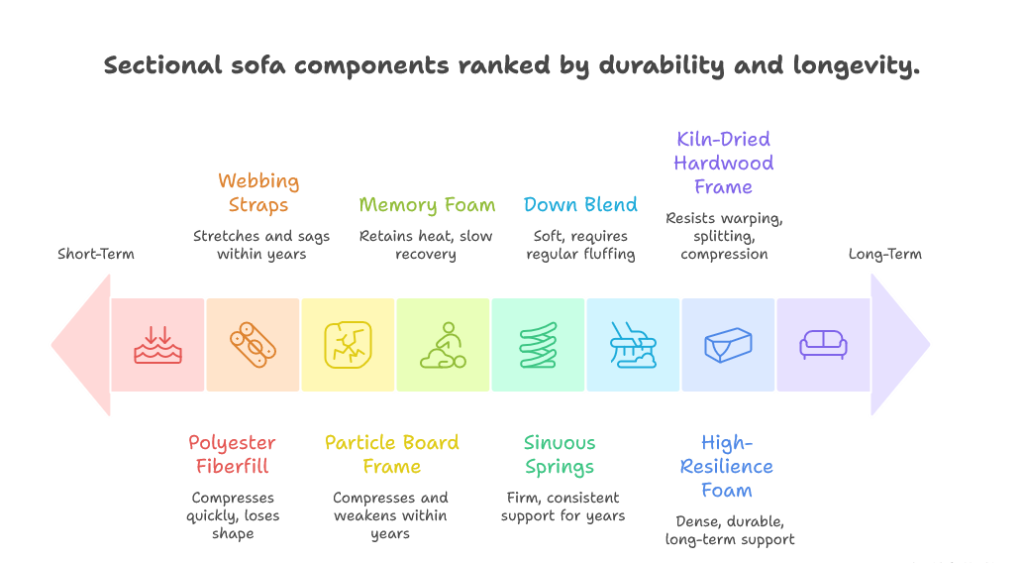
This is the section most furniture guides skip entirely and it’s the single most important factor in determining whether your sectional lasts 4 years or 14.
Frame: The skeleton of each module. High-quality sectionals use kiln-dried hardwood frames oak, maple, or beech. Which resist warping, splitting and compression under long-term load. The American Home Furnishings Alliance identifies kiln-dried hardwood as the gold standard for residential furniture frames. Budget models commonly use particle board or low-grade engineered wood composites, which compress and weaken within 2–3 years of regular use.
Suspension system: The layer sitting directly beneath your cushions. There are two main types:
1. Sinuous (S-shaped) springs – Zigzag metal springs that run front-to-back across the frame. These provide firm, consistent support and are standard in mid-to-high-end sectionals. They hold their shape reliably for 8–12 years.
2. Webbing straps – Interwoven nylon or rubber bands common in budget models. Comfortable when new, but prone to stretching and sagging within 2–3 years of regular use.
Cushion fill: What you actually feel when you sit down. The fill determines both comfort and long-term shape retention:
High-resilience (HR) foam — Dense, durable, and recommended by Consumer Reports for long-term seated support. The industry benchmark for mid-to-premium sectionals.
Memory foam — Conforms to body shape; excellent for lounging but retains heat and takes longer to recover between uses.
Down blend — Luxuriously soft, but requires regular fluffing to maintain shape. Common in premium models from Restoration Hardware and Pottery Barn.
Polyester fiberfill — The budget option. Compresses noticeably within 12–18 months of daily use.
Sofia’s Research Note: In my analysis of 40+ sectional models, the biggest predictor of long-term satisfaction was frame quality not fabric or cushion style. A sectional with a kiln-dried hardwood frame and HR foam will outlast three particle-board models at the same price point.
How Do Sectional Sofas Work – The Mechanics in Detail
Sectional sofas work through a system of interlocking modules held together by physical connectors, allowing users to rearrange, expand, or separate their seating without any tools or professional assistance.
Each module is a self-contained unit. The connector system is what transforms individual pieces into a unified sofa and it varies significantly by price point, manufacturer and intended use case.
Types of Connectors in Sectional Sofas
The connector system is the most technically overlooked aspect of sectional sofa design. Here is every major connector type, how it works, and what it means for your daily experience:
Alligator clips (cable tie clips): The most widely used connector type in mid-range sectionals priced $800–$2,000. Metal clips attach to the underside of adjacent modules, gripping both frames simultaneously and holding pieces flush. They’re quick to connect and release, making reconfiguration genuinely easy. Ashley Furniture uses reinforced alligator clip systems across their Benchcraft and Signature Design sectional lines.
Metal bracket systems: Found in higher-end models priced above $2,000. Rigid metal plates bolt to both module frames, creating a rigid, stable joint that resists lateral movement. La-Z-Boy and Ethan Allen use bracket-based connector systems in their premium sectional collections. These take slightly more effort to reconfigure but provide the highest stability.
Hook-and-slot systems: A precision-engineered connector where a protruding hook on one module slots into a corresponding receiver on the adjacent module. Common in Scandinavian and European furniture design. Provides clean alignment with no visible external hardware.
Velcro and adhesive strips: Found primarily in budget sectionals priced under $600. Easy to use, but Velcro degrades with repeated separation and repositioning. These offer the least lateral stability of any connector type – modules shift noticeably under active use.
Connector comparison at a glance:
| Connector Type | Price Range | Durability | Reconfiguration | Stability |
|---|---|---|---|---|
| Alligator clips | Mid-range | High | Easy | Good |
| Metal brackets | Premium | Very high | Moderate | Excellent |
| Hook-and-slot | Mid/Premium | High | Easy | Very good |
| Velcro/adhesive | Budget | Low | Very easy | Poor |
Why Sectionals Don’t Slide Apart During Normal Use
This is a question almost no furniture guide addresses and the answer reveals something important about how sectional sofa engineering actually works.
Three physical forces keep modules stable during everyday use:
Weight distribution: When people sit on a sectional, their combined body weight presses modules downward and inward simultaneously. This compressive force actually tightens connector joints during use. A sectional with two or three adults seated is more stable than an empty one for exactly this reason.
Floor friction: The rubber or felt feet on each module create friction against the floor surface beneath them. On carpet, this friction is substantial. On hardwood or tile, it’s reduced — which is why the next point matters so much.
Rug anchoring: Placing a large area rug beneath the entire sectional footprint is one of the most effective stability strategies available. The rug creates a unified anchor surface across all modules simultaneously. On hardwood floors without a rug, lateral drift during use is noticeable especially in homes with children. On a properly anchored rug, the same sectional feels completely solid.
Real-Life Scenarios Where Sectional Mechanics Matter Most
Understanding how sectional sofas work mechanically becomes most valuable in real-world situations that a showroom visit never prepares you for:
Moving to a new home: A traditional 3-seat sofa that’s physically impossible to move through a standard 28–32 inch interior doorway becomes three individually manageable modules when it’s a sectional. Disconnect, move each piece separately, reassemble on the other side. This is one of the strongest practical arguments for sectionals over traditional sofas.
Hosting large gatherings: Reconfigure temporarily into a U-shape for maximum seating during holidays or events, then return to your standard L-shape afterward. The entire process takes under ten minutes.
Small apartment living: A 3-seat L-shape sectional can be split into a loveseat and a standalone chaise for studio layouts – giving you two functional pieces from one original purchase.
Growing families: When your household expands, you add modules rather than replacing the entire sofa. Many manufacturers sell individual modules separately. This component-level scalability is a financial advantage most buyers don’t factor in at purchase time.
Sectional Configurations Explained- Every Layout Type
Knowing how sectional sofas work is one thing. Knowing which configuration to choose for your specific room is what translates that knowledge into a result you’ll actually love.
The Four Main Configuration Types
| Layout | Best For | Ideal Room Size | Primary Advantage |
|---|---|---|---|
| L-shape | Corner placement | Under 350 sq ft | Space efficiency |
| U-shape | Group seating | Over 450 sq ft | Maximum capacity |
| Modular/floating | Open floor plans | Any | Design flexibility |
| Pit-style | Entertainment rooms | Large open spaces | Immersive lounging |
L-shape: The most popular sectional configuration globally, and for good reason. One long section runs along one wall with a shorter perpendicular section forming the “L.” It maximizes corner space and leaves the center of the room open for traffic flow. Ideal for apartments, condos and mid-size living rooms. This is the configuration I recommend most often to readers who are buying their first sectional.
U-shape: Two parallel sections connected by a corner piece or central chaise, creating a wrap-around arrangement. Perfect for families, dedicated TV rooms, and entertainment spaces. Requires significant floor space — plan for a minimum 12 x 12 foot footprint, and ideally 14 x 14 feet for comfortable circulation.
Floating/modular: Modules placed away from walls and positioned toward the center of large open-plan spaces. Works as a subtle architectural boundary between a lounge zone and a dining or kitchen area, using the sofa’s back as a soft visual divider. Best executed when sofa back height is between 30–36 inches.
Pit-style: A low-profile, deeply cushioned configuration where all sections sit at the same level, creating a wrap-around lounging environment. Popular in home theater rooms and entertainment spaces. Brands like Burrow and Lovesac specialize in pit-compatible modular systems.
Left-Facing vs. Right-Facing- Explained Simply
Left-facing (LAF) and right-facing (RAF) are determined by standing in front of the sofa and looking toward it not by sitting on it. If the chaise or longer section extends to your left as you face the sofa, it is left-facing. If it extends to your right, it is right-facing.
This is one of the most common and costly ordering mistakes in online furniture buying. Order the wrong orientation and your sofa’s chaise will block a doorway, face a wall, or extend directly into your main traffic path. Always confirm orientation relative to your specific room layout before purchasing. Most retailers have strict return or exchange policies on large furniture.
Layout Decision Framework- Three Questions in Order
Work through these questions before browsing a single product listing:
Question 1 — Room size: Under 300 sq ft? Commit to an L-shape. Over 450 sq ft? U-shape or pit configurations become viable. Mid-size room? A 3–4 module modular arrangement is typically the right fit.
Question 2 — Traffic flow: Identify every doorway and primary pathway through your living room. The industry-standard minimum for comfortable daily circulation is 30–36 inches of clearance around all sides of the sofa. This is non-negotiable — not a suggestion.
Question 3 — Daily lifestyle: Frequent movie nights suggest a chaise or pit configuration. Regular hosting points toward U-shape. Remote workers who need visual openness in their space benefit most from floating modular arrangements.
Three Configurations Most Guides Never Mention
Curved conversational layout: Some fully modular systems include curved connector pieces that create a crescent or partial-circle seating arrangement. These are ideal for rooms centered around a fireplace, art piece, or low round coffee table. The geometry naturally encourages conversation rather than parallel seating.
Split-zone sectional: Separating a sectional into two distinct clusters across a large open-plan space. This creates two functional seating zones without purchasing two separate sofas. Works especially well in combined living and dining spaces over 600 square feet.
Asymmetric modular stacking: Available in fully modular systems, this configuration combines modules of different seat depths or back heights to create a layered, architectural look. More of a design statement than a practical arrangement, but increasingly popular in high-end residential interiors.
Hidden Benefits of Sectional Sofas Most Guides Skip
When people ask how sectional sofas work in terms of real value, the conversation almost always stops at size and flexibility. Here are three genuine advantages that almost no furniture guide addresses:
Long-Term Cost Efficiency
A high-quality sectional sofa is among the most economical large furniture purchases when evaluated over a 10-year horizon. Individual modules can be replaced as needed. If one cushion’s foam compresses prematurely, or one section’s upholstery tears, you replace that module — not the entire sofa.
Many manufacturers — including Pottery Barn, West Elm, and Crate & Barrel — sell individual replacement modules, cushion cores, and upholstery covers as separate purchases. This component-level repairability dramatically extends total product lifespan and reduces lifetime cost per year of use compared to replacing a traditional sofa every 5–7 years.
Psychological Comfort and Social Design
Sectional sofas — particularly U-shape and curved configurations — naturally encourage conversation. Unlike a traditional sofa-and-loveseat arrangement where people sit in parallel facing a screen, a sectional wraps seating around a shared center point.
Research in environmental psychology consistently finds that angled and curved seating arrangements reduce psychological formality and lower social barriers. This is precisely why hospitality designers choose sectional-style configurations for hotel lobbies, premium airport lounges, and upscale hospitality spaces. The geometry itself works in your favor.
Adaptability Across Life Stages
A well-chosen sectional purchased for a young couple’s apartment can genuinely scale across a decade of life changes. Add a module when a child arrives. Reconfigure the layout when you move to a larger home. Split it into two separate pieces for a guest room and main living room when space allows. No other category of furniture offers this kind of adaptive longevity at scale.
The Sectional Sofa Buying Framework (Five Steps)
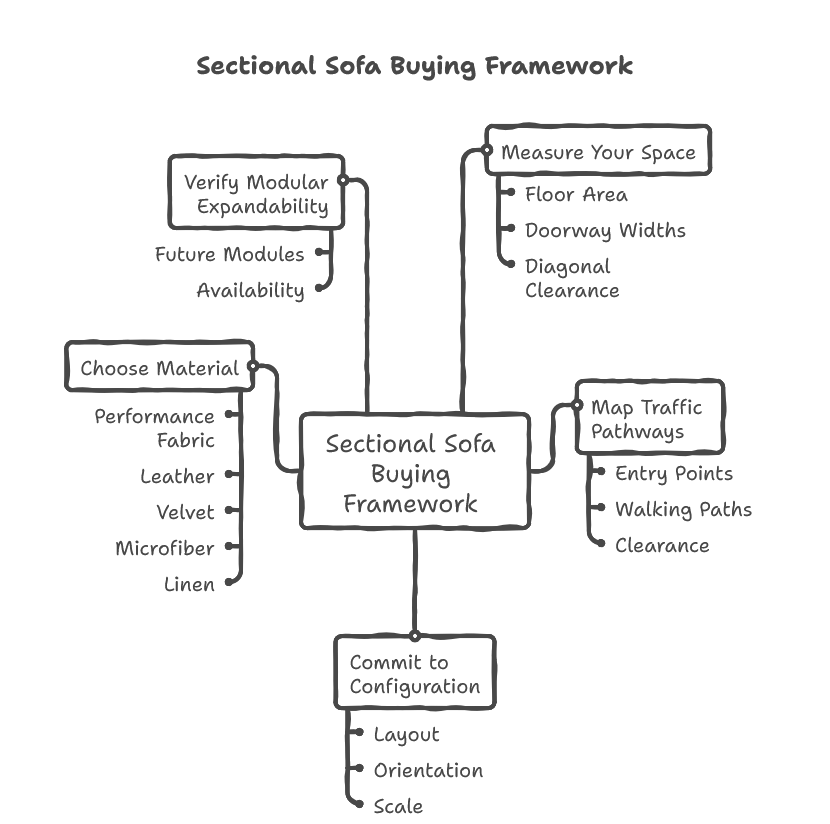
Knowing how sectional sofas work mechanically is only valuable if you can translate it into a smart purchase decision. This is the five-step framework I use when evaluating sectionals for SofiaCrooks.com.
Step 1 — Measure Your Space with Precision
Do not estimate. Measure the full floor area of your living room, note every doorway width (standard interior doors are 28–32 inches), and map the diagonal clearance of any doorways modules must pass through. Create a simple floor sketch with exact dimensions. Place painter’s tape on the floor in the exact footprint of the sectional you’re considering before ordering — this single step eliminates the most common post-delivery regrets.
Step 2 — Map Every Traffic Pathway
Identify all entry points into your living space and the natural walking paths people use daily. Your sectional must not interrupt primary pathways. Maintain a minimum 30–36 inches of clearance on all sides used for regular movement. In homes with children or elderly family members, aim for the full 36 inches.
Step 3 — Commit to a Configuration Before Browsing
Decide on your layout before opening a single product page. It is easy to fall in love with an aesthetically beautiful sectional that is the wrong configuration, wrong orientation, or wrong scale for your room. Know what you need first. Then shop within that constraint.
Step 4 — Choose Material Based on Your Actual Household
Material choice should be driven by honest self-assessment of how your household actually lives — not how you’d like it to live:
| Material | Best For | Durability | Maintenance Level |
|---|---|---|---|
| Performance fabric | Pets, children, high use | Excellent | Low |
| Leather | Low-traffic, formal rooms | Very high | Medium |
| Velvet | Aesthetics, low traffic | Moderate | High |
| Microfiber | Daily comfort | Good | Low |
| Linen | Natural feel, breathability | Moderate | High |
Performance fabrics- engineered textiles with stain-resistant and moisture-wicking properties- are the fastest-growing category in residential upholstery. Brands like Sunbrella, originally designed for outdoor marine furniture, now offer indoor-rated performance fabrics that genuinely resist wine, pet dander, and cooking oils without compromising softness. For households with pets or young children, performance fabric is the single most practical material choice available.
Step 5 — Verify Modular Expandability Before You Pay
Ask one specific question before finalizing any purchase: “Can I buy additional individual modules from this collection in the future, and will they remain available?” Many budget sectionals are sold as sealed, fixed sets with no expansion path. A truly modular system guarantees future module availability. IKEA, Burrow, Lovesac, and Crate & Barrel all maintain long-term module availability as a stated product commitment. Verify this explicitly before purchasing.
Durability Scorecard — Budget vs. Mid-Range vs. Premium
| Component | Budget ($400–900) | Mid-Range ($900–2,000) | Premium ($2,000+) |
|---|---|---|---|
| Frame | Particle board | Engineered wood blend | Kiln-dried hardwood |
| Springs | Webbing straps | Sinuous springs | 8-way hand-tied springs |
| Cushions | Polyester fiberfill | High-resilience foam | HR foam with down wrap |
| Connectors | Velcro or basic clips | Alligator clips | Metal bracket systems |
| Fabric | Standard woven | Stain-treated textile | Performance or genuine leather |
Sofia’s Pick Principle: I always recommend buying one tier above your initial budget in frame quality. The frame is the one component you cannot easily replace. A kiln-dried hardwood frame in a mid-range sectional will outlast two budget frames making the higher initial price consistently worth it over time.
Sectional Placement Science — More Than Just Tips
Good placement makes a properly chosen sectional feel perfectly sized. Poor placement makes an expensive sectional feel wrong in ways you can’t immediately identify.
Three Core Placement Rules
Rule 1 — Maintain 30–36 inches of walkway clearance. This is the minimum passage width for comfortable daily movement, as established by standard interior design practice. In high-traffic areas — between the sofa and a dining table, or between the sofa and the television — aim for the full 36 inches.
Rule 2 — Anchor with a correctly sized rug. The rug must be large enough that all front legs of every module rest on it. For a standard L-shape configuration, an 8×10 foot rug is the practical minimum. For U-shape configurations, a 9×12 foot rug is more appropriate. A correctly sized rug visually grounds the seating group and physically prevents module drift — both functional and aesthetic work in one.
Rule 3 — Align with your room’s focal point. Orient the sectional toward the room’s primary visual anchor -a TV wall, fireplace, large window, or architectural feature. This creates logical sightlines from every seat and ensures the room layout feels purposeful rather than arbitrary.
Spatial Psychology and Sectional Placement
The position of a sectional relative to a room’s entry point has a measurable effect on how welcoming the space feels to people entering it. A sectional positioned with its back directly facing the main entry creates a psychological barrier — visitors experience the space as closed-off before they’ve sat down.
Orienting the sectional so it faces toward or angles toward the room’s entry creates an immediately more open and welcoming atmosphere. This is a principle grounded in environmental psychology research on perceived spatial comfort — not decorating opinion. It costs nothing to implement and is one of the most impactful placement decisions you can make.
Using Sectionals as Room Dividers
In open-concept floor plans, a sectional’s back naturally functions as a soft architectural boundary. This works most effectively when sofa back height falls between 30–36 inches — tall enough to suggest a visual boundary between living and dining zones without blocking light or sightlines above it. Reinforce the zone definition with a pendant light over the dining area and a distinct rug under the sectional to fully separate the two functional spaces.
Mistakes Even Smart Buyers Make
These are the errors that only become visible after delivery when it’s expensive and complicated to fix them:
Ignoring doorway and stairwell dimensions. Always measure the narrowest point each module must pass through before delivery. Even individual sectional modules can measure 36–42 inches in width, which will not fit through a standard 28-inch interior door without significant angling. Measure diagonally too — this determines whether pieces can be tilted upright or must be carried flat.
Buying a non-expandable sectional. Fixed sets may look appealing and feel like better value at checkout, but they offer zero flexibility as your household changes. Always confirm individual module availability before purchasing, not after.
Choosing the wrong seat depth. Standard seat depth runs 21–23 inches. Deep-lounge sectionals commonly feature seat depths of 24–28 inches. These feel exceptional when you’re lying back watching TV but are genuinely uncomfortable for upright sitting for people under 5’5″. Always test seat depth deliberately, especially when buying online.
Underestimating scale after seeing it in a showroom. Showroom floors are designed to make furniture look proportional. They’re typically 1,200–2,000 square feet. A sectional that reads as mid-size in that environment can dominate a 280 sq ft living room. Use painter’s tape on your floor in the exact sofa dimensions before purchasing. Every time.
Not reading the return policy before purchasing. Sectionals are among the most complicated furniture items to return. Many retailers charge 15–25% restocking fees, offer store credit only, or restrict returns to in-store pickup only. Read the policy before purchasing.
Sectional Sofa Trends Shaping 2026
AI-assisted room planning tools. Wayfair’s “View in Room” feature and IKEA’s Place app both use augmented reality to overlay any sectional into your actual living room through your smartphone camera. These tools have materially reduced post-purchase return rates by allowing buyers to verify scale and fit before committing. If you’re buying online, use them — they work.
Sustainable and recycled materials. Consumer demand for verified sustainable furniture has pushed major manufacturers to introduce sectionals featuring recycled polyester cushion fill, FSC-certified wood frames, and low-VOC adhesives. Brands like Medley and Inside Weather have built product lines around independently verified sustainable sourcing — a category that is growing, not fading.
Smart sectionals with integrated technology. Wireless charging pads built into armrests, USB-C ports embedded in side panels, and IoT-connected recliner modules that integrate with home automation systems are moving from concept to mid-range availability. Still premium-priced in 2026, but entering the mainstream faster than most industry observers predicted.
Deep-seat cloud and bouclé aesthetics. The ultra-low, pillow-top “cloud sofa” form factor pioneered by brands like Natuzzi and widely referenced across interior design platforms in 2024–2025 has settled into the mainstream in 2026. Deep-seat sectionals in bouclé, teddy fabric, and oversized cushion formats are the dominant aesthetic trend this year across mid-to-premium price points.
Frequently Asked Questions
How do sectional sofas work mechanically?
Sectional sofas work by connecting multiple independent upholstered modules using hardware connectors — typically alligator clips, metal brackets, or hook-and-slot systems located beneath the sofa frame. Each module is self-supporting, and the connectors hold adjacent pieces flush and stable. The combined weight of people sitting during normal use actually reinforces the connection, compressing joints inward and preventing drift.
Can sectional sofas be separated and rearranged?
Yes. Most sectional sofas are specifically designed to be separated and reconfigured. You disconnect the hardware connectors (located underneath the modules), reposition the pieces, and reconnect. Fully modular systems from brands like Lovesac, Burrow, and IKEA allow extensive rearrangement flexibility. Fixed-set sectionals offer more limited reconfiguration but can still typically be separated for moving.
What is the difference between left-facing and right-facing sectionals?
Left-facing (LAF) means the chaise or longer section extends to your left when you stand in front of the sofa facing it. Right-facing (RAF) means it extends to your right. This distinction is critical when ordering online — the wrong orientation can block doorways or extend into traffic pathways in your room.
Are sectional sofas better than traditional sofas?
Sectional sofas offer more seating capacity, layout flexibility, and long-term cost efficiency through modular repairability. Traditional sofas are better suited to smaller rooms (under 200 sq ft), homes with narrow doorways, and people who prefer simpler styling. The right choice depends entirely on your room size, household size, and lifestyle.
How do you move a sectional sofa?
Disconnect each module using the connector hardware beneath the sofa. Move each module individually — they are light enough for one or two people to carry and maneuver through standard doorways. This is one of the strongest practical advantages sectionals have over traditional sofas, which frequently require professional movers or cannot fit through doorways at all.
How long do sectional sofas last?
A budget sectional with a particle board frame and polyester fill typically lasts 3–5 years under regular household use. A mid-range model with sinuous springs and high-resilience foam lasts 7–10 years. Premium sectionals built on kiln-dried hardwood frames with 8-way hand-tied springs are designed to last 15–20 years with proper care, according to durability standards established by the American Home Furnishings Alliance.
Can you sleep on a sectional sofa?
Yes, particularly on chaise sections, which are designed for full-length lounging. Many sectionals are also available in sleeper configurations where a chaise or armless section contains a pull-out mattress. Deep-seat sectionals with seat depths of 28 inches or more are commonly used for overnight guest sleeping and function comfortably for that purpose.
What size rug do I need under a sectional?
For an L-shape sectional in a standard living room, an 8×10 foot rug is the practical minimum. For U-shape configurations, a 9×12 foot rug is appropriate. The correct sizing rule: all front legs of every module should rest on the rug surface. This both visually anchors the seating group and physically reduces module drift on hard floor surfaces.
How do I stop my sectional from separating?
Ensure all hardware connectors are properly fastened and tightened. Place a large area rug under the full sectional footprint. This is the single most effective anti-separation strategy. On hardwood or tile floors, add rubber furniture pads to the feet of each module. On carpet, heavy-duty carpet gripper pads beneath module feet provide additional friction.
Are modular sofas worth the higher price?
For most households, yes, over a 5-to-10-year horizon. The ability to expand, reconfigure, and replace individual modules means a quality modular sectional pays for itself compared to replacing a fixed sofa every 5–7 years. The critical condition: verify explicitly that the manufacturer guarantees long-term individual module availability before purchasing.
Final Thoughts
Sectional sofas are one of the highest-value furniture investments you can make for a modern home . When you choose one based on engineering not just aesthetics. The frame material, suspension system, and connector type will determine how your sofa feels and performs three years from now far more than the fabric color or cushion profile.
Start with your space. Measure carefully. Commit to a configuration before you browse. Then find the best-built version of that configuration within your budget prioritizing frame quality above everything else.
At SofiaCrooks.com, comfort isn’t a trend we chase. It’s the standard every recommendation is built around. A well-researched sectional sofa isn’t just a piece of furniture. It becomes the center of your home.