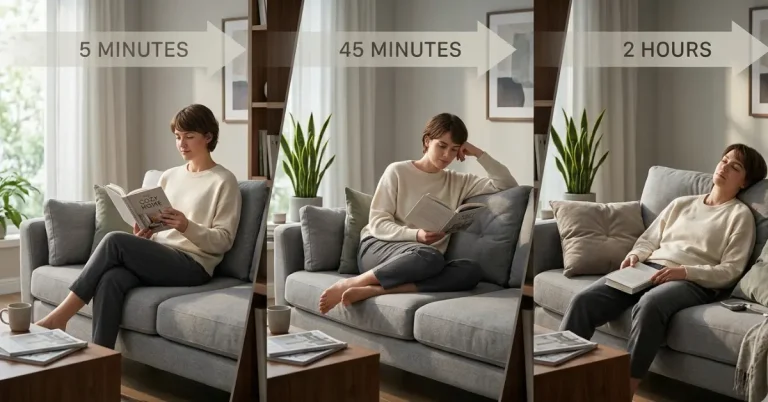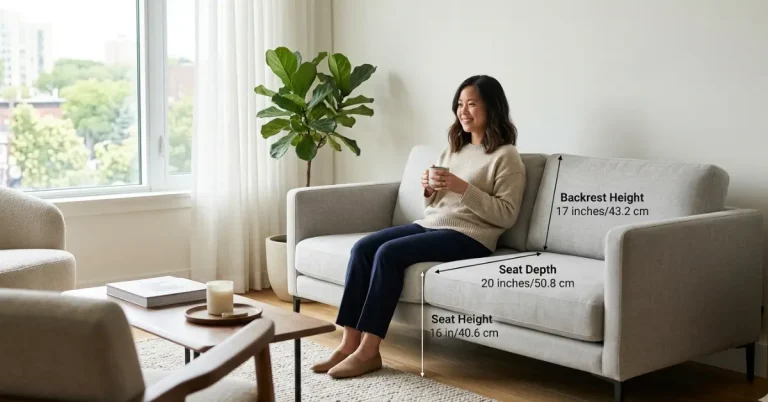
Sit on a typical sofa.
Your feet don’t touch the floor.
Your lower back floats with no support.
You slide forward just to feel stable.
That’s not comfort. That’s bad design for your body.
If you’re under 5 feet, most sofas are simply too deep. They’re built for average heights, not petite frames. So even an expensive couch can feel awkward after 10 minutes.
Here’s the good news. You don’t need to guess.
In this guide, you’ll get:
- The exact sofa depth that actually fits your height
- A clear chart based on real body proportions
- Practical buying advice
- And the best sofas in the USA that won’t leave you slouching
No fluff. Just what works.
2. What Is the Ideal Sofa Depth for Under 5 Feet?
If you’re under 5 feet tall, the ideal sofa seat depth is 16 to 18 inches (40 to 46 cm).
Here’s why that range works.
Your thighs are shorter. So when the seat is too deep, your back can’t rest against the backrest without your legs sticking straight out. That’s when slouching starts.
A 16 to 18 inch depth lets you:
- Sit all the way back
- Keep your feet flat on the floor
- Maintain proper lower back support
That’s real comfort. Not just soft cushions.
Before You Buy
The Short Person’s Sofa Fit Guide
A printable height-to-dimensions chart, self-measuring steps, and a shopping checklist — know your exact numbers before you shop.
Get the Guide — $9 →3. What Is Sofa Depth and Why Do People Get It Wrong?
Most buyers look at one number and think they understand it. They don’t.
“Sofa depth” can mean two different things. Only one actually affects your comfort.
When you’re choosing the right sofa depth, it helps to understand basic ergonomics and body posture principles that explain how seating affects spinal alignment and comfort.
What Is Total Sofa Depth?
This is the full measurement from the back of the sofa to the front edge.
It includes:
- Backrest thickness
- Seat cushions
- Frame
It tells you how much space the sofa takes in your room.
It does not tell you how it will feel to sit on.
What Is Seat Depth?
Seat depth is what actually matters.
It’s the distance from the back cushion to the front edge of the seat where you sit.
This is the number that decides:
- Whether your back touches the backrest
- Whether your feet stay flat on the floor
- Whether you sit upright or start slouching
If you ignore this, you’re guessing.
Why Does Seat Depth Matter More for Short People?
Because your body proportions are different.
Shorter height usually means shorter thighs. That changes everything.
Here’s a real scenario.
You sit on a deep sofa with a 22-inch seat depth.
You try to lean back.
Your legs are too short to bend comfortably at the edge.
So you shift forward.
Now:
- Your lower back loses support
- Your posture collapses
- You start adjusting every few minutes
That’s not a cushion problem. That’s a depth problem.
For someone under 5 feet, even a few extra inches can ruin comfort.
So when you check product specs, ignore total depth for a moment.
Go straight to seat depth.
That one number decides if the sofa fits your body or not.
4. What Is the Ideal Sofa Depth by Height?
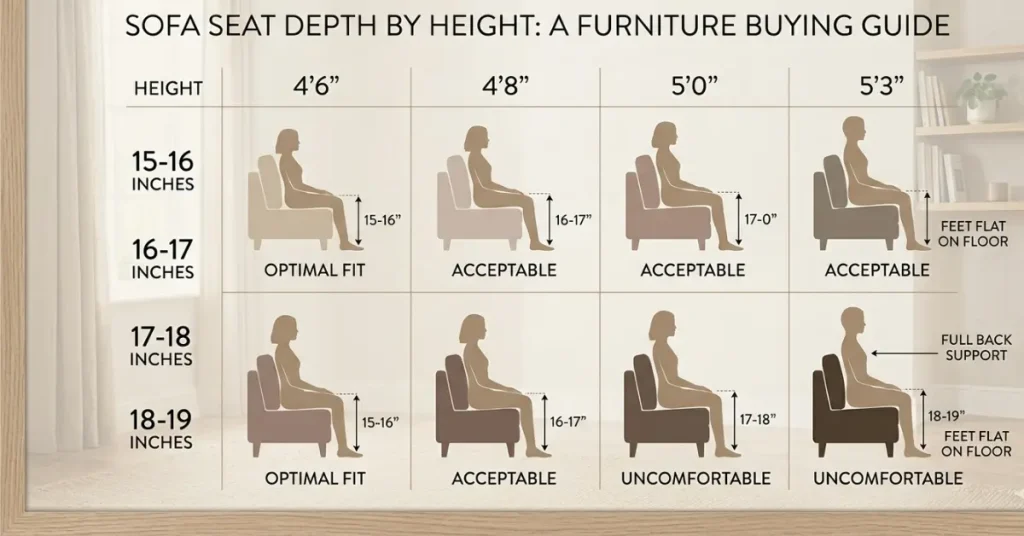
You don’t need guesswork. Your height gives you a clear starting point.
Here’s a simple chart you can actually use when shopping.
| Height | Ideal Seat Depth |
|---|---|
| 4’6″–4’8″ | 15–16 inches |
| 4’8″–5’0″ | 16–18 inches |
| 5’0″–5’3″ | 17–19 inches |
Look at where you fall. Stay within that range.
If you’re under 5 feet, the sweet spot is usually 16 to 18 inches. Go deeper than that and things start to feel off fast.
Here’s what happens in real life.
You sit down on a 22-inch deep sofa.
Your back can’t reach the backrest.
So you slide forward.
Now your lower back has zero support.
That’s the problem this chart solves.
Use it when:
- Comparing sofa specs online
- Testing sofas in a showroom
- Deciding between two similar models
Ignore it, and you’re back to trial and error.
5. Why Do Standard Sofas Feel Uncomfortable for Short People?
Most sofas are not built for you. Simple as that.
The average sofa seat depth is 21 to 24 inches. That works for taller people. Not for someone under 5 feet.
Here’s what actually goes wrong.
No lower back support
You can’t sit all the way back. Your spine stays unsupported. After a while, you feel it.
Dangling or stretched legs
Your feet either don’t touch the floor or you have to stretch to reach it. Neither feels stable.
Neck and back strain
You start adjusting your posture without realizing it. Slouching. Leaning. Twisting slightly. That adds up.
A sofa can look perfect online. Plush cushions. Modern design.
But if the seat depth is wrong, none of that matters.
Comfort is not about softness. It’s about fit.
6. How Do You Measure the Right Sofa Depth for Your Body?
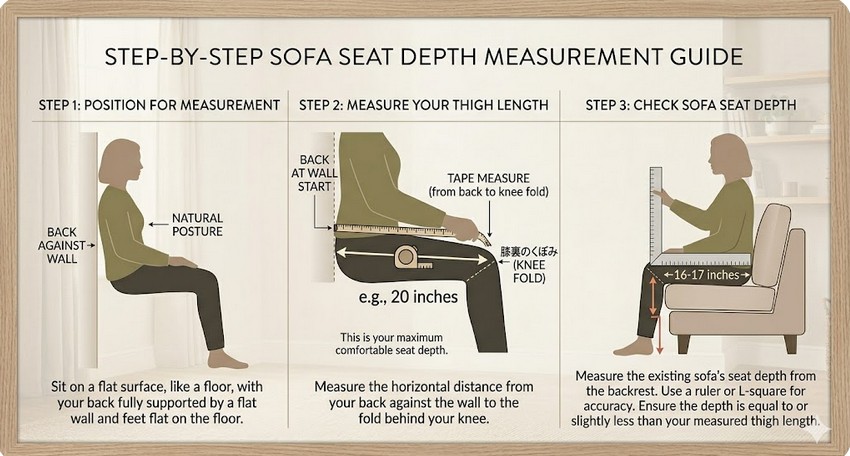
Don’t rely on showroom comfort alone. It’s misleading. A sofa feels different after 10 minutes at home.
Most people don’t realize that average sofas are built using standard proportions, and a quick look at a standard sofa dimensions guide shows why shorter users often struggle with deep seating.
Use this simple method before you buy.
Sit Against the Wall Method
This is the most practical real-world test.
Sit on the floor with your back against a wall.
Keep your posture natural, not forced straight.
Now check one thing.
Where do your knees land?
Measure the distance from your lower back to the back of your knees.
That number gives you a rough idea of your ideal seat depth.
If you’re under 5 feet, you’ll usually land in the 16–18 inch range.
Measure Your Thigh Length
This step removes guesswork completely.
Measure from your hip joint to the back of your knee.
That is your usable seat depth range.
Shorter thighs mean you need a shallower seat.
Otherwise your legs float forward or your back loses contact.
Always Leave 1 to 2 Inches of Margin
Never match your measurement exactly.
Give yourself a small buffer.
Why?
Because cushions compress when you sit.
And sofa backs are not perfectly rigid.
So if your ideal range is 17 inches, aim for 16 to 18 inches.
Not 20. Not more.
That small detail is what separates comfortable seating from constant shifting.
7. What Other Sofa Dimensions Actually Matter for Short People?
Most guides stop at seat depth. That’s not enough. Real comfort depends on a few more hidden dimensions.
Seat Height Matters More Than People Think
Ideal seat height for short people is 16 to 18 inches.
If it’s too high:
- Feet dangle
- Pressure builds under thighs
- You feel unstable
If it’s too low:
- Standing up feels awkward
- Knees bend too sharply
You want your feet flat on the floor with relaxed knees. Nothing forced.
Back Height Changes Your Posture
A low back looks modern. But it often fails support.
For shorter users:
- Mid-back support is usually enough
- Too high can feel bulky and unnecessary
- Too low leads to shoulder strain
You want support where your natural posture meets the sofa, not above or below it.
Cushion Firmness Is Not Just Comfort, It’s Alignment
Soft cushions feel good for five minutes. Then problems start.
For short people, overly soft cushions cause:
- Sinking deeper than expected
- Loss of seat depth accuracy
- Slouched spine position
A medium-firm cushion works better.
It keeps your body at the right height and maintains structure over time.
Comfort is not just about softness. It’s about control of posture.
9. How Can You Make Any Sofa Work for Short People?
Not every sofa will match your ideal depth. That’s reality. But you can still fix a lot with small adjustments.
Use Lumbar Pillows for Back Support
Deep sofas often fail one thing. Lower back support.
A simple lumbar pillow changes that.
It pushes your lower back forward so:
- You stop slouching
- Your spine stays aligned
- You don’t sink into the cushions
This is the fastest fix if your sofa feels too deep.
Add a Footrest for Stability
If your feet don’t reach the floor comfortably, don’t ignore it.
A small footrest solves:
- Dangling legs
- Pressure under thighs
- Restless sitting posture
Even a simple ottoman can completely change how stable a sofa feels.
Choose Firmer Cushions When Possible
Soft cushions feel good at first. Then you sink too far.
For short people, that creates a hidden problem. The seat depth effectively becomes deeper than advertised.
Firm cushions help you:
- Stay at the correct seating height
- Maintain proper knee angle
- Keep your posture stable over time
You’re not chasing softness here. You’re chasing alignment.
10. Frequently Asked Questions About Sofa Depth for Short People
These are the exact questions people search before buying. Answering them clearly also helps search engines understand your page better.
Is 22-inch seat depth too deep for a short person?
Yes, in most cases it is.
For someone under 5 feet, 22 inches usually forces you to lean forward or slouch. You lose lower back support and your feet may not stay grounded.
It can still work only if you use strong lumbar support or sit more upright than relaxed.
What is the shallowest sofa depth that still feels comfortable?
For most short people, anything around 15 to 16 inches seat depth is on the shallow end.
It works well for very petite users or compact seating setups.
But going too shallow can also feel stiff, so balance matters. The sweet spot is still usually 16 to 18 inches.
Can a short person use a deep sofa?
Yes, but not without adjustments.
Deep sofas can work if you:
- Use lumbar pillows
- Add a footrest
- Sit with intentional posture support
Without those, comfort usually breaks down quickly over long sitting sessions.
11. Conclusion: What Actually Matters When Choosing Sofa Depth
If you remember one thing, keep it simple.
For people under 5 feet, the real comfort range is 16 to 18 inches seat depth.
Not because it sounds good on paper.
Because it matches how your body actually sits.
Everything else is adjustment.
Before you buy anything, do one thing first.
Measure your body. Check the seat depth. Compare both.
That small step saves you from years of uncomfortable seating and wasted money.