The Furniture Fit Problem
Why a Comfortable Sofa Can Still Feel Wrong
When a sofa feels uncomfortable, it is easy to assume the furniture is poorly designed or made with inferior materials. In reality, discomfort often has a different cause: the sofa’s dimensions do not match the user’s body dimensions. This mismatch is known as furniture fit.
Furniture fit describes how well a piece of furniture supports the physical characteristics of the person using it. A sofa with good furniture fit allows the body to rest in a stable, natural position with appropriate support and minimal unnecessary strain. A sofa with poor furniture fit can create discomfort even if it is well constructed, made from premium materials, and highly rated by other users.
This distinction changes an important assumption. A sofa is not universally comfortable or uncomfortable. Its comfort depends on how well its dimensions interact with the person sitting on it.
Comfort Is More Than Personal Preference
Many people think comfort is entirely subjective- that one person likes a sofa while another does not. Personal preference certainly influences choices such as fabric texture, cushion firmness, or visual style. However, ergonomic comfort is not based on preference alone. It is also influenced by measurable physical relationships between the human body and furniture.
For example, if a person’s feet cannot rest naturally on the floor because the seating position is too high, the resulting discomfort is not simply a matter of opinion. The body receives less support, muscles work harder to maintain balance, and pressure may increase beneath the thighs. These are physical outcomes that can be explained and evaluated using measurable dimensions.
Understanding this difference helps separate subjective preference from objective furniture fit. A person may prefer a softer cushion, but they are unlikely to remain comfortable if the sofa’s dimensions do not support their body properly.
Why Short People Experience Furniture Fit Differently
Furniture manufacturers often design products to accommodate a broad range of users rather than the specific proportions of every individual. As a result, a sofa that works well for an average-sized adult may not provide the same experience for someone with a shorter stature.
For a short person, common furniture-fit problems may include:
- Feet that do not rest fully on the floor.
- Increased pressure beneath the thighs.
- Difficulty sitting back against the backrest.
- Extra effort when sitting down or standing up.
- A feeling of sliding forward instead of sitting securely.
These outcomes are not necessarily signs of poor furniture quality. Instead, they indicate that the sofa’s dimensions are not well matched to the user’s body dimensions.
How Anthropometry and Ergonomics Work Together
Understanding furniture fit requires two complementary fields of study: anthropometry and ergonomics.
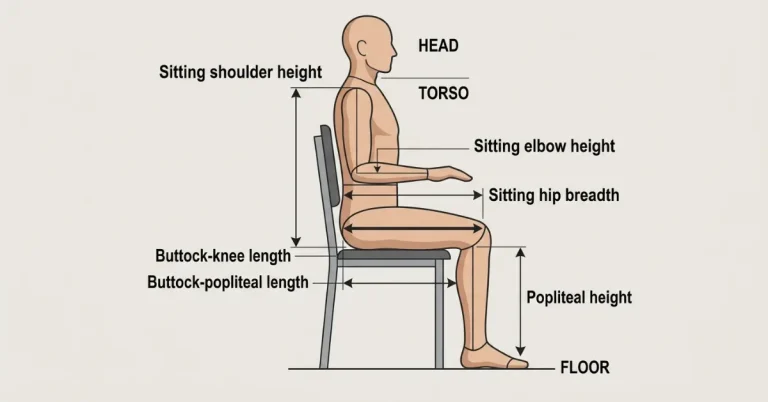
Anthropometry is the scientific study of human body measurements and proportions. It examines measurable characteristics such as lower-leg length, thigh length, sitting height, and body width. These measurements help designers understand how people differ from one another.
Ergonomics applies that information to the design and evaluation of products, environments, and systems. In furniture design, ergonomics focuses on creating seating that supports natural posture, efficient movement, and long-term comfort.
These disciplines perform different but connected roles:
- Anthropometry measures the human body.
- Ergonomics evaluates how the body interacts with furniture.
- Together, they determine whether a sofa provides good furniture fit.
This relationship is widely used in furniture engineering, industrial design, product development, and human-centered design because it replaces assumptions with measurable evidence.
From Body Dimensions to Body–Furniture Compatibility
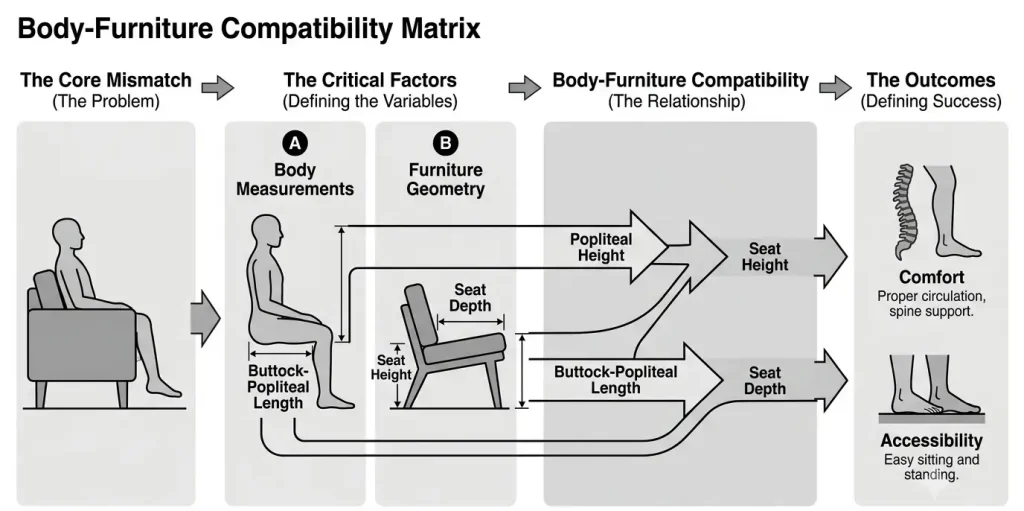
Good furniture fit is achieved through body–furniture compatibility—the degree to which furniture dimensions correspond to the user’s body dimensions.
This compatibility cannot be determined by looking at a sofa alone or by knowing only a person’s overall height. Instead, it depends on how specific furniture dimensions relate to specific body dimensions.
Consider two adults who are both 5 feet 2 inches (157 cm) tall. One has relatively long lower legs and a shorter torso, while the other has shorter lower legs and a longer torso. Although they share the same overall height, they may experience the same sofa very differently because the body dimensions that influence sitting posture are not identical.
This example illustrates an important principle: overall height is only one body measurement. Furniture fit depends on the relationship between multiple body dimensions and multiple furniture dimensions working together.
Evaluating Furniture More Objectively
Thinking in terms of body–furniture compatibility changes how a sofa should be evaluated.
Instead of asking, “Is this sofa comfortable?”, a more useful question is:
“Do this sofa’s dimensions support my body dimensions?”
This approach transforms furniture selection from guesswork into a process that can be evaluated systematically. Rather than relying solely on appearance, reviews, or first impressions, comfort becomes something that can be understood through measurable relationships between the human body and furniture.
Before those relationships can be evaluated, it is necessary to understand the language of sofa dimensions. Each dimension describes a different aspect of how a sofa supports the body and together they form the foundation of furniture fit.
Understanding Sofa Dimensions
A Sofa Is a System of Connected Measurements
Once furniture fit is understood as the relationship between the body and the furniture, the next step is understanding the measurements that define a sofa. These measurements are called furniture dimensions.
A furniture dimension is a measurable physical characteristic that describes the size, position, or shape of part of a piece of furniture. Each dimension provides different information about how the furniture functions. Some determine how the body is supported, while others influence movement, accessibility, or the amount of space the furniture occupies.
A common mistake is to evaluate a sofa using only one measurement. In reality, a sofa functions as a system of interconnected dimensions. Changing one dimension often changes how another dimension performs, which means comfort cannot be predicted from a single number alone.
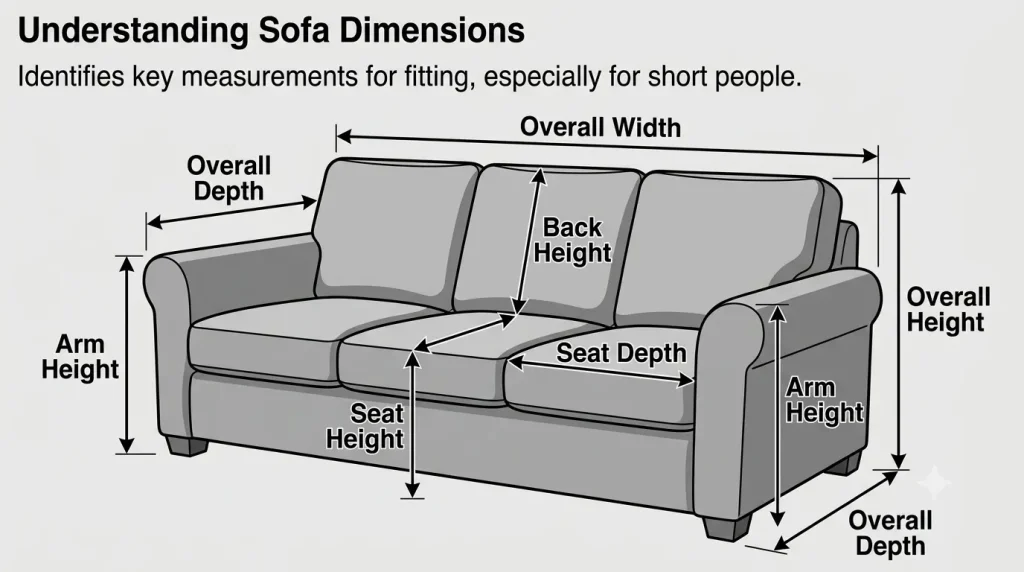
The Primary Dimensions That Influence Furniture Fit
Although sofas have many measurable characteristics, five dimensions have the greatest influence on body–furniture compatibility:
- Seat height
- Seat depth
- Seat width
- Back height
- Arm height
Each answers a different ergonomic question about how the sofa supports the body.
Seat Height
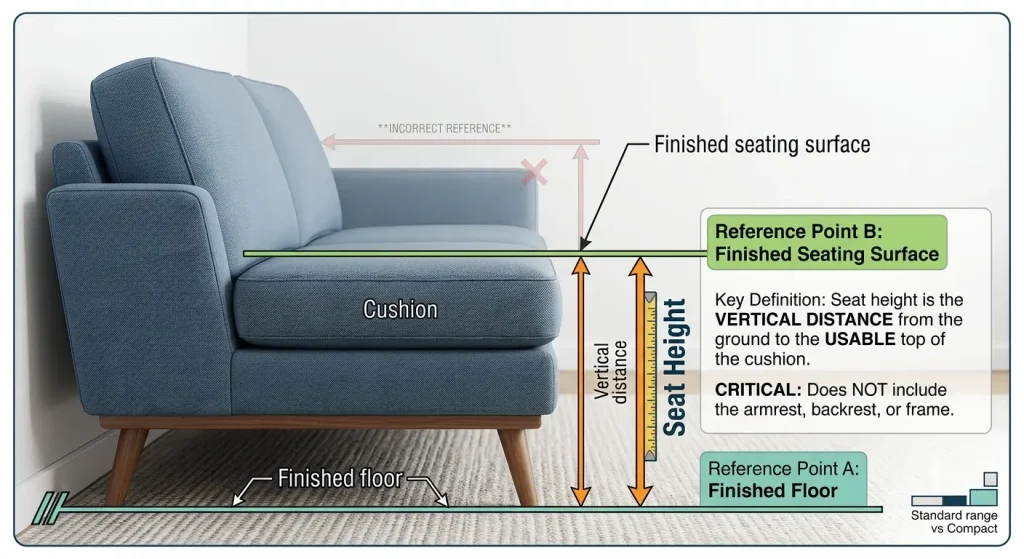
Seat height is the vertical distance between the finished floor and the seating surface.
This dimension determines how high the body sits above the floor and influences whether the feet can rest naturally on the ground. It also affects the angles of the knees and hips, weight distribution through the lower body, and the effort required to sit down or stand up.
For shorter people, seat height is often the most influential furniture dimension because it directly affects lower-body support and accessibility.
Seat Depth
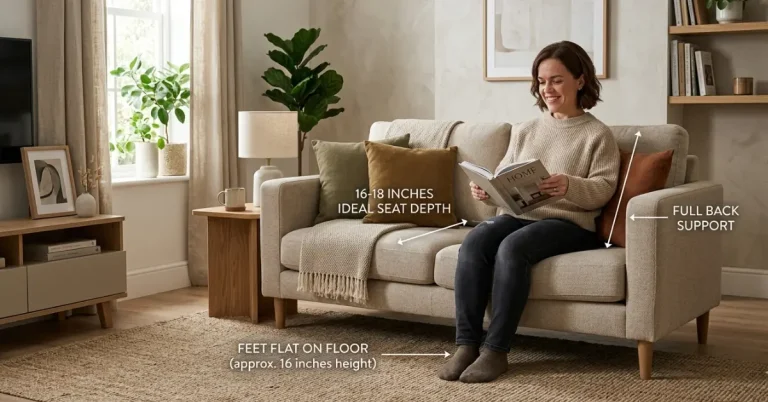
Seat depth is the horizontal distance from the front edge of the seating surface to the point where the back cushion or backrest begins.
This measurement determines how much of the thighs are supported while allowing the back to rest comfortably against the backrest.
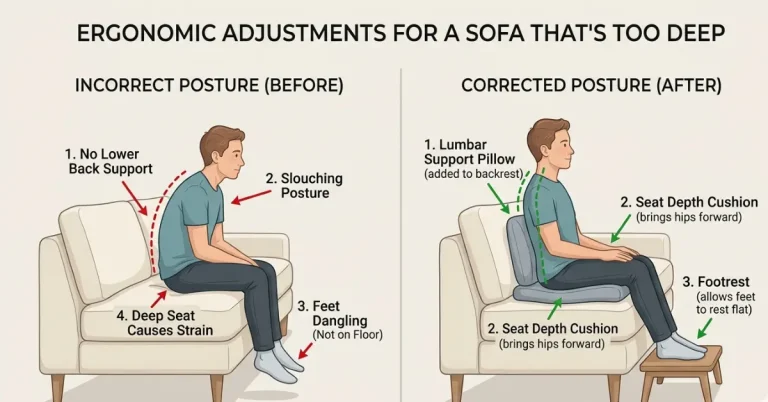
If the seat is too deep, a shorter user may need to slide forward to keep both feet on the floor. While this may improve lower-body positioning, it also reduces back support because the body no longer reaches the backrest naturally.
Conversely, a seat that is too shallow may provide less thigh support even if the backrest is easily reached.
Seat height and seat depth therefore work together rather than independently.
Seat Width
Seat width is the usable horizontal space available for one person to sit comfortably.
Unlike seat height or seat depth, seat width usually has less influence on whether a sofa fits a short person. Instead, it affects freedom of movement, personal space, and seating capacity.
However, seat width still contributes to overall comfort. A very narrow seat may restrict natural posture, while an exceptionally wide seat may encourage positions that reduce back support unless additional cushions are used.
Its influence depends more on body width and preferred sitting posture than on overall height.
Back Height
Back height is the vertical distance from the seating surface to the highest point of the backrest.
This dimension determines which parts of the upper body receive support. A low backrest may support only the lower and middle back, while a taller backrest may also support the shoulders, neck, or head.
Back height influences upper-body comfort but does not determine whether the lower body is properly supported. A sofa can have an excellent backrest yet still provide poor furniture fit if its seating dimensions are incompatible with the user.
Arm Height
Arm height is the vertical distance from the seating surface to the top of the armrest.
Proper arm height allows the forearms to rest comfortably while keeping the shoulders relaxed. Armrests that are too high may elevate the shoulders, while armrests that are too low may provide little useful support.
Arm height also influences how easily users enter and leave the sofa, especially when using the armrests for assistance during movement.
Although it is not a primary determinant of lower-body fit, it contributes to the overall ergonomic experience.
How Sofa Dimensions Work Together
The primary sofa dimensions should never be evaluated in isolation because each one influences how the others perform.
For example, imagine two sofas with an identical seat height of 18 inches (46 cm).
The first sofa has a seat depth of 20 inches (51 cm).
The second has a seat depth of 24 inches (61 cm).
Even though both seating surfaces are the same height, the experience can be very different for a shorter user. On the shallower sofa, the user may be able to sit fully against the backrest while keeping both feet comfortably on the floor. On the deeper sofa, the same user may need to move forward to maintain foot contact, reducing back support and changing overall posture.
The seat height has not changed, but its practical effect has changed because it interacts with another dimension.
This illustrates an important principle of furniture ergonomics: individual dimensions influence one another, and furniture fit depends on their combined effect rather than any single measurement.
Design Always Involves Trade-offs
Furniture designers rarely optimize every dimension simultaneously because changing one characteristic often affects another.
For example:
- Increasing seat depth can create a more relaxed lounging position but may reduce accessibility for shorter users.
- Increasing back height can improve upper-body support but also changes the sofa’s visual scale and overall height.
- Raising arm height may provide better arm support while making it more difficult for some users to shift positions or lie across the sofa.
These trade-offs explain why no single combination of dimensions is ideal for every person or every activity. The most appropriate dimensions depend on how the sofa will be used and how well its measurements correspond to the user’s body.
Overall Height Is Not the Same as Seat Height
One of the most misunderstood furniture dimensions is overall height.
Overall height is the vertical distance from the finished floor to the highest point of the sofa, usually the top of the backrest.
Because it measures the entire piece of furniture, it is useful for determining whether the sofa will fit beneath windows, through doorways, or within a room. However, it does not indicate how high the seating surface is.
Two sofas can have dramatically different overall heights while providing exactly the same seating position. Likewise, two sofas with similar overall heights may have noticeably different seat heights because of differences in frame design, cushion construction, or backrest proportions.
Confusing these dimensions is a common reason buyers misjudge how a sofa will feel before they try it.
Reading Furniture Dimensions as a Complete System
Furniture manufacturers typically publish these measurements in product specification sheets so buyers can compare models before purchasing. While each dimension has its own definition and purpose, they should be interpreted as parts of a connected system rather than as independent values.
Understanding the language of sofa dimensions makes product specifications easier to interpret and allows meaningful comparisons between different designs. Among these dimensions, one serves as the primary reference point for evaluating how the lower body interacts with the floor. Before it can be measured accurately or interpreted correctly, it must first be defined with complete precision.
Defining Sofa Seat Height
Why a Precise Definition Matters
Before a sofa seat height can be measured, compared, or evaluated, it must be defined precisely. Although the term seat height appears straightforward, it is one of the most frequently misunderstood furniture dimensions because different people—and sometimes different manufacturers—use different reference points.
Without a consistent definition, two people can measure the same sofa and report different results. Likewise, two sofas with similar published dimensions may appear equivalent even though they provide different seating experiences. A precise definition establishes a common measurement language, making comparisons reliable and repeatable.
What Is Sofa Seat Height?
Sofa seat height is the vertical distance from the finished floor to the usable seating surface of the sofa when the seat is unoccupied.
Each part of this definition has a specific meaning.
A vertical distance is a straight-line measurement taken perpendicular to the floor. It is not measured along the slope of a cushion or the angle of the sofa frame.
The finished floor is the surface on which the sofa rests after installation, such as hardwood, tile, vinyl, laminate, or carpet. Every seat-height measurement begins from this reference point.
The usable seating surface is the area that normally supports the occupant during everyday sitting. On most upholstered sofas, this is the top of the fully expanded seat cushion rather than decorative trim, piping, or raised cushion edges.
Because these reference points remain consistent regardless of sofa style, they allow meaningful comparisons between different products.
The Three Reference Points
Every accurate seat-height measurement depends on three fixed reference points:
- Starting point: the finished floor.
- Measurement direction: a true vertical line.
- Ending point: the usable seating surface.
Changing any one of these reference points changes the measurement itself.
For example, measuring from the bottom of the sofa frame instead of the finished floor ignores flooring thickness and produces an inconsistent result. Measuring along the front edge of a sloped cushion instead of vertically creates a longer measurement that does not represent the actual seating position.
Reference points therefore determine measurement consistency, which is essential when comparing sofas from different manufacturers or measuring the same sofa over time.
Understanding the Seating Surface
Although the seating surface appears simple, it is not always flat.
Many sofas use crowned cushions, where the center of the cushion is slightly higher than the edges to improve appearance and comfort. Others use flatter cushions with minimal contouring.
The seating surface refers to the area that supports the body during normal use—not necessarily the highest decorative point on the cushion.
This distinction matters because decorative features such as piping, tufting, or rounded edges can increase the visible height without changing the functional sitting position.
The goal is to measure the surface that determines where the occupant actually sits.
Nominal Seat Height vs. Effective Seat Height
One of the most useful distinctions when evaluating sofas is the difference between nominal seat height and effective seat height.
Nominal seat height is the published dimension provided by the manufacturer. It is typically measured on an unoccupied sofa with the cushion fully expanded and is intended to provide a consistent specification for product comparison.
Effective seat height is the seating height experienced by the user after sitting on the sofa. Because cushions compress under body weight, the effective seat height is usually lower than the nominal seat height.
The amount of difference depends on factors such as:
- Cushion material
- Cushion firmness
- Cushion thickness
- Suspension system
- Body weight
- Cushion wear over time
Understanding this distinction prevents a common misconception: two sofas with the same published seat height may not place the user at the same sitting height during actual use.
Published specifications describe the sofa before it is occupied. Effective seat height describes the seating position while it is being used.
Seat Height Compared with Similar Furniture Dimensions
Seat height is only one measurement within a larger furniture measurement system, and it should not be confused with related dimensions.
Overall height measures from the finished floor to the highest point of the sofa, usually the top of the backrest. It describes the overall size of the furniture rather than the height of the seating position.
Back height measures the vertical support available for the upper body. It influences shoulder, neck, and head support but does not determine how high the user sits.
Arm height measures the position of the armrests relative to the seating surface or, in some specifications, relative to the floor. It affects arm support and ease of movement but is independent of seat height.
Another important measurement is deck height.
The seat deck is the structural platform beneath the seat cushion that supports the seating system. Deck height is the vertical distance from the finished floor to the top of this platform before the cushion is added.
Because the cushion rests on the seat deck, the finished seat height depends on both measurements.
The relationship can be expressed simply:
Deck Height + Cushion Thickness (after full expansion) = Nominal Seat Height
This relationship explains why two sofas with similar frames can have different seating heights simply because they use different cushion designs.
Understanding Manufacturer Specifications
Most furniture manufacturers publish seat height in inches or centimeters within product specification sheets. These dimensions are intended to provide practical comparison values rather than laboratory measurements.
Small variations may occur because of:
- Upholstery thickness
- Cushion construction
- Manufacturing tolerances
- Whether the cushions are fixed or removable
- The manufacturer’s measurement procedure
A measurement tolerance is the acceptable variation between the published specification and the finished product that naturally occurs during manufacturing.
Understanding tolerances helps readers interpret specifications realistically. A small difference between a published dimension and an independently measured value does not necessarily indicate an error or a defect.
A Common Language for Evaluation
A precise definition of sofa seat height does more than explain where a tape measure begins and ends. It establishes the reference points needed to measure consistently, interpret product specifications accurately, and compare different sofas objectively.
Once the measurement itself is clearly defined, the next challenge is ensuring that it is collected using a reliable and repeatable method so the results can be trusted in real-world comparisons.
Measurement Science: Principles and Engineering Foundations
Why Measurement Methodology Matters
A sofa’s seat height is often presented as a single number—for example, 18 inches (46 cm). While this value appears objective, the number itself has little meaning unless the measurement methodology is understood.
A measurement is not simply reading a value from a tape measure. It is a standardized process that transforms a physical object into reliable information that can be compared, evaluated, and used to make decisions.
In engineering, manufacturing, ergonomics, and furniture design, a useful measurement must answer three questions:
- What is being measured?
- Where is it measured from?
- How is it measured?
If any of these questions are answered differently, the resulting value may no longer represent the same physical characteristic.
For this reason, measurement should be viewed as a structured system rather than a single action.
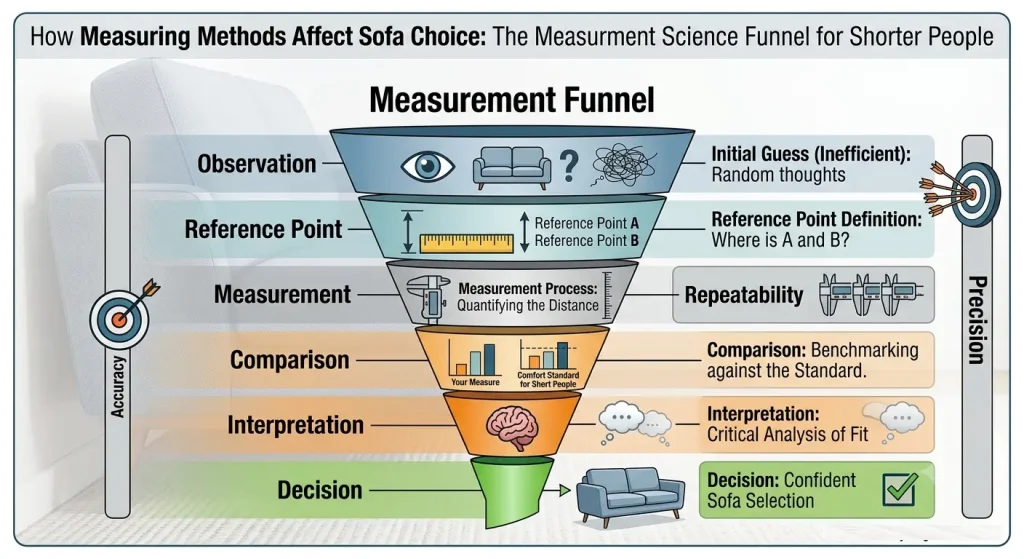
A useful mental model is:
Observation → Quantification → Comparison → Interpretation → Decision
Each stage depends on the one before it.
- Observation identifies the physical characteristic to evaluate.
- Quantification assigns that characteristic a numerical value.
- Comparison evaluates that value against another measurement or standard.
- Interpretation determines what the comparison means.
- Decision uses that interpretation to select, reject, or modify a product.
This sequence explains why measuring a sofa is not the goal. The goal is making an informed furniture decision, and measurement is the evidence that supports that decision.
Measurement Begins with Furniture Geometry
Every sofa has a furniture geometry—the three-dimensional arrangement of its frame, cushions, and support surfaces.
Furniture geometry creates measurable characteristics known as furniture dimensions.
Examples include:
- Seat height
- Seat depth
- Seat width
- Back height
- Arm height
These dimensions do not exist independently. They are geometric properties of the furniture that can be observed, measured, and compared.
Measurement therefore connects furniture geometry with furniture evaluation.
Without measurement, geometry remains descriptive.
With measurement, geometry becomes quantifiable.
Every Measurement Depends on a Datum Plane
Engineering measurements require a stable starting location known as a datum plane.
A datum plane is the fixed reference surface from which all related measurements begin.
For sofa seat height, the finished floor serves as the datum plane because it remains constant regardless of cushion shape, upholstery style, or frame construction.
Using a common datum plane ensures that different sofas can be compared under the same geometric conditions.
If one person measures from the finished floor while another measures from the bottom of the sofa frame, the measurements describe two different reference systems.
Neither value is necessarily incorrect.
They simply measure different things.
For meaningful comparison, the datum plane must remain consistent.
Reference Points Create Comparable Measurements
A reference point is a precisely defined location used to begin or end a measurement.
Reference points transform approximate observations into repeatable measurements.
For seat height, the reference system consists of:
- Datum Plane: Finished floor
- Ending Reference Point: Usable seating surface
- Measurement Direction: Vertical
Together, these three elements create a standardized measurement system.
Changing any one of them changes the measurement itself.
This explains why identical sofas sometimes appear to have different seat heights when measured using different techniques.
The difference often lies not in the furniture, but in the reference system used by the observer.
Understanding the Measurement Axis
Knowing where a measurement starts is only part of the process.
The next requirement is understanding how the measurement travels.
This path is called the measurement axis.
For seat height, the measurement axis is a true vertical line extending from the finished floor to the usable seating surface.
The measurement axis must remain perpendicular to the datum plane.
It must never follow:
- the slope of the cushion,
- the angle of the frame,
- the contour of upholstery,
- or the front edge of the seat.
Following these surfaces measures their length rather than the vertical seating position.
The purpose of the measurement axis is to describe the body’s position relative to gravity—not the shape of the furniture.
Because gravity always acts vertically, seat height must also be measured vertically.
Vertical Distance Represents Functional Position
A vertical distance is the shortest distance measured perpendicular to the datum plane.
Unlike surface measurements, a vertical distance ignores decorative features and focuses only on functional geometry.
This distinction is especially important for upholstered furniture.
Modern sofas often include:
- crowned cushions,
- waterfall fronts,
- pillow-top cushions,
- stitched seams,
- decorative piping,
- sculpted upholstery.
These design elements change the appearance of the seating surface but do not necessarily change the functional sitting position.
Measuring along the upholstery would describe the furniture’s surface.
Measuring vertically describes the user’s seating position.
For furniture evaluation, the second measurement is the meaningful one because it represents where the occupant actually sits rather than how the cushion is shaped.
Measurement Quality Determines Decision Quality
Once the measurement system has been established, the next question is whether the measurement itself can be trusted.
In measurement science, obtaining a number is not the objective. The objective is obtaining a number that accurately represents the physical characteristic being evaluated and can be reproduced by another person using the same method.
A useful measurement follows a simple chain of quality:
Measurement Method → Measurement Quality → Reliable Comparison → Correct Evaluation → Better Decision
If the measurement method is inconsistent, every step that follows becomes less reliable. Even a perfectly designed sofa can be evaluated incorrectly if the measurement itself is flawed.
For this reason, furniture engineers, ergonomists, and product designers place as much importance on the measurement process as they do on the measured value.
Understanding Measurement Accuracy and Measurement Precision
Two concepts are often confused: measurement accuracy and measurement precision.
Measurement accuracy describes how close a measurement is to the true value of the object being measured.
Measurement precision describes how consistently the same value can be obtained when the measurement is repeated under identical conditions.
These concepts are related but not identical.
Imagine a sofa whose true static seat height is 18 inches (46 cm).
- If three measurements are 18.0, 18.0, and 18.0 inches, they are both accurate and precise.
- If the measurements are 17.0, 17.0, and 17.0 inches, they are precise because they are consistent, but they are not accurate because they are consistently wrong.
- If the measurements are 17.5, 18.2, and 18.8 inches, they may average close to the true value, but they lack precision because the results vary significantly.
For furniture evaluation, both qualities matter. Accuracy ensures the measurement reflects reality, while precision ensures different sofas can be compared fairly.
Why Calibration Matters
Measurement quality also depends on the measuring tool.
Calibration is the process of verifying that a measuring instrument provides correct readings by comparing it with a known standard.
Although most homeowners do not formally calibrate a tape measure, the principle remains important. A damaged, stretched, or poorly manufactured tape measure can introduce small errors that affect comparisons.
For practical furniture measurement:
- Use a rigid tape measure with clearly marked graduations.
- Ensure the tape begins at the true zero mark.
- Avoid bent or damaged measuring tapes.
- Use the same measuring tool when comparing multiple sofas.
Using one consistent tool eliminates an unnecessary source of variation.
Measurement Uncertainty Is Normal
No physical measurement is perfectly exact.
Every measurement contains some degree of measurement uncertainty, which is the range within which the true value is expected to lie.
Measurement uncertainty exists because of factors such as:
- Upholstery compression
- Cushion recovery
- Manufacturing tolerances
- Reading limitations on the measuring scale
- Slight differences in measurement position
Recognizing uncertainty is a normal part of engineering and manufacturing. It does not mean a measurement is unreliable; it means every measured value should be interpreted within an acceptable range rather than as an absolutely exact number.
This is why furniture specifications often differ slightly from independent measurements without indicating a defect.
Static, Loaded, and Functional Measurements
One reason people become confused when comparing sofas is that the term seat height can describe different measurement conditions.
These conditions form a useful measurement hierarchy.
Published Seat Height
This is the value listed in a manufacturer’s product specification. It is intended to help buyers compare products before purchase and is usually based on standardized measurement procedures.
↓
Static Seat Height
This is the seat height measured when the sofa is unoccupied and the seating surface has fully recovered to its natural shape. Published specifications generally represent this condition.
↓
Loaded Seat Height
When a person sits on the sofa, the cushion and suspension system compress under body weight. The seating surface moves downward, reducing the vertical distance between the finished floor and the occupant.
↓
Functional Sitting Height
This is the seating height experienced during normal use. It reflects not only cushion compression but also how the occupant’s body interacts with the sofa’s suspension, upholstery, and seating geometry.
Each level answers a different question:
- Published seat height supports product comparison.
- Static seat height describes the manufactured furniture.
- Loaded seat height describes how the furniture behaves under load.
- Functional sitting height describes the user’s actual seating experience.
Understanding this hierarchy explains why two sofas with the same published dimensions may feel noticeably different in everyday use.
Repeatability Creates Trustworthy Comparisons
A measurement becomes useful only when it can be reproduced.
This principle is known as repeatability.
Repeatability is the ability to obtain nearly identical measurements when the same object is measured multiple times using:
- the same datum plane,
- the same reference points,
- the same measurement axis,
- the same measuring tool,
- and the same measurement conditions.
If three consecutive measurements differ significantly, the problem usually lies in the measurement method rather than the sofa itself.
Repeatability allows measurements to be:
- compared across different furniture models,
- verified by different people,
- repeated over time,
- and trusted during purchasing decisions.
Without repeatability, numerical values lose much of their practical meaning because differences may reflect inconsistent methodology rather than genuine differences in furniture geometry.
From Measurement Science to Practical Application
Measurement science establishes the rules that make furniture dimensions reliable, comparable, and meaningful. It explains why consistent reference systems, accurate methods, and repeatable procedures are essential before any numerical value can be trusted.
These principles become valuable only when they are applied consistently in real environments. The next step is to use this measurement framework to determine sofa seat height accurately, whether the sofa is being evaluated at home, in a showroom, or through a manufacturer’s published specifications.
Preparing and Measuring Sofa Seat Height
Measurement Methodology Becomes Valuable Only When It Is Applied
Measurement science explains why a seat height measurement can be trusted. The next step is applying those principles consistently in real environments.
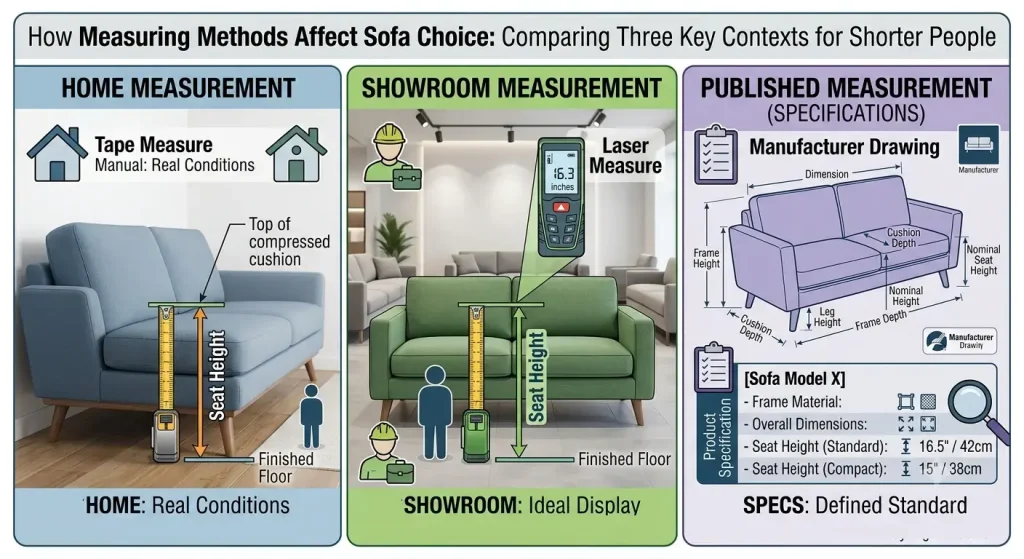
Whether a sofa is measured at home, in a furniture showroom, or before purchase, the objective remains the same: to determine its static seat height using a standardized method. A standardized method reduces measurement uncertainty, improves repeatability, and makes measurements comparable across different sofas.
Rather than thinking of measurement as placing a tape measure against a sofa, think of it as following a controlled process.
A useful measurement process follows this sequence:
Furniture Geometry → Measurement Method → Measurement Quality → Reliable Comparison → Furniture Evaluation
Each stage depends on the previous one. Skipping any stage reduces confidence in the final measurement.
Preparing the Sofa for Measurement
Before measuring, the sofa should be prepared so its geometry reflects its normal condition rather than a temporary state.
A static seat height should always be measured when:
- the sofa rests naturally on the finished floor,
- the seating surface is free from occupants,
- removable seat cushions are positioned correctly,
- cushions have recovered from previous compression,
- and the sofa is not tilted or resting on uneven supports.
These conditions ensure the measurement represents the sofa’s manufactured geometry rather than a temporary deformation.
New sofas deserve particular attention.
Freshly unpacked cushions often require several hours—or sometimes longer—to regain their intended shape after being compressed during shipping. Measuring immediately after unpacking may underestimate the true static seat height.
Older sofas present a different challenge.
Years of repeated loading can permanently compress foam and suspension materials, reducing the seating height compared with the original manufacturer specification.
Consequently, two visually identical sofas may produce different measurements because one represents its original geometry while the other reflects long-term material fatigue.
Understanding cushion condition is therefore part of accurate measurement—not an unrelated observation.
Selecting the Right Measurement Tool
The measuring instrument influences both measurement accuracy and measurement precision.
A rigid tape measure is generally the most practical tool because it naturally maintains a straight measurement axis while minimizing bending or sagging.
Other tools can also be used in specific situations:
- Laser distance measures provide highly accurate vertical distances but require unobstructed reference points and careful positioning.
- Digital measuring tools can improve readability and reduce manual recording errors, particularly when multiple sofas are being compared.
Regardless of the tool used, it should:
- begin at an accurate zero point,
- have clearly marked graduations,
- remain undamaged,
- and provide sufficient measurement resolution.
For furniture evaluation, measuring to approximately 1/8 inch (3 mm) or 0.5 centimeter is generally more than adequate. Recording additional decimal places rarely improves decision-making because normal upholstery variation and manufacturing tolerances exceed extremely fine measurement differences.
The objective is meaningful precision rather than unnecessary precision.
Measuring Sofa Seat Height at Home
A home environment provides the greatest control over measurement conditions because the sofa can be positioned and evaluated without time constraints.
Use the following standardized procedure:
- Place the sofa on its normal finished floor.
- Confirm that all seat cushions are correctly installed.
- Allow recently used cushions to recover fully before measuring.
- Identify the primary usable seating surface, avoiding decorative piping or raised cushion edges.
- Position the rigid tape measure vertically so the measurement axis remains perpendicular to the finished floor.
- Measure from the finished floor to the usable seating surface.
- Repeat the procedure at least three times.
- Record the average measurement if small variations occur.
Multiple measurements improve confidence because isolated readings may be affected by slight changes in tape position or cushion contour.
For sofas with multiple seating positions—such as sectionals or modular sofas—measure each seat independently.
Although manufacturers often publish a single seat height, individual seating positions may vary slightly because of cushion construction or support configuration.
Measuring Sofa Seat Height in a Showroom
Furniture showrooms present a different measurement environment.
Unlike a sofa at home, a display model may have been used by dozens of visitors throughout the day.
Repeated sitting temporarily compresses cushions, reducing their height until the foam recovers.
Before measuring a showroom sofa, evaluate whether the seating surface has returned to its natural shape.
If the cushion appears noticeably compressed, the recorded value may represent a partially loaded condition rather than the intended static condition published by the manufacturer.
The surrounding environment should also be examined.
Some display sofas sit directly on the showroom floor.
Others are positioned on:
- display platforms,
- decorative rugs,
- raised flooring,
- temporary exhibition structures.
The finished floor supporting the sofa remains the correct datum plane.
Decorative platforms or rugs that are not part of the sofa’s normal installation should not become part of the measurement system.
Maintaining the same datum plane allows meaningful comparison between showroom measurements and manufacturer specifications.
Practical Edge Cases That Affect Measurements
Real-world measurements are rarely performed under perfect laboratory conditions.
Several practical factors can influence the measured seat height if they are not recognized.
Soft Carpet
A thick carpet may compress beneath the sofa’s legs after installation.
If the measurement begins from the top of an uncompressed carpet instead of the finished support surface beneath the sofa, the measured seat height may differ slightly from measurements taken on hard flooring.
Whenever comparisons are important, the same flooring condition should be used for every sofa.
New Cushions
Recently manufactured foam often requires time to stabilize after shipping.
Until the material fully expands, static seat height may be slightly lower than the long-term seating height.
Measuring too early can therefore underestimate the sofa’s true geometry.
Worn Cushions
Foam gradually loses resilience through repeated loading.
As permanent compression increases, the seating surface moves closer to the finished floor.
The sofa frame remains unchanged, but the functional seating geometry changes because the cushion no longer supports the body at its original height.
For this reason, an older sofa should not be expected to match its original published seat height exactly.
Why Seat Height Should Not Be Measured While Sitting
One of the most common mistakes is measuring seat height while someone is sitting on the sofa.
Doing so changes the furniture geometry being measured.
Body weight compresses the cushion and suspension system, converting a static measurement into a loaded measurement.
Neither measurement is incorrect—they simply represent different conditions.
When comparing sofas or verifying manufacturer specifications, measurements should always be taken with the seating surface unoccupied.
Only then do they represent the sofa’s static geometry under standardized conditions.
Consistency Produces Comparable Measurements
Every reliable seat height measurement depends on using the same datum plane, measurement axis, measuring tool, and measurement condition.
Changing any one of these variables changes the numerical result, even when the sofa itself remains unchanged.
This is why identical sofas measured using different methods can appear to have different seat heights.
A consistent methodology transforms isolated measurements into comparable data. Once those measurements have been collected, they can be interpreted alongside manufacturer specifications to verify dimensions, compare models, and evaluate furniture before making a purchasing decision.
Product Specifications, Verification, Documentation and Evaluation
Understanding Manufacturer Product Specifications
Many furniture purchases begin before a buyer ever sees the sofa in person. Online retailers, furniture stores, and manufacturers typically provide a product specification that summarizes the sofa’s measurable characteristics.
A manufacturer product specification is a standardized technical description of a product. It communicates the furniture’s intended dimensions, construction details, materials, and other measurable attributes so that buyers, retailers, and designers can evaluate the product consistently.
For sofa evaluation, product specifications usually include:
- Seat height
- Seat depth
- Seat width
- Overall height
- Overall width
- Overall depth
- Arm height
- Weight capacity
- Cushion construction
These values describe the sofa’s designed geometry rather than the user’s experience after sitting on it.
Understanding this distinction prevents one of the most common buying mistakes. It’s assuming that every published dimension represents how the furniture feels during everyday use.
Reading Furniture Datasheets Like a Designer
A product specification is often presented within a furniture datasheet.
A furniture datasheet is a technical document that combines numerical measurements, engineering information, construction details, material descriptions, and dimensional illustrations into a single reference.
Unlike marketing descriptions, furniture datasheets are designed to communicate measurable characteristics.
Furniture designers, manufacturers, retailers, architects, and interior designers rely on these documents because they create a common technical language.
When evaluating a datasheet, separate information into two categories.
Descriptive information
- Fabric options
- Color
- Style
- Finish
- Collection
Evaluative information
- Seat height
- Seat depth
- Overall dimensions
- Weight limits
- Cushion construction
- Suspension system
Descriptive information influences preference.
Evaluative information supports measurement and comparison.
Understanding this difference allows buyers to focus first on furniture geometry before considering appearance or aesthetics.
How Specification Diagrams Improve Understanding
Numerical values become much easier to interpret when accompanied by a specification diagram.
A specification diagram is a simplified illustration showing where each furniture dimension is measured.
Rather than relying only on numbers, the diagram identifies:
- the datum plane,
- measurement direction,
- starting reference points,
- ending reference points,
- and the furniture dimensions represented.
For example, a specification diagram distinguishes seat height from overall height, preventing buyers from confusing the seating position with the total height of the sofa.
Good specification diagrams reduce interpretation errors because they explain where each dimension originates—not just what the number is.
Understanding Dimension Drawings
A more detailed technical illustration is called a dimension drawing.
Dimension drawings are commonly used in furniture manufacturing, industrial design, architecture, and engineering.
Unlike marketing illustrations, they show furniture using standardized measurement conventions.
A typical dimension drawing identifies:
- overall width,
- overall depth,
- overall height,
- seat height,
- seat depth,
- arm height,
- back height,
- and sometimes internal frame dimensions.
Dimension drawings reveal the relationships between measurements.
Instead of viewing each dimension independently, readers can understand how one measurement influences another within the overall furniture geometry.
For example:
Seat Height
↓
Influences
↓
Lower-body position
Seat Depth
↓
Influences
↓
Thigh support
Back Height
↓
Influences
↓
Upper-body support
Together these dimensions determine the seating geometry rather than functioning as isolated measurements.
Published Measurements vs. Static Measurements
Another important distinction concerns published measurements and static measurements.
Although these terms are closely related, they are not identical.
A published measurement is the value reported by the manufacturer within the product specification or furniture datasheet.
A static measurement describes the furniture’s geometry when the sofa is unoccupied and the seating surface has returned to its natural shape.
In most cases, manufacturers publish static measurements because they provide a standardized basis for comparison across different models.
However, published values should still be interpreted as specification values rather than laboratory constants.
Small variations naturally occur because of:
- upholstery thickness,
- foam recovery,
- manufacturing tolerances,
- measurement methodology,
- and production variation.
Recognizing this distinction helps buyers interpret specifications realistically rather than expecting every physical measurement to match the published value exactly.
Verifying Manufacturer Measurements
Whenever possible, published dimensions should be verified through direct observation.
Verification is not performed because manufacturer specifications are unreliable.
It is performed because furniture exists in real environments rather than controlled manufacturing conditions.
A useful verification process follows this sequence:
Manufacturer Specification
↓
Physical Measurement
↓
Comparison
↓
Interpretation
↓
Furniture Evaluation
Suppose a manufacturer lists a seat height of 18 inches (46 cm).
If a showroom measurement produces 17.8 inches (45 cm), the small difference is usually explained by upholstery variation, measurement resolution, or cushion recovery.
A much larger difference should first prompt a review of the measurement method before questioning the manufacturer’s specification.
Verification therefore evaluates both the furniture and the measurement process itself.
Recording Measurements Creates Better Comparisons
Measurements become significantly more valuable when they are documented consistently.
Instead of relying on memory, create a simple measurement record for every sofa being evaluated.
Each record should include:
- Manufacturer and model
- Measurement location
- Date of measurement
- Seat height
- Measurement unit
- Measurement condition (static)
- Source of the measurement
- Observations affecting measurement quality
Using a consistent recording format allows multiple sofas to be compared objectively rather than remembered subjectively.
It also makes future evaluations easier if the same sofa is measured again after years of use.
Building a Furniture Evaluation Framework
At this stage, the measurement process is complete.
The sofa’s geometry has been converted into measurable data.
Those measurements have been verified against manufacturer specifications.
The results have been documented for comparison.
This creates a simple evaluation framework:
Furniture Geometry
↓
Furniture Dimensions
↓
Measurement
↓
Verification
↓
Comparison
↓
Evaluation
Notice that the framework still describes only one side of furniture fit.
It explains how high the sofa is.
It does not explain whether that height is appropriate for the person who will use it.
A seat height of 17 inches (43 cm) may provide excellent support for one individual and poor support for another because furniture dimensions cannot be interpreted in isolation.
To determine whether a measured seat height represents good furniture fit, the sofa’s dimensions must now be evaluated against the relevant dimensions of the human body. That comparison begins with anthropometric measurement.
Measuring the Human Body
Why Furniture Measurements Must Be Compared with Body Measurements
By this point, the sofa has been evaluated from a measurement perspective. Its furniture geometry has been translated into measurable dimensions, those dimensions have been verified, and the seat height has been documented using a consistent methodology.
One critical question, however, remains unanswered.
Does the measured seat height fit the person who will use the sofa?
The measurement itself cannot answer that question because every furniture dimension is only one side of a compatibility relationship.
A seat height of 17 inches (43 cm) is not inherently comfortable or uncomfortable. Its suitability depends on the body dimensions of the person sitting on it. The same sofa may provide excellent support for one individual while causing discomfort for another because furniture dimensions describe only the product, not the user.
This distinction changes the purpose of measurement.
Until now, measurement has focused on understanding furniture geometry. The next stage of evaluation focuses on understanding human geometry. Only when these two measurement systems are compared can body–furniture compatibility be evaluated.
A useful mental model is:
Human Geometry
↓
Human Dimensions
↓
Anthropometric Measurement
↓
Comparison with Furniture Dimensions
↓
Body–Furniture Compatibility
↓
Ergonomic Evaluation
↓
Furniture Fit
↓
Comfort
↓
Purchase Decision
This sequence demonstrates that comfort is not determined by furniture dimensions alone. Comfort emerges from the relationship between measurable characteristics of the furniture and measurable characteristics of the human body.
Anthropometry: The Science of Measuring the Human Body
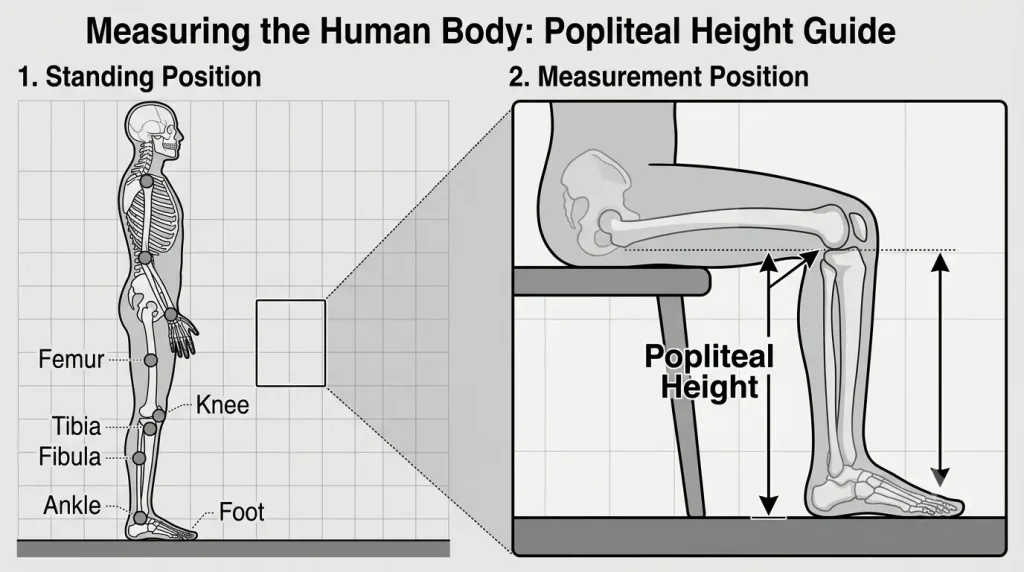
The scientific discipline responsible for measuring the human body is called anthropometry.
Anthropometry is the systematic study of human body dimensions, proportions, and physical characteristics through standardized measurement methods. Rather than estimating body size from appearance, anthropometry converts the human body into objective, repeatable measurements that can be analyzed and compared.
These measurements are used across numerous industries where products must interact safely and comfortably with people.
Anthropometric data supports the design of:
- residential furniture,
- office seating,
- automotive interiors,
- aircraft cabins,
- wheelchairs,
- assistive devices,
- educational furniture,
- public seating,
- and workplace equipment.
Instead of designing products around an “average person,” designers use anthropometric databases to understand how body dimensions vary across populations. This allows products to accommodate a broader range of users while reducing discomfort, poor posture, and usability problems.
The same scientific principles apply when evaluating a sofa.
Rather than asking whether a sofa appears low or high, anthropometry asks whether the sofa’s measurable dimensions correspond to the measurable dimensions of the intended user.
Human Measurement Science Focuses on Functional Dimensions
Anthropometry measures many characteristics of the human body, but not every measurement contributes equally to furniture evaluation.
Some measurements describe overall body size.
Others describe the dimensions that directly influence how the body interacts with a chair or sofa.
For furniture evaluation, functional dimensions are more important than descriptive dimensions.
A functional dimension directly influences the body’s position, movement, or support during sitting.
For example:
- Overall height describes total body stature.
- Shoulder width describes upper-body breadth.
- Hand length describes the size of the hand.
These measurements are valuable in many design contexts, but they contribute relatively little to determining whether a sofa’s seat height provides proper lower-body support.
Measurements associated with the lower body have much greater functional importance because they determine how the feet contact the floor, how the knees bend, and how the thighs are supported while sitting.
Anthropometry therefore prioritizes measurements according to their relationship with the furniture being evaluated rather than according to how familiar the measurement may be.
Understanding the Body Measurement Hierarchy
One reason many people choose uncomfortable furniture is that they rely on the wrong body measurement.
Height is often treated as the primary indicator of furniture fit because it is the measurement people know best. In reality, overall height occupies only the highest level of a much more detailed hierarchy.
For evaluating sofa seat height, body measurements can be understood as a progression from general descriptions to highly functional dimensions.
Overall Height
↓
Standing Body Dimensions
↓
Sitting Height
↓
Lower-Body Dimensions
↓
Popliteal Height
↓
Functional Sitting Position
Each level reduces uncertainty because it describes the body more specifically.
Overall height provides a broad description of body size.
Standing dimensions explain how the body is organized while upright.
Sitting height describes the vertical dimension of the seated upper body.
Lower-body dimensions explain how the legs interact with seating surfaces.
Popliteal height identifies the dimension that most directly influences appropriate seat height.
Functional sitting position describes how the body ultimately interacts with the sofa during everyday use.
Moving down this hierarchy increases the relevance of the measurement for furniture evaluation.
The objective is not to collect more measurements but to identify the measurements that directly determine body–furniture compatibility.
Overall Height, Sitting Height, and Popliteal Height Describe Different Characteristics
These three measurements are often confused because they all relate to body size, yet each represents a different aspect of human geometry.
Overall height measures the body’s total stature while standing. It includes the combined length of the head, torso, pelvis, thighs, lower legs, and feet.
Because it represents the entire body, overall height is useful for describing general body size but provides little information about the dimensions that control sitting posture.
Sitting height measures the vertical distance from the sitting surface to the top of the head while seated. It primarily reflects the dimensions of the pelvis, spine, neck, and head.
Sitting height helps designers evaluate head clearance, desk height, and interior spaces, but it does not indicate how high a seating surface should be above the floor.
Popliteal height, by contrast, measures the vertical distance from the underside of the foot to the area directly behind the knee while the lower leg is positioned naturally for sitting.
Unlike overall height or sitting height, popliteal height directly describes the lower-body geometry responsible for supporting the seated position.
Because sofa seat height influences the relationship between the seating surface, the knees, and the feet, popliteal height becomes significantly more relevant than either overall height or sitting height.
As the measurements become more specific, their usefulness for evaluating seat height also increases.
Why Overall Height Is a Poor Predictor of Sofa Fit
People of identical height rarely have identical body proportions.
One individual may have a longer torso and shorter legs.
Another may have shorter torso dimensions but longer lower legs.
Although both individuals share the same overall height, their seating requirements can differ substantially.
This variation explains why overall height is an unreliable predictor of appropriate seat height.
Overall height combines many independent body segments into a single value.
It does not indicate:
- how long the lower legs are,
- where the knees naturally align,
- how high the feet position the body while sitting,
- or how the lower body supports weight on a seating surface.
Furniture designers therefore avoid relying solely on stature when determining seating dimensions. Instead, they evaluate the specific body segments that directly interact with the furniture.
For sofa seat height, the lower leg provides far more meaningful information than the body’s total height because it determines the vertical relationship between the seating surface and the finished floor.
Understanding this principle shifts furniture evaluation away from assumptions and toward measurable compatibility.
The next step is to examine the lower leg in greater detail and identify the specific anthropometric measurement that most directly determines whether a sofa’s seat height supports a comfortable sitting posture.
The Lower Leg as the Primary Reference System
Once anthropometry identifies the body measurements that matter most, the next step is determining which part of the body directly governs seat height.
Although the entire body contributes to sitting posture, not every body segment influences the vertical relationship between the seating surface and the finished floor. For evaluating sofa seat height, the most important reference system is the lower leg.
The lower leg establishes the body’s contact with the floor and determines the position of the knee during sitting. Because seat height controls how the lower body is supported, it must ultimately be evaluated against the dimensions of the lower leg rather than against total body height.
This creates a direct semantic relationship:
Lower-Leg Geometry
↓
Popliteal Height
↓
Recommended Seat Height
↓
Body–Furniture Compatibility
↓
Ergonomic Support
↓
Comfort
The closer the seat height corresponds to the user’s lower-leg dimensions, the greater the likelihood that the feet remain supported, the knees remain in a comfortable position, and body weight is distributed efficiently across the seating surface.
Popliteal Height: The Most Important Measurement for Seat Height
Among all anthropometric measurements, popliteal height has the strongest relationship with sofa seat height.
Popliteal height is the vertical distance from the finished floor to the underside of the knee (the popliteal region) while a person sits with the feet resting naturally on the floor and the lower legs in a neutral position.
Unlike overall height, popliteal height isolates the body segment that directly determines how high the seating surface should be.
It answers a practical question that overall stature cannot:
How much vertical space exists between the floor and the user’s knee while sitting naturally?
Because a sofa supports the body beneath the thighs, the seating surface must relate to this dimension rather than to the person’s total height.
This relationship can be expressed as a simple knowledge chain:
Popliteal Height
↓
Determines
↓
Recommended Seat Height Range
↓
Influences
↓
Knee Position
↓
Supports
↓
Natural Sitting Posture
↓
Improves
↓
Comfort
This semantic chain explains why ergonomists and furniture designers prioritize popliteal height when evaluating seating geometry.
Understanding Lower-Leg Length
Although popliteal height is the primary measurement, it is influenced by the dimensions of the lower leg itself.
The lower-leg length is the distance between the knee and the ankle. It forms the structural link between the thigh and the foot and largely determines how high the knee sits above the floor.
Lower-leg length is not measured directly when evaluating seat height, but it contributes to the popliteal height measurement because it defines the vertical position of the knee.
Longer lower legs generally increase popliteal height.
Shorter lower legs generally reduce it.
This relationship explains why two people with similar overall height can require different seat heights if their lower-leg proportions differ.
The Tibia: The Primary Weight-Bearing Bone
The largest bone in the lower leg is the tibia, commonly called the shinbone.
The tibia extends from the knee to the ankle and supports most of the body’s weight while standing and sitting.
From a furniture perspective, the tibia establishes the primary structural pathway between the knee and the floor.
As tibial length changes, the vertical position of the knee changes as well.
This creates another semantic relationship:
Tibia Length
↓
Influences
↓
Lower-Leg Length
↓
Influences
↓
Popliteal Height
↓
Determines
↓
Recommended Seat Height
The tibia therefore affects seating indirectly through its contribution to lower-leg geometry.
The Fibula: Providing Stability Rather Than Height
Running alongside the tibia is the fibula, the thinner bone on the outside of the lower leg.
Unlike the tibia, the fibula carries relatively little body weight. Its primary role is to stabilize the lower leg and provide attachment points for muscles and ligaments around the knee and ankle.
Although the fibula contributes less to vertical support, it remains part of the overall skeletal system that defines lower-leg geometry.
Together, the tibia and fibula create the structural framework that positions the knee above the foot.
Without this stable framework, consistent anthropometric measurement would not be possible.
Why the Knee Is the Primary Reference Joint
The knee serves as the central reference joint for evaluating seat height because it connects the thigh to the lower leg.
When sitting, the knee determines how the body’s weight is transferred between the thighs, lower legs, and feet.
A seat that is significantly higher than the user’s popliteal height forces the knees downward and may reduce foot contact with the floor.
A seat that is substantially lower positions the knees higher than the hips and increases flexion within the lower body.
Neither condition necessarily causes immediate discomfort, but both alter the body’s natural sitting geometry.
This explains why the knee functions as the primary anatomical reference point during seat-height evaluation.
The relationship is not based on the knee itself but on its vertical position relative to the finished floor.
The Ankle Completes the Lower-Leg Reference System
The ankle forms the connection between the lower leg and the foot.
Although it receives less attention than the knee, the ankle plays a critical role in maintaining a stable sitting posture.
When the seat height corresponds appropriately to popliteal height, the ankle can remain in a relaxed, neutral position while the feet maintain contact with the finished floor.
If the seating surface is too high, the ankles often compensate by plantarflexing so the toes reach downward.
If the seating surface is too low, excessive ankle dorsiflexion may occur as the knees rise above their natural position.
The ankle therefore contributes to stability by helping the body adapt to the seat height selected.
Body Proportions Explain Why People of the Same Height Sit Differently
Anthropometry measures more than absolute dimensions; it also examines body proportions.
Body proportions describe how individual body segments relate to one another.
Two people may both be 5 feet 4 inches (163 cm) tall yet have entirely different lower-body proportions.
One individual may have:
- a longer torso,
- shorter femurs,
- shorter lower legs.
Another may have:
- a shorter torso,
- longer femurs,
- longer lower legs.
Although their overall height is identical, their popliteal heights—and therefore their recommended seat heights—may differ considerably.
This explains why body proportion is more informative than stature alone when evaluating furniture fit.
Furniture designers recognize this variation by relying on anthropometric measurements rather than assuming that one body dimension predicts every aspect of human geometry.
The Lower Leg Determines the Recommended Seat Height
The relationship between the human body and sofa seat height is no longer based on assumption.
It can now be expressed through a clear semantic model:
Body Proportions
↓
Influence
↓
Lower-Leg Geometry
↓
Determines
↓
Popliteal Height
↓
Determines
↓
Recommended Seat Height
↓
Influences
↓
Body–Furniture Compatibility
↓
Supports
↓
Ergonomic Sitting Posture
↓
Produces
↓
Comfort
This model explains why anthropometry treats popliteal height as the primary body measurement for evaluating seat height. Rather than estimating fit from overall stature, it identifies the specific body dimension that directly interacts with the seating surface.
At this stage, both sides of the evaluation are understood. The sofa has been measured using a standardized methodology, and the relevant human dimensions have been identified through anthropometric measurement. The remaining task is to compare these two measurement systems to determine whether a particular seat height provides an appropriate fit for a short person.
Understanding Human Variation Through Anthropometry
Measurements Require Interpretation, Not Just Collection
At this stage, two independent measurement systems have been established. The sofa has been measured using standardized furniture measurement principles, and the body has been measured using anthropometric methods. However, neither measurement has meaning on its own.
Measurement is only the first stage of evaluation.
A measurement becomes useful only when it is interpreted within an appropriate reference framework. A seat height of 17 inches (43 cm), for example, is an objective measurement, but that number alone cannot determine whether the sofa fits a particular person. Likewise, a popliteal height measurement describes an individual’s body but does not indicate whether it is unusually high, unusually low, or typical within a broader population.
Furniture evaluation therefore follows a structured knowledge process:
Observation
↓
Measurement
↓
Interpretation
↓
Comparison
↓
Body–Furniture Compatibility
↓
Ergonomic Evaluation
↓
Furniture Fit
↓
Comfort
Every stage depends on the one before it. Without interpretation, measurements remain isolated numbers rather than meaningful design information.
Anthropometry: The Science of Human Measurement
Anthropometry is the scientific discipline that measures the physical dimensions and proportions of the human body. Within ergonomics and furniture design, anthropometry provides the quantitative foundation for understanding how people interact with products, environments, and equipment.
Unlike casual body measurements, anthropometric measurements are collected using standardized reference points, measurement procedures, and definitions. This standardization allows measurements taken from different individuals to be compared objectively and consistently.
Anthropometry serves two complementary purposes.
The first is individual assessment, where measurements describe the geometry of one specific person.
The second is population analysis, where measurements collected from thousands of individuals reveal patterns of human variation across an entire population.
Both perspectives are essential. Individual measurements determine whether a sofa fits one person, while population measurements help designers create furniture that accommodates many different users.
Human Variation Is a Design Principle
One of the most important principles of anthropometry is that human variation is normal.
People naturally differ in stature, limb lengths, joint positions, body proportions, and functional body dimensions. These differences are not exceptions; they are expected characteristics of every human population.
This principle has an important implication for furniture design.
If people vary, furniture cannot be evaluated using one “ideal” body.
Instead, furniture must be evaluated against the range of body dimensions found within the intended users.
This creates the following relationship:
Human Variation
↓
Produces
↓
Different Body Proportions
↓
Creates
↓
Different Anthropometric Measurements
↓
Influences
↓
Body–Furniture Compatibility
↓
Determines
↓
Furniture Fit
Understanding this relationship explains why two people can experience the same sofa differently even when using identical furniture.
Population Data Explains What Is Typical
To understand human variation, anthropometrists collect population data.
Population data consists of standardized body measurements gathered from large groups of people using consistent measurement protocols. Rather than describing one individual, these datasets describe how body dimensions are distributed across an entire population.
Population data answers questions such as:
- How much does popliteal height vary among adults?
- What range of lower-leg lengths is common?
- Which body dimensions change together, and which vary independently?
- How many people can comfortably use a particular furniture dimension?
This transforms isolated measurements into meaningful context.
An individual’s measurements are no longer viewed in isolation but as part of a measurable distribution of human dimensions.
Anthropometric Databases and Reference Populations
Population measurements are organized into anthropometric databases.
An anthropometric database is a structured collection of standardized body measurements gathered from a defined group of people. These databases form the evidence base used by ergonomists, furniture engineers, industrial designers, automotive manufacturers, accessibility specialists, and product developers.
Every database represents a specific reference population.
A reference population is the group from which measurements are collected. It may represent adults, older adults, office workers, military personnel, or another clearly defined population.
Choosing the correct reference population is important because body dimensions differ between populations due to factors such as age, sex, ethnicity, and geographic region.
Furniture designed for one reference population may not provide the same level of accommodation for another.
Anthropometric Surveys Build Reliable Design Data
Anthropometric databases are created through anthropometric surveys.
During these surveys, researchers measure thousands of individuals using standardized measurement methods and clearly defined anatomical landmarks.
The objective is not to identify an average person but to document the full range of human dimensions within a population.
Because measurements are collected consistently, designers can compare products against reliable body data rather than assumptions or anecdotal experience.
This evidence-based approach explains why anthropometry forms the foundation of modern ergonomic design.
Understanding Percentiles
Human measurements are not identical across a population, so anthropometric data is commonly summarized using percentiles.
A percentile describes the relative position of an individual’s measurement within a reference population.
For example:
- The 5th percentile represents individuals whose measurement is equal to or greater than approximately 5% of the population and smaller than about 95%.
- The 50th percentile represents the median measurement, where approximately half of the population measures smaller and half measures larger.
- The 95th percentile represents individuals whose measurement is equal to or greater than approximately 95% of the population.
Percentiles do not define good or bad body dimensions.
Instead, they describe how measurements are distributed within a population.
This relationship can be represented as:
Reference Population
↓
Anthropometric Survey
↓
Anthropometric Database
↓
Measurement Distribution
↓
Percentiles
↓
Design Decisions
Percentiles allow designers to understand not only typical body dimensions but also the variability that exists across users.
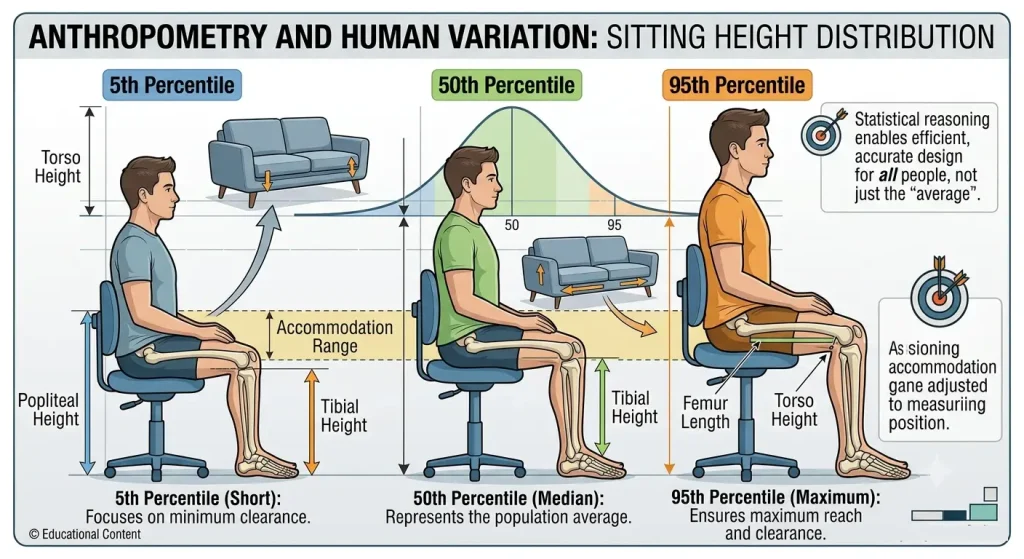
Accommodation Ranges and Design Populations
Because people vary, furniture designers rarely attempt to optimize a product for a single body size.
Instead, they establish an accommodation range.
An accommodation range describes the span of body dimensions that a product is intended to serve comfortably.
The accommodation range is selected based on the intended design population, which is the specific group of users for whom the product is designed.
For example, a residential sofa intended for the general adult population is typically designed to accommodate a broad range of anthropometric measurements rather than one exact body size.
This design process follows a logical sequence:
Reference Population
↓
Anthropometric Database
↓
Percentile Analysis
↓
Design Population
↓
Accommodation Range
↓
Furniture Dimensions
↓
Expected User Fit
The result is a product designed to serve many users, even though no single dimension can perfectly match every individual.
Why One Seat Height Cannot Fit Everyone
Human variation makes a universal seat height impossible.
Even when two people have identical overall height, differences in lower-leg length, body proportions, and popliteal height can lead to different seating requirements.
Likewise, individuals with similar popliteal heights may differ in body weight, flexibility, posture preferences, or intended furniture use.
This means furniture fit is always based on compatibility rather than absolute dimensions.
A published seat height is therefore best understood as a design compromise intended to accommodate a specific range of users rather than every possible body type.
Recognizing this principle helps explain why furniture recommendations should always begin with anthropometric measurements instead of assumptions based on stature alone.
The Human Fit Model
The relationship between anthropometry and furniture evaluation can be summarized through a simple conceptual model.
Reference Population
↓
Anthropometric Surveys
↓
Anthropometric Database
↓
Human Variation
↓
Percentile Distribution
↓
Design Population
↓
Accommodation Range
↓
Furniture Dimensions
↓
Individual Anthropometric Measurements
↓
Body–Furniture Compatibility
↓
Furniture Fit
This model connects scientific measurement with practical furniture evaluation. It explains how standardized anthropometric data becomes design guidance and why individual body measurements remain essential when determining whether a particular sofa seat height is appropriate for a specific person.
Why Body Proportions Predict Furniture Fit Better Than Height
Human Bodies Share the Same Parts but Not the Same Proportions
Anthropometric databases demonstrate that human variation exists across every population. The next step is understanding where that variation occurs.
Although people possess the same skeletal structures and body segments, those segments are not proportioned identically. The relationship between the torso, pelvis, femur, lower leg, and foot differs from one individual to another, creating unique body proportions.
Body proportions describe the relative lengths and relationships of body segments rather than their absolute size.
This distinction is important because furniture does not interact with overall body height. Instead, it interacts with specific body segments that contact the seating surface, backrest, armrests, and floor.
The relationship can be represented as:
Human Variation
↓
Creates
↓
Different Body Proportions
↓
Produces
↓
Different Functional Body Dimensions
↓
Determines
↓
Body–Furniture Compatibility
This explains why two people with similar stature can experience the same sofa very differently.
The Body Segment Hierarchy
Overall height is a broad anthropometric descriptor, but furniture fit depends on progressively more specific body dimensions.
This creates a hierarchy of measurements, where each level provides greater predictive value than the one before it.
Standing Height
↓
Sitting Height
↓
Pelvic Position
↓
Femur Length
↓
Lower-Leg Length
↓
Popliteal Height
↓
Recommended Seat Height
Each level removes uncertainty.
Standing height describes total body size.
Sitting height isolates the upper and lower body relationship.
Pelvic position establishes the body’s sitting reference.
Femur length influences seat depth and thigh support.
Lower-leg length positions the knee relative to the floor.
Popliteal height identifies the functional dimension that determines appropriate seat height.
This hierarchy explains why anthropometric evaluation progresses from general body dimensions toward measurements that directly interact with furniture geometry.
Standing Height, Sitting Height, and Popliteal Height Serve Different Purposes
These three measurements are often confused because each describes body size. In anthropometry, however, they answer different questions.
Standing height measures the vertical distance from the floor to the top of the head. It represents overall stature and is useful for describing general body size.
Sitting height measures the vertical distance from the sitting surface to the top of the head. It describes the proportion of the upper body and is widely used in ergonomics, transportation, and workspace design.
Popliteal height measures the vertical distance from the finished floor to the underside of the knee while sitting in a standardized posture. It represents the lower-body dimension that directly determines recommended seat height.
Their relationships differ accordingly:
Standing Height
↓
Describes
↓
Overall Body Size
Sitting Height
↓
Describes
↓
Upper-Body Proportion
Popliteal Height
↓
Determines
↓
Recommended Seat Height
These measurements complement one another, but they are not interchangeable.
Functional Anthropometry Focuses on Real-World Use
Not every anthropometric measurement has the same practical purpose.
Static anthropometry measures the body in standardized, stationary positions. These measurements provide consistency and allow reliable comparison between individuals.
Examples include standing height, sitting height, and popliteal height.
However, furniture is not used by motionless bodies.
People sit down, lean back, shift position, reach for objects, cross their legs, and stand up. Evaluating these interactions requires functional anthropometry, sometimes referred to as dynamic anthropometry.
Functional anthropometry studies how body dimensions relate to movement, posture, and task performance rather than only static size.
The relationship can be expressed as:
Static Anthropometry
↓
Provides
↓
Standardized Body Measurements
↓
Supports
↓
Consistent Comparison
While:
Functional Anthropometry
↓
Evaluates
↓
Body Movement
↓
Interaction with Furniture
↓
Real-World Furniture Fit
Furniture designers rely on both approaches. Static measurements establish dimensional accuracy, while functional anthropometry explains how those dimensions perform during everyday use.
Why Short Stature Does Not Predict Sofa Fit
One of the most common misconceptions is that people with short stature automatically require the same furniture dimensions.
Anthropometric evidence does not support this assumption.
Short stature identifies a person’s overall standing height relative to a reference population. It does not describe the proportions of the pelvis, femur, lower leg, or foot.
Two people measuring 5 feet (152 cm) may have entirely different body proportions.
One individual may have a relatively long torso and shorter legs.
Another may have a shorter torso but proportionally longer lower legs.
Although their standing height is identical, their popliteal heights may differ enough to require different seat heights.
This creates an important semantic distinction:
Short Stature
↓
Describes
↓
Overall Height
It does not determine:
Recommended Seat Height
Instead:
Body Proportions
↓
Influence
↓
Lower-Leg Geometry
↓
Determine
↓
Popliteal Height
↓
Determines
↓
Recommended Seat Height
Understanding this distinction prevents one of the most common mistakes in furniture selection—assuming that total height predicts seating compatibility.
Furniture Designers Design for Functional Dimensions
Modern furniture is not engineered around average height alone.
Designers begin with anthropometric databases, analyze reference populations, evaluate percentile distributions, and establish accommodation ranges for the intended design population.
From there, they determine furniture dimensions that accommodate the greatest number of users while recognizing that no single dimension can satisfy every body type.
This design process follows a structured knowledge chain:
Anthropometric Database
↓
Reference Population
↓
Percentile Analysis
↓
Accommodation Range
↓
Functional Anthropometric Dimensions
↓
Furniture Geometry
↓
Furniture Dimensions
↓
Expected User Fit
This process explains why published seat heights represent engineering decisions informed by population data rather than arbitrary measurements.
From Human Dimensions to Furniture Compatibility
The relationship between body proportions and furniture fit can now be understood as a complete semantic model.
Human Variation
↓
Creates
↓
Different Body Proportions
↓
Influence
↓
Functional Anthropometric Measurements
↓
Determine
↓
Body–Furniture Compatibility
↓
Supports
↓
Furniture Fit
This model shifts the evaluation away from generalized assumptions and toward measurable relationships between the human body and furniture geometry.
At this point, the measurements have been interpreted and their significance is clear. The remaining question is no longer which dimensions matter, but how those dimensions influence posture, joint alignment, weight distribution, and the physical experience of comfort while sitting.
Ergonomics and Biomechanics
From Anthropometric Measurements to Human Movement
Anthropometric measurements identify the body dimensions that should be compared with furniture dimensions. Those measurements become meaningful only when viewed through ergonomics and biomechanics, the sciences that explain how the human body interacts with physical environments.
Ergonomics is the discipline of designing products and environments to fit human capabilities and limitations. Its objective is to improve safety, efficiency, comfort, and usability by matching product dimensions to human characteristics.
Biomechanics studies how the body’s bones, joints, muscles, and soft tissues move under load. While anthropometry answers “What are the body’s dimensions?”, biomechanics answers “How do those dimensions function during movement and posture?”
Together, these disciplines transform body measurements into furniture evaluation.
The relationship follows a logical sequence:
Anthropometric Measurements
↓
Furniture Dimensions
↓
Body–Furniture Compatibility
↓
Ergonomic Evaluation
↓
Biomechanical Response
↓
Comfort
↓
Functional Performance
A sofa may match a person’s measurements on paper, but if it creates inefficient posture or increases joint loading, it cannot be considered an ergonomic fit.
Neutral Posture Is the Foundation of Comfortable Sitting
The primary objective of ergonomic seating is to support a neutral posture.
A neutral posture is a balanced sitting position in which the body’s joints remain close to their natural alignment, muscles require minimal unnecessary effort, and body weight is distributed efficiently across the seating surface and the floor.
Rather than forcing the body into a rigid position, neutral posture minimizes mechanical stress while allowing natural movement.
When a sofa’s seat height corresponds appropriately with the user’s anthropometric measurements, several biomechanical conditions become possible:
- the feet rest fully on the finished floor,
- the pelvis remains stable,
- the thighs receive consistent support,
- the knees remain near their natural position,
- and the body’s weight is shared between the seating surface and the feet.
This relationship can be expressed as:
Appropriate Seat Height
↓
Supports
↓
Neutral Posture
↓
Optimizes
↓
Joint Alignment
↓
Improves
↓
Pressure Distribution
↓
Enhances
↓
Comfort
Neutral posture is therefore an outcome of proper body–furniture compatibility rather than a posture consciously maintained by the user.
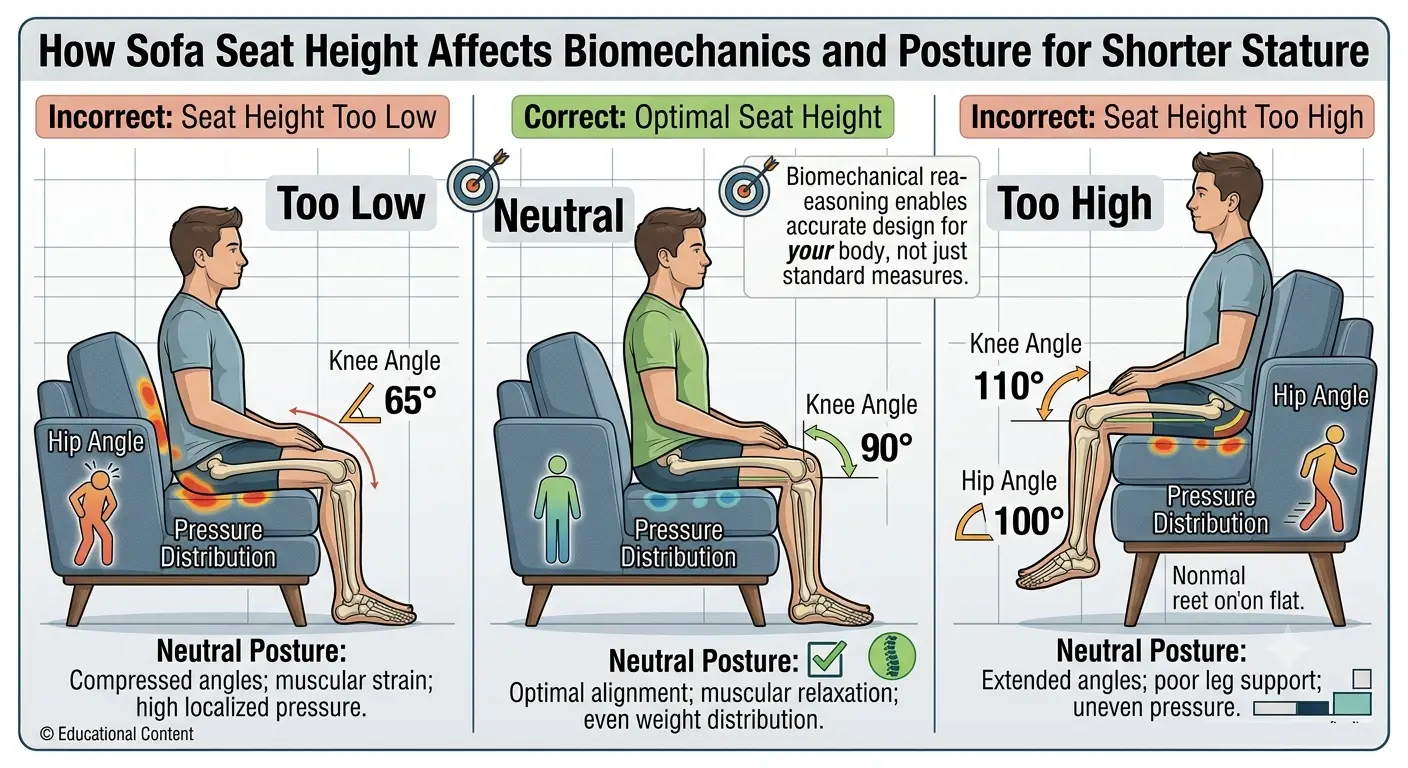
Knee Angle Influences Lower-Body Support
Among the most important biomechanical relationships affected by seat height is the knee angle.
The knee angle is formed between the femur and the lower leg while sitting.
When seat height corresponds closely to popliteal height, the knee generally remains near a comfortable functional position for most users. This allows the feet to remain supported while reducing unnecessary muscular effort in the lower body.
If the seat is substantially higher than the user’s recommended range, the feet may lose firm contact with the finished floor. As support shifts away from the feet, the underside of the thighs may experience greater localized pressure, and users often compensate by sliding forward or changing posture.
If the seat is substantially lower, the knees rise relative to the hips, increasing knee flexion and altering the body’s sitting geometry.
The semantic relationship is:
Seat Height
↓
Influences
↓
Knee Angle
↓
Affects
↓
Lower-Limb Support
↓
Contributes To
↓
Comfort
The objective is not to achieve one exact angle for every individual but to maintain joint positions that support efficient sitting mechanics.
Hip Angle Influences Pelvic Position and Upper-Body Alignment
Seat height also affects the hip angle, which describes the relationship between the torso and the femur while sitting.
The hip serves as the body’s central connection between the upper and lower body. Small changes in seat height can alter pelvic orientation, which in turn influences spinal alignment and upper-body posture.
When seat height corresponds appropriately with body dimensions, the pelvis can remain in a stable position that supports natural alignment of the torso.
If the seat is excessively low, the hips flex more deeply as the pelvis moves closer to the floor.
If the seat is excessively high, users often compensate by shifting forward or reducing foot support to maintain balance.
This relationship forms another semantic chain:
Seat Height
↓
Influences
↓
Hip Angle
↓
Affects
↓
Pelvic Position
↓
Supports
↓
Upper-Body Alignment
↓
Influences
↓
Comfort
Hip angle therefore connects lower-body geometry with whole-body posture.
Pressure Distribution Determines How the Body Is Supported
Comfort depends not only on posture but also on pressure distribution.
Pressure distribution describes how body weight is transferred across contact surfaces while sitting.
Ideally, body weight is shared between:
- the seating surface,
- the thighs,
- and the feet resting on the finished floor.
Balanced pressure distribution reduces localized loading and allows multiple body regions to participate in supporting body weight.
When seat height is inappropriate, this balance changes.
A higher seat may increase pressure beneath the thighs while reducing foot support.
A lower seat may alter pelvic loading and change how weight is transferred through the hips and lower body.
This relationship can be summarized as:
Seat Height
↓
Influences
↓
Pressure Distribution
↓
Changes
↓
Weight Transfer
↓
Affects
↓
Perceived Comfort
Pressure distribution explains why two sofas with similar cushioning may feel very different if their seat heights differ.
Sit-to-Stand Mechanics Depend on Seat Height
A sofa is used not only for sitting but also for transitioning between sitting and standing.
This movement is described by sit-to-stand mechanics.
Sit-to-stand mechanics examine how the body’s joints, muscles, and center of mass coordinate during the transition from a seated posture to standing.
Seat height directly influences the amount of movement required to complete this task.
A lower seating surface generally requires greater movement through the hips and knees before standing can begin.
A higher seating surface typically reduces the vertical distance that must be overcome, although excessive seat height may introduce different balance challenges for some users.
The relationship follows this sequence:
Seat Height
↓
Influences
↓
Sit-to-Stand Mechanics
↓
Changes
↓
Joint Motion
↓
Affects
↓
Movement Efficiency
↓
Influences
↓
Functional Comfort
This explains why seat height affects not only the experience of sitting but also the ease of entering and leaving the sofa.
Ergonomics Connects Measurement with Comfort
Anthropometry explains what should be measured.
Ergonomics explains why those measurements matter.
Biomechanics explains how the body responds once those measurements interact with furniture.
Together, they form a complete evaluation model:
Anthropometric Measurements
↓
Body–Furniture Compatibility
↓
Neutral Posture
↓
Joint Alignment
↓
Pressure Distribution
↓
Efficient Sit-to-Stand Mechanics
↓
Comfort
This model demonstrates that seat height influences far more than whether the feet touch the floor. It affects posture, movement, joint mechanics, and the way body weight is supported throughout the sitting experience.
Although seat height plays a central role in ergonomic seating, it represents only one dimension of overall furniture geometry. A sofa that provides an appropriate seat height may still feel uncomfortable if other dimensions influence body support differently.
Seat Height as Part of a Seating System
Seat Height Does Not Function Independently
Seat height is one of the most influential furniture dimensions, but it is not an independent variable. A sofa is a seating system in which every major dimension interacts with the others to determine body support, posture, movement, and comfort.
A seating system is the integrated combination of structural dimensions and support characteristics that together define how a person sits on a sofa. Rather than evaluating each dimension separately, ergonomics evaluates how they work as a coordinated whole.
This creates the following relationship:
Furniture Geometry
↓
Seat Height
- Seat Depth
- Back Height
- Arm Height
- Cushion Firmness
↓
Seating System
↓
Body–Furniture Compatibility
↓
Ergonomic Performance
↓
Comfort
This systems-based perspective explains why changing one dimension often changes the function of every other dimension.
Seat Height and Seat Depth Work Together
Seat depth is the horizontal distance from the front edge of the seating surface to the point where the backrest begins or where the user’s back is supported.
Although seat height and seat depth measure different directions, they work together to determine lower-body support.
Seat height primarily influences the vertical relationship between the floor, feet, knees, and hips.
Seat depth primarily influences how the thighs are supported and whether the user’s back can comfortably reach the backrest.
These dimensions cannot be evaluated independently because changing one alters the functional effect of the other.
For example, a sofa with an appropriate seat height but excessive seat depth may force a shorter person to sit forward instead of resting against the backrest. Conversely, a seat depth that matches the user’s femur length allows the pelvis to remain supported while maintaining proper contact with the backrest.
The relationship follows this semantic chain:
Seat Depth
↓
Influences
↓
Thigh Support
↓
Pelvic Position
↓
Backrest Contact
↓
Postural Stability
↓
Comfort
When combined with appropriate seat height, seat depth contributes to a balanced sitting posture rather than compensatory body positions.
Cushion Firmness Changes Functional Seat Height
Seat height is typically published as a static measurement, but the body experiences a different dimension after sitting.
This difference is largely influenced by cushion firmness.
Cushion firmness describes how much resistance a seat cushion provides when subjected to body weight. Softer cushions compress more under load, while firmer cushions compress less.
Compression changes the body’s effective seating position.
A sofa with a published seat height of 18 inches (46 cm) may provide a lower functional seat height if its cushion compresses significantly during use.
Conversely, a firmer cushion may maintain a functional seat height that remains close to its published measurement.
The relationship can be represented as:
Published Seat Height
↓
Modified By
↓
Cushion Firmness
↓
Produces
↓
Functional Seat Height
↓
Influences
↓
Body–Furniture Compatibility
This explains why two sofas with identical published dimensions may position the body differently once occupied.
Back Height Supports the Upper Body
Back height describes the vertical dimension of the sofa’s backrest above the seating surface.
While seat height positions the lower body, back height determines how the upper body is supported.
An appropriate back height helps stabilize the pelvis and torso by providing consistent support for the back. Different back heights accommodate different sitting preferences and activities, but their effectiveness depends partly on the posture established by seat height and seat depth.
This creates another semantic relationship:
Seat Height
↓
Establishes
↓
Lower-Body Position
↓
Supports
↓
Pelvic Stability
↓
Influences
↓
Backrest Contact
↓
Determined By
↓
Back Height
The backrest therefore functions as part of the entire seating system rather than as an isolated component.
Arm Height Influences Upper-Limb Support
Arm height measures the vertical distance from the seating surface to the top of the armrest.
Although armrests do not determine seat height, they influence how the shoulders, elbows, and forearms are supported during sitting.
When armrests are proportionate to the user’s seated position, they can reduce unnecessary muscular effort in the upper body during activities such as reading, resting, or using a mobile device.
If armrests are substantially higher or lower than the user’s natural elbow position, users often compensate by elevating or lowering the shoulders, changing overall posture.
The relationship follows this sequence:
Seat Height
↓
Determines
↓
Seated Elbow Position
↓
Interacts With
↓
Arm Height
↓
Influences
↓
Upper-Body Support
↓
Comfort
Because seated elbow position depends partly on seat height, armrest evaluation cannot be separated from the overall seating geometry.
A Seating System Is Evaluated Through Relationships
Each furniture dimension contributes a different function, but none determines comfort independently.
A systems-based evaluation recognizes that furniture dimensions influence one another through connected biomechanical relationships.
This integrated model can be summarized as:
Seat Height
↓
Positions
↓
Lower Body
Seat Depth
↓
Supports
↓
Thighs and Pelvis
Back Height
↓
Supports
↓
Torso
Arm Height
↓
Supports
↓
Upper Limbs
Cushion Firmness
↓
Modifies
↓
Functional Seat Height
Together these dimensions form the seating system that determines overall body–furniture compatibility.
Evaluating only one measurement provides an incomplete understanding of how a sofa will perform.
Furniture Fit Emerges From the Entire Seating System
A sofa should therefore be understood as an integrated ergonomic system rather than a collection of independent measurements.
Seat height remains a foundational dimension because it establishes the body’s initial relationship with the floor, but its practical effect is continuously modified by seat depth, cushion firmness, back height, and arm height.
Only by evaluating these dimensions together can the seating system be assessed accurately.
This systems perspective also explains an observation many furniture shoppers experience in practice: two sofas may list identical dimensions yet produce noticeably different sitting experiences because the interactions within the seating system—not the measurements alone—determine how the body is supported.
Furniture Engineering and Cushion Science
Furniture Dimensions Describe Geometry, Construction Determines Performance
The previous section established that seat height functions as part of a seating system rather than an isolated measurement. That seating system, however, is influenced by more than geometry alone.
Two sofas can share identical published dimensions while producing different functional seat heights because their internal construction responds differently under load.
Furniture engineering explains why this occurs.
Furniture engineering examines how structural components, support systems, and cushioning materials influence the performance of finished furniture. Within this discipline, cushion science focuses specifically on how seating materials compress, recover, distribute pressure, and support the body during use.
This expands the evaluation model:
Furniture Geometry
↓
Furniture Construction
↓
Mechanical Performance
↓
Functional Seat Height
↓
Body–Furniture Compatibility
↓
Comfort
The seat height listed in a specification describes the sofa before it is occupied. Furniture engineering explains what happens after a person sits down.
The Sofa Is a Structural System
A sofa is not simply a cushion placed on a frame. It is a structural system in which each component contributes to overall seating performance.
The primary structural elements include:
- the frame,
- the suspension system,
- the cushion core,
- and the comfort layers.
These components function together.
The frame forms the rigid structure that maintains the sofa’s dimensions and transfers loads throughout the furniture. It establishes the geometric foundation on which every other component depends.
Above the frame sits the suspension system. Depending on the sofa’s design, this may consist of sinuous springs, webbing, coil springs, or other support mechanisms. The suspension absorbs part of the user’s weight before that load reaches the frame.
Finally, the cushion materials respond to the remaining load by compressing and redistributing pressure.
The structural relationship follows a clear engineering sequence:
Frame
↓
Supports
↓
Suspension
↓
Supports
↓
Cushion System
↓
Supports
↓
Human Body
↓
Creates
↓
Functional Seat Height
This hierarchy explains why the same cushion material may perform differently when paired with different suspension systems.
Cushion Materials Influence Functional Seat Height
The cushion is the component that most directly changes the body’s seating position after loading.
Different filling materials respond differently because each possesses distinct mechanical properties.
Foam cushions support the body through controlled compression. Their response depends on material density, firmness, and resilience.
Feather cushions contain natural feather fillings that compress readily under body weight, creating a softer seating experience. Because feathers shift during use, they often require periodic redistribution to maintain consistent support.
Fiber cushions use synthetic fibers to create softness and loft. Fiber fillings generally compress more than high-resilience foam and gradually lose volume with repeated use.
These materials produce different functional seating geometries even when the sofa shares identical published dimensions.
The relationship becomes:
Cushion Material
↓
Determines
↓
Compression Behavior
↓
Influences
↓
Functional Seat Height
↓
Affects
↓
Body–Furniture Compatibility
Material selection therefore influences furniture performance as much as dimensional design.
Compression Changes the Effective Seat Height
When a person sits on a sofa, the cushion deforms under body weight.
This deformation is known as compression.
Compression is the reduction in cushion thickness caused by an applied load.
Compression is expected and necessary. Without it, cushions would feel excessively rigid and distribute pressure poorly.
The important question is not whether compression occurs, but how much it occurs.
The amount of compression depends on several interacting variables:
- cushion material,
- internal construction,
- suspension support,
- body weight,
- and load distribution.
This creates another engineering relationship:
Applied Load
↓
Produces
↓
Compression
↓
Changes
↓
Functional Seat Height
↓
Influences
↓
Posture and Comfort
Because compression changes the body’s final sitting position, effective seat height should always be understood as a loaded measurement rather than a purely geometric dimension.
Resilience Determines Recovery After Compression
Compression alone does not describe cushion performance.
A second mechanical property—resilience—determines how effectively a cushion returns to its original shape after the load is removed.
Resilience describes a material’s ability to recover following deformation.
High-resilience materials regain their shape more efficiently and maintain consistent seating geometry over repeated use.
Materials with lower resilience may recover more slowly or develop permanent compression over time.
This distinction affects long-term furniture performance.
Two sofas may exhibit similar initial compression, yet after months or years of regular use their functional seat heights may differ because one cushion retains its structure more effectively.
The semantic relationship is:
Compression
↓
Followed By
↓
Recovery
↓
Determined By
↓
Resilience
↓
Influences
↓
Long-Term Functional Seat Height
↓
Affects
↓
Furniture Performance
This explains why long-term comfort depends not only on softness but also on material durability.
ILD Measures Foam Firmness
Among foam cushions, one of the most widely used engineering measurements is ILD, or Indentation Load Deflection.
ILD measures the amount of force required to compress a foam sample by a specified percentage under standardized testing conditions.
Rather than describing overall quality, ILD describes the foam’s resistance to compression.
Lower ILD values generally indicate softer foam that compresses more easily.
Higher ILD values generally indicate firmer foam that resists compression.
ILD therefore helps explain why two foam cushions with similar dimensions can produce different functional seat heights.
The relationship follows this sequence:
ILD
↓
Influences
↓
Compression Resistance
↓
Determines
↓
Compression
↓
Changes
↓
Functional Seat Height
↓
Influences
↓
Furniture Fit
Because ILD is measured under controlled laboratory conditions, it provides manufacturers with a standardized method for comparing foam firmness across products.
Cushion Science Explains Why Identical Dimensions Feel Different
The interaction between materials and structure forms the basis of cushion science.
Cushion science examines how material composition, internal construction, compression characteristics, resilience, and support systems influence the body’s experience during sitting.
This perspective explains an observation that often confuses furniture shoppers.
Two sofas may both list a published seat height of 18 inches (46 cm), yet one may feel noticeably lower after sitting because its foam compresses more, its suspension deflects further, or its cushion materials distribute load differently.
The published measurement has not changed.
The functional seating geometry has.
This relationship can be summarized as:
Published Seat Height
↓
Modified By
↓
Frame
Suspension
Cushion Materials
Compression
Resilience
↓
Creates
↓
Functional Seat Height
↓
Determines
↓
Real-World Furniture Fit
Understanding this distinction moves furniture evaluation beyond dimensions alone and toward engineering performance. It also raises an important practical question: when manufacturers publish seat-height specifications, do those measurements accurately represent the seating experience users will encounter under normal conditions?
Understanding Product Specifications
Product Specifications Translate Furniture into Measurable Data
Furniture engineering explains how a sofa performs. Product specifications explain how that performance is documented and communicated.
A product specification is a structured technical description prepared by a manufacturer that identifies the measurable characteristics of a product. Rather than relying on descriptive terms such as “low seat” or “deep seating,” specifications communicate furniture geometry through standardized dimensions that can be measured, compared, and verified.
This transforms physical furniture into objective information.
The relationship follows a logical sequence:
Furniture Geometry
↓
Standardized Measurement
↓
Product Specification
↓
Dimension Data
↓
Product Comparison
↓
Purchase Decision
Without standardized specifications, buyers would have to rely entirely on photographs, marketing language, or subjective reviews.
Manufacturers Measure Products Using Standard Reference Points
A manufacturer cannot publish dimensions without first defining where each measurement begins and ends.
Every published dimension therefore depends on standardized reference points, measurement procedures, and clearly defined measurement axes.
For seat height, the reference points normally remain consistent:
- the finished floor serves as the lower reference point,
- the finished seating surface serves as the upper reference point,
- and the vertical measurement axis connects the two.
The resulting value becomes the published seat height.
The measurement process can be represented as:
Reference Points
↓
Measurement Method
↓
Dimension Measurement
↓
Product Specification
↓
Published Data
Because manufacturers follow repeatable procedures, product specifications provide measurements that can be reproduced under the same conditions.
Dimension Diagrams Explain Where Measurements Are Taken
Numbers alone rarely explain how a furniture dimension was obtained.
For this reason, many manufacturers include a dimension diagram alongside the product specifications.
A dimension diagram is a technical illustration that identifies the location and direction of each published measurement using measurement lines, arrows, and labeled reference points.
Instead of describing dimensions with text alone, the diagram visually communicates:
- where seat height begins,
- where it ends,
- which surfaces are measured,
- and how the measurement axis is oriented.
This creates an important relationship:
Furniture
↓
Dimension Diagram
↓
Reference Points
↓
Measurement Locations
↓
Published Dimensions
Dimension diagrams reduce ambiguity because they allow buyers to interpret measurements using the same geometric framework employed by the manufacturer.
Published Measurements Describe Standardized Conditions
One of the most common misunderstandings is assuming that every published dimension represents the exact size a user will experience during normal use.
Earlier sections explained the difference between static and functional seat height.
Manufacturers generally publish dimensions measured under standardized conditions so that products can be compared consistently.
These published values provide a common reference rather than describing every possible real-world seating condition.
Understanding this distinction allows readers to interpret product data correctly.
The semantic relationship is:
Standardized Measurement
↓
Produces
↓
Published Seat Height
↓
Provides
↓
Comparable Product Data
↓
Not Necessarily
↓
Functional Seat Height During Use
Published measurements therefore establish consistency, while functional measurements describe user experience.
Measurement Tolerance Explains Small Dimensional Differences
Every physical measurement contains a degree of acceptable variation.
This variation is described as measurement tolerance.
Measurement tolerance is the allowable difference between a published dimension and the actual manufactured dimension while remaining within acceptable production limits.
Furniture is manufactured from materials that are cut, assembled, upholstered, and finished through multiple production processes. Small dimensional differences can occur without affecting the intended function of the product.
For example, two sofas built from the same design may differ by a small fraction of an inch because of upholstery thickness, cushion construction, manufacturing variation, or measurement conditions.
This creates another engineering relationship:
Manufacturing Process
↓
Dimensional Variation
↓
Measurement Tolerance
↓
Acceptable Product Variation
↓
Published Specification
Understanding tolerance prevents buyers from interpreting every minor dimensional difference as a manufacturing defect.
Product Specifications Should Be Read as a Complete System
A common purchasing mistake is evaluating only one published measurement.
In practice, product specifications describe an entire furniture system.
Seat height should therefore be interpreted alongside related dimensions such as:
- overall height,
- seat depth,
- overall width,
- overall depth,
- arm height,
- and back height.
Reading these dimensions together provides a more accurate understanding of the sofa’s geometry than evaluating any single measurement in isolation.
The semantic model becomes:
Product Specifications
↓
Contain
↓
Multiple Furniture Dimensions
↓
Describe
↓
Furniture Geometry
↓
Support
↓
Body–Furniture Compatibility Evaluation
This systems approach reflects the same engineering principles discussed throughout the article: furniture performance emerges from relationships rather than isolated measurements.
Verifying Published Specifications
Although manufacturer specifications provide the primary source of dimensional information, they should be interpreted rather than accepted without context.
When evaluating a sofa in a showroom or at home, comparing published dimensions with direct measurements helps confirm that the product matches its documented geometry.
This comparison follows a simple verification process:
Published Specification
↓
Direct Measurement
↓
Comparison
↓
Verification
↓
Greater Confidence in Product Evaluation
Verification becomes particularly valuable when comparing multiple models, custom upholstery options, or sofas with highly compressible cushion constructions.
Product Specifications Support Informed Comparisons
Product specifications are not merely technical details added to a product page. They are standardized engineering data that allow different sofas to be evaluated using the same measurement framework.
When interpreted correctly, they transform subjective impressions into measurable comparisons.
The complete information flow is:
Manufacturer
↓
Standardized Measurement
↓
Product Specification
↓
Dimension Diagram
↓
Published Dimensions
↓
Measurement Tolerance
↓
Verified Product Data
↓
Reliable Furniture Comparison
Once readers understand how manufacturers generate and communicate dimensional information, they have the knowledge needed to move beyond interpreting individual specifications and begin comparing multiple sofas using consistent evaluation criteria.
Comparing Sofas Objectively
Comparison Begins After Measurements Have Been Standardized
By this stage, the sofa has already been measured, its engineering characteristics have been understood, and its published specifications have been interpreted. The remaining task is not collecting more measurements but converting those measurements into an objective performance evaluation.
Comparison only becomes meaningful after every sofa has been measured and documented using the same reference system. A seat height measured from different reference points, or a specification interpreted differently from another manufacturer’s documentation, cannot produce a valid comparison.
The evaluation process therefore begins with standardized information.
The knowledge flow becomes:
Furniture Geometry
↓
Furniture Engineering
↓
Product Specifications
↓
Normalized Measurements
↓
Comparison
↓
Performance Evaluation
↓
Body–Furniture Compatibility
↓
Purchase Decision
This ontology separates comparison from evaluation. Comparison identifies differences between products. Performance evaluation determines whether those differences are meaningful for the intended user.
Performance Evaluation Requires Evaluation Criteria
A comparison has little value unless every product is judged against the same evaluation criteria.
Evaluation criteria are the measurable characteristics used to assess whether a seating system satisfies functional requirements.
Rather than asking, “Which sofa has the lowest seat height?” an objective evaluation asks, “Which seating system best satisfies the requirements created by the user’s body dimensions, ergonomic needs, and intended use?”
Each criterion represents one aspect of seating performance.
Examples include:
- seat height,
- seat depth,
- cushion firmness,
- support characteristics,
- dimensional consistency,
- and functional suitability.
These criteria form the foundation of evidence-based evaluation.
The semantic relationship is:
Comparison
↓
Requires
↓
Evaluation Criteria
↓
Produces
↓
Performance Evaluation
↓
Supports
↓
Purchase Decision
Without evaluation criteria, comparison becomes subjective because every buyer emphasizes different characteristics.
The Comparison Hierarchy
Not every characteristic contributes equally to furniture performance.
An objective evaluation follows a hierarchy in which foundational properties are examined before subjective preferences.
The hierarchy progresses as follows:
Level 1 — Furniture Geometry
Published dimensions define the physical structure of the sofa.
↓
Level 2 — Furniture Engineering
Frame construction, suspension, cushion materials, compression, and resilience explain how that geometry performs under load.
↓
Level 3 — Seating Performance
The interaction between geometry and engineering determines functional seat height, posture, pressure distribution, and sit-to-stand mechanics.
↓
Level 4 — Body–Furniture Compatibility
Performance is evaluated against anthropometric measurements to determine how well the seating system accommodates the intended user.
↓
Level 5 — Purchase Decision
Only after the previous four levels have been evaluated should subjective preferences such as aesthetics, upholstery, color, or brand influence the final decision.
This hierarchy prevents visual preference from overriding measurable performance.
A Decision Matrix Organizes Objective Comparisons
When multiple sofas satisfy the basic dimensional requirements, comparison becomes a process of structured decision-making.
A decision matrix organizes evaluation criteria so that every sofa is assessed using the same framework rather than personal impressions.
Instead of comparing products randomly, each seating system is evaluated against identical questions:
- Does the geometry support the intended body dimensions?
- Does the engineering maintain functional seat height under load?
- Does the seating system support the intended activities?
- Does the construction demonstrate consistent performance?
The resulting process follows this sequence:
Evaluation Criteria
↓
Performance Assessment
↓
Comparison Matrix
↓
Relative Ranking
↓
Evidence-Based Decision
The matrix does not select the “best” sofa. It identifies which sofa performs best according to the defined evaluation criteria.
Intended Use Changes Evaluation Priorities
Objective evaluation does not assume that every user shares the same functional requirements.
The importance assigned to each evaluation criterion changes according to intended use.
A sofa used primarily for reading places greater emphasis on upright support and sustained posture.
A sofa designed for television viewing may prioritize pressure distribution and relaxed seating geometry.
A reception-area sofa emphasizes ease of entry and exit, making functional seat height and sit-to-stand mechanics more influential.
Accessibility requirements may shift additional priority toward efficient standing transitions and consistent support.
This creates an important semantic chain:
Intended Use
↓
Prioritizes
↓
Evaluation Criteria
↓
Changes
↓
Performance Evaluation
↓
Influences
↓
Final Ranking
The same sofa may therefore rank differently across different user scenarios because the functional requirements are different.
Trade-Off Analysis Improves Decision Quality
Very few sofas maximize every performance characteristic simultaneously.
Selecting one feature often requires accepting compromises elsewhere.
This process is known as trade-off analysis.
For example:
A lower seat height may improve accessibility for shorter users but may require greater effort for taller individuals during sit-to-stand movements.
A firmer cushion may preserve functional seat height more effectively while feeling less compliant during extended sitting.
A deeper seating surface may improve thigh support for some users but reduce effective back support for others with shorter femur lengths.
Trade-off analysis recognizes that furniture design involves balancing competing engineering objectives rather than maximizing every variable.
The semantic relationship becomes:
Design Choice
↓
Creates
↓
Performance Trade-Off
↓
Changes
↓
Evaluation Outcome
↓
Influences
↓
Purchase Decision
Understanding these trade-offs allows readers to interpret differences between products rather than viewing every variation as either positive or negative.
Practical Edge Cases Affect Comparisons
Objective evaluation also considers situations in which published dimensions alone fail to describe real-world performance.
Examples include:
- Two sofas may publish identical seat heights while producing different functional seat heights because their cushion firmness and compression characteristics differ.
- Manufacturers may round dimensions to the nearest unit of measurement, creating small differences between published values and direct measurements that remain within accepted production tolerances.
- Modular sofas may use different seating modules that vary slightly in seat height because of their structural design.
- New cushions often compress during an initial break-in period before stabilizing, while older cushions may exhibit permanent compression that changes functional seat height.
Recognizing these conditions improves comparison accuracy because it distinguishes dimensional variation from performance variation.
The Decision Funnel
Objective furniture evaluation follows a repeatable decision methodology rather than intuition.
The process can be summarized as a decision funnel:
Observation
↓
Measurement
↓
Comparison
↓
Performance Evaluation
↓
Trade-Off Analysis
↓
Ranking
↓
Validation
↓
Purchase Decision
Each stage reduces uncertainty by filtering information through increasingly meaningful criteria.
Products that fail essential evaluation criteria are eliminated before subjective preferences become relevant.
This prevents visual appeal, marketing language, or brand familiarity from outweighing measurable seating performance.
Evidence-Based Evaluation Produces Better Decisions
Industrial designers, ergonomic specialists, and furniture engineers evaluate products using structured criteria rather than isolated dimensions. Engineering drawings, quality-control measurements, production tolerances, and anthropometric data all contribute to understanding how a seating system performs under standardized conditions.
Applying the same evaluation principles allows consumers to compare sofas using evidence instead of assumptions.
The complete knowledge model is:
Furniture Geometry
↓
Furniture Engineering
↓
Product Specifications
↓
Normalized Measurements
↓
Evaluation Criteria
↓
Comparison Matrix
↓
Performance Evaluation
↓
Trade-Off Analysis
↓
Body–Furniture Compatibility
↓
Purchase Decision
At this point, it is possible to identify which sofas perform best according to objective criteria. The remaining question is whether one of those high-performing sofas will provide the right fit for your own body during everyday use.
Diagnosing Good and Poor Sofa Fit
Performance Evaluation Ends with Functional Validation
The previous section explained how to compare sofas using objective evaluation criteria. The final step is to determine whether the selected seating system performs correctly when it is used by the intended person.
This process is functional validation.
Functional validation is the practical assessment of whether a sofa’s geometry, engineering, and ergonomics produce the expected outcome during actual sitting. Rather than asking whether a sofa has the correct published dimensions, it asks whether those dimensions create appropriate Body–Furniture Compatibility.
The evaluation sequence becomes:
Furniture Geometry
↓
Furniture Engineering
↓
Performance Evaluation
↓
Functional Validation
↓
Body–Furniture Compatibility
↓
Comfort
A sofa can satisfy its published specifications while still producing poor functional outcomes if the interaction between the furniture and the user is unsuccessful.
Foot Contact Is the Foundation of Stable Sitting
One of the first indicators of proper furniture fit is foot contact.
Foot contact refers to the degree to which both feet rest naturally and completely on the finished floor while sitting in a relaxed posture.
Complete foot contact provides a stable base of support that helps distribute body weight and maintain balance. When the feet remain supported, the lower legs contribute to postural stability, reducing unnecessary muscular effort.
The relationship is:
Seat Height
↓
Determines
↓
Foot Contact
↓
Influences
↓
Postural Stability
↓
Supports
↓
Comfort
If the feet hang above the floor or only the toes make contact, the seating system may place excessive demands on the lower limbs to maintain stability.
Conversely, if the knees rise excessively above the hips because the seat is unusually low, sitting posture and movement efficiency may also be affected.
Foot contact therefore serves as a practical indicator of functional seating performance rather than an isolated measurement.
Knee Angle Reflects Lower-Body Alignment
Foot contact should be interpreted together with knee angle.
Knee angle describes the angle formed between the thigh and the lower leg while sitting in a natural posture.
Earlier sections explained that seat height influences lower-leg position. Knee angle is the observable result of that relationship.
The semantic chain becomes:
Seat Height
↓
Determines
↓
Lower-Leg Position
↓
Determines
↓
Knee Angle
↓
Influences
↓
Pelvic Position
↓
Affects
↓
Comfort
Many ergonomic seating recommendations aim for a knee angle near a right angle or slightly more open during relaxed sitting, although the optimal value depends on individual anthropometry, intended use, and seating design.
Instead of focusing on an exact number, readers should evaluate whether the knee angle allows the lower body to remain relaxed without excessive flexion or extension.
Pressure Distribution Reveals Hidden Fit Problems
A sofa may initially feel comfortable while still producing uneven loading across the body.
This is why pressure points are an important diagnostic indicator.
Pressure points are localized areas where body weight becomes concentrated because the seating system does not distribute load evenly.
Pressure concentration may occur beneath the thighs, the sitting bones, or other body regions depending on the interaction between seat height, cushion construction, body proportions, and sitting posture.
The relationship follows:
Furniture Geometry
Cushion Engineering
↓
Determine
↓
Pressure Distribution
↓
Influence
↓
Pressure Points
↓
Affect
↓
Comfort
Even pressure distribution generally allows body weight to be supported across a larger surface area, reducing localized discomfort during extended sitting.
Uneven pressure distribution often signals that the seating system is not functioning as intended for the user’s body dimensions.
Comfort Is the Result of System Performance
Many people evaluate a sofa by asking whether it feels comfortable after sitting for a few seconds.
From an ergonomic perspective, comfort is not an independent characteristic of the sofa.
Comfort is an outcome produced by successful interaction between furniture geometry, engineering, biomechanics, and anthropometry.
The semantic model becomes:
Furniture Geometry
Furniture Engineering
Body–Furniture Compatibility
↓
Determine
↓
Posture
↓
Influence
↓
Pressure Distribution
↓
Produce
↓
Comfort
This explains why comfort cannot be predicted from softness alone. A very soft sofa may initially feel pleasant but still provide poor long-term support if its geometry or engineering does not accommodate the user’s body effectively.
Evaluating comfort as a system outcome produces more reliable conclusions than relying on first impressions.
Accessibility Depends on Functional Movement
Furniture fit should also be evaluated through accessibility.
Accessibility describes how easily a person can use the sofa safely, efficiently, and independently.
One practical indicator is the ability to transition smoothly between sitting and standing.
Earlier sections explained the biomechanics of sit-to-stand movement. Functional validation examines whether the selected seating system supports that movement without unnecessary effort or instability.
The relationship is:
Seat Height
↓
Influences
↓
Joint Angles
↓
Affect
↓
Sit-to-Stand Mechanics
↓
Determine
↓
Accessibility
For many shorter users, appropriate accessibility means maintaining stable foot contact, controlled movement, and efficient weight transfer throughout the transition rather than relying on excessive arm or momentum assistance.
A Diagnostic Framework for Furniture Fit
Instead of relying on intuition, furniture fit can be evaluated using a structured diagnostic sequence.
Step 1
Confirm stable foot contact.
↓
Step 2
Observe natural knee angle and lower-body alignment.
↓
Step 3
Assess whether body weight is distributed evenly without noticeable pressure points.
↓
Step 4
Evaluate overall comfort after remaining seated for an appropriate period rather than judging immediate softness.
↓
Step 5
Assess accessibility by observing whether sitting down and standing up can be performed smoothly and with control.
Each observation contributes evidence about the overall performance of the seating system.
The complete diagnostic model becomes:
Observation
↓
Functional Validation
↓
Postural Assessment
↓
Pressure Distribution Assessment
↓
Accessibility Assessment
↓
Body–Furniture Compatibility
↓
Evidence-Based Comfort Evaluation
By diagnosing furniture fit through observable outcomes instead of first impressions, readers can determine whether a sofa truly supports their body in everyday use. Even so, identifying a poor fit is only part of the evaluation process. The next practical question is whether those fit problems can be corrected without replacing the sofa entirely.
Adjustments and Adaptations: An Evidence-Based Intervention Framework
By this stage, the body–furniture compatibility of the sofa has already been evaluated. The remaining question is not whether the sofa fits, but whether its functional performance can be improved through adaptation or whether its geometry and engineering require replacement.
A poor seating experience should not immediately lead to a purchase decision. It should first trigger a structured adaptation process that identifies the source of the problem, classifies its severity, and determines the most appropriate intervention.
The decision model becomes:
Observation
↓
Diagnosis
↓
Classification
↓
Adaptation
↓
Performance Validation
↓
Replacement Threshold
↓
Final Decision
This transforms adaptation from trial and error into an evidence-based evaluation process.
Diagnosis Must Precede Adaptation
Every intervention begins with diagnosis.
A seating problem may originate from different sources, even when the symptoms appear similar. For example, feet that fail to rest comfortably on the floor may result from excessive functional seat height, excessive cushion compression, poor body positioning, or a combination of these factors. Applying the wrong solution to the wrong cause rarely improves functional performance.
Diagnosis therefore identifies the source of reduced performance before any modification is considered.
The semantic relationship is:
Observed Problem
↓
Cause Identification
↓
Functional Classification
↓
Appropriate Adaptation Strategy
This approach reflects the structured assessment methods commonly used in ergonomic evaluations, accessibility assessments, rehabilitation seating, and furniture engineering.
Not Every Problem Requires the Same Level of Intervention
Adaptations vary in complexity, cost, durability, and effectiveness. Treating every problem as though it requires furniture replacement often leads to unnecessary expense, while relying on simple accessories for structural problems usually produces disappointing results.
An effective intervention hierarchy progresses from the least invasive solution to the most significant.
No Intervention
↓
Environmental Adjustment
↓
Accessory
↓
Cushion Modification
↓
Structural Modification
↓
Furniture Replacement
Each level should only be considered if the previous level cannot restore acceptable functional performance.
This hierarchy minimizes unnecessary intervention while preserving long-term usability.
Environmental Adjustments Are the Simplest Intervention
Some seating problems originate from the surrounding environment rather than the sofa itself.
For example, repositioning the sofa on a level finished floor, improving surrounding clearance for movement, or changing the user’s sitting position may improve accessibility without altering the seating system.
These adjustments do not modify furniture geometry. Instead, they optimize the conditions under which the furniture is used.
Their semantic relationship is:
Environment
↓
Influences
↓
Functional Performance
↓
Accessibility
↓
Everyday Use
Because environmental adjustments are inexpensive, reversible, and low risk, they should be evaluated before more invasive interventions.
Accessories Modify Functional Performance Without Altering Furniture Geometry
Accessories serve as external tools that improve the interaction between the user and the seating system.
A footrest raises foot support when functional seat height exceeds the user’s lower-leg dimensions.
The relationship becomes:
Footrest
↓
Raises Foot Support
↓
Changes Lower-Leg Angle
↓
Changes Knee Angle
↓
Changes Pelvic Orientation
↓
Redistributes Pressure
↓
Improves Functional Performance
Similarly, an ottoman may provide stable lower-limb support when positioned at an appropriate height and distance.
These accessories do not change the sofa’s published dimensions. Instead, they improve how the body interacts with those dimensions.
Because they are completely reversible, they represent one of the lowest-risk adaptation strategies.
Cushion Modifications Change Functional Geometry
A cushion is more than a comfort accessory. It modifies the user’s functional relationship with the seating system.
Depending on its position, thickness, and material properties, a cushion may:
- reduce functional seat depth,
- increase lumbar support,
- change pelvic orientation,
- alter pressure distribution,
- or modify functional seat height.
The semantic chain becomes:
Cushion Thickness
↓
Changes Sitting Position
↓
Changes Functional Seat Height or Functional Seat Depth
↓
Changes Back Contact
↓
Changes Lumbar Support
↓
Influences Functional Performance
Because cushion modifications influence functional geometry rather than furniture geometry, their effectiveness should always be validated after installation.
For example, an excessively thick cushion may improve seat height but simultaneously reduce effective back support.
Structural Modifications Have Greater Impact but Lower Reversibility
Some interventions alter the seating system itself.
Examples include replacing worn cushions, upgrading suspension components, or modifying support structures.
These changes influence the engineering characteristics of the sofa rather than simply changing body position.
Structural modifications generally offer greater long-term durability than accessories, but they also involve higher adaptation cost and lower reversibility.
The relationship becomes:
Structural Modification
↓
Changes Furniture Engineering
↓
Changes Functional Geometry
↓
Influences Biomechanics
↓
Improves Functional Performance
Because structural modifications are more permanent, they should follow careful diagnosis rather than experimentation.
Every Adaptation Requires Performance Validation
An intervention should never be considered successful simply because it has been installed.
Its effectiveness must be verified.
The validation process follows a consistent sequence:
Observe
↓
Measure
↓
Compare
↓
Validate
↓
Retain or Modify Again
After every adaptation, reassess:
- functional seat height,
- lower-limb support,
- accessibility,
- movement quality,
- and overall ergonomic performance.
This validation loop reflects the iterative assessment methods used in ergonomic intervention studies, occupational therapy, seating assessments, and furniture engineering evaluations.
Replacement Is the Final Stage of the Evaluation Process
Replacement should not be viewed as the alternative to modification. It represents the final stage of evidence-based evaluation after lower-level interventions have failed to achieve acceptable functional performance.
A replacement threshold is reached when cumulative adaptations cannot overcome limitations created by the sofa’s geometry or engineering.
Examples include:
- permanently excessive functional seat height,
- structural frame geometry incompatible with the user’s anthropometric measurements,
- severe suspension failure,
- irreversible cushion compression,
- or engineering limitations that prevent acceptable accessibility.
These conditions represent structural limitations rather than adjustable performance issues.
The decision model becomes:
Functional Limitation
↓
Adaptation
↓
Performance Validation
↓
Replacement Threshold
↓
Furniture Replacement
This prevents repeated investment in modifications that cannot resolve the underlying cause.
Adaptation Is a Decision Process, Not a Collection of Accessories
Successful adaptation depends on understanding the relationship between diagnosis, intervention, validation, and long-term performance.
The complete intervention framework becomes:
Observation
↓
Diagnosis
↓
Classification
↓
Environmental Adjustment
↓
Accessory
↓
Cushion Modification
↓
Structural Modification
↓
Performance Validation
↓
Replacement Threshold
↓
Replacement Decision
By treating adaptations as evidence-based interventions instead of isolated products, readers can distinguish temporary improvements from lasting solutions and make decisions that optimize accessibility, ergonomic performance, durability and long-term seating efficiency.
Decision Framework: Turning Measurements into a Confident Buying Decision
By this point, every major component of sofa evaluation has been established. You understand how to measure sofa seat height, interpret anthropometric measurements, evaluate ergonomics, compare seating systems, assess furniture engineering, identify poor fit, and determine whether adaptations can improve functional performance.
The remaining challenge is combining these independent evaluations into a single decision methodology.
An evaluation framework is a structured process that organizes multiple criteria into a logical sequence so each decision is based on evidence rather than preference alone. Instead of asking whether a sofa “feels comfortable,” the framework asks whether the sofa satisfies the requirements identified throughout the evaluation process.
The complete decision model becomes:
User Needs
↓
Buying Criteria
↓
Measurement Verification
↓
Performance Evaluation
↓
Trade-off Analysis
↓
Purchase Decision
This transforms furniture selection from subjective judgment into a repeatable evaluation process.
Every Buying Decision Begins with User Needs
A sofa cannot be evaluated independently of the person using it. Every purchasing decision begins by identifying user needs, because different users prioritize different functional outcomes.
User needs define the conditions that the seating system must satisfy.
These conditions may include:
- accommodating a shorter user,
- supporting frequent sit-to-stand movements,
- providing comfortable seating for extended reading,
- creating a relaxed viewing position,
- or improving accessibility for users with limited mobility.
The semantic relationship is:
User Needs
↓
Determine
↓
Buying Criteria
↓
Influence
↓
Evaluation Priorities
↓
Guide
↓
Purchase Decision
Without clearly defined user needs, measurements have no meaningful context.
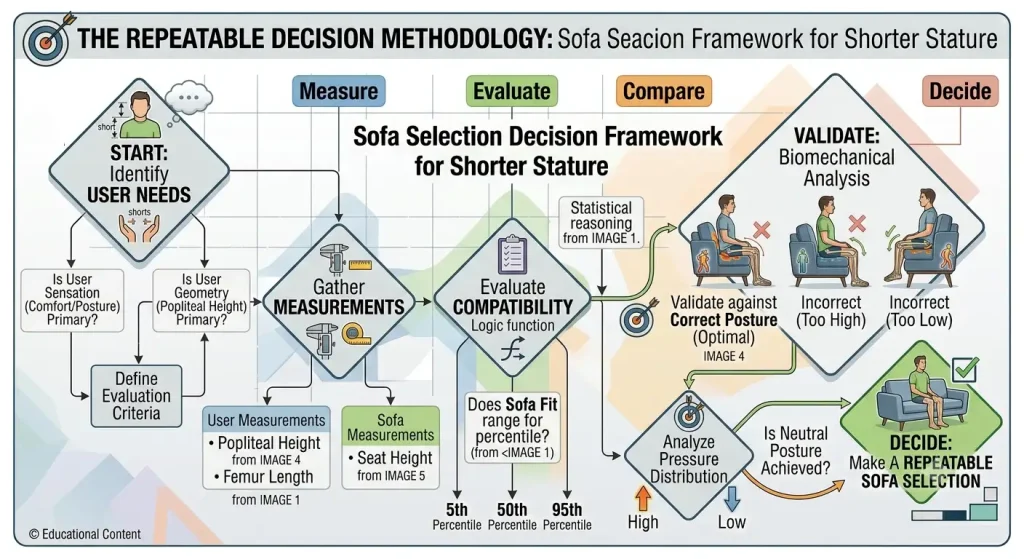
Intended Activity Determines Evaluation Priorities
An intended activity describes how the sofa will be used most of the time.
The same seating system may perform differently depending on whether its primary purpose is conversation, reading, watching television, entertaining guests, or supporting frequent transitions between sitting and standing.
Intended activity changes which performance characteristics deserve the greatest attention.
For example:
- A reading sofa may prioritize upright posture, lumbar support, and stable foot contact.
- A television sofa may prioritize relaxed posture and controlled pressure distribution during prolonged sitting.
- A household with older adults may prioritize accessibility and efficient sit-to-stand mechanics.
The semantic chain becomes:
Intended Activity
↓
Prioritizes
↓
Performance Requirements
↓
Changes
↓
Evaluation Criteria
↓
Influences
↓
Final Ranking
This explains why identical dimensions do not necessarily produce identical purchasing decisions.
Buying Criteria Create an Objective Evaluation Standard
Buying criteria are the measurable conditions a sofa must satisfy before it can be considered suitable.
Unlike personal preferences, buying criteria are evaluated systematically.
A comprehensive evaluation includes criteria from five connected categories:
Furniture Geometry
Measures whether published dimensions align with the user’s anthropometric requirements.
↓
Furniture Engineering
Evaluates frame construction, suspension, cushion materials, resilience, and long-term dimensional stability.
↓
Functional Performance
Assesses posture, accessibility, pressure distribution, movement efficiency, and functional seat height.
↓
Practical Requirements
Considers room size, maintenance requirements, durability, and expected frequency of use.
↓
Personal Preferences
Includes style, upholstery, color, texture, and aesthetic priorities.
This hierarchy reflects the principle that objective performance should be evaluated before subjective preference.
A Decision Tree Reduces Uncertainty
A decision tree is a logical sequence of questions that eliminates unsuitable options before comparing similar ones.
Rather than evaluating every characteristic simultaneously, each stage filters sofas according to increasingly specific requirements.
The decision tree follows this progression:
Does the sofa satisfy essential anthropometric requirements?
↓
If No → Eliminate.
If Yes → Continue.
↓
Does the seating system provide acceptable ergonomic performance?
↓
If No → Eliminate or consider adaptation.
If Yes → Continue.
↓
Does furniture engineering support long-term functional performance?
↓
If No → Compare alternatives.
If Yes → Continue.
↓
Does the sofa satisfy practical requirements and intended activity?
↓
If No → Compare alternatives.
If Yes → Continue.
↓
Do personal preferences distinguish between the remaining options?
↓
Final Purchase Decision
This filtering approach reduces decision complexity while ensuring that critical performance factors are evaluated before cosmetic features.
Trade-offs Should Be Evaluated Explicitly
Few sofas maximize every desirable characteristic. Most purchasing decisions involve balancing competing strengths and limitations.
A trade-off analysis compares the benefits gained by improving one characteristic against the limitations introduced elsewhere.
For example:
- a lower functional seat height may improve accessibility for shorter users but reduce comfort for taller household members;
- firmer cushions may improve long-term dimensional stability while feeling less plush initially;
- deeper seats may increase relaxation during lounging but reduce upright support for reading.
The semantic relationship becomes:
Evaluation Criteria
↓
Reveal
↓
Trade-offs
↓
Require
↓
Priority Ranking
↓
Support
↓
Purchase Decision
Recognizing trade-offs prevents readers from searching for a nonexistent “perfect” sofa and instead encourages selection of the sofa that best satisfies their highest-priority requirements.
The Evaluation Framework Produces Repeatable Decisions
A repeatable decision process should produce similar conclusions whenever the same evidence is evaluated.
The complete evaluation framework follows this sequence:
User Needs
↓
Intended Activity
↓
Buying Criteria
↓
Measurement Verification
↓
Geometry Evaluation
↓
Engineering Evaluation
↓
Functional Performance Evaluation
↓
Trade-off Analysis
↓
Final Ranking
↓
Purchase Decision
Because every stage builds upon verified information, the final decision reflects measurable performance rather than first impressions.
This framework also allows multiple sofas to be evaluated consistently using the same criteria, making comparisons more reliable and easier to justify.
By transforming measurements, ergonomic principles, engineering characteristics, and user requirements into a structured decision methodology, readers can identify the most suitable sofa with greater confidence. The final step is confirming that this evidence-based decision performs equally well under real-world conditions before committing to the purchase.
Real-World Validation: Confirming Performance Before and After Purchase
An evidence-based decision does not end when a sofa ranks highest within an evaluation framework. Measurements, engineering characteristics, and ergonomic assessments reduce uncertainty, but they should still be validated under real-world conditions whenever possible.
Verification is the process of confirming that published information, measured dimensions, and expected functional performance match actual experience. It transforms a predicted outcome into an observed outcome.
The complete validation model becomes:
Purchase Decision
↓
Verification
↓
Real-World Performance
↓
Long-Term Confidence
Validation closes the gap between theoretical evaluation and everyday use.
Verification Should Match the Buying Environment
The validation process depends on where the sofa is being evaluated. The available information differs when purchasing in a showroom, through online shopping, or when assessing an existing sofa already in the home.
Although the environment changes, the objective remains the same: verify that functional performance agrees with the evidence collected during evaluation.
The semantic relationship is:
Buying Environment
↓
Determines
↓
Available Evidence
↓
Determines
↓
Verification Method
↓
Confirms
↓
Purchase Confidence
A consistent verification process ensures that different buying environments produce comparable decisions.
Showroom Validation Combines Measurement and Observation
A showroom provides the most direct opportunity to validate predicted performance because published specifications can be compared with the physical product.
Begin by confirming key dimensions using the same measurement methodology established earlier. Measure functional seat height from the finished floor to the unloaded seating surface using consistent reference points.
Verification then extends beyond measurement.
Observe whether:
- both feet achieve stable floor contact,
- lower-leg position appears natural,
- sitting posture feels balanced,
- transitions between sitting and standing occur smoothly,
- and repeated sitting produces consistent functional performance.
This sequence follows the validation chain:
Published Specification
↓
Physical Measurement
↓
Functional Observation
↓
Performance Verification
↓
Purchase Confidence
Rather than relying solely on first impressions, combine objective measurements with repeated observation.
Online Shopping Requires Specification Verification
During online shopping, physical testing is unavailable before purchase. Verification therefore focuses on the quality and consistency of published information.
Review:
- manufacturer product specifications,
- dimension diagrams,
- furniture datasheets,
- measurement definitions,
- and any stated measurement tolerances.
Because manufacturers generally publish static measurements rather than loaded or functional dimensions, compare these specifications with your own measurements and evaluation criteria rather than assuming they represent actual sitting performance.
When specifications appear incomplete or inconsistent, additional verification may include contacting the manufacturer, reviewing detailed product documentation, or requesting clarification regarding measurement methods.
The semantic chain becomes:
Published Information
↓
Specification Review
↓
Consistency Verification
↓
Evidence Confidence
↓
Purchase Decision
This process reduces uncertainty when direct inspection is impossible.
Existing Sofas Provide a Useful Reference System
An existing sofa can serve as a practical benchmark for evaluating potential replacements.
Instead of asking whether the current sofa feels comfortable, identify which measurable characteristics contribute to satisfactory or unsatisfactory performance.
For example:
- measure functional seat height,
- evaluate ease of standing,
- observe lower-limb support,
- assess accessibility,
- and identify any recurring discomfort during prolonged use.
These observations establish a reference model against which new sofas can be compared.
The semantic relationship becomes:
Existing Sofa
↓
Measured Performance
↓
Reference Benchmark
↓
Comparison
↓
Improved Evaluation
↓
Better Purchase Decision
Using a familiar seating system as a benchmark often produces more reliable comparisons than relying on memory alone.
Product Testing Should Validate Performance, Not Preference
Product testing is the structured evaluation of a sofa under realistic conditions using predefined criteria.
Testing differs from casual sitting because it follows the same evaluation framework applied throughout the article.
An effective product test verifies:
- functional seat height,
- accessibility,
- pressure distribution,
- stability during movement,
- posture throughout different sitting durations,
- and consistency during repeated sit-to-stand transitions.
Each observation should answer a measurable question rather than a subjective one.
The evaluation sequence becomes:
Observation
↓
Measurement
↓
Comparison
↓
Performance Validation
↓
Decision Confirmation
This approach produces repeatable conclusions that are less influenced by temporary impressions.
Verification Continues After Purchase
Verification should not stop once the sofa enters the home.
Initial measurements confirm manufacturing consistency, but continued observation confirms long-term functional performance within the actual living environment.
After installation, verify:
- that measured dimensions correspond closely with published specifications,
- that functional seat height remains appropriate under regular use,
- that accessibility meets everyday requirements,
- and that expected ergonomic performance is maintained during repeated use.
If modifications have been introduced, repeat the same validation process used earlier:
Observe
↓
Measure
↓
Compare
↓
Validate
↓
Retain or Reassess
Consistent validation ensures that adaptations continue to produce the intended functional outcome rather than introducing new limitations.
Real-World Validation Completes the Evaluation Process
Every stage of evaluation has reduced uncertainty by replacing assumptions with measurable evidence. Verification is the final step that confirms whether those predictions remain accurate under practical conditions.
The complete validation framework becomes:
Evaluation Framework
↓
Buying Environment
↓
Verification Method
↓
Measurement Confirmation
↓
Product Testing
↓
Observed Functional Performance
↓
Decision Validation
A sofa should ultimately be judged not only by published dimensions or initial impressions, but by whether its measured performance remains consistent in everyday use. The remaining consideration is whether that performance can be maintained as the furniture ages and its materials change over time.
Long-Term Ownership and Maintenance
Long-term sofa performance should be evaluated in the same systematic way as the initial purchase. A sofa is not a static product. Throughout its product lifecycle, repeated loading, material aging, and environmental conditions gradually change the geometry and engineering of the seating system. The objective of long-term ownership is therefore not simply to preserve appearance, but to preserve functional performance and body–furniture compatibility.
Product Lifecycle: Why Furniture Performance Changes
Every seating system progresses through a predictable performance lifecycle:
New Product → Break-in Period → Stable Performance → Material Aging → Performance Decline → Maintenance, Component Replacement, or Furniture Replacement
Each stage influences the sofa differently. During the break-in period, new cushions often soften slightly as foams, fibers, and suspension components reach their normal operating condition. Later, repeated loading causes gradual material fatigue, reducing the seating system’s ability to maintain its original geometry.
This lifecycle explains why the published seat height should be treated as an initial engineering specification rather than a permanent functional measurement.
Cushion Compression Changes Functional Seat Height
The most significant long-term change is cushion compression. Compression occurs whenever the seating materials deform under load. High-resilience materials recover most of their original shape after unloading, while lower-resilience materials gradually develop permanent compression.
The semantic relationship is straightforward:
Repeated Loading
→ Cushion Compression
→ Reduced Functional Seat Height
→ Changed Joint Angles
→ Altered Pressure Distribution
→ Reduced Ergonomic Performance
The sofa frame may remain structurally unchanged while the effective seating position continues to evolve.
Foam Aging Reduces Seating Performance
Foam aging describes the gradual decline in a foam’s mechanical properties over years of use. As polymers fatigue, resilience decreases and permanent deformation becomes more likely. This process changes much more than perceived softness.
Foam aging influences:
- Functional seat height
- Pressure distribution
- Pelvic stability
- Sit-to-stand mechanics
- Accessibility
- Long-term seating efficiency
Because these changes occur gradually, users often adapt unconsciously until discomfort becomes noticeable.
Maintenance Preserves Functional Performance
Maintenance is best understood as performance preservation rather than cosmetic care. Its purpose is to slow performance decline and maintain the engineered characteristics of the seating system.
Effective maintenance includes:
- Following manufacturer care recommendations.
- Inspecting cushions for uneven compression.
- Checking suspension performance if support noticeably changes.
- Monitoring changes in functional seat height over time.
- Repeating key measurements whenever seating performance appears different.
This reflects the same performance-monitoring approach used in furniture engineering and quality-management processes, where dimensional stability is periodically evaluated throughout a product’s service life.
Rotation Distributes Wear More Evenly
If removable cushions are reversible, regular rotation redistributes mechanical loading across different surfaces. Instead of concentrating compression in a single location, rotation spreads wear more evenly throughout the cushion.
The engineering relationship becomes:
Rotation
→ More Uniform Compression
→ Better Shape Retention
→ More Stable Functional Seat Height
→ Longer Ergonomic Performance
Rotation slows uneven deterioration but cannot reverse permanent material fatigue.
Performance Validation Throughout Ownership
Long-term ownership should follow the same evaluation methodology used before purchase.
Observe
→ Measure
→ Compare
→ Evaluate
→ Maintain or Replace
If functional seat height, accessibility, or pressure distribution changes noticeably, repeat the same measurement process used during the original evaluation. Comparing current measurements with previous records makes performance changes measurable rather than subjective.
Knowing When Maintenance Is No Longer Enough
Not every decline can be corrected through maintenance. A structured intervention hierarchy helps determine the appropriate response.
Routine Maintenance
→ Cushion Rotation
→ Cushion Replacement
→ Suspension Repair
→ Complete Furniture Replacement
Each step represents a greater intervention intended to restore functional performance while preserving value whenever practical.
A replacement threshold is reached when maintenance or component replacement can no longer restore acceptable body–furniture compatibility. Common indicators include permanently reduced functional seat height, severe foam aging, loss of structural support, or persistent accessibility problems that remain after reasonable interventions.
Long-term ownership therefore becomes a continuous process of performance validation rather than passive use. By periodically observing, measuring, and evaluating the seating system throughout its product lifecycle, you can distinguish normal material aging from meaningful declines in ergonomic performance and make evidence-based maintenance or replacement decisions.
Independent Evaluation Model
By this point, individual concepts such as anthropometry, ergonomics, furniture geometry, engineering, product specifications, and long-term performance no longer need to be viewed as separate topics. Together they form a repeatable evaluation methodology that can be applied to virtually any sofa. Instead of memorizing recommended seat heights or relying on subjective impressions, you can evaluate furniture through a structured reasoning process that produces consistent, evidence-based decisions.
The Body–Furniture Compatibility Model
The Body–Furniture Compatibility Model explains that comfort is not an inherent property of a sofa or a characteristic of the user alone. Instead, comfort emerges from the relationship between measurable human characteristics and measurable furniture characteristics.
The model follows this semantic chain:
Human Anthropometry
→ Furniture Geometry
→ Body–Furniture Compatibility
→ Biomechanical Performance
→ Functional Performance
→ Comfort
→ Purchase Confidence
Each relationship is causal rather than independent. Changes in either the body or the furniture alter the entire evaluation outcome. This explains why two people can experience the same sofa differently and why a single sofa cannot provide identical ergonomic performance for every user.
The Seating System Model
A sofa should always be evaluated as a complete Seating System Model, not as a collection of isolated dimensions.
The seating system consists of interconnected engineering components:
- Seat height
- Seat depth
- Cushion construction
- Cushion firmness
- Suspension system
- Frame geometry
- Back height
- Arm height
These components interact continuously.
For example:
Cushion Firmness
→ Compression
→ Functional Seat Height
→ Joint Angles
→ Pressure Distribution
→ Sit-to-Stand Performance
Similarly,
Seat Depth
→ Pelvic Position
→ Back Contact
→ Lumbar Support
→ Postural Stability
Because every variable influences others, evaluating a single measurement without considering the complete seating system produces incomplete conclusions.
The Measurement → Interpretation → Decision Framework
Accurate measurements become valuable only after they are interpreted correctly. This creates a reusable Measurement → Interpretation → Decision Framework that separates observation from judgment.
The framework follows six sequential stages:
Measure
→ Obtain consistent measurements of the furniture and the user using clearly defined reference points.
Interpret
→ Compare those measurements using anthropometric principles, ergonomic relationships, and furniture engineering concepts rather than isolated numbers.
Evaluate
→ Assess the complete seating system, including geometry, construction, material performance, and intended use.
Validate
→ Confirm that observed performance matches the predicted performance during real sitting conditions.
Monitor
→ Re-evaluate functional performance over time as cushions, suspension, and materials age.
Decide
→ Select, maintain, modify, or replace the sofa based on measurable evidence instead of preference alone.
This framework transforms measurements into informed decisions by connecting every stage of the evaluation process.
The Comfort Prediction Model
The Comfort Prediction Model explains that comfort is best understood as the result of multiple interacting variables rather than a single measurement or personal opinion.
The model can be represented as:
Anthropometry
+
Furniture Geometry
+
Furniture Engineering
+
Biomechanics
+
Intended Activity
+
Long-Term Material Performance
Predicted Functional Performance
→ Comfort
This model predicts comfort before purchase by evaluating the factors that create ergonomic performance instead of relying solely on showroom impressions or marketing claims.
For example, two sofas may advertise the same published seat height. If one uses high-resilience foam with limited compression and the other uses softer cushioning that produces greater loaded seat height reduction, their functional performance will differ even though their published dimensions appear identical. The Comfort Prediction Model accounts for these engineering differences before a purchase decision is made.
A Transferable Evaluation Method
The value of these models extends beyond this specific buying decision. They create a transferable method that can be applied whenever you evaluate residential furniture, office seating, or any other product where body dimensions interact with engineered seating systems.
The complete reasoning process becomes:
Observe
→ Measure
→ Interpret
→ Compare
→ Evaluate
→ Validate
→ Monitor
→ Decide
Rather than asking whether a sofa is “good” or “bad,” this approach asks a more precise question: How well does this seating system perform for this body under this intended use throughout its product lifecycle?
That shift—from subjective opinion to structured evaluation is the enduring skill developed throughout this knowledge model.