
Finding a comfortable sofa is often described as a matter of personal preference. People are encouraged to choose the style they like, the fabric they prefer, or the firmness that feels best during a quick test. While these factors certainly influence the overall experience, they do not explain why some people feel comfortable almost immediately while others struggle with discomfort, even on well-made, expensive furniture.
For many shorter adults, the problem is not that a sofa is poorly constructed. Instead, the problem is that the sofa and the human body are not designed around the same dimensions.
A sofa is an engineered seating system with specific measurements, angles, and support characteristics. The human body is a biological system with its own structure, proportions, and movement patterns. Comfort emerges when these two systems work together. When they do not, the body must compensate through changes in posture, muscle activity, and weight distribution. Over time, those compensations can make sitting feel less stable, less supportive, and more physically demanding.
This distinction is important because it shifts the conversation away from the common assumption that comfort is determined by quality or cost alone. A higher price does not automatically create a better seating experience. Premium materials, sophisticated construction, and luxurious upholstery cannot fully compensate for a mismatch between human dimensions and furniture dimensions. Likewise, a thoughtfully engineered seating system that aligns with a person’s body proportions may feel significantly more comfortable regardless of decorative features or market position.
The phrase “sofa for short people” is therefore best understood as a question of compatibility rather than a separate category of furniture. It does not describe a special type of sofa reserved for people below a certain height. Instead, it describes the relationship between the physical characteristics of a person and the engineering characteristics of a seating system.
That relationship begins with the human body.
Although height is the characteristic people most often mention, ergonomics rarely evaluates seating using height alone. Two adults of the same height may have different leg lengths, thigh lengths, torso lengths, shoulder heights, or hip widths. These differences influence how each person sits, where body weight is concentrated, how the spine is supported, and whether the feet, thighs, pelvis, and back work together in a balanced position.
For this reason, body proportions are often more informative than overall height when evaluating seating comfort. The length of the lower legs influences how the feet interact with the floor. The length of the thighs affects how much support the legs receive while sitting. The proportions of the torso influence how the back aligns with the seating surface. Even small variations in these measurements can change the way forces move through the body during prolonged sitting.
Understanding these relationships is the purpose of ergonomics.
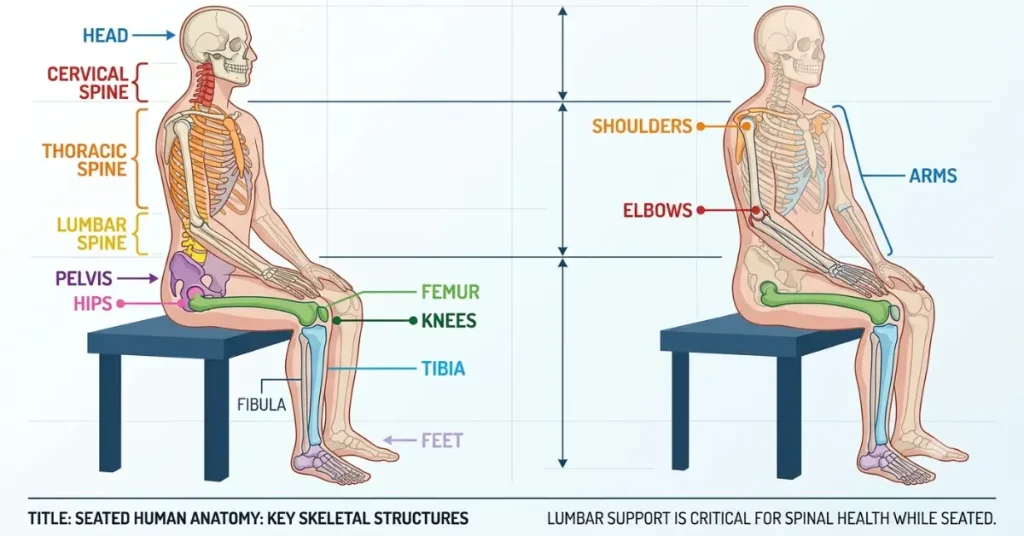
Ergonomics is the science of designing environments, tools, and products to match human capabilities and limitations. Rather than asking people to adapt to poorly matched objects, ergonomics asks how objects can support the natural structure and function of the human body. In seating, this means examining how anatomy, movement, posture, pressure distribution, and furniture design interact to create—or reduce—comfort.
Viewed through this perspective, comfort is no longer simply a feeling. It becomes the result of measurable interactions between body dimensions and furniture dimensions. Factors such as joint position, pressure distribution, spinal alignment, muscle activity, and body stability all contribute to the experience of sitting. When these elements work together efficiently, the body requires less effort to maintain posture. When they conflict, muscles compensate, pressure becomes uneven, and fatigue develops more quickly.
Because of this, understanding seating comfort requires more than learning furniture terminology. It requires understanding why the body responds the way it does when interacting with a seating system. Questions about seat height, seat depth, back support, cushioning, and sitting posture all become easier to answer once the underlying principles of human movement and body mechanics are understood.
This guide has been designed as an educational resource that builds that understanding step by step. Rather than beginning with furniture specifications or shopping advice, it starts with the scientific foundations that explain why seating comfort differs from one person to another. Along the way, it explores anthropometry, biomechanics, posture, pressure distribution, furniture engineering, seating geometry, and the relationships that connect these concepts into a complete framework for understanding furniture fit.
By approaching the topic from first principles instead of product recommendations, the goal is not simply to explain what makes one seating system different from another. The goal is to explain why those differences matter, how they influence the body’s natural mechanics, and how an understanding of those relationships leads to more informed decisions about seating in general.
Before examining how sofas are designed, measured and engineered. It is necessary to understand the system they are intended to support. Every dimension, angle and structural component of a seating system exists in relation to the human body. For that reason, the next step is to explore the body’s anatomy, proportions, and biomechanics, because understanding the human body always comes before understanding the sofa.
What Is a Sofa for Short People?
A sofa for short people is not a separate category of furniture or a product defined by a particular brand, style or appearance. Instead, it describes a relationship between the dimensions of a sofa and the proportions of the person using it. In ergonomics, comfort is determined by how well a seating system supports the human body rather than by whether it belongs to a specific product category.
This distinction is important because the phrase sofa for short people is often misunderstood. It does not mean a miniature sofa, a compact sofa, or a sofa intended only for small living spaces. A sofa can have a large overall size and still provide an appropriate sitting experience for someone with shorter body dimensions. Likewise, a physically smaller sofa may not provide suitable support if its seating geometry does not correspond to the user’s body.
The defining characteristic of a sofa for shorter adults is body–furniture compatibility. A seating system is considered compatible when its dimensions allow the body to maintain a stable, balanced, and supported sitting position with minimal unnecessary muscular effort. Rather than forcing the body to adapt to the furniture, the furniture accommodates the body’s natural structure and movement.
This concept can be understood as a simple relationship:
Human Body
        ↓
Body Proportions
        ↓
Furniture Dimensions
        ↓
Body Support
        ↓
Seating Comfort
Because every person has different body proportions, there is no single sofa dimension that works for everyone. Two people who are the same height may have different leg lengths, torso lengths, hip widths, or shoulder heights. These differences influence how they interact with the same seating surface. As a result, furniture fit depends on anthropometric compatibility rather than height alone.
When ergonomists evaluate seating, they rarely ask whether a sofa is “good” or “bad.” Instead, they ask whether the geometry of the seating system matches the geometry of the person using it. If the dimensions work together, the body remains stable and well supported. If they do not, the body compensates by changing posture, shifting weight, or increasing muscular effort to maintain balance.
For this reason, a sofa for short people should be understood as an ergonomic concept, not a marketing label. It represents a seating system whose dimensions and support characteristics correspond more closely with the anthropometric needs of people who have shorter body proportions. Understanding this relationship provides the foundation for every topic discussed throughout this guide from body measurements and posture to sofa engineering and seating comfort.
Core Characteristics of a Sofa Designed for Body Fit
A sofa designed around body fit is characterized not by its style or materials, but by how its structural dimensions work together to support the body’s natural biomechanics. Every component of a seating system influences the position of the body and every body segment responds differently depending on how that support is provided. Comfort therefore emerges from the interaction between human anatomy and furniture geometry rather than from any single design feature.
The most fundamental characteristic is appropriate seat height. Seat height influences how the lower body interacts with the floor. When the vertical distance between the sitting surface and the floor corresponds with the user’s lower-leg dimensions, the feet can participate in supporting body weight. This creates a stable base for the pelvis and helps maintain balanced sitting posture. When this relationship is poorly matched, the body often compensates by shifting weight or changing position.
A second defining characteristic is appropriate seat depth. Seat depth determines how much of the thighs are supported while allowing the back to maintain natural contact with the backrest. The relationship between thigh length and seating depth influences pressure distribution, pelvic stability, and the body’s ability to remain comfortably positioned during extended periods of sitting.
Another essential characteristic is effective lumbar support. The lumbar region forms the natural inward curve of the lower spine and plays a central role in maintaining spinal alignment during sitting. A seating system that supports this region allows the trunk to remain balanced with less muscular effort, while inadequate support often requires the surrounding muscles to compensate continuously.
Body fit also depends on postural support rather than simply softness. A comfortable seating system helps the body maintain a neutral and stable position without encouraging excessive muscular tension or unnecessary movement. In ergonomic design, posture is not viewed as a single rigid position but as the body’s ability to remain balanced while making small, natural adjustments over time.
These characteristics work together rather than independently. Seat height influences lower-body stability, seat depth affects pelvic position, lumbar support contributes to spinal alignment, and posture reflects the combined effect of all these relationships. Their interaction ultimately determines how pressure is distributed throughout the body and how much effort is required to remain seated comfortably.
Understanding these characteristics shifts the discussion away from furniture features alone and toward the principles that govern seating performance. Before individual dimensions such as seat height or seat depth can be evaluated in detail. It is necessary to understand why different people require different seating geometries. That begins with the human body itself its proportions, measurements and biomechanics which form the foundation of ergonomic seating design.
The Ergonomic Purpose of Sofa Design
The primary purpose of a sofa is not simply to provide a place to sit. From an ergonomic perspective, a sofa is an engineered support system designed to interact with the human body during periods of rest, conversation, reading, entertainment and other seated activities. Every structural element—from the frame beneath the cushions to the angle of the backrest—exists to manage how the body is supported against gravity.
Ergonomics approaches sofa design by asking a fundamental question: How can a seating system support the body’s natural structure while minimizing unnecessary physical effort? The answer depends on understanding that sitting is an active biomechanical process rather than a passive position. Even while resting, the body continuously maintains balance, stabilizes the spine, distributes body weight, and makes small postural adjustments to reduce muscle fatigue and tissue pressure.
This interaction can be understood as a continuous chain:
Human Anatomy
        ↓
Body Mechanics
        ↓
Sofa Geometry
        ↓
Body Support
        ↓
Pressure Distribution
        ↓
Postural Stability
        ↓
Seating Comfort
A well-designed sofa works with the body’s biomechanics instead of forcing the body to compensate. Appropriate seat height helps establish stable foot contact, creating a solid foundation for the lower body. Appropriate seat depth supports the thighs while allowing the pelvis and spine to remain aligned with the backrest. Effective lumbar support follows the natural curve of the lower back, reducing the muscular effort required to maintain an upright posture. Together, these elements distribute pressure more evenly across the body, reducing localized stress and improving sitting endurance.
Comfort, therefore, is not created by softness alone. Excessively soft cushions may initially feel pleasant but can allow the body to sink into positions that increase muscular effort and alter spinal alignment. Likewise, an overly firm seating surface may concentrate pressure over smaller areas of the body. Ergonomic comfort results from achieving a balance between support, stability, movement, and pressure distribution so that the body can remain relaxed without sacrificing proper alignment.
Rather than evaluating each component independently, ergonomics considers the sofa as a complete seating system. Frame construction, suspension, cushioning, seating geometry, and back support function together to influence how the body behaves during sitting. The effectiveness of one component depends on how well it complements the others, creating a unified support environment instead of isolated features.
Understanding the ergonomic purpose of sofa design reveals that comfort is not accidental. It is the outcome of carefully coordinated relationships between the human body and engineered furniture. However, even a well-engineered sofa cannot provide optimal support if its dimensions are based on body proportions that differ from those of the person using it. This explains why the same sofa may feel comfortable to one individual while creating discomfort for another.
Why It Differs from Standard Sofas
Standard sofas are generally designed to accommodate a broad range of users rather than the unique body proportions of any single individual. Furniture manufacturers often rely on anthropometric datasets that represent large segments of the population, allowing one design to serve many people reasonably well. While this approach improves general usability, it does not guarantee an optimal fit for every body type.
This distinction is important because average design is not the same as individualized ergonomic fit. Human bodies vary in far more ways than overall height. Differences in lower-leg length, thigh length, torso height, pelvic dimensions, shoulder height, flexibility, and posture all influence how a person interacts with a seating system. As these differences increase, the likelihood of a mismatch between body dimensions and furniture dimensions also increases.
The relationship can be summarized as follows:
Population Average
        ↓
Standard Furniture Dimensions
        ↓
Individual Body Proportions
        ↓
Compatibility or Mismatch
        ↓
Seating Experience
When the dimensions of a standard sofa do not correspond closely with a person’s body proportions, the body begins to compensate. If the seating surface is deeper than the thighs can comfortably accommodate, maintaining contact with the backrest may become more difficult. If the vertical relationship between the sitting surface and the lower legs is poorly matched, lower-body stability may be affected. Similarly, if the lumbar region of the backrest does not align with the natural curve of the spine, the surrounding muscles often assume a greater role in maintaining posture.
These responses are not flaws in either the person or the furniture. They are predictable outcomes of biomechanical mismatch. The body continuously adapts to its environment, but adaptation requires muscular effort, changes in posture, and repeated shifts in weight distribution. Over longer periods of sitting, these compensations can contribute to feelings of fatigue, instability, or discomfort even when the sofa itself is built from high-quality materials.
It is also important to distinguish between overall sofa size and functional seating dimensions. A sofa with generous exterior dimensions may still provide appropriate support if its seat geometry aligns with the user’s anthropometric characteristics. Conversely, a compact sofa does not automatically provide better ergonomic compatibility. External size influences room placement, while functional dimensions determine how the body interacts with the seating system.
Recognizing these differences shifts the discussion away from labels such as “standard” or “specialized” and toward a more meaningful concept: body–furniture compatibility. Once it becomes clear that comfort depends on the relationship between human proportions and seating geometry, the next step is to understand the body itself. That begins with the measurements and anatomical characteristics that determine how every person sits, moves, and maintains posture while using a sofa.
How Body Proportions Influence Sofa Design
Every person sits differently because every person is built differently. Although overall height is the measurement most commonly associated with furniture fit, ergonomics recognizes that body proportions are far more influential than total stature. Body proportions describe the relative size and relationship of individual body segments, such as the lower legs, thighs, pelvis, torso, shoulders, and arms. These proportions determine how the body interacts with a seating system and explain why two people of the same height may experience the same sofa in completely different ways.
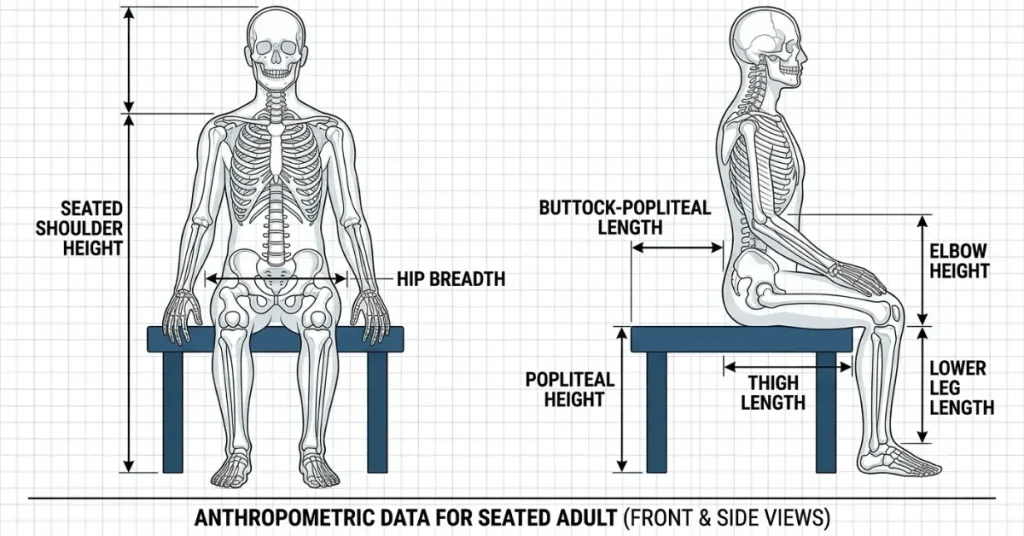
Rather than treating the body as a single measurement, ergonomic design views it as a collection of interconnected structures. Each body segment performs a specific role during sitting, and each interacts with a corresponding part of the sofa. This creates a continuous relationship between human anatomy and furniture geometry.
The interaction can be visualized as follows:
Body Proportions
        ↓
Anthropometric Measurements
        ↓
Sofa Dimensions
        ↓
Body Position
        ↓
Support Quality
        ↓
Comfort
One of the most influential body measurements is popliteal height, which is the vertical distance from the underside of the foot to the back of the knee while sitting. This measurement influences how the lower legs interact with the floor and how body weight is shared between the feet and the seating surface. Appropriate support in this area contributes to lower-body stability and helps establish a balanced sitting posture.
Another important measurement is the buttock–popliteal length, which represents the horizontal distance from the back of the buttocks to the back of the knee. This dimension determines how much thigh support the body requires without creating excessive pressure behind the knees. It directly influences the relationship between the user and the seat depth, affecting both pelvic position and spinal alignment.
The lumbar curve introduces another essential relationship. The human spine is not naturally straight; its gentle inward curve in the lower back helps distribute mechanical forces while maintaining balance. When the lumbar region is appropriately supported, the pelvis and spine can work together more efficiently. This reduces unnecessary muscular effort and allows the upper body to remain stable during prolonged sitting.
The width and shape of the pelvis also influence furniture design. The pelvis acts as the body’s primary weight-bearing structure while seated, transferring loads from the spine to the seating surface. Because body weight is concentrated through this region, the distribution of pressure beneath the pelvis has a significant influence on perceived comfort and sitting endurance. Effective seating therefore considers not only vertical support but also how forces are distributed across the contact surface.
Body proportions also affect the upper body. Torso length influences the relationship between the spine and the backrest, while shoulder height affects how the upper back is supported during relaxation. Likewise, arm length influences how comfortably the shoulders and elbows interact with armrests during everyday activities such as reading, talking, or watching television.
These measurements should not be viewed independently. The body functions as an integrated biomechanical system in which every segment influences the others. A change in one body position often produces adjustments throughout the entire kinetic chain.
For example:
Lower Leg Length
        ↓
Foot Contact
        ↓
Pelvic Stability
        ↓
Lumbar Alignment
        ↓
Upper Body Posture
        ↓
Muscle Activity
        ↓
Comfort
This interconnected behavior explains why seating comfort cannot be determined by a single furniture measurement or a single body measurement. Instead, comfort emerges from the compatibility between the body’s proportions and the sofa’s geometry. Ergonomic design seeks to optimize this compatibility by understanding how anatomical structures, joint positions, and body movements interact with engineered seating dimensions.
Recognizing the importance of body proportions transforms the discussion from one of furniture preference to one of human-centered design. Instead of asking whether a sofa is universally comfortable, ergonomics asks a more meaningful question: How well does this seating system support the specific body that uses it?
Why Standard Sofas Are Designed Around Population Averages
Most sofas are not designed for a single body type. Instead, they are developed to accommodate the widest possible range of users within a general population. This approach allows manufacturers to produce furniture that is practical for millions of households, but it also means that the final design represents a compromise rather than an individualized ergonomic solution.
To understand why this happens, it is helpful to distinguish between population-based design and person-centered design. Population-based design uses anthropometric data collected from large groups of people. Researchers measure body dimensions such as standing height, sitting height, hip breadth, lower-leg length, thigh length, and shoulder height across thousands of individuals. These measurements are then analyzed to identify statistical averages and common ranges that can guide furniture design.
The design process follows a relationship like this:
Population Anthropometry
        ↓
Statistical Analysis
        ↓
Average Human Dimensions
        ↓
Furniture Design Standards
        ↓
Standard Sofa Dimensions
The goal is not to create a sofa that perfectly fits every individual. Instead, the objective is to produce seating that functions reasonably well for the greatest number of people while balancing manufacturing efficiency, production costs, and consumer expectations. As a result, many sofa dimensions are based on average anthropometric values rather than the specific proportions of any one person.
This is why terms such as average furniture dimensions appear throughout ergonomic research and furniture standards. Dimensions like seat height, seat depth, backrest height, and armrest position are often selected because they accommodate a large portion of the adult population, not because they represent the ideal fit for every user.
However, average human dimensions should not be confused with the dimensions of an average person. Human bodies vary considerably. Even within the same age group or sex, people differ in lower-leg length, thigh length, pelvic width, torso length, shoulder height, flexibility, and body mass distribution. These differences are a natural result of biological diversity and cannot be fully represented by a single set of measurements.
For example, two adults who are both 160 centimeters (5 feet 3 inches) tall may have noticeably different body proportions. One person may have relatively longer legs and a shorter torso, while another may have shorter legs and a longer torso. Although their overall height is identical, their interaction with the same sofa may be very different because different body segments contact the seating system in different ways.
This illustrates an important ergonomic principle:
Population Average
        ↓
Standard Furniture Dimensions
        ↓
Individual Body Proportions
        ↓
Furniture Fit
The concept of an average is valuable for large-scale design, but it cannot predict how a specific individual will experience a particular seating system. A statistical average represents the center of a population, not the unique characteristics of every person within it.
For shorter adults, this distinction becomes especially important. Many standard sofa dimensions are optimized to accommodate broad population ranges rather than the specific anthropometric characteristics that commonly occur among people with shorter body proportions. As the difference between a person’s body dimensions and the furniture’s dimensions increases, the likelihood of ergonomic mismatch also increases.
Recognizing this limitation is the first step toward understanding why seating comfort varies so widely between individuals. The next section explores what happens when the geometry of the human body and the geometry of a sofa no longer align, and how those mismatches influence posture, pressure distribution, and overall sitting comfort.
How Body–Furniture Mismatch Creates Discomfort
A sofa does not create comfort on its own. Comfort emerges from the interaction between human body proportions and furniture dimensions. When these two systems are compatible, the body can maintain balance with relatively little muscular effort. When they are incompatible, the body must compensate by changing posture, redistributing weight, and increasing muscle activity to remain stable. This process is known as body–furniture mismatch.
The relationship begins with a simple principle:
Body Proportions
        ↓
Furniture Dimensions
        ↓
Body Position
        ↓
Pressure Distribution
        ↓
Postural Adaptation
        ↓
Comfort or Discomfort
Every person has unique body proportions. Measurements such as lower-leg length, thigh length, pelvic width, and torso length determine how the body occupies a seating system. Furniture dimensions—including seat height, seat depth, and backrest geometry—determine how the sofa supports those body segments. Discomfort occurs when these two sets of dimensions no longer work together.
One common example is dangling feet. When the distance from the sitting surface to the floor exceeds the user’s lower-leg length, the feet may not establish stable contact with the floor. Because the feet normally help support body weight and stabilize the lower body, losing this support changes how forces move through the body.
The chain of events can be understood as:
Seat Height
        ↓
Reduced Foot Contact
        ↓
Lower-Body Instability
        ↓
Pelvic Compensation
        ↓
Postural Changes
Without a stable base, the pelvis becomes less secure, making it more difficult to maintain an efficient sitting posture over time.
Another frequent mismatch involves unsupported thighs. The thighs are intended to share body weight across the seating surface. When the relationship between buttock–popliteal length and seat depth is poorly matched, the thighs may receive either insufficient or uneven support. Instead of distributing body weight broadly across the seat, pressure becomes concentrated over smaller contact areas.
This relationship follows a similar pattern:
Seat Depth
        ↓
Thigh Support
        ↓
Pressure Distribution
        ↓
Pelvic Stability
        ↓
Comfort
Balanced pressure distribution is one of the primary goals of ergonomic seating. The body is most comfortable when mechanical loads are spread across larger contact surfaces rather than concentrated in isolated regions. As pressure becomes uneven, the body naturally responds by making frequent adjustments in posture to relieve localized loading.
These adjustments often influence the position of the pelvis, which serves as the body’s primary weight-bearing structure during sitting. The pelvis forms the foundation for the spine, meaning that changes in pelvic position affect the alignment of the entire upper body.
The relationship can be summarized as:
Pressure Distribution
        ↓
Pelvic Position
        ↓
Spinal Alignment
        ↓
Postural Stability
When pelvic alignment changes, the spine frequently follows. One common response is slouching, where the trunk gradually moves into a rounded sitting posture. Slouching is not simply a matter of poor sitting habits; it is often a natural adaptation to a seating system that no longer supports the body’s preferred alignment. As the pelvis rotates and the spine changes position, muscles throughout the back, abdomen, shoulders, and neck work continuously to maintain balance.
These compensatory adjustments demonstrate that discomfort is rarely caused by a single furniture dimension in isolation. Instead, it develops through a chain of interconnected biomechanical events. A mismatch between body proportions and furniture geometry changes how body weight is supported, how pressure is distributed, how the pelvis stabilizes the spine, and ultimately how posture is maintained.
Understanding this sequence shifts the focus away from individual symptoms and toward the underlying mechanisms that create them. The next section follows this chain further, explaining how continued postural compensation can increase muscular effort, alter spinal mechanics, and contribute to lumbar strain during prolonged sitting.
From Poor Posture to Lumbar Strain: The Biomechanical Chain
The human body is designed to maintain balance with the least possible amount of muscular effort. During sitting, this balance depends on the alignment of the spine, the stability of the pelvis, and the even distribution of body weight across the seating surface. When these elements work together, the body’s supporting muscles can remain relatively relaxed while continuously making small, automatic adjustments to maintain posture.
When body proportions and furniture dimensions are no longer compatible, this balanced system begins to change. The body does not immediately experience pain or discomfort. Instead, it first adapts by altering its posture in an attempt to restore stability. These adaptations are natural protective responses, but they often require the musculoskeletal system to perform more work than it would in a well-supported sitting position.
The sequence can be understood as a continuous biomechanical chain:
Body–Furniture Mismatch
        ↓
Postural Adaptation
        ↓
Pelvic Movement
        ↓
Spinal Alignment Changes
        ↓
Increased Muscle Activity
        ↓
Fatigue
        ↓
Reduced Sitting Comfort
One of the most important concepts in ergonomics is spinal alignment. The human spine contains natural curves that help distribute mechanical forces while supporting the weight of the upper body. These curves allow the spine to absorb loading efficiently and reduce unnecessary stress on surrounding muscles and connective tissues.
During sitting, the position of the pelvis largely determines how these spinal curves are maintained. When the pelvis remains stable, the lumbar region—the lower portion of the spine—can preserve much of its natural inward curvature. This alignment allows body weight to travel through the skeleton efficiently, reducing the amount of continuous muscular effort required to remain upright.
When pelvic position changes because of inadequate support or altered posture, the lumbar curve often changes as well. As the lower back gradually moves away from its natural alignment, the muscles surrounding the spine become increasingly responsible for maintaining stability. Instead of sharing the load efficiently through the body’s skeletal structure, more of the work is transferred to soft tissues.
This process is known as muscle compensation.
Muscle compensation occurs whenever muscles perform additional work to stabilize a posture that the body’s structure can no longer maintain comfortably on its own. Rather than relaxing between movements, these muscles remain active for extended periods, continuously resisting gravity and supporting the trunk.
The relationship can be summarized as:
Reduced Structural Support
        ↓
Greater Muscle Compensation
        ↓
Continuous Muscle Activity
        ↓
Energy Expenditure
        ↓
Fatigue
Fatigue develops because muscles consume energy while producing force. Even relatively small increases in sustained muscular activity can gradually reduce endurance during prolonged sitting. As fatigue increases, posture often changes further, creating a cycle in which the body repeatedly shifts position to relieve discomfort before settling into another compensatory posture.
Over time, this cycle influences the lumbar region more directly. The lumbar spine serves as the mechanical connection between the pelvis and the upper body, making it particularly sensitive to prolonged postural changes. As surrounding muscles work harder to maintain stability, mechanical loading within the lower back may become less evenly distributed. This increased demand can contribute to lumbar strain, a term used to describe excessive loading of the muscles and soft tissues that support the lower spine.
The progression follows a predictable pattern:
Pelvic Instability
        ↓
Altered Lumbar Alignment
        ↓
Muscle Compensation
        ↓
Prolonged Loading
        ↓
Lumbar Strain
        ↓
Fatigue
It is important to recognize that lumbar strain is not caused by a single furniture measurement in isolation. Instead, it develops through a chain of interconnected biomechanical events that begin with body–furniture compatibility. Changes in support influence posture, posture influences muscle activity, and muscle activity influences long-term sitting endurance. Each stage builds upon the one before it, demonstrating that seating comfort is the result of an integrated system rather than an individual feature.
This cause-and-effect relationship also explains why discomfort varies from one person to another. Two people may sit on the same sofa for the same amount of time, yet experience different levels of fatigue because their body proportions, movement patterns, and postural responses differ. Ergonomics therefore focuses not on identifying a universally comfortable seating system, but on understanding how human characteristics interact with furniture design.
The discussion so far has shown that discomfort originates from the relationship between the body and the seating environment. To understand that relationship fully, it is necessary to examine the body itself. The next chapter explores the Popliteal Height, Buttock–Popliteal Length, Hip Breadth and biomechanics of the Body Weight and Weight Distribution.
Why Human Measurements Matter More Than Height
When people discuss whether a sofa is suitable for a shorter adult, the conversation usually begins with height. While overall height provides a general description of body size, it is not the measurement that determines how the body interacts with a seating system. In ergonomics, human measurements are far more important because they describe the dimensions of the body segments that actually contact the furniture.
This distinction is fundamental to understanding seating comfort. A sofa does not support a person’s standing height. It supports the body while sitting. During sitting, different parts of the body interact with different parts of the seating system. The feet contact the floor, the thighs rest on the seat, the pelvis bears much of the body’s weight, and the spine relies on the backrest for support. Each of these interactions depends on specific anthropometric measurements rather than on total stature.
The relationship can be understood as follows:
Standing Height
        ↓
General Body Size
Human Measurements
        ↓
Body Position
        ↓
Furniture Interaction
        ↓
Support
        ↓
Comfort
For example, two adults who are both 160 cm (5 ft 3 in) tall may have noticeably different lower-leg lengths, thigh lengths, torso heights, or hip widths. Although their standing heights are identical, their sitting posture and support requirements may be completely different. One person may naturally achieve stable foot contact while another may not. One may receive adequate thigh support, while another may experience uneven pressure distribution.
This is why anthropometry, the science of measuring the human body, plays a central role in ergonomic seating design. Anthropometric measurements allow furniture designers and ergonomists to understand how individual body segments interact with seating geometry instead of relying on height alone.
The following measurements form the foundation of ergonomic seating analysis. Each one influences a different aspect of body support, posture, and pressure distribution, and together they explain why seating comfort varies from one individual to another.
Popliteal Height
Popliteal height is the vertical distance from the underside of the foot to the crease behind the knee while a person is sitting with the lower legs positioned naturally and the feet resting on a level surface. In anthropometry, it is one of the most important measurements because it establishes the relationship between the lower body and the seating surface.
To measure popliteal height accurately, a person sits upright with their knees bent at approximately ninety degrees and both feet placed flat on the floor. The measurement is taken from the floor to the underside of the thigh at the back of the knee, where the lower leg meets the upper leg. This method reflects the body’s functional sitting position rather than its standing dimensions.
The measurement follows this relationship:
Popliteal Height
        ↓
Lower-Leg Position
        ↓
Foot Contact
        ↓
Lower-Body Stability
        ↓
Posture
Popliteal height matters because the feet provide more than simple contact with the floor. They form part of the body’s support system while sitting. Stable foot contact helps distribute body weight, supports pelvic stability, and contributes to balanced spinal alignment. When the lower legs are positioned comfortably, the body can maintain posture with less unnecessary muscular effort.
This measurement directly relates to seat height, one of the primary dimensions of a sofa. The relationship is not based on matching numbers exactly, but on allowing the lower body to function efficiently within the seating system. When seat height and popliteal height work together, the feet can participate in supporting the body’s weight, creating a stable foundation for the pelvis and spine.
The relationship can be summarized as:
Popliteal Height
        ↓
Seat Height
        ↓
Foot Support
        ↓
Pelvic Stability
        ↓
Spinal Alignment
        ↓
Seating Comfort
If this relationship becomes less compatible, the body’s mechanics change. Reduced foot support alters how weight is distributed through the lower body, requiring the pelvis and surrounding muscles to compensate in order to maintain balance. These adjustments can influence posture throughout the entire kinetic chain, demonstrating why popliteal height is considered one of the most influential anthropometric measurements in ergonomic seating analysis.
Understanding popliteal height also illustrates an important principle that applies to every measurement discussed in this guide: no single body dimension determines seating comfort by itself. Each measurement contributes to a larger system in which multiple body segments interact with multiple furniture dimensions. The next measurements build upon this foundation, showing how the thighs, pelvis, torso, and upper body work together to create a stable and comfortable sitting position.
Buttock–Popliteal Length
Buttock–popliteal length is the horizontal distance from the back of the buttocks to the back of the knee while a person is seated in an upright position. Unlike overall leg length, this measurement focuses specifically on the portion of the thighs that rests on the seating surface. In ergonomics and anthropometry, it is one of the primary measurements used to understand how the lower body interacts with a seat.
To measure buttock–popliteal length, a person sits with the pelvis positioned against a vertical back support, the knees bent at approximately ninety degrees, and the feet resting naturally on the floor. The measurement is taken from the rearmost point of the buttocks to the crease behind the knee. This reflects the functional space occupied by the thighs during sitting.
The relationship begins with:
Buttock–Popliteal Length
        ↓
Thigh Length
        ↓
Contact with Seat
        ↓
Body Support
This measurement matters because the thighs are responsible for supporting a significant portion of body weight while sitting. When they receive balanced support, pressure is distributed over a larger contact area, reducing localized loading and helping the pelvis remain stable. A stable pelvis, in turn, provides a stronger foundation for maintaining the natural alignment of the spine.
The primary furniture dimension related to buttock–popliteal length is seat depth. Seat depth determines how much of the thighs are supported while allowing the lower legs to move freely and the back to remain in contact with the backrest. The relationship is not simply about longer or shorter dimensions—it is about achieving appropriate support across the full sitting posture.
This interaction can be summarized as:
Buttock–Popliteal Length
        ↓
Seat Depth
        ↓
Thigh Support
        ↓
Pressure Distribution
        ↓
Pelvic Stability
        ↓
Seating Comfort
When this relationship becomes less compatible, the body’s support pattern changes. Reduced thigh support can concentrate pressure over smaller areas of the seating surface, while excessive contact near the back of the knees may alter lower-body positioning. In both situations, the pelvis often adjusts its position to restore balance, influencing spinal alignment and overall sitting posture. For this reason, buttock–popliteal length is considered one of the most important measurements for understanding how the lower body interacts with seating geometry.
Hip Breadth
Hip breadth is the maximum horizontal width of the body across the hips while sitting. It represents the amount of lateral space the pelvis and surrounding soft tissues occupy on a seating surface. Unlike measurements that describe body length or height, hip breadth focuses on body width and plays an essential role in understanding how weight is distributed across the seat.
To measure hip breadth, a person sits in a natural upright posture on a firm surface with body weight evenly distributed. The widest distance across the hips is measured from one outer side of the body to the other. Because soft tissues compress differently depending on body composition and posture, this measurement is considered alongside other anthropometric dimensions rather than in isolation.
The relationship begins with:
Hip Breadth
        ↓
Pelvic Contact Area
        ↓
Weight Distribution
        ↓
Lateral Stability
Hip breadth matters because the pelvis is the primary weight-bearing structure during sitting. The pelvis transfers much of the body’s load to the seating surface, making the amount of available contact area an important factor in pressure distribution and postural stability. When body weight is spread across a broader, well-supported surface, mechanical loads are distributed more evenly and the body requires less muscular effort to remain balanced.
The furniture dimension most closely associated with hip breadth is seat width. Seat width influences the amount of lateral space available for the pelvis and thighs, allowing the body to maintain a natural sitting position without unnecessary restriction or instability.
The relationship can be summarized as:
Hip Breadth
        ↓
Seat Width
        ↓
Pelvic Support
        ↓
Pressure Distribution
        ↓
Postural Stability
        ↓
Comfort
Hip breadth also affects how the body performs small postural adjustments during prolonged sitting. Throughout the day, people naturally shift their weight, rotate the pelvis slightly, and make subtle movements to relieve localized pressure. Adequate lateral support allows these movements to occur while maintaining overall balance, whereas an incompatible relationship between body width and seating width can alter how weight is transferred across the pelvis.
Together with popliteal height and buttock–popliteal length, hip breadth expands the understanding of seating ergonomics beyond simple height measurements. It demonstrates that body fit depends not only on vertical and horizontal dimensions but also on how the body distributes weight across the seating surface, creating another essential connection between human anthropometry and sofa geometry.
Seated Shoulder Height
Seated shoulder height is the vertical distance from the sitting surface to the highest point of the shoulders when a person is seated in an upright, natural posture. Unlike standing shoulder height, this measurement reflects the position of the upper body during sitting and helps explain how the torso interacts with the upper portion of a seating system.
To measure seated shoulder height, a person sits on a flat surface with the pelvis positioned neutrally, the spine in a relaxed upright posture, and both feet resting naturally on the floor. The measurement is taken vertically from the seating surface to the uppermost point of the shoulder, typically at the acromion, the bony prominence located at the outer edge of the shoulder.
The relationship begins with:
Seated Shoulder Height
        ↓
Upper Body Position
        ↓
Backrest Contact
        ↓
Upper Body Support
This measurement matters because the shoulders represent the upper endpoint of the trunk while sitting. The position of the shoulders reflects the alignment of the torso, the natural curves of the spine, and the balance of the upper body. When the trunk is properly supported, the shoulders can remain relaxed with minimal muscular effort. As posture changes, shoulder position changes as well, making seated shoulder height an important indicator of overall sitting mechanics.
Seated shoulder height relates primarily to backrest height and the vertical support provided to the upper torso. A backrest does more than support the lower back; it also influences how the thoracic spine, shoulder blades, and upper body are stabilized during prolonged sitting. Appropriate support allows the trunk to distribute its weight through the seating system instead of relying entirely on the muscles of the shoulders and upper back.
The relationship can be summarized as:
Seated Shoulder Height
        ↓
Backrest Height
        ↓
Upper Torso Support
        ↓
Shoulder Relaxation
        ↓
Postural Stability
        ↓
Seating Comfort
It is important to recognize that seated shoulder height should not be evaluated independently. It works together with torso length, lumbar support, pelvic stability, and spinal alignment to create balanced upper-body support. Changes in the position of the pelvis or lower spine often influence shoulder position, demonstrating that the upper body functions as part of an integrated biomechanical system rather than as an isolated structure. This measurement therefore helps explain how support travels from the pelvis through the spine to the shoulders, contributing to both comfort and postural endurance.
Body Weight and Weight Distribution
Body weight refers to the total force the body applies to a seating surface under the influence of gravity. While body weight describes the magnitude of this force, weight distribution explains how that force is spread across different areas of the body during sitting. In ergonomics, understanding weight distribution is often more important than understanding body weight alone because comfort depends on where forces are concentrated rather than simply how much force exists.
During sitting, body weight is not shared equally across every contact point. Most of the load is transferred through the pelvis, particularly the ischial tuberosities, commonly called the “sit bones.” Additional forces are distributed through the thighs, lower back, and, when appropriate, the feet resting on the floor. Together, these contact areas create the body’s support system.
The relationship begins with:
Body Weight
        ↓
Weight Distribution
        ↓
Pressure Distribution
        ↓
Body Support
        ↓
Comfort
Weight distribution matters because pressure is created whenever body weight acts on a contact surface. If the same amount of force is concentrated over a small area, pressure increases. When that force is spread over a larger, well-supported area, pressure becomes more evenly distributed. Ergonomic seating aims to manage this relationship by allowing multiple body regions to share the body’s load instead of concentrating it in one location.
Body weight and weight distribution relate to several sofa dimensions simultaneously rather than to a single measurement. Seat width influences how the pelvis and thighs share body weight. Seat depth affects how much of the thighs participate in supporting the body. Seat height influences whether the feet contribute to lower-body stability, while the shape and support of the backrest affect how loads are shared between the pelvis and the upper body.
This integrated relationship can be summarized as:
Body Weight
        ↓
Seat Geometry
        ↓
Pressure Distribution
        ↓
Pelvic Stability
        ↓
Spinal Support
        ↓
Seating Comfort
Weight distribution is also dynamic rather than fixed. During prolonged sitting, people naturally make small movements to redistribute pressure and reduce localized loading. These micro-adjustments help maintain circulation, reduce tissue stress, and delay the onset of muscular fatigue. Because body weight is continuously managed through posture and movement, ergonomics evaluates not only how much weight the body applies to a seating system but also how effectively the seating system allows that weight to be distributed across the body’s supporting structures.
Together, body weight and weight distribution demonstrate that seating comfort is not determined by body mass alone. Instead, comfort depends on how efficiently mechanical forces are transferred through the pelvis, thighs, spine, and supporting surfaces, creating another essential connection between human anthropometry and seating geometry.
Mobility and Preferred Sitting Posture
While body measurements describe the physical dimensions of the human body, they do not fully explain how a person uses a seating system. Mobility and preferred sitting posture introduce another important aspect of ergonomics: the body is designed for movement, not for remaining completely still. A comfortable sitting experience depends not only on how well a person’s measurements match a seating system, but also on how easily the body can change position throughout the day.
Mobility refers to the body’s ability to move its joints and body segments through their natural range of motion while maintaining balance and control. It includes movements such as bending the hips, rotating the pelvis, extending the knees, adjusting the spine, and repositioning the shoulders. These movements allow the body to redistribute mechanical loads, reduce localized pressure, and maintain circulation during prolonged sitting.
The relationship begins with:
Mobility
        ↓
Body Movement
        ↓
Pressure Redistribution
        ↓
Reduced Tissue Loading
        ↓
Improved Sitting Endurance
People rarely maintain one perfectly fixed sitting position. Instead, they naturally perform micro-adjustments—small, often unconscious movements that shift body weight between the pelvis, thighs, back, and feet. These movements reduce continuous loading on individual tissues and help the muscles alternate between periods of activity and relaxation. A seating system should support these natural adjustments rather than restrict them.
Another important factor is preferred sitting posture. This describes the position a person naturally adopts when sitting comfortably during everyday activities. Preferred posture varies between individuals because it is influenced by anatomy, flexibility, muscle strength, habits, age, and the task being performed. Someone reading a book may naturally sit differently from someone watching television or having a conversation, even though the same seating system is being used.
The relationship can be summarized as:
Preferred Sitting Posture
        ↓
Body Position
        ↓
Weight Distribution
        ↓
Muscle Activity
        ↓
Perceived Comfort
Preferred posture should not be confused with a single “correct” posture. Modern ergonomics recognizes that comfort is supported by postural variation rather than by maintaining one rigid position for extended periods. Healthy sitting involves small changes in joint angles, muscle activity, and weight distribution that prevent continuous loading of the same tissues.
Mobility and posture also interact closely with previously discussed anthropometric measurements. Popliteal height influences how easily the lower legs move while seated. Buttock–popliteal length affects the relationship between the thighs and the seating surface during posture changes. Hip breadth influences lateral weight shifts, while seated shoulder height contributes to the movement of the upper torso and shoulders. Body weight determines how forces are redistributed during every adjustment.
This integrated relationship can be visualized as:
Anthropometric Measurements
        ↓
Mobility
        ↓
Postural Adjustment
        ↓
Pressure Redistribution
        ↓
Balanced Muscle Activity
        ↓
Long-Term Seating Comfort
Understanding mobility and preferred sitting posture reinforces an important ergonomic principle: comfort is not created by keeping the body motionless. Instead, comfort results from allowing the body to move naturally while remaining supported. A seating system should accommodate these natural movements so that posture can change without disrupting overall stability or increasing unnecessary muscular effort.
The Structural Anatomy of a Sofa
A sofa is often viewed as a decorative piece of furniture. But from an ergonomic and engineering perspective, it is a structural support system designed to manage the interaction between the human body and gravity. Every component of a sofa performs a specific mechanical function. Together, these components distribute body weight, stabilize posture, absorb movement, and provide long-term structural support.
Rather than functioning as independent parts, the seat, backrest, armrests, frame, suspension, cushioning, and upholstery operate as an integrated system. A change to one component influences the performance of the others. For example, the effectiveness of a backrest depends not only on its own shape but also on the position of the seat and the stability provided by the frame beneath it.
The engineering relationship can be visualized as:
Human Body
        ↓
Body Weight
        ↓
Seat
        ↓
Suspension
        ↓
Frame
        ↓
Legs
        ↓
Floor
At the same time, another support pathway manages upper-body stability:
Human Body
        ↓
Pelvis
        ↓
Spine
        ↓
Backrest
        ↓
Frame
These systems work together to create what ergonomists call seating support. Comfort is therefore not produced by a single soft cushion or attractive fabric. Instead, it emerges from the coordinated performance of every structural component. Understanding these components individually provides the foundation for understanding how sofas support posture, distribute pressure, and maintain durability over years of use.
Seat
The seat is the primary load-bearing surface of a sofa. It is the part that directly supports the pelvis and thighs, making it the central point of interaction between the body and the seating system. Nearly every force generated during sitting passes through the seat before being transferred into the suspension system and structural frame.
The primary purpose of the seat is to provide a stable platform that supports body weight while distributing pressure across a broad contact area. Instead of concentrating force beneath a few small points, a properly engineered seat allows the pelvis and thighs to share the body’s load more evenly. This balanced support helps reduce localized pressure and contributes to greater sitting stability.
The seat is not a single component. It is an engineered assembly consisting of multiple structural layers, typically including the support surface, suspension system, cushioning materials, upholstery, and attachment points connected to the frame. Each layer contributes differently to comfort and structural performance.
The relationship follows this sequence:
Seat Structure
        ↓
Body Support
        ↓
Pressure Distribution
        ↓
Pelvic Stability
        ↓
Posture
        ↓
Comfort
From a postural perspective, the seat establishes the body’s foundation. Because the pelvis rests directly on the seating surface, its position influences the alignment of the spine, the angle of the hips, and the distribution of body weight throughout the upper body. A stable seating surface allows the body to maintain balance with less muscular effort, while an unstable surface requires continuous postural adjustments.
The seat also plays a major role in durability. Every time someone sits down, mechanical forces compress the seat and its supporting materials. Over thousands of loading cycles, these repeated forces gradually affect structural performance. The long-term durability of a sofa therefore depends heavily on how effectively the seat distributes loads to the suspension system and frame beneath it.
Backrest
The backrest is the structural component that supports the trunk after body weight has been transferred through the pelvis. Its purpose is not simply to provide a surface for leaning backward, but to stabilize the spine, reduce muscular effort, and assist the body in maintaining balanced posture during sitting.
During upright sitting, the spine naturally forms a series of gentle curves that help distribute mechanical forces. The backrest interacts with these curves by providing posterior support to the torso. Rather than carrying the entire weight of the upper body, it shares part of the mechanical load that would otherwise be managed exclusively by the spinal muscles.
The support pathway can be understood as:
Backrest
        ↓
Spinal Support
        ↓
Reduced Muscle Activity
        ↓
Improved Postural Stability
        ↓
Comfort
Like the seat, the backrest consists of several structural elements working together. Its supporting frame provides rigidity, while cushioning materials absorb localized pressure between the torso and the seating surface. The geometry of the backrest determines how contact forces are distributed across the lower back, thoracic region, and shoulders.
The effectiveness of the backrest depends on its relationship with the seat rather than on its design alone. The position of the pelvis established by the seat influences how the spine contacts the backrest, demonstrating that these components function as a coordinated support system rather than independent structures.
The backrest also contributes to durability by resisting repeated loading generated whenever users lean backward or change posture. These forces are transferred through the internal frame, making structural integrity essential for maintaining consistent support over time.
Armrests
The armrests are secondary support structures positioned on either side of the seating system. Although they do not carry the body’s primary weight, they contribute significantly to upper-body stability, movement, and overall seating function.
The primary purpose of an armrest is to provide a stable surface for supporting the forearms and assisting the shoulders during sitting. When the arms are supported appropriately, the muscles surrounding the shoulders and upper neck perform less continuous work to hold the weight of the upper limbs. This allows the upper body to remain more relaxed during prolonged seated activities such as reading, conversing, or watching television.
The support relationship follows this sequence:
Armrests
        ↓
Forearm Support
        ↓
Shoulder Relaxation
        ↓
Reduced Upper-Body Muscle Activity
        ↓
Improved Sitting Stability
Structurally, armrests are extensions of the sofa’s primary frame. They are reinforced to resist both vertical loading from resting arms and lateral forces generated when users lean against them or use them while sitting down and standing up. Padding and upholstery are added to improve pressure distribution without compromising structural strength.
Beyond comfort, armrests influence posture by helping stabilize the upper body during transitional movements. They assist with balance when changing position, entering or exiting the sofa, and making small postural adjustments. Rather than functioning as decorative accessories, armrests form part of the sofa’s overall support system.
Durability is equally important because armrests experience repeated compressive and lateral forces throughout the life of the sofa. Their structural performance depends on strong frame connections and materials capable of maintaining rigidity despite continual use.
Together, the seat, backrest, and armrests form the primary human–sofa interface. These are the components users interact with directly, but they cannot perform effectively on their own. Their ability to support posture, distribute body weight, and maintain comfort ultimately depends on the hidden structural foundation beneath them. The next section explores that foundation by examining the frame, legs, and suspension system that allow every visible component of a sofa to function as a unified engineered structure.
The Structural Foundation
The visible parts of a sofa—the seat, backrest, and armrests—are only one part of the seating system. Beneath these components lies the structural foundation, a hidden engineering framework responsible for supporting every mechanical load generated during everyday use. This foundation consists primarily of the frame, legs, and suspension system, which work together to maintain stability, preserve structural integrity, and transfer body weight safely to the floor.
Rather than functioning independently, these components create a continuous load-bearing pathway.
The structural relationship can be visualized as:
Human Body
        ↓
Seat
        ↓
Suspension
        ↓
Frame
        ↓
Legs
        ↓
Floor
Each component has a different engineering role. The suspension absorbs and distributes dynamic forces, the frame provides structural rigidity, and the legs transfer those forces into the supporting surface. Together, they determine how stable, supportive, and durable a sofa remains throughout its lifespan.
Frame
The frame is the primary structural skeleton of a sofa. It forms the internal architecture that connects every major component, including the seat, backrest, armrests, suspension system, and legs. Although hidden beneath upholstery and cushions, the frame is the foundation upon which the entire seating system is built.
The primary purpose of the frame is to provide structural strength. It resists bending, twisting, compression, and repeated loading generated whenever someone sits, leans back, changes position, or stands up. Without a rigid frame, the individual components of a sofa could not maintain their intended geometry or support the body consistently over time.
The structural relationship follows this sequence:
Frame
        ↓
Structural Integrity
        ↓
Component Stability
        ↓
Consistent Body Support
        ↓
Postural Stability
A sofa frame is typically constructed from interconnected structural members joined together to form a rigid load-bearing assembly. Cross supports, corner reinforcements, and attachment points distribute mechanical forces throughout the structure rather than allowing stress to accumulate in a single location. This load-sharing approach improves both stability and long-term durability.
The frame also influences comfort indirectly. While users rarely make direct contact with it, the frame determines whether the seat and backrest maintain their designed positions under load. If the frame flexes excessively, the seating geometry changes, altering pressure distribution, pelvic support, and spinal alignment. In this way, structural rigidity contributes to consistent ergonomic performance.
Durability depends heavily on the frame because every repeated sitting cycle introduces mechanical stress into the structure. A well-engineered frame distributes these forces efficiently, reducing localized strain and helping the sofa maintain its structural characteristics over many years of use.
Legs
The legs are the structural supports that connect the sofa to the floor. Although they appear relatively simple, they perform a critical engineering function by transferring the combined weight of the furniture and its occupants safely to the supporting surface while maintaining overall stability.
The primary purpose of the legs is to provide elevation and load transfer. They create the final connection in the structural pathway, allowing mechanical forces generated within the seating system to pass into the floor.
This relationship can be summarized as:
Body Weight
        ↓
Frame
        ↓
Legs
        ↓
Floor
        ↓
Structural Stability
Each leg functions as a compression member designed to resist vertical loading while also stabilizing the sofa against horizontal forces created during everyday movement. Sitting down, standing up, shifting body weight, and leaning against the backrest all generate dynamic forces that travel through the frame before reaching the legs.
The position and structural attachment of the legs influence how evenly these forces are distributed. Balanced load transfer helps prevent unnecessary stress concentrations within the frame and reduces unwanted movement of the seating system during use.
Although the legs have little direct influence on pressure distribution or body support, they contribute to comfort by maintaining a stable seating platform. Even small amounts of structural movement can alter the relationship between the body and the seating surface, requiring continuous muscular adjustments to maintain balance. Stable leg support therefore contributes indirectly to postural control by preserving the intended geometry of the entire sofa.
Long-term durability also depends on the ability of the legs and their attachment points to resist repeated loading without loosening, deforming, or transferring excessive stress into surrounding structural members.
Suspension
The suspension system is the mechanical layer positioned between the frame and the seating surface. It serves as the primary support mechanism beneath the seat, controlling how body weight is absorbed, distributed, and returned during sitting.
Unlike the rigid frame, the suspension is designed to deform in a controlled manner under load. This controlled movement allows the seating system to absorb impact while maintaining support, preventing the body from resting directly on the frame beneath it.
The engineering relationship follows this sequence:
Body Weight
        ↓
Seat
        ↓
Suspension
        ↓
Controlled Load Distribution
        ↓
Frame
The suspension performs several essential functions simultaneously. First, it spreads mechanical loads across a wider portion of the frame instead of concentrating force beneath a single contact point. Second, it helps maintain consistent support beneath the seating surface by responding dynamically as body weight shifts during sitting. Third, it reduces impact forces generated when a person sits down, improving both comfort and structural longevity.
From an ergonomic perspective, the suspension contributes significantly to pressure distribution and postural stability. As the body makes natural micro-adjustments during prolonged sitting, the suspension responds by adapting to changing loads while continuing to support the pelvis and thighs. This dynamic interaction helps maintain a stable seating surface without excessive rigidity.
The relationship can be summarized as:
Suspension
        ↓
Load Distribution
        ↓
Seat Stability
        ↓
Pressure Management
        ↓
Postural Support
        ↓
Comfort
Suspension is equally important for durability because it absorbs a large proportion of the repetitive forces created during everyday use. By reducing the direct mechanical stress transferred to the frame, it helps preserve structural integrity and prolong the functional life of the entire seating system.
Together, the frame, legs, and suspension form the hidden engineering foundation of a sofa. While users rarely see these components, they determine how effectively the visible seating surfaces maintain support, resist wear, and preserve their intended ergonomic performance. The next section builds upon this structural foundation by examining the comfort system—including foam, seat cushions, and back cushions—which directly influences pressure distribution, body support, and perceived seating comfort.
The Comfort System
The structural foundation of a sofa provides strength and stability, but it does not directly determine how the seating surface feels to the human body. That role belongs to the comfort system, a collection of engineered components designed to manage pressure, absorb mechanical loads, and support the body’s natural posture during sitting.
The comfort system primarily consists of foam, seat cushions, and back cushions. These components work together to create the interface between the body and the structural foundation beneath. Rather than functioning as isolated layers, they operate as a coordinated system that influences pressure distribution, body support, movement, and long-term seating performance.
The relationship can be understood as:
Human Body
        ↓
Body Weight
        ↓
Comfort System
        ↓
Pressure Distribution
        ↓
Structural Foundation
        ↓
Support
        ↓
Comfort
Unlike the frame or suspension, which primarily manage structural forces, the comfort system manages human contact. It determines how mechanical loads are transferred from the body into the supporting structure while helping maintain balanced posture and reducing localized pressure.
Foam
Foam is the primary cushioning material used within a sofa’s comfort system. Its purpose is to provide controlled support between the human body and the structural foundation beneath. Instead of allowing body weight to act directly on the suspension or frame, foam compresses under load and redistributes mechanical forces across a larger contact area.
From an engineering perspective, foam is not designed simply to feel soft. It is designed to respond predictably when compressed and to recover its original shape after the load is removed. This ability allows the seating surface to support the body repeatedly while maintaining consistent performance over time.
The relationship follows this sequence:
Foam
        ↓
Controlled Compression
        ↓
Pressure Distribution
        ↓
Body Support
        ↓
Comfort
The effectiveness of foam depends on how it manages pressure distribution. As the pelvis, thighs, and back apply force to the seating surface, the foam compresses in response to body weight. Rather than concentrating pressure beneath a few contact points, it spreads those forces across a broader surface. This reduces localized tissue loading and helps the body remain comfortable during extended periods of sitting.
Foam also influences posture by supporting the body’s natural contours. A properly functioning foam layer allows the pelvis and spine to remain stable while accommodating the body’s shape. If the cushioning compresses unevenly or loses its structural resilience over time, the body’s position may gradually change, requiring additional muscular effort to maintain balance.
Durability is another important characteristic. Every sitting cycle compresses the foam before allowing it to recover. Over years of repeated loading, the material gradually experiences mechanical fatigue. The long-term performance of the comfort system therefore depends on the foam’s ability to retain its resilience, maintain consistent support, and resist permanent deformation.
Seat Cushions
The seat cushions form the primary contact surface between the lower body and the sofa. They sit above the suspension system and contain the cushioning materials responsible for supporting the pelvis and thighs while distributing body weight across the seating surface.
Their primary purpose is to create a stable yet adaptable interface that supports the body’s weight without concentrating excessive pressure beneath individual contact points. Rather than functioning independently, the seat cushions work together with the foam, suspension, and frame to produce balanced support throughout the seating system.
The relationship can be summarized as:
Seat Cushions
        ↓
Pelvic Support
        ↓
Pressure Distribution
        ↓
Postural Stability
        ↓
Comfort
From a construction perspective, seat cushions typically consist of an outer fabric cover surrounding one or more cushioning materials positioned above a supportive internal structure. Each layer contributes differently to comfort, support, and long-term performance, allowing the cushion to respond dynamically as body weight shifts during sitting.
Seat cushions have a significant influence on posture because they determine how the pelvis interacts with the seating surface. Since the pelvis serves as the foundation of the spine while sitting, its position influences the alignment of the lumbar region, torso, and upper body. Stable pelvic support therefore contributes to balanced spinal alignment and reduced muscular effort.
Durability depends on how effectively the seat cushions maintain their shape and structural characteristics through repeated compression. Consistent performance allows the seating geometry to remain stable over time, preserving the intended ergonomic relationship between the body and the sofa.
Back Cushions
The back cushions provide the primary contact surface for the spine, rib cage, shoulders, and upper torso. While the seat cushions support body weight from below, the back cushions stabilize the upper body from behind, helping the spine maintain a balanced sitting position.
Their primary purpose is to distribute contact pressure across the back while supporting the natural contours of the torso. Instead of allowing isolated areas of the spine or shoulders to absorb concentrated forces, the back cushions spread those forces across a broader support surface.
The support pathway follows this sequence:
Back Cushions
        ↓
Torso Support
        ↓
Spinal Stability
        ↓
Reduced Muscle Activity
        ↓
Comfort
Structurally, back cushions consist of cushioning materials enclosed within an upholstered cover and positioned against the sofa’s internal backrest structure. Together, they create a compliant support surface that responds to body movement while remaining connected to the underlying frame.
Back cushions influence posture by supporting the trunk during sitting. As the upper body leans against the backrest, the cushions help maintain consistent contact between the torso and the structural support beneath. This shared support reduces the continuous effort required from the spinal muscles to stabilize the upper body, allowing a more balanced sitting posture.
Their role becomes particularly important during prolonged sitting. As the body naturally performs small postural adjustments, the back cushions adapt to changing contact patterns while continuing to distribute pressure evenly across the back. This dynamic interaction helps maintain support without restricting normal movement.
From a durability perspective, back cushions experience repeated compression and recovery throughout everyday use. Their long-term effectiveness depends on maintaining consistent shape, resilience, and support characteristics despite thousands of loading cycles. When these properties are preserved, the cushions continue to provide stable upper-body support and contribute to the overall ergonomic performance of the seating system.
Together, foam, seat cushions, and back cushions form the sofa’s comfort system. They transform the rigid structural foundation into a body-supporting interface by managing pressure distribution, stabilizing posture, and responding to natural human movement. However, comfort is influenced not only by the internal support system but also by the materials that surround it and the mechanisms that allow the sofa to change position. The next section explores the surface and motion systems, including fabric and reclining mechanisms, and explains how they contribute to comfort, functionality, and long-term performance.
Surface & Motion Systems
The structural foundation and comfort system determine how a sofa supports the body, but they are not the final layers of the seating system. The surface and motion systems influence how the body interacts with the sofa during everyday use. These components include the fabric, which forms the outer contact surface, and reclining mechanisms, which allow the seating geometry to change in response to body movement.
Unlike the frame or cushions, these systems are not primarily responsible for carrying structural loads. Instead, they influence tactile comfort, movement, usability, and the overall interaction between the user and the seating system.
The relationship can be summarized as:
Structural Foundation
        ↓
Comfort System
        ↓
Surface & Motion Systems
        ↓
Human Interaction
        ↓
Overall Seating Experience
Together, these layers complete the engineered seating system by combining structural support, pressure management, surface comfort, and controlled movement.
Fabric
Fabric is the outermost layer of a sofa and the first component that comes into direct contact with the human body. While it is often associated with appearance, its engineering purpose extends far beyond aesthetics. Fabric serves as the protective covering for the internal comfort system while also influencing tactile sensation, friction, temperature regulation, and long-term durability.
The primary purpose of fabric is to create a durable interface between the user and the underlying cushions. It protects the internal materials from abrasion, contamination, sunlight, and everyday wear while allowing the comfort system beneath to function effectively.
The interaction follows this sequence:
Fabric
        ↓
Body Contact
        ↓
Surface Friction
        ↓
Movement
        ↓
Perceived Comfort
From a construction perspective, fabric is stretched over the cushioning materials and securely attached to the sofa’s structural frame. Its performance depends on characteristics such as fiber composition, weave structure, elasticity, abrasion resistance, breathability, and dimensional stability. These properties determine how the fabric responds to repeated loading, body movement, and environmental exposure throughout years of use.
Fabric also influences comfort by affecting how the body interacts with the seating surface. Materials with different textures create different levels of surface friction, influencing how easily the body changes position during sitting. Breathable fabrics help regulate heat and moisture at the contact surface, contributing to thermal comfort during prolonged use.
Its influence on posture is indirect but meaningful. Surface friction affects how easily the pelvis and torso perform natural postural adjustments. If movement across the seating surface is excessively restricted or excessively slippery, the body’s normal micro-adjustments may be altered, changing how weight is redistributed over time.
Durability depends on the fabric’s ability to resist abrasion, stretching, fading, seam stress, and repeated compression while preserving both structural integrity and appearance.
Reclining Mechanisms
A reclining mechanism is a mechanical system that allows the position of the seat, backrest, or foot support to change relative to the main frame. Unlike fixed seating systems, reclining mechanisms introduce controlled movement into the sofa, allowing the geometry of the seating system to adapt to different sitting positions.
The primary purpose of a reclining mechanism is to modify the relationship between the body and the seating structure while maintaining stability and structural support. Instead of forcing the body to adapt to a single seating position, the mechanism allows the seating system itself to change configuration.
The engineering relationship follows this sequence:
Reclining Mechanism
        ↓
Seat Geometry Changes
        ↓
Body Position Changes
        ↓
Pressure Redistribution
        ↓
Postural Variation
From a construction perspective, reclining mechanisms consist of interconnected mechanical components integrated within the sofa’s frame. Hinges, pivots, linkages, support arms, and locking systems work together to guide movement while maintaining structural integrity throughout repeated operating cycles.
Their influence on comfort comes from allowing body weight to be redistributed across different contact areas as posture changes. Instead of concentrating pressure continuously in one position, the body can alter joint angles and support patterns, reducing localized loading during prolonged sitting.
Reclining mechanisms also influence posture by changing the orientation of the pelvis, spine, thighs, and lower legs relative to the seating system. These adjustments modify how body weight is shared between the seat, backrest, and leg support, demonstrating that posture is dynamic rather than fixed.
Durability is especially important because reclining mechanisms experience repeated movement under mechanical load. Every adjustment subjects the internal joints and moving components to cycles of stress. Long-term reliability therefore depends on precise engineering, strong structural connections, and consistent mechanical performance throughout thousands of operating cycles.
Transition to Sofa Measurements
Knowing the structural anatomy of a sofa explains what the components are and why they exist, but it does not yet explain how their dimensions influence human fit. Every structural component has measurable characteristics that determine how the body interacts with the seating system.
Measurements such as seat height, seat depth, seat width, backrest height, backrest angle, seat pitch, armrest height, and armrest width define the geometry of the sofa. These dimensions establish the physical relationship between the seating system and the anthropometric measurements discussed in the previous chapter.
When sofa measurements correspond appropriately with human measurements such as popliteal height, buttock–popliteal length, hip breadth, and seated shoulder height, the seating system can support balanced posture, efficient pressure distribution, and long-term comfort. When these dimensions are incompatible, the body compensates through altered posture and increased muscular effort.
The next chapter examines each of these sofa measurements individually, explaining how they are defined, how they are measured, and how they interact with human anthropometry to determine overall furniture fit and seating ergonomics.
How human measurements interact with sofa measurements.
Seat Height vs. Popliteal Height
Among all human–sofa measurement relationships, the interaction between seat height and popliteal height is one of the most fundamental. It determines how the lower body is positioned while sitting and influences everything from foot support and pelvic stability to spinal alignment and overall seating comfort. Rather than acting as independent measurements, they function as a connected ergonomic system in which each dimension affects the performance of the other.
Definition of Both Measurements
Seat height is the vertical distance from the floor to the top surface of the seat where the body rests. It establishes how high the pelvis is positioned above the floor during sitting and determines the relationship between the seat and the lower legs.
Popliteal height is the vertical distance from the underside of the foot to the crease behind the knee while a person sits with the knees naturally bent and the feet resting on a level surface. It represents the functional height of the lower leg during sitting rather than the person’s standing height.
These two measurements interact directly because both describe the same vertical space from opposite perspectives.
The relationship begins with:
Popliteal Height
        ↕
Seat Height
        ↓
Lower-Leg Position
        ↓
Foot Contact
        ↓
Pelvic Stability
        ↓
Seating Comfort
In ergonomics, the goal is not for the measurements to be identical, but for them to work together so the body can maintain a balanced and supported sitting posture.
Cause-and-Effect Relationship
When seat height corresponds appropriately with popliteal height, the feet can rest naturally on the floor while the knees remain in a comfortable position. This creates a stable base of support for the lower body, allowing body weight to be shared between the feet, thighs, pelvis, and seating surface.
As the lower body becomes more stable, the pelvis requires less compensation to maintain balance. A stable pelvis supports the natural alignment of the lumbar spine, allowing the upper body to remain upright with reduced muscular effort.
The complete biomechanical chain can be understood as:
Seat Height
        ↓
Foot Contact
        ↓
Lower-Body Stability
        ↓
Pelvic Position
        ↓
Spinal Alignment
        ↓
Reduced Muscle Activity
        ↓
Comfort
This sequence demonstrates that seat height influences comfort indirectly by first influencing posture and body mechanics. The body does not perceive seat height in isolation—it responds to the chain of biomechanical events that follows.
Comfort Outcome
When seat height and popliteal height are compatible, the body maintains a more balanced sitting position. The feet contribute to supporting body weight, pressure is distributed more evenly across the pelvis and thighs, and the spine can preserve its natural alignment with less continuous muscular effort.
This balanced support promotes:
- Stable foot contact
- Balanced weight distribution
- Improved pelvic stability
- More natural spinal alignment
- Reduced muscular effort during prolonged sitting
- Greater sitting endurance
Rather than creating comfort through softness alone, the relationship creates comfort through mechanical efficiency. The body expends less energy maintaining posture because the seating geometry supports its natural structure.
Potential Problems
When the relationship between seat height and popliteal height becomes incompatible, the body’s support system begins to change.
If seat height exceeds popliteal height, the feet may lose full contact with the floor. Without a stable base of support, the lower body contributes less to maintaining balance, causing the pelvis to compensate and altering spinal alignment.
This progression can be summarized as:
High Seat Height
        ↓
Reduced Foot Contact
        ↓
Pelvic Compensation
        ↓
Postural Changes
        ↓
Increased Muscle Activity
        ↓
Reduced Comfort
Conversely, if seat height is substantially lower than popliteal height, the knees may remain excessively flexed while body weight shifts differently across the pelvis and thighs. Although the feet maintain contact with the floor, the altered joint angles can change lower-body mechanics and sitting posture.
In both situations, the underlying issue is not a single measurement but the loss of compatibility between the body’s dimensions and the seating system.
Possible Solutions
From an ergonomic perspective, the objective is to restore the relationship rather than simply modify one measurement in isolation. The seating system should allow the lower legs, feet, pelvis, and spine to function together as an integrated support chain.
Possible ergonomic strategies include:
- Maintaining stable foot contact throughout sitting.
- Supporting balanced weight distribution between the feet, thighs, and pelvis.
- Preserving a neutral pelvic position to promote natural spinal alignment.
- Avoiding excessive joint angles that increase muscular compensation.
- Evaluating seat height in relation to the individual’s popliteal height rather than overall body height.
These principles emphasize human–furniture compatibility rather than universal dimensions. Ergonomics seeks to fit the seating system to the body’s functional measurements instead of assuming that one seat height can provide equal comfort for every individual.
Transition
The relationship between seat height and popliteal height explains how the body is supported vertically, but it represents only one dimension of furniture fit. Equally important is the body’s support from front to back. The next section explores the interaction between seat depth and buttock–popliteal length, showing how thigh support, pressure distribution, and pelvic stability depend on another critical anthropometric relationship.
Seat Depth vs. Buttock–Popliteal Length
While seat height determines how the lower body is positioned vertically, seat depth determines how the thighs are supported horizontally. This relationship is governed by buttock–popliteal length, one of the most important anthropometric measurements in seating ergonomics. Together, these measurements establish how body weight is distributed across the lower body and how the pelvis maintains stability during sitting.
Rather than functioning independently, seat depth and buttock–popliteal length create a continuous support system. Their compatibility determines whether the thighs receive balanced support while allowing the pelvis and spine to remain in a stable position.
Definition
Seat depth is the horizontal distance measured from the front edge of the seating surface to the point where the seat meets the backrest. It defines how much of the seat is available to support the user’s thighs while seated.
Buttock–popliteal length is the horizontal distance from the rearmost point of the buttocks to the crease behind the knee when a person sits upright with the pelvis against a vertical surface and the knees bent naturally. This measurement represents the functional length of the upper legs during sitting.
These measurements describe the same horizontal space from opposite perspectives.
The relationship begins with:
Buttock–Popliteal Length
            ↕
        Seat Depth
            ↓
      Thigh Support
            ↓
 Pressure Distribution
            ↓
      Pelvic Stability
            ↓
     Seating Comfort
The purpose of ergonomic design is not to maximize seat depth but to create a balanced relationship that supports the thighs without interfering with the natural position of the knees or the pelvis.
Cause-and-Effect Relationship
When seat depth corresponds appropriately with buttock–popliteal length, the thighs receive broad, even support across much of their length while the body can maintain full contact with the backrest. This allows body weight to be distributed efficiently between the pelvis and thighs rather than concentrating pressure beneath a small area.
As thigh support improves, the pelvis becomes more stable because the lower body shares a greater portion of the body’s load. A stable pelvis provides a consistent foundation for the lumbar spine, helping the upper body remain balanced with less muscular effort.
The biomechanical sequence can be understood as:
Seat Depth
        ↓
Thigh Support
        ↓
Balanced Pressure Distribution
        ↓
Pelvic Stability
        ↓
Lumbar Alignment
        ↓
Reduced Muscle Compensation
        ↓
Comfort
This relationship demonstrates that seat depth influences comfort indirectly. It first affects thigh support, which influences pressure distribution, which then affects pelvic position and spinal alignment.
Comfort Outcome
When seat depth and buttock–popliteal length work together, the body benefits from a larger contact area between the thighs and the seating surface. This broader support helps distribute body weight more evenly, reducing localized pressure while improving overall stability.
A compatible relationship contributes to:
- Even support beneath the thighs.
- Balanced pressure distribution across the lower body.
- Stable pelvic positioning.
- Consistent contact between the body and the backrest.
- Reduced muscular effort to maintain posture.
- Improved sitting endurance during prolonged use.
Instead of relying on muscles to stabilize the body continuously, the seating geometry performs more of the supporting function. This allows the musculoskeletal system to operate more efficiently while maintaining a natural sitting posture.
Potential Problems
When seat depth exceeds buttock–popliteal length, the front portion of the seat extends farther than the functional length of the thighs. To reach the backrest, the body may experience increased pressure near the back of the knees. Alternatively, the user may move forward on the seat to reduce this pressure, decreasing contact with the backrest and altering pelvic support.
The progression follows this sequence:
Excessive Seat Depth
        ↓
Reduced Functional Thigh Position
        ↓
Pelvic Movement
        ↓
Reduced Backrest Contact
        ↓
Postural Compensation
        ↓
Reduced Comfort
Conversely, if seat depth is substantially shorter than buttock–popliteal length, a smaller portion of the thighs receives support. Body weight becomes concentrated more heavily beneath the pelvis because less of the thighs participate in load sharing. This changes pressure distribution and may increase muscular effort to maintain stability during prolonged sitting.
In both situations, discomfort develops because the relationship between body measurements and furniture dimensions becomes less compatible, not because either measurement is inherently good or bad.
Possible Solutions
The ergonomic objective is to establish a seating relationship that allows the thighs, pelvis, and spine to function together as an integrated support system.
Possible ergonomic strategies include:
- Supporting a substantial portion of the thighs without interfering with natural knee movement.
- Maintaining consistent contact between the pelvis and the backrest.
- Promoting even pressure distribution across the pelvis and thighs.
- Preserving stable pelvic alignment during prolonged sitting.
- Evaluating seat depth relative to an individual’s buttock–popliteal length rather than relying solely on overall body height.
These principles reinforce an important concept in anthropometry: horizontal body dimensions are just as important as vertical dimensions when evaluating furniture fit. Effective seating depends on compatibility between the body’s functional measurements and the geometry of the seating system.
Transition
The relationship between seat depth and buttock–popliteal length explains how the sofa supports the body from front to back. However, seating comfort also depends on how the body is supported from side to side. The next section examines the interaction between seat width and hip breadth, explaining how lateral body dimensions influence pressure distribution, pelvic stability, and overall seating comfort.
Seat Width vs. Hip Breadth
While seat height and seat depth determine how the body is supported vertically and front-to-back, seat width determines how the body is supported laterally. This relationship is primarily governed by hip breadth, an anthropometric measurement that describes the width of the pelvis during sitting. Together, these measurements influence weight distribution, postural stability, freedom of movement, and overall seating comfort.
Unlike seat height or seat depth, which mainly affect the lower limbs and thighs, the relationship between seat width and hip breadth focuses on how the pelvis occupies the seating surface. The pelvis is the body’s primary weight-bearing structure during sitting, making adequate lateral support essential for maintaining balance and allowing natural postural adjustments.
Definition
Seat width is the horizontal distance between the inner edges of the seating area where the body rests. It defines the amount of usable lateral space available for the pelvis and thighs while sitting.
Hip breadth is the maximum horizontal width of the body across the hips while seated. It includes the width of the pelvis and the surrounding soft tissues under normal sitting conditions. Because hip breadth reflects the body’s functional width during sitting, it is a more meaningful ergonomic measurement than standing hip width when evaluating seating fit.
These measurements describe the same side-to-side dimension from opposite perspectives.
Their relationship begins with:
Hip Breadth
        ↕
Seat Width
        ↓
Pelvic Position
        ↓
Weight Distribution
        ↓
Lateral Stability
        ↓
Seating Comfort
The objective of ergonomic seating is not simply to provide more space, but to provide appropriate space that allows the body to remain supported while still moving naturally.
Cause-and-Effect Relationship
When seat width corresponds appropriately with hip breadth, the pelvis rests comfortably on the seating surface without unnecessary compression or excessive unused space. Body weight is distributed across the pelvis and upper thighs more evenly, allowing the body to maintain lateral balance with minimal muscular effort.
A stable pelvis creates a reliable foundation for the spine. As body weight is distributed efficiently, the trunk remains centered over the seating surface, reducing the need for continuous side-to-side muscular corrections.
The biomechanical sequence can be understood as:
Seat Width
        ↓
Pelvic Support
        ↓
Balanced Weight Distribution
        ↓
Lateral Stability
        ↓
Spinal Alignment
        ↓
Reduced Muscle Activity
        ↓
Comfort
This relationship demonstrates that seat width influences comfort indirectly. It first determines how the pelvis is supported, which affects weight distribution, postural stability, and ultimately the body’s overall sitting experience.
Comfort Outcome
When seat width and hip breadth work together, the body can maintain a stable and balanced sitting posture while still performing natural movements. The pelvis remains well supported, pressure is distributed across a broad contact area, and the user has sufficient space to make small postural adjustments without compromising stability.
A compatible relationship contributes to:
- Even support beneath the pelvis and upper thighs.
- Balanced lateral weight distribution.
- Improved pelvic stability.
- Greater freedom for natural postural adjustments.
- Reduced muscular effort to maintain balance.
- Improved comfort during prolonged sitting.
Importantly, comfort is supported not only by stability but also by controlled freedom of movement. During extended sitting, people naturally shift their weight, rotate the pelvis slightly, and adjust their posture. Appropriate seat width allows these movements to occur while preserving overall support.
Potential Problems
When seat width is narrower than hip breadth, the pelvis and thighs may experience increased lateral compression. A smaller contact area concentrates body weight over fewer supporting surfaces, altering pressure distribution and potentially restricting natural movement. Limited space can also reduce the body’s ability to perform the small postural adjustments that help redistribute pressure during prolonged sitting.
The progression can be summarized as:
Limited Seat Width
        ↓
Restricted Pelvic Space
        ↓
Reduced Weight Distribution
        ↓
Limited Movement
        ↓
Increased Muscle Activity
        ↓
Reduced Comfort
Conversely, if seat width is substantially greater than hip breadth, the body may lose some lateral stability because the pelvis has less guidance from the seating surface. Although additional space allows greater movement, excessive unused space can reduce the feeling of support and encourage asymmetrical sitting positions over time.
In both situations, the issue is not the absolute size of the seat but the relationship between the body’s lateral dimensions and the available seating space.
Possible Solutions
The ergonomic objective is to create a balanced relationship that combines stability with natural freedom of movement.
Possible ergonomic strategies include:
- Providing sufficient lateral space for the pelvis and thighs without excessive restriction.
- Supporting even weight distribution across the seating surface.
- Allowing natural side-to-side postural adjustments during prolonged sitting.
- Maintaining balanced pelvic positioning to support spinal alignment.
- Evaluating seat width relative to an individual’s seated hip breadth rather than relying on generalized body size.
These principles emphasize that lateral fit is an essential part of furniture ergonomics. Appropriate seat width helps the body maintain balance while preserving the mobility needed for healthy sitting.
Transition
The relationship between seat width and hip breadth explains how the pelvis is supported from side to side, completing the analysis of the seating surface. However, seating comfort also depends on how the upper body is supported. The next section examines the relationship between backrest height and seated shoulder height, followed by armrest height and elbow position, demonstrating how upper-body measurements influence spinal support, shoulder posture, and overall seating ergonomics.
Backrest Height vs. Seated Shoulder Height
Once the lower body has been stabilized through the relationship between seat height, seat depth, and seat width, the next stage of ergonomic support involves the upper body. This relationship is primarily determined by backrest height and seated shoulder height. Together, these measurements influence how the torso is supported, how the spine maintains its natural alignment, and how the muscles of the back and shoulders function during sitting.
Definition
Backrest height is the vertical distance from the seating surface to the upper edge of the backrest. It defines how much of the back and upper torso can be supported while sitting.
Seated shoulder height is the vertical distance from the seating surface to the highest point of the shoulders when a person sits upright in a natural posture. It represents the functional height of the upper body during sitting rather than while standing.
These measurements describe the relationship between the upper body and the vertical support provided by the seating system.
The interaction begins with:
Seated Shoulder Height
            ↕
      Backrest Height
            ↓
      Torso Support
            ↓
     Spinal Stability
            ↓
 Shoulder Muscle Activity
            ↓
           Comfort
The ergonomic objective is not simply to provide a taller backrest but to create a support system that works harmoniously with the body’s natural posture and movement.
Cause-and-Effect Relationship
When backrest height corresponds appropriately with seated shoulder height, the backrest supports the trunk without interfering with the natural movement of the shoulders. The pelvis establishes the foundation of posture, while the backrest shares part of the mechanical load carried by the spine and surrounding muscles.
As the torso receives consistent support, the muscles responsible for stabilizing the upper body perform less continuous work. Reduced muscular effort allows the body to maintain an upright posture for longer periods with greater efficiency.
The biomechanical relationship follows this sequence:
Backrest Height
        ↓
Torso Contact
        ↓
Spinal Support
        ↓
Reduced Muscle Activity
        ↓
Improved Postural Stability
        ↓
Comfort
This relationship illustrates that backrest height does not directly create comfort. Instead, it influences the amount and location of upper-body support, which then affects spinal stability and muscular effort.
Comfort Outcome
When backrest height and seated shoulder height work together, the torso remains well supported while the shoulders retain their natural freedom of movement. The spine can maintain its physiological curves more easily, reducing the amount of continuous muscular activity required to stabilize the upper body.
A compatible relationship contributes to:
- Consistent support for the torso.
- Improved spinal stability.
- Reduced fatigue in the upper back and shoulders.
- Balanced sitting posture.
- Better postural endurance during prolonged sitting.
Comfort results from the body sharing mechanical loads with the backrest rather than relying entirely on the muscles of the spine and shoulders.
Potential Problems
When backrest height is not compatible with seated shoulder height, the distribution of support changes.
If the backrest provides insufficient support for the torso, the spinal muscles must perform more continuous stabilization work. Over time, this increased muscular demand can contribute to postural fatigue.
Conversely, if the upper portion of the backrest interferes with natural shoulder movement, it may limit normal postural adjustments and alter how the upper body moves during sitting.
The progression can be summarized as:
Incompatible Backrest Height
        ↓
Reduced Torso Support
or
Restricted Shoulder Movement
        ↓
Increased Muscle Compensation
        ↓
Postural Fatigue
        ↓
Reduced Comfort
Possible Solutions
The ergonomic objective is to support the torso while preserving natural upper-body movement.
Possible ergonomic strategies include:
- Supporting the trunk without restricting shoulder mobility.
- Maintaining consistent contact between the back and the backrest.
- Allowing the spine to maintain its natural alignment.
- Reducing unnecessary muscular effort through balanced upper-body support.
- Evaluating backrest height in relation to seated shoulder height rather than standing height alone.
Armrest Height vs. Elbow Position
While the backrest stabilizes the spine, the armrests influence how the upper limbs interact with the seating system. Their effectiveness depends largely on their relationship with elbow position, which determines how the shoulders, arms, and upper back share mechanical loads during sitting.
Definition
Armrest height is the vertical distance from the seating surface to the top of the armrest where the forearm naturally rests.
Elbow position refers to the functional location of the elbows when the upper arms remain relaxed beside the body and the forearms are comfortably supported. Unlike a fixed body measurement, elbow position changes slightly with posture and arm movement, making it a dynamic ergonomic reference.
These measurements interact through the support provided to the upper limbs.
The relationship begins with:
Elbow Position
        ↕
Armrest Height
        ↓
Forearm Support
        ↓
Shoulder Position
        ↓
Upper-Body Comfort
The purpose of this relationship is not simply to support the arms, but to reduce the continuous muscular effort required to stabilize the shoulders and upper torso.
Cause-and-Effect Relationship
When armrest height corresponds appropriately with elbow position, the forearms rest comfortably while the shoulders remain relaxed. Supporting the weight of the arms reduces the workload placed on the shoulder girdle and upper neck muscles, allowing the upper body to maintain posture with less effort.
The biomechanical sequence can be understood as:
Armrest Height
        ↓
Forearm Support
        ↓
Shoulder Relaxation
        ↓
Reduced Neck & Shoulder Muscle Activity
        ↓
Improved Upper-Body Stability
        ↓
Comfort
This demonstrates that armrests influence comfort indirectly by affecting muscle activity rather than by supporting body weight directly.
Comfort Outcome
When armrest height and elbow position are compatible, the upper limbs become part of the overall support system instead of acting as unsupported loads. The shoulders remain in a more neutral position, the neck experiences less continuous muscular tension, and the upper body can remain balanced for longer periods.
A compatible relationship contributes to:
- Relaxed shoulder posture.
- Reduced muscular effort in the neck and upper back.
- Stable positioning of the forearms.
- Improved upper-body balance.
- Greater comfort during prolonged sitting.
This relationship is particularly important during activities such as reading, using a tablet, talking, or simply resting the arms while seated.
Potential Problems
When armrest height is incompatible with elbow position, the upper body compensates.
If the armrests are positioned substantially higher than the natural elbow position, the shoulders may elevate to reach them, increasing muscular activity in the neck and shoulder region.
If the armrests are substantially lower than the elbows, the forearms receive little effective support, requiring the shoulders to carry more of the upper limb’s weight.
The progression follows this sequence:
Incompatible Armrest Height
        ↓
Poor Forearm Support
        ↓
Shoulder Compensation
        ↓
Increased Neck & Shoulder Muscle Activity
        ↓
Muscular Fatigue
        ↓
Reduced Comfort
Possible Solutions
The ergonomic objective is to allow the upper limbs to remain supported while preserving a neutral shoulder position.
Possible ergonomic strategies include:
- Supporting the forearms without lifting or lowering the shoulders unnaturally.
- Maintaining a relaxed elbow position during sitting.
- Reducing continuous muscle activity in the shoulders and neck.
- Preserving natural upper-body posture while allowing free arm movement.
- Evaluating armrest height relative to the user’s functional elbow position rather than using a universal measurement.
Together, the relationships between backrest height and seated shoulder height and armrest height and elbow position complete the analysis of upper-body ergonomics. Combined with the lower-body relationships discussed in previous sections, they demonstrate that seating comfort results from the interaction of multiple human measurements and multiple sofa measurements working together as an integrated ergonomic system.
Human Measurements + Sofa Measurements
Throughout this guide, one fundamental principle has remained consistent: seating comfort is created through compatibility not through individual measurements. Neither the human body nor the sofa determines comfort independently. Instead, comfort emerges from the continuous interaction between human anthropometry and sofa geometry, where each body measurement corresponds to a specific furniture measurement.
The complete compatibility system can be visualized as:
Human Measurements
        ↓
Furniture Measurements
        ↓
Body–Furniture Interaction
        ↓
Weight Distribution
        ↓
Postural Stability
        ↓
Muscle Activity
        ↓
Perceived Comfort
Each relationship explored in this chapter contributes a unique part of the overall seating system.
- Popliteal height interacts with seat height to establish stable foot contact and lower-body support.
- Buttock–popliteal length interacts with seat depth to determine thigh support and pressure distribution.
- Hip breadth interacts with seat width to provide lateral stability while allowing natural body movement.
- Seated shoulder height interacts with backrest height to support the torso and reduce continuous spinal muscle activity.
- Elbow position interacts with armrest height to support the upper limbs and minimize unnecessary loading on the shoulders and neck.
These relationships are not isolated. Instead, they form an integrated biomechanical chain in which a change to one measurement influences every level of the body’s support system.
The complete relationship can be summarized as:
Popliteal Height
        ↔
Seat Height
        ↓
Buttock–Popliteal Length
        ↔
Seat Depth
        ↓
Hip Breadth
        ↔
Seat Width
        ↓
Seated Shoulder Height
        ↔
Backrest Height
        ↓
Elbow Position
        ↔
Armrest Height
        ↓
Balanced Sitting Posture
        ↓
Efficient Weight Distribution
        ↓
Reduced Muscle Compensation
        ↓
Long-Term Seating Comfort
This systems-based perspective represents the foundation of ergonomics. The body functions as an interconnected mechanical system, and the sofa functions as an interconnected support system. When these two systems are compatible, body weight is distributed efficiently, the pelvis remains stable, the spine preserves its natural alignment, and the muscles perform only the work necessary to maintain posture. When compatibility decreases, the body compensates by altering joint angles, increasing muscular effort, and redistributing pressure, often reducing comfort over time.
Understanding these relationships also demonstrates why overall height alone cannot predict furniture fit. Two people of the same height may have different lower-leg lengths, thigh lengths, hip widths, torso heights, and preferred sitting postures. Consequently, their interactions with the same sofa can be entirely different. Anthropometric measurements provide a far more accurate explanation of seating comfort because they describe the individual body segments that actually interact with the furniture.
This chapter has established how the body and the sofa fit together geometrically. However, geometry alone does not explain why one seating experience feels comfortable while another feels fatiguing. Comfort is also influenced by biomechanics, pressure management, spinal alignment, tissue loading, movement, and neuromuscular responses.
The next chapter expands from measurement compatibility to the broader science of comfort and ergonomics. Building on the human–sofa relationships established here, it explores how the body’s muscles, joints, connective tissues, and nervous system respond to prolonged sitting, explaining why proper support is not merely a matter of dimensions but of how the entire human body functions while interacting with a seating system.
Why Sofa Measurements Matter
When people evaluate a sofa, they often focus on qualities such as appearance, fabric, color, or cushion softness. While these characteristics influence aesthetics and tactile experience. They do not explain whether the sofa will actually fit the person using it. From an ergonomic perspective, measurements are the foundation of furniture fit because they define the physical relationship between the human body and the seating system.
A sofa does not interact with a person’s height, age, or preferences directly. Instead, it interacts with measurable body dimensions such as popliteal height, buttock–popliteal length, hip breadth, shoulder height, and elbow position. Likewise, every sofa is defined by measurable dimensions including seat height, seat depth, seat width, backrest height, and armrest height. Comfort emerges when these two measurement systems work together.
The relationship can be summarized as:
Human Measurements
        ↓
Sofa Measurements
        ↓
Furniture Fit
        ↓
Body Support
        ↓
Posture
        ↓
Comfort
This systems-based approach explains why two people can have completely different experiences on the same sofa. Even individuals of similar overall height may have different leg lengths, torso proportions, or hip widths. As a result, the same seating geometry can support one person effectively while requiring another to compensate through changes in posture and muscle activity.
External Measurements vs. Functional Measurements
Not every sofa measurement has the same ergonomic value. Some dimensions describe the outside size of the furniture, while others describe the space the body actually uses. Understanding this distinction is essential when evaluating furniture fit.
External measurements describe the overall physical size of the sofa. These include dimensions such as overall width, overall height, and overall depth. They are useful for determining whether a sofa fits through a doorway, within a room, or alongside other furniture. However, they do not explain how the body will be supported during sitting.
Functional measurements, by contrast, describe the portions of the sofa that directly interact with the human body. Seat height determines foot support, seat depth influences thigh support, seat width affects pelvic positioning, and backrest height contributes to spinal support. These dimensions have a direct influence on ergonomics because they define the body’s working relationship with the seating system.
The distinction can be illustrated as:
External Measurements
        ↓
Room Fit
        ↓
Furniture Placement
Functional Measurements
        ↓
Body Contact
        ↓
Body Support
        ↓
Seating Comfort
For this reason, ergonomists prioritize functional measurements when evaluating seating comfort. External dimensions explain where a sofa fits, while functional dimensions explain how a sofa fits the person.
Static Dimensions vs. Ergonomic Dimensions
Another important distinction is the difference between static dimensions and ergonomic dimensions.
Static dimensions are fixed physical measurements that can be recorded with a tape measure. For example, seat height remains the same regardless of who is sitting on the sofa. These measurements describe the geometry of the furniture itself.
Ergonomic dimensions describe how those measurements function when a human body interacts with them. Once a person sits down, body weight compresses the cushions, posture changes, and multiple body segments begin interacting with different parts of the sofa simultaneously. The effective seating geometry may therefore differ from the original static measurements.
This interaction follows a continuous chain:
Static Sofa Dimensions
        ↓
Human Interaction
        ↓
Body Movement
        ↓
Pressure Distribution
        ↓
Effective Seating Geometry
        ↓
Ergonomic Performance
This distinction explains why a single published specification rarely tells the entire story. Measuring a sofa provides valuable information, but understanding how those measurements behave under real sitting conditions is equally important. Ergonomics focuses on the dynamic relationship between the body and the furniture rather than on isolated numbers alone.
Transition
Understanding why sofa measurements matter provides the foundation for evaluating furniture fit, but it does not explain the role of each individual dimension. Every measurement contributes to a different aspect of body support, posture, and comfort. The next section examines the primary seating measurements—seat height, seat depth, and seat width—explaining what each measurement means, how it is measured, why it matters, the common mistakes people make when interpreting it, and how it influences posture through its interaction with the human body.
Primary Seating Measurements
The seat is the primary interface between the human body and the sofa. Nearly every force generated during sitting passes through the seating surface before being transferred into the suspension system and frame. For this reason, the three primary seating measurements—seat height, seat depth, and seat width—form the foundation of ergonomic furniture fit.
Each measurement controls a different dimension of body support. Seat height governs the vertical relationship between the body and the floor, seat depth determines front-to-back thigh support, and seat width establishes lateral support for the pelvis and thighs. Together, these measurements create the geometric foundation for posture, stability, and long-term seating comfort.
Seat Height
Definition
Seat height is the vertical distance from the floor to the top of the seating surface when the sofa is not occupied. It establishes how high the pelvis sits above the floor and determines the relationship between the seat and the lower legs.
How to Measure
Place a tape measure vertically from the finished floor to the highest point of the seat cushion in its unloaded state. Measure at the center of the primary seating position, where body weight is normally supported.
Because cushions compress during use, some ergonomists also distinguish between unloaded seat height and loaded seat height, which reflects the seat height after normal body weight compresses the cushion.
Ideal Ergonomic Range
For many shorter adults, an unloaded seat height of approximately 15–17 inches (38–43 cm) often provides a more compatible relationship with lower-leg anthropometry than taller seating surfaces. However, there is no universal ideal measurement. The most important principle is that seat height should correspond to the user’s popliteal height, allowing the feet to participate naturally in supporting body weight.
Why It Matters
Seat height influences the first stage of the body’s support system.
The relationship follows:
Seat Height
        ↓
Foot Contact
        ↓
Lower-Body Stability
        ↓
Pelvic Position
        ↓
Spinal Alignment
        ↓
Comfort
When the feet contribute to supporting body weight, pressure is distributed more efficiently between the feet, thighs, and pelvis, creating a stable foundation for the spine.
Common Mistakes
One of the most common misunderstandings is assuming that higher seating automatically provides greater comfort. In reality, seat height should be evaluated relative to the user’s lower-leg dimensions rather than as an independent feature.
Another common mistake is measuring only the wooden frame or ignoring how cushion compression changes the effective seating height during everyday use.
Connection to Posture
Seat height influences posture indirectly by affecting the position of the feet, knees, pelvis, and lumbar spine. Stable foot support helps maintain pelvic balance, reducing the muscular effort required to stabilize the torso during prolonged sitting.
Seat Depth
Definition
Seat depth is the horizontal distance from the front edge of the seating surface to the point where the seat meets the backrest. It determines how much of the thighs are supported while sitting.
How to Measure
Measure horizontally from the front edge of the usable seating surface to the front face of the back cushion or backrest where the pelvis naturally rests. When removable back cushions are present, the measurement should reflect the usable seating depth, not simply the structural frame beneath them.
Ideal Ergonomic Range
For many shorter adults, a usable seat depth of approximately 18–22 inches (46–56 cm) often corresponds more closely with shorter thigh lengths. However, ergonomic suitability depends primarily on the relationship between seat depth and buttock–popliteal length, rather than on a universal numerical target.
Why It Matters
Seat depth determines how body weight is distributed across the thighs.
The relationship can be summarized as:
Seat Depth
        ↓
Thigh Support
        ↓
Pressure Distribution
        ↓
Pelvic Stability
        ↓
Lumbar Alignment
        ↓
Comfort
Balanced thigh support allows body weight to be shared across a larger contact area, improving pelvic stability and reducing unnecessary muscular compensation.
Common Mistakes
Many people assume that a deeper seat always provides greater comfort because it offers more sitting space. Ergonomically, however, usable support is more important than overall size.
Another frequent mistake is measuring the seat frame instead of the effective seating area created by the cushions. Thick back cushions can significantly reduce the amount of usable seat depth available during sitting.
Connection to Posture
Seat depth influences how the pelvis contacts the backrest and how the thighs support body weight. Because the pelvis serves as the foundation of the spine, changes in thigh support often affect lumbar alignment, trunk stability, and overall sitting posture.
Seat Width
Definition
Seat width is the horizontal distance across the usable seating surface between the inner edges of the seating area. It defines the amount of lateral space available for the pelvis and thighs while sitting.
How to Measure
Measure from one inner seating boundary to the other at the primary seating position. Decorative armrests, thick side cushions, or inward-curving panels should not be included unless they form part of the usable seating area.
Ideal Ergonomic Range
Unlike seat height and seat depth, seat width does not have a single ideal range because appropriate width depends heavily on individual hip breadth, body proportions, and intended use. The ergonomic objective is to provide sufficient space for natural movement while maintaining stable pelvic support.
Why It Matters
Seat width determines how body weight is distributed laterally across the pelvis.
The relationship follows:
Seat Width
        ↓
Pelvic Support
        ↓
Lateral Stability
        ↓
Weight Distribution
        ↓
Postural Balance
        ↓
Comfort
Appropriate lateral space allows the body to maintain balance while performing the small postural adjustments that naturally occur during prolonged sitting.
Common Mistakes
A common misconception is that wider always means more comfortable. Although additional width provides greater freedom of movement, excessive space may reduce lateral support, while insufficient space can restrict natural body movement and alter pressure distribution.
Another mistake is evaluating seat width solely by the sofa’s advertised overall width rather than measuring the actual usable seating area between the armrests.
Connection to Posture
Seat width affects how the pelvis stabilizes the trunk during sitting. Balanced lateral support allows body weight to be distributed evenly while permitting subtle side-to-side adjustments that reduce continuous tissue loading. Together with seat height and seat depth, seat width completes the primary seating geometry that forms the foundation of ergonomic posture and long-term seating comfort.
Back Support Measurements
The primary seating measurements determine how the pelvis and lower body interact with the sofa, but they do not fully explain upper-body comfort. Once the body is seated, the backrest, armrests, and seat pitch influence how the spine, shoulders, neck, and upper limbs are supported. These measurements work together to reduce muscular effort, maintain postural balance, and distribute body weight throughout the seating system.
Unlike seat height or seat depth, which primarily affect the lower body, back support measurements determine how the upper body is positioned and stabilized during sitting.
Backrest Height
Definition
Backrest height is the vertical distance from the seating surface to the highest point of the backrest. It defines how much of the back, shoulders, and upper torso receives structural support while sitting.
How to Measure
Measure vertically from the compressed seating surface—where the pelvis naturally rests—to the upper edge of the backrest. For sofas with loose back cushions, measure from the effective seating surface to the top of the cushion in its normal position rather than to the structural frame hidden underneath.
Ideal Ergonomic Range
There is no universal ideal backrest height because the appropriate height depends on the user’s seated shoulder height, preferred sitting posture, and intended use. The most ergonomic relationship is one in which the backrest provides adequate support for the torso while allowing the shoulders and upper body to move naturally.
Why It Matters
Backrest height determines how the upper body shares its weight with the seating system.
The relationship follows:
Backrest Height
        ↓
Torso Support
        ↓
Spinal Stability
        ↓
Reduced Muscle Activity
        ↓
Postural Endurance
        ↓
Comfort
When the torso receives balanced support, the spinal muscles perform less continuous stabilization work, helping maintain an upright posture with reduced fatigue.
Common Mistakes
A common misconception is that a taller backrest always provides better support. In reality, effective support depends on where the backrest contacts the body rather than on its absolute height.
Another mistake is evaluating backrest height without considering cushion compression. Thick cushions may reduce the effective support height experienced during actual use.
Connection to Posture
Backrest height influences posture by supporting the trunk and reducing the muscular effort required to stabilize the spine. Proper upper-body support allows the natural spinal curves to be maintained more efficiently during prolonged sitting.
Armrest Height
Definition
Armrest height is the vertical distance from the seating surface to the top of the armrest where the forearms naturally rest. It determines how the upper limbs are supported while sitting.
How to Measure
Measure vertically from the compressed seating surface to the highest usable point of the armrest. Because the seating surface compresses under body weight, measuring from the loaded seat provides a more realistic representation of how the arms will be supported.
Ideal Ergonomic Range
Rather than relying on a fixed numerical range, ergonomic evaluation focuses on the relationship between armrest height and the user’s natural elbow position. Ideally, the forearms should rest comfortably while the shoulders remain relaxed and close to their neutral position.
Why It Matters
Supporting the forearms reduces the continuous workload placed on the shoulder girdle and neck muscles.
The biomechanical relationship is:
Armrest Height
        ↓
Forearm Support
        ↓
Shoulder Relaxation
        ↓
Reduced Neck & Shoulder Muscle Activity
        ↓
Upper-Body Comfort
Although the arms account for only part of total body weight, supporting them helps reduce cumulative muscular effort throughout the upper body during prolonged sitting.
Common Mistakes
One common mistake is assuming armrests exist only for comfort while entering or leaving the sofa. In reality, they also influence upper-body posture by changing how the shoulders and arms carry mechanical loads.
Another mistake is measuring from the floor instead of from the seating surface. Ergonomically, the body’s relationship to the seat is more meaningful than the armrest’s relationship to the floor.
Connection to Posture
Proper armrest height helps maintain a neutral shoulder position while reducing unnecessary muscular activity in the neck and upper back. This allows the upper body to remain balanced with less continuous effort.
Seat Pitch
Definition
Seat pitch is the angle or slope of the seating surface from the front edge toward the backrest. Unlike seat height or seat depth, which are linear measurements, seat pitch describes the orientation of the seating surface.
How to Measure
Seat pitch is measured by determining the angle of the seat relative to a horizontal reference or by comparing the height difference between the front and rear portions of the seating surface. A greater rearward slope creates a steeper seat pitch.
Ideal Ergonomic Range
There is no single ideal seat pitch because the most appropriate angle depends on the intended seating posture and the interaction between the seat, backrest, and human body. The ergonomic objective is to support pelvic stability while allowing comfortable weight distribution across the thighs and pelvis.
Why It Matters
Seat pitch influences how gravity acts on the body during sitting.
The relationship follows:
Seat Pitch
        ↓
Pelvic Position
        ↓
Weight Distribution
        ↓
Spinal Alignment
        ↓
Muscle Activity
        ↓
Comfort
Even small changes in seat angle can alter how body weight is transferred to the seating surface and how the pelvis positions the lumbar spine.
Common Mistakes
A frequent misconception is that seat pitch is determined only by visual appearance. In reality, cushion compression, suspension behavior, and body weight all influence the effective seat angle during actual use.
Another mistake is evaluating seat pitch independently. Its ergonomic effect depends on how it interacts with seat depth, backrest angle, and the user’s sitting posture.
Connection to Posture
Seat pitch directly affects pelvic orientation, making it one of the most influential measurements for spinal alignment. A well-balanced seat pitch allows the pelvis to remain stable while distributing body weight efficiently across the seating surface. When combined with appropriate seat height, seat depth, backrest height, and armrest height, it helps create a coordinated seating geometry that supports natural posture with minimal muscular compensation.
Overall Sofa Dimensions
The measurements discussed so far—seat height, seat depth, seat width, backrest height, armrest height, and seat pitch—are functional measurements because they directly influence how the body interacts with the sofa. In contrast, overall dimensions describe the sofa as a complete piece of furniture. They determine how the sofa fits within a room, how people move around it, and how its overall proportions influence usability.
Although overall dimensions do not directly determine ergonomic comfort, they affect how the functional seating dimensions are integrated into the sofa’s design. Understanding the difference between these measurement types helps prevent confusing furniture size with furniture fit.
Overall Height
Definition
Overall height is the vertical distance from the floor to the highest point of the sofa. This measurement typically includes the backrest and any fixed structural elements extending above the seating surface.
How to Measure
Place a tape measure vertically from the finished floor to the highest point of the sofa while it is positioned on a level surface. Decorative cushions that can be removed are generally not included.
Why It Matters
Overall height influences how the sofa fits within a room and how much upper-body support the design can potentially provide. Taller sofas may accommodate higher backrests, while lower-profile sofas often emphasize a more minimalist appearance.
Overall height also affects visual scale, sightlines, and how open or enclosed a room feels.
Common Mistakes
A common mistake is assuming that a taller sofa automatically has a taller usable backrest. In reality, much of the additional height may come from the frame, decorative elements, or thicker legs rather than increased ergonomic support.
Connection to Usability and Posture
Overall height influences posture only indirectly. Its primary ergonomic significance depends on how much of that height contributes to the functional backrest that supports the torso.
Overall Depth
Definition
Overall depth is the horizontal distance from the front-most point of the sofa to the rear-most point, including the frame, backrest, and cushions.
How to Measure
Measure horizontally from the front edge of the sofa to the furthest point at the back while the cushions are in their normal position.
Why It Matters
Overall depth determines how much floor space the sofa occupies and influences furniture placement within a room. It also provides insight into the sofa’s structural proportions and the space required for circulation.
However, overall depth is not the same as seat depth. A sofa can have a large overall depth because of a thick backrest while still providing a relatively moderate seating area.
Common Mistakes
One of the most common misunderstandings is confusing overall depth with usable seat depth. Buyers often assume a deeper sofa always provides a deeper seating area, when much of the extra depth may be occupied by the frame or back cushions.
Connection to Usability and Posture
Overall depth affects room usability far more than posture. From an ergonomic perspective, the effective seat depth is considerably more important than the sofa’s total front-to-back dimension.
Overall Width
Definition
Overall width is the maximum horizontal distance from one outer side of the sofa to the other, including the armrests and structural frame.
How to Measure
Measure horizontally across the widest part of the sofa from the outer edge of one armrest to the outer edge of the opposite armrest.
Why It Matters
Overall width determines how many seating positions the sofa can accommodate and whether it fits within the available room layout. It also influences circulation pathways, furniture arrangement, and spatial planning.
Common Mistakes
A frequent misconception is assuming that a wider sofa automatically provides wider seating positions. Thick armrests and side panels may significantly reduce the usable seat width, making the internal seating area much narrower than the advertised overall width suggests.
Connection to Usability and Posture
Overall width contributes primarily to usability by influencing seating capacity and space planning. Posture is determined by the usable seat width, not by the sofa’s external width.
Leg Height
Definition
Leg height is the vertical distance from the floor to the underside of the sofa’s structural frame. It determines how much clearance exists beneath the furniture.
How to Measure
Measure vertically from the finished floor to the lowest structural point of the sofa frame, excluding decorative trim that does not support the furniture.
Why It Matters
Leg height influences several practical aspects of usability. It affects ease of cleaning beneath the sofa, airflow around the furniture, visual openness within a room, and accessibility for robotic vacuum cleaners or other cleaning equipment.
Leg height also contributes to the sofa’s overall proportions and influences how high the seating surface can be positioned relative to the floor.
Common Mistakes
Many people confuse leg height with seat height because both are measured from the floor. In reality, taller legs do not necessarily produce a higher seating surface, as cushion thickness, frame construction, and suspension design also contribute to the final seat height.
Connection to Usability and Posture
Leg height influences posture only indirectly by contributing to the sofa’s structural geometry. Its primary importance lies in usability, accessibility, maintenance, and the overall architectural proportions of the furniture rather than in direct ergonomic support.
Transition
Overall dimensions describe the sofa’s external size and how it functions within a living space, but they do not always represent the dimensions the body actually experiences during sitting. Cushions compress, backrests occupy space, and the usable seating area often differs from the published specifications. The next section examines effective seat depth, one of the most frequently misunderstood measurements in furniture ergonomics. Explaining why the dimension you experience while sitting can be more important than the dimension listed on the product specification sheet.
Effective Seat Depth: The Most Misunderstood Measurement
Among all sofa measurements, effective seat depth is one of the most misunderstood because it describes the seating space the body actually experiences, rather than the measurement recorded on a specification sheet. Many people compare sofas using the published seat depth, assuming it accurately represents how far they will sit from the backrest. In practice, however, the body’s usable seating area is often significantly different.
Understanding effective seat depth helps explain why two sofas with the same advertised seat depth can provide completely different seating experiences.
Definition
Effective seat depth is the usable horizontal distance between the front edge of the seating surface and the point where the body naturally contacts the back cushions or backrest during normal sitting.
Unlike structural measurements, effective seat depth represents the space available after the sofa is occupied. It reflects the actual geometry experienced by the pelvis and thighs rather than the dimensions of the furniture itself.
The relationship can be summarized as:
Structural Seat Depth
        ↓
Back Cushions
        ↓
Usable Seating Space
        ↓
Effective Seat Depth
        ↓
Furniture Fit
This distinction makes effective seat depth one of the most important functional measurements in seating ergonomics.
Difference from Seat Depth
Although the terms are often used interchangeably, seat depth and effective seat depth describe different concepts.
Seat depth is a structural measurement. It is the horizontal distance from the front edge of the seat to the point where the seat meets the backrest or internal frame.
Effective seat depth measures the space that remains available once the back cushions occupy part of that area. Because the body rests against the cushions—not the hidden frame—the effective measurement more accurately represents the body’s sitting environment.
The relationship can be illustrated as:
Seat Depth
        ↓
Back Cushion Thickness
        ↓
Effective Seat Depth
For this reason, two sofas with identical structural seat depths may provide noticeably different amounts of usable seating space.
How Cushions Change Effective Depth
Back cushions are designed to support the torso while improving comfort, but they also reduce the amount of horizontal seating space available to the body.
Thicker cushions extend farther into the seating area, shortening the effective distance between the front edge of the seat and the point where the pelvis contacts the backrest. Softer cushions may compress under body weight, allowing the body to sink farther backward, while firmer cushions maintain more of their original shape. As a result, the effective seat depth changes not only because of cushion thickness but also because of cushion behavior under load.
The interaction follows this sequence:
Back Cushion Design
        ↓
Cushion Compression
        ↓
Usable Seating Space
        ↓
Effective Seat Depth
        ↓
Body Position
This demonstrates that effective seat depth is a dynamic measurement influenced by both furniture construction and human interaction.
Relationship to Buttock–Popliteal Length
Effective seat depth has its strongest ergonomic relationship with buttock–popliteal length, the anthropometric measurement representing the horizontal distance from the buttocks to the back of the knees while seated.
Rather than comparing buttock–popliteal length to the sofa’s structural frame, ergonomists compare it to the usable seating depth. When these measurements are compatible, the thighs receive balanced support while the pelvis can remain comfortably against the backrest.
The compatibility system can be summarized as:
Buttock–Popliteal Length
        ↕
Effective Seat Depth
        ↓
Thigh Support
        ↓
Pelvic Stability
        ↓
Spinal Alignment
        ↓
Comfort
Because effective seat depth reflects the body’s true sitting environment, it provides a more meaningful basis for evaluating furniture fit than structural dimensions alone.
Why It Matters More Than Advertised Measurements
Published product specifications describe how a sofa is manufactured, but they do not always describe how it functions when occupied. Cushions compress, upholstery changes shape and the body interacts with the seating surface in ways that cannot be understood from structural measurements alone.
Effective seat depth bridges the gap between engineering dimensions and real-world ergonomics. It explains why sofas with similar specifications may produce different levels of thigh support, pelvic stability, and sitting comfort.
For this reason, effective seat depth should be viewed as a functional ergonomic measurement rather than simply another specification. It reflects the actual relationship between the human body and the seating system, making it one of the most valuable measurements for understanding furniture fit and evaluating how a sofa will perform during everyday use.
How Sofa Construction Creates Comfort
At first glance, a sofa may seem like a collection of fabric, cushions, and a wooden frame. In reality, it is an engineered support system designed to manage body weight, distribute pressure, maintain posture, and withstand thousands of sitting cycles throughout its lifespan. Every internal component has a specific mechanical function, and the overall seating experience depends on how these components work together rather than on any single material or feature.
This systems-based perspective is fundamental to ergonomics. A sofa does not create comfort simply because it feels soft or looks well-padded. Instead, comfort emerges when the internal construction supports the body’s natural biomechanics while minimizing unnecessary muscular effort and uneven pressure distribution.
The relationship can be summarized as:
Sofa Construction
        ↓
Body Support
        ↓
Pressure Distribution
        ↓
Postural Stability
        ↓
Perceived Comfort
Understanding this relationship helps explain why two sofas with similar dimensions may provide very different seating experiences. Even if they share the same seat height or seat depth, differences in construction can change how the body is supported over time.
The Load Path: How Body Weight Travels Through a Sofa
Whenever someone sits down, body weight follows a predictable load path through the sofa. Rather than being absorbed by one component, the force travels through multiple structural layers before reaching the floor.
The load path follows this sequence:
Human Body
        ↓
Fabric
        ↓
Seat & Back Cushions
        ↓
Foam or Cushion Filling
        ↓
Suspension System
        ↓
Frame
        ↓
Legs
        ↓
Floor
Each layer performs a distinct role.
The fabric provides the immediate contact surface and protects the internal materials. The cushions and foam distribute body pressure while adapting to the body’s shape. Beneath them, the suspension system manages dynamic loads by flexing under weight and helping the seating surface recover after use. The frame provides the rigid structural backbone that supports every other component, while the legs transfer the accumulated load safely into the floor.
Because every layer depends on the one beneath it, weakness in a single component can influence the performance of the entire seating system.
Structural System vs. Comfort System
Although all sofa components contribute to the seating experience, they can be divided into two interconnected engineering systems.
The structural system provides strength, stability, and load-bearing capacity. It includes the frame, suspension, joints, fasteners, and legs. Its primary purpose is to maintain the sofa’s shape while supporting repeated mechanical loads over many years.
The comfort system consists of the components that interact directly with the human body, including the foam, seat cushions, back cushions, and upholstery. This system manages pressure distribution, absorbs impact, and supports the body’s natural contours.
The relationship between these systems can be illustrated as:
Structural System
(Frame + Suspension)
            ↓
Supports
            ↓
Comfort System
(Foam + Cushions + Fabric)
            ↓
Supports
            ↓
Human Body
Neither system functions effectively on its own. A durable frame cannot compensate for poorly performing cushions, and premium cushioning cannot maintain comfort if the underlying structure lacks stability. Long-term seating performance depends on both systems working together as a single engineered unit.
Construction Determines Ergonomics
Ergonomics is often associated with visible measurements such as seat height or seat depth, but construction determines how those measurements perform in real use. The internal design influences how much the cushions compress, how the suspension responds to movement, and how consistently the body remains supported over time.
This interaction follows a continuous chain:
Construction Quality
        ↓
Support Consistency
        ↓
Pressure Distribution
        ↓
Pelvic Stability
        ↓
Spinal Alignment
        ↓
Muscle Activity
        ↓
Long-Term Comfort
A well-designed construction system distributes body weight evenly, stabilizes the pelvis, supports the natural curves of the spine, and reduces the muscular effort required to maintain posture. As materials age and repeated loading occurs, high-quality construction also helps preserve these ergonomic characteristics instead of allowing support to deteriorate rapidly.
For this reason, evaluating a sofa requires looking beyond its external appearance. The visible upholstery tells only part of the story; the engineering beneath the surface largely determines how the sofa performs throughout years of everyday use.
Transition
This chapter establishes that sofa comfort is created by an integrated construction system rather than by any single feature. The next sections examine each major construction component individually, beginning with the frame systems. By understanding how wood frames and metal frames are engineered, it becomes easier to see how structural design forms the foundation for durability, stability, posture, and long-term seating comfort.
Frame Systems
The frame is the structural backbone of a sofa. Every other component including the suspension system, cushions, upholstery and legs is attached to or supported by the frame. While cushions create the immediate feeling of comfort, the frame determines whether that comfort remains consistent over months and years of use.
From an engineering perspective, the frame is responsible for maintaining the sofa’s geometry while safely transferring body weight through the suspension system to the floor. If the frame flexes excessively or loses its structural integrity, even high-quality cushions and premium upholstery cannot maintain proper support.
The structural relationship can be summarized as:
Human Body
        ↓
Comfort System
        ↓
Suspension System
        ↓
Frame
        ↓
Structural Stability
        ↓
Long-Term Support
The two most common frame materials are wood and metal, each with distinct structural characteristics.
Wood Frames
Definition
A wood frame is a load-bearing structure constructed from solid hardwood, engineered wood, plywood, or combinations of wood-based materials. It forms the primary skeleton of the sofa and provides attachment points for springs, webbing, cushions, upholstery, and legs.
Well-designed wood frames are engineered to resist bending, twisting, and repeated loading while maintaining the sofa’s overall shape.
How It Works
When someone sits on a sofa, body weight travels through the cushions and suspension before reaching the wooden frame. The frame distributes these forces across multiple structural members and joints before transferring them to the legs and ultimately the floor.
The load path follows:
Body Weight
        ↓
Cushions
        ↓
Suspension
        ↓
Wood Frame
        ↓
Legs
        ↓
Floor
The frame itself is designed to remain relatively rigid, allowing the suspension system—not the frame—to provide controlled flexibility.
Advantages
Wood frames offer several engineering benefits:
- High structural rigidity.
- Excellent compatibility with multiple suspension systems.
- Strong resistance to compression under normal residential use.
- Good vibration damping, reducing unwanted movement.
- Ability to maintain dimensional stability when properly constructed.
Because wood naturally absorbs small amounts of vibration, it often contributes to a stable and controlled seating experience.
Disadvantages
Wood is not immune to long-term mechanical and environmental influences.
Potential limitations include:
- Performance depends heavily on wood quality and construction methods.
- Poorly manufactured joints may loosen under repeated loading.
- Some engineered wood products are less durable than high-quality hardwood.
- Moisture and environmental changes may affect dimensional stability if materials are not properly prepared.
These limitations are largely related to manufacturing quality rather than the material itself.
Effect on Ergonomics
Although users rarely see the frame, it plays an essential ergonomic role by maintaining the geometry of the seating system.
A stable frame helps preserve:
- Seat height.
- Seat depth.
- Backrest alignment.
- Suspension performance.
- Pressure distribution.
Because the frame resists unwanted movement, the suspension and cushions can perform as intended, allowing the pelvis and spine to remain consistently supported during sitting.
Effect on Long-Term Durability and Comfort
Long-term comfort depends on structural consistency.
A well-constructed wood frame helps the sofa maintain its original seating geometry despite thousands of loading cycles. As a result, the suspension system continues to function predictably, cushions remain properly supported, and the body experiences more consistent pressure distribution over time.
Metal Frames
Definition
A metal frame is a structural support system manufactured from steel, aluminum, or other engineered metals. Instead of relying on wooden structural members, the frame uses welded or mechanically joined metal components to support the seating system.
Metal frames are commonly used in modern furniture, modular seating systems, and reclining mechanisms because of their high strength-to-weight ratio.
How It Works
Like a wood frame, a metal frame transfers body weight from the suspension system to the legs and floor. However, its structural behavior differs because metal possesses greater tensile strength and can be engineered into thinner structural members while maintaining significant load-bearing capacity.
The structural pathway remains:
Body Weight
        ↓
Comfort System
        ↓
Suspension
        ↓
Metal Frame
        ↓
Legs
        ↓
Floor
The engineering objective is the same: maintain structural stability while supporting repeated loading.
Advantages
Metal frames provide several structural benefits:
- High strength relative to weight.
- Excellent dimensional consistency.
- Strong resistance to warping or shrinking caused by environmental changes.
- Suitable for complex structural designs and reclining mechanisms.
- Capable of supporting high repeated mechanical loads.
These characteristics make metal particularly useful where precision and mechanical durability are required.
Disadvantages
Metal frames also present engineering trade-offs.
Potential limitations include:
- Less natural vibration damping than wood.
- Greater reliance on weld quality and connection design.
- Structural repairs may be more complex if damage occurs.
- Poorly protected metal components may be susceptible to corrosion in certain environments.
Again, these factors depend largely on engineering quality and manufacturing standards.
Effect on Ergonomics
Metal itself does not determine comfort directly. Instead, it provides a stable platform that allows the suspension and comfort systems to perform consistently.
When properly engineered, a metal frame preserves seating geometry by maintaining:
- Stable suspension attachment.
- Consistent seat dimensions.
- Reliable backrest positioning.
- Predictable load transfer throughout the seating system.
This stability supports balanced posture and helps reduce unnecessary body compensation caused by structural movement.
Effect on Long-Term Durability and Comfort
The long-term comfort of a metal-framed sofa depends on its ability to maintain structural integrity throughout years of repeated loading.
A rigid and well-engineered frame minimizes deformation, helping the suspension retain its intended performance and preventing uneven support from developing over time. As a result, pressure distribution, pelvic stability, and spinal support remain more consistent throughout the sofa’s service life.
Transition
Whether constructed from wood or metal, the frame provides the foundation that supports the entire seating system. However, the frame alone does not create comfort. Between the rigid frame and the body lies another essential engineering layer—the suspension system. In the next section, we examine sinuous springs, eight-way hand-tied springs, and webbing, exploring how each system manages body weight, absorbs movement, and influences long-term seating ergonomics.
Suspension Systems
The suspension system forms the mechanical bridge between the sofa’s rigid frame and its comfort layers. While the frame provides structural stability and the cushions create the immediate seating surface, the suspension controls how body weight is absorbed, distributed, and returned during sitting. Without an effective suspension system, even high-quality foam and premium upholstery cannot provide consistent support over time.
From an engineering perspective, the suspension acts as a dynamic load-management system. Instead of allowing the body to rest directly on the frame, it creates controlled flexibility that helps distribute pressure while maintaining the sofa’s structural geometry.
The support pathway can be summarized as:
Human Body
        ↓
Seat Cushions
        ↓
Suspension System
        ↓
Frame
        ↓
Floor
Different suspension designs achieve this goal in different ways. The three most common systems are sinuous springs, eight-way hand-tied springs, and webbing.
Sinuous Springs
Definition
Sinuous springs, also called zigzag springs or serpentine springs, are continuous steel wires bent into repeated S-shaped curves and attached across the seat frame. They run from the front rail to the back rail, creating a flexible support platform beneath the cushions.
How It Works
When a person sits down, the springs flex downward under body weight. As the load is removed, the steel springs return toward their original shape, helping the seating surface recover after use.
The mechanical sequence is:
Body Weight
        ↓
Spring Flex
        ↓
Load Distribution
        ↓
Controlled Resistance
        ↓
Support Recovery
Each spring works together with neighboring springs to spread mechanical forces across the seating area instead of concentrating them at a single point.
Advantages
Sinuous spring systems provide several engineering benefits:
- Even support across the seating surface.
- Consistent spring response.
- Relatively lightweight construction.
- Efficient manufacturing and installation.
- Good resilience during repeated everyday use.
Because the springs are manufactured from steel, they provide predictable elastic behavior throughout normal loading cycles.
Disadvantages
Like all engineered systems, sinuous springs have limitations.
Potential disadvantages include:
- Individual springs may lose elasticity after prolonged heavy use.
- Performance depends on proper spacing and secure attachment to the frame.
- Localized wear can influence support consistency if individual springs weaken.
These characteristics depend largely on the quality of the spring steel and the overall engineering of the suspension system.
Effect on Ergonomics
Sinuous springs help distribute body weight beneath the cushions, contributing to stable pelvic support and more even pressure distribution. Their consistent elasticity allows the seating surface to respond predictably to body movement while maintaining postural stability.
Effect on Long-Term Comfort
A properly engineered sinuous spring system helps preserve seating support over years of repeated loading. By maintaining consistent flexibility, it allows the cushions above to perform more effectively and reduces the likelihood of uneven support developing over time.
Eight-Way Hand-Tied Springs
Definition
Eight-way hand-tied springs are a traditional suspension system consisting of individual coil springs secured together with twine in eight different directions. Each spring is connected to adjacent springs both horizontally and diagonally, creating an interconnected network beneath the seating surface.
How It Works
Rather than functioning independently, each coil spring shares mechanical loads with neighboring springs. When one spring compresses, part of the force is distributed throughout the interconnected network, allowing the suspension to respond as a coordinated system.
The load pathway follows:
Body Weight
        ↓
Coil Spring Compression
        ↓
Force Sharing
        ↓
Balanced Support
        ↓
Structural Stability
This interconnected behavior allows the suspension to respond gradually instead of concentrating stress within a single spring.
Advantages
Engineering advantages include:
- Excellent distribution of body weight.
- Progressive support under changing loads.
- High structural adaptability.
- Stable seating characteristics across the entire suspension system.
- Ability to maintain support during prolonged sitting.
Because the springs work together, localized loading is spread more evenly throughout the seating platform.
Disadvantages
Potential limitations include:
- More complex construction.
- Greater dependence on proper tying and assembly.
- Increased manufacturing time compared with simpler suspension systems.
- Performance can decline if connecting ties loosen over many years of use.
These factors relate primarily to construction quality rather than to the suspension concept itself.
Effect on Ergonomics
The interconnected spring network promotes balanced pressure distribution while allowing the pelvis and spine to remain well supported. Because loads are shared across multiple springs, body weight is managed more uniformly, reducing localized stress on the seating surface.
Effect on Long-Term Comfort
By distributing mechanical loads throughout the suspension network, eight-way hand-tied systems can maintain consistent seating characteristics during extended use. This helps preserve support quality and reduces the development of uneven seating areas as the sofa ages.
Webbing
Definition
Webbing is a suspension system constructed from woven elastic or non-elastic straps stretched across the frame to create a flexible foundation beneath the cushions. The straps intersect to form a supportive grid that carries body weight.
How It Works
As weight is applied, the woven straps stretch slightly and distribute forces across multiple intersecting bands. Depending on the material and tension, the webbing provides varying levels of flexibility and resistance.
The support mechanism can be summarized as:
Body Weight
        ↓
Webbing Tension
        ↓
Load Distribution
        ↓
Flexible Support
Unlike spring systems that rely on steel elasticity, webbing depends on the controlled tension of woven materials.
Advantages
Webbing systems offer several practical advantages:
- Lightweight construction.
- Simple structural design.
- Even distribution of loads across the seating surface.
- Quiet operation with minimal mechanical noise.
- Compatibility with a wide range of furniture designs.
Properly tensioned webbing creates a stable platform for the comfort layers positioned above it.
Disadvantages
Potential limitations include:
- Elastic materials may gradually lose tension after prolonged loading.
- Support characteristics depend heavily on webbing quality and installation.
- Reduced tension can change the seating geometry over time.
As with other suspension systems, long-term performance depends on material quality and engineering standards.
Effect on Ergonomics
Webbing influences ergonomics by supporting the cushions while helping distribute body weight beneath the pelvis and thighs. A well-tensioned system contributes to stable posture by maintaining consistent support across the seating surface.
Effect on Long-Term Comfort
The durability of webbing depends on how well it maintains its original tension throughout repeated loading cycles. When the tension remains stable, the seating surface preserves its intended support characteristics. If tension decreases significantly, the cushions above may compress unevenly, altering pressure distribution and reducing long-term seating consistency.
Transition
Regardless of whether a sofa uses sinuous springs, eight-way hand-tied springs, or webbing, the suspension system serves the same fundamental purpose: managing mechanical loads before they reach the frame. However, suspension alone does not determine how the body feels while sitting. The next layer—the comfort materials—plays an equally important role. In the following section, we examine foam density, foam firmness (ILD), polyfoam, and latex foam, explaining how material properties influence pressure distribution, body support, and long-term seating comfort.
Foam Technologies
While the frame provides structural stability and the suspension system manages mechanical loads, the foam layer is responsible for how the body actually experiences the sofa. Foam is the primary pressure-management material between the human body and the suspension beneath it. Its physical properties determine how deeply the body sinks, how evenly weight is distributed, how quickly the cushion recovers, and how consistently support is maintained over years of use.
Two characteristics largely define foam performance: density and firmness. Although these terms are often confused, they describe different material properties. In addition, different foam materials—such as polyfoam and latex foam—behave differently under load, creating distinct ergonomic characteristics.
The relationship can be summarized as:
Foam Material
        ↓
Compression Behavior
        ↓
Pressure Distribution
        ↓
Body Support
        ↓
Postural Stability
        ↓
Long-Term Comfort
Foam Density
Definition
Foam density describes the amount of material contained within a given volume of foam. It measures how much polyurethane or latex material occupies the internal cellular structure rather than how hard or soft the foam feels.
Higher density generally indicates that more material exists within the foam, creating a stronger internal structure.
How It Works
When body weight compresses the cushion, the foam’s cellular network deforms and then gradually returns toward its original shape after the load is removed. Density influences how well this internal structure withstands repeated compression over time.
The mechanical relationship follows:
Foam Density
        ↓
Cell Structure Strength
        ↓
Resistance to Wear
        ↓
Support Consistency
        ↓
Long-Term Comfort
Advantages
Higher-density foam typically provides:
- Greater structural durability.
- Better resistance to permanent compression.
- More consistent support throughout repeated use.
- Improved ability to maintain cushion shape.
- Longer service life.
Disadvantages
Density alone does not determine comfort.
Potential limitations include:
- Higher-density foam may feel heavier.
- It can be paired with either soft or firm formulations.
- Density should not be interpreted as a measure of softness.
Confusing density with firmness is one of the most common misunderstandings in furniture ergonomics.
Effect on Ergonomics
Higher-density foam helps maintain consistent pressure distribution because it resists premature structural breakdown. As support remains stable, pelvic positioning and spinal alignment are less likely to change as the sofa ages.
Effect on Long-Term Comfort
Long-term comfort depends heavily on support consistency. Foam that retains its internal structure allows the seating system to perform predictably throughout years of repeated loading instead of gradually developing uneven support.
Foam Firmness (ILD)
Definition
Foam firmness is commonly expressed using Indentation Load Deflection (ILD), which measures the force required to compress a foam sample by a specified percentage. Unlike density, ILD describes how resistant the foam feels when compressed.
How It Works
As body weight is applied, firmer foam resists compression more strongly, while softer foam compresses more easily.
The relationship is:
Foam Firmness (ILD)
        ↓
Compression Resistance
        ↓
Body Immersion
        ↓
Pressure Distribution
        ↓
Support
Firmness determines how the body interacts with the seating surface during normal sitting.
Advantages
Appropriately selected firmness provides:
- Controlled body support.
- Predictable cushion response.
- Balanced weight distribution.
- Stable pelvic positioning.
- Consistent sitting characteristics.
Disadvantages
Extremely soft or extremely firm foam may alter the body’s support pattern depending on how it interacts with individual body proportions and the suspension beneath it.
Because firmness preferences vary, ILD should always be considered alongside body weight, posture, and overall cushion construction.
Effect on Ergonomics
Foam firmness influences how deeply the pelvis and thighs settle into the cushion. This affects pressure distribution, pelvic stability, and spinal alignment during prolonged sitting.
Effect on Long-Term Comfort
Foam that maintains its original firmness throughout repeated loading preserves more consistent support over time, reducing changes in seating geometry that could influence posture.
Polyfoam
Definition
Polyfoam, or polyurethane foam, is the most widely used cushioning material in upholstered furniture. It consists of an engineered cellular structure that can be manufactured in a wide range of densities and firmness levels.
How It Works
As weight is applied, the interconnected foam cells compress and absorb mechanical energy. Once the load is removed, the cells expand toward their original shape.
The process follows:
Body Weight
        ↓
Cell Compression
        ↓
Pressure Distribution
        ↓
Support
        ↓
Shape Recovery
Advantages
Polyfoam offers several engineering advantages:
- Highly versatile manufacturing.
- Wide range of density and firmness options.
- Good compatibility with different suspension systems.
- Consistent production quality.
- Efficient pressure distribution.
Disadvantages
Performance varies significantly depending on foam quality.
Potential limitations include:
- Lower-quality polyfoam may lose resilience more quickly.
- Repeated loading can gradually reduce support consistency.
- Long-term performance depends on density and manufacturing standards.
Effect on Ergonomics
Properly engineered polyfoam distributes body weight across the seating surface while supporting the pelvis and thighs. Its adaptability allows manufacturers to tailor cushioning characteristics for different seating objectives.
Effect on Long-Term Comfort
Higher-quality polyfoam maintains its resilience and structural integrity for longer periods, helping preserve consistent pressure distribution and support throughout the sofa’s lifespan.
Latex Foam
Definition
Latex foam is a cushioning material produced from natural latex, synthetic latex, or blends of both. Its highly elastic cellular structure gives it mechanical characteristics that differ from conventional polyurethane foam.
How It Works
Instead of compressing deeply and slowly recovering, latex responds rapidly to changes in body movement. Its natural elasticity allows it to deform under load while quickly returning to its original shape after pressure is removed.
The relationship follows:
Body Weight
        ↓
Elastic Compression
        ↓
Responsive Support
        ↓
Immediate Recovery
This rapid recovery allows the seating surface to adapt continuously as posture changes.
Advantages
Latex foam provides several ergonomic benefits:
- High elasticity.
- Excellent resilience.
- Rapid shape recovery.
- Consistent support during movement.
- Strong resistance to long-term deformation.
These characteristics allow the cushion to maintain stable support while responding dynamically to changing body positions.
Disadvantages
Potential limitations include:
- Greater material weight than many polyurethane foams.
- Higher manufacturing costs.
- Support characteristics differ from conventional foam and may not match every seating design.
These differences reflect engineering trade-offs rather than material deficiencies.
Effect on Ergonomics
Latex foam provides responsive body support by adapting quickly to movement while maintaining even pressure distribution. Its elastic behavior helps stabilize the pelvis and spine during frequent posture changes, making it well suited for dynamic sitting.
Effect on Long-Term Comfort
Because latex has excellent resilience, it typically maintains its support characteristics over many loading cycles. Rapid recovery and resistance to permanent compression help preserve consistent seating geometry, allowing the body to experience stable support long after the sofa has entered regular everyday use.
Transition
The foam layer determines how pressure is managed immediately beneath the body, but modern sofas often incorporate additional comfort technologies above or within the foam itself. The next section explores pocket coil systems and feather cushions, explaining how these advanced comfort materials further influence pressure relief, body contouring, responsiveness, and long-term seating performance.
Advanced Comfort Systems
While the frame, suspension, and foam establish the structural and ergonomic foundation of a sofa, many modern seating systems include additional comfort technologies that refine how the body interacts with the seating surface. Two of the most widely used are pocket coils and feather cushions. Rather than replacing the primary support system, these components work alongside it to influence pressure distribution, body contouring, responsiveness, and movement.
From an engineering perspective, these are secondary comfort layers. They modify how the sofa responds to body weight but still rely on the underlying suspension and frame to maintain structural stability.
The interaction can be summarized as:
Frame
        ↓
Suspension
        ↓
Foam
        ↓
Advanced Comfort System
        ↓
Human Body
        ↓
Comfort Experience
Pocket Coils
Definition
Pocket coils are individually wrapped steel springs enclosed within fabric pockets and integrated into the seat cushion or comfort layer. Unlike traditional interconnected spring systems, each coil compresses independently, allowing different areas of the seating surface to respond separately to body weight.
Pocket coils are positioned above the primary suspension system and below the upper comfort layers, creating an additional level of adaptive support.
How It Works
When a person sits down, the coils directly beneath the body compress while neighboring coils remain relatively unaffected unless they also receive pressure. This localized movement allows the seating surface to respond more precisely to changes in body position.
The mechanical sequence follows:
Body Weight
        ↓
Individual Coil Compression
        ↓
Localized Support
        ↓
Pressure Distribution
        ↓
Body Stability
Instead of creating one uniform response across the entire cushion, the coils adapt to different loading patterns throughout the seating surface.
Advantages
Pocket coil systems provide several engineering benefits:
- Independent support across different seating zones.
- Improved adaptability to body movement.
- More even distribution of localized pressure.
- Responsive support during posture changes.
- Reduced transfer of movement across the seating surface.
Because each spring works independently, support becomes more responsive to individual body contours.
Disadvantages
Like any engineered component, pocket coils have limitations.
Potential disadvantages include:
- More complex cushion construction.
- Greater manufacturing complexity than foam-only cushions.
- Performance depends on spring quality and integration with surrounding foam.
- Additional weight compared with some simplified cushion systems.
Their effectiveness also depends on how well they work with the suspension and foam beneath them.
Effect on Ergonomics
Pocket coils enhance ergonomics by allowing different parts of the body to receive individualized support. Instead of forcing the entire cushion to compress uniformly, localized spring movement helps maintain more consistent pressure distribution beneath the pelvis, thighs, and torso.
The ergonomic relationship can be summarized as:
Pocket Coils
        ↓
Independent Compression
        ↓
Adaptive Support
        ↓
Pressure Distribution
        ↓
Pelvic Stability
        ↓
Comfort
This adaptability allows the seating surface to accommodate natural body movements without significantly disturbing overall support.
Effect on Long-Term Comfort
Because body weight is distributed across multiple independently functioning springs, pocket coil systems help preserve support consistency over repeated loading cycles. When combined with durable foam, they contribute to maintaining a stable seating experience throughout years of regular use.
Feather Cushions
Definition
Feather cushions are comfort layers filled primarily with natural feathers, often blended with down or supported by an internal foam core. Their purpose is to create a soft, contouring surface that conforms to the body’s shape while sitting.
Unlike foam, which relies on cellular compression, feather cushions depend on the movement and redistribution of individual feather clusters.
How It Works
As body weight is applied, the feathers shift and compress around areas of pressure, allowing the cushion to mold to the body’s contours. When the load is removed, the feathers gradually redistribute throughout the cushion.
The support process follows:
Body Weight
        ↓
Feather Compression
        ↓
Body Contouring
        ↓
Pressure Redistribution
        ↓
Comfort
Because the filling remains mobile, the seating surface changes shape continuously in response to body movement.
Advantages
Feather cushions provide several comfort-related characteristics:
- Excellent contouring to body shape.
- Soft initial seating feel.
- Broad pressure distribution across the contact surface.
- Natural adaptability to posture changes.
- Comfortable tactile experience.
Their ability to conform to the body’s contours contributes to a distinctive seating sensation.
Disadvantages
Potential limitations include:
- Feather filling naturally shifts during everyday use.
- Cushions may require periodic redistribution of the filling to maintain an even shape.
- Support characteristics depend on the feather blend and overall cushion construction.
- Feather layers alone provide less structural support than engineered foam systems.
For this reason, many modern cushion designs combine feathers with foam or other support materials.
Effect on Ergonomics
Feather cushions primarily influence surface comfort rather than structural support. By conforming closely to the body’s contours, they increase the contact area between the body and the seating surface, helping distribute pressure across a broader region.
The ergonomic relationship follows:
Feather Cushion
        ↓
Body Contouring
        ↓
Larger Contact Area
        ↓
Pressure Distribution
        ↓
Surface Comfort
Because they emphasize contouring rather than resistance, feather cushions depend on the underlying support layers to maintain pelvic stability and spinal alignment.
Effect on Long-Term Comfort
Long-term comfort depends on maintaining a balance between contouring and structural support. Feather cushions continue to provide a soft seating surface, but their performance is closely linked to regular redistribution of the filling and the quality of the support system beneath them.
When paired with resilient foam, effective suspension, and a stable frame, feather cushions contribute to a seating system that combines pressure relief with consistent ergonomic support. Rather than functioning independently, they complete the final comfort layer in the sofa’s engineered support system, demonstrating that lasting comfort results from the interaction of every construction component working together rather than from any single material alone.
This chapter has explained how a sofa is built and how its internal construction creates support. However, construction alone does not explain why different sofas feel and function differently. The next chapter expands beyond engineering to examine the Types of Sofas. There, we explore how different sofa designs—such as loveseats, sectionals, modular sofas, sleeper sofas, reclining sofas, and other seating styles—combine these construction principles in different ways to serve different body sizes, room layouts, sitting behaviors, and ergonomic needs.
Understanding Sofa Categories
The term sofa refers to a broad category of upholstered seating furniture rather than a single standardized design. Although sofas share the common purpose of providing a place to sit, they differ significantly in their size, structure, intended function, seating capacity, and ergonomic characteristics. These differences have led to the development of distinct sofa categories, each designed to address specific living environments, seating behaviors, and user needs.
Understanding sofa categories begins with recognizing that they are not defined by appearance alone. Instead, each category represents a unique combination of construction, function, and design intent. Two sofas may look similar at first glance yet belong to different categories because they are engineered for different purposes.
The relationship can be summarized as:
User Needs
        ↓
Functional Requirements
        ↓
Sofa Category
        ↓
Construction
        ↓
Seating Experience
Viewing sofas through this systems-based perspective helps explain why no single category is universally suitable for every person or every living space.
Construction, Style and Function: Understanding the Difference
One of the most common misconceptions is assuming that construction, style and function describe the same aspect of a sofa. In reality, they represent three different layers of furniture design.
Construction refers to how the sofa is engineered and built. It includes the internal frame, suspension system, cushion materials, joints, and structural components that determine stability, support, and durability.
Style describes the sofa’s visual design. Characteristics such as arm shape, leg profile, backrest design, upholstery details, and decorative elements influence its aesthetic identity without necessarily changing how it performs mechanically.
Function explains what the sofa is designed to do. Some categories prioritize maximizing seating capacity, others emphasize flexibility, space efficiency, reclining support, or multi-purpose use.
These relationships can be illustrated as:
Construction
        ↓
Structural Performance

Style
        ↓
Visual Appearance

Function
        ↓
Intended Use
Although these elements interact, they should be evaluated separately. A sofa’s appearance does not always predict its ergonomic performance, just as a durable construction does not determine its visual style.
Why Different Sofa Types Exist
Different sofa categories have evolved because people use seating in different ways. Living spaces vary in size, household composition differs, and sitting behaviors range from upright conversation to extended relaxation, reading, working, or sleeping. Rather than creating a single universal design, furniture manufacturers developed specialized categories that address these varying functional requirements.
For example, some sofa types are engineered to maximize seating within compact rooms, while others prioritize adaptability through modular components. Certain designs incorporate reclining mechanisms to support changing postures, whereas others integrate sleeping surfaces to serve multiple purposes within limited living spaces.
The development process follows a logical progression:
Living Environment
        ↓
User Behavior
        ↓
Functional Requirements
        ↓
Engineering Design
        ↓
Sofa Category
Each category therefore reflects a response to specific practical and ergonomic challenges rather than simply a different visual style.
How Sofa Categories Influence Ergonomics and Usability
A sofa category affects more than seating capacity or room layout. It also influences how the body interacts with the furniture during everyday use. Dimensions, seating geometry, cushion arrangement, backrest configuration, and movement mechanisms all contribute to the ergonomic characteristics of each category.
For example, a sectional may encourage multiple seating positions because of its expanded layout, while a loveseat naturally limits seating capacity but can offer a more compact footprint. A recliner changes the relationship between the seat, backrest, and leg support, whereas a sleeper sofa must balance the structural requirements of both sitting and sleeping.
These interactions can be summarized as:
Sofa Category
        ↓
Structural Design
        ↓
Body Position
        ↓
Pressure Distribution
        ↓
Posture
        ↓
Comfort & Usability
Understanding these relationships makes it possible to evaluate sofa categories based on their functional and ergonomic characteristics rather than their names or appearances alone.
Transition
This introduction establishes that sofa categories are defined by purpose, engineering, and intended use, not simply by style. The following sections examine each major category individually, beginning with apartment sofas and loveseats, to explain how their construction, advantages, limitations, intended users, and comfort characteristics differ within the broader world of upholstered seating.
Compact Living Sofas
Not every living space requires a large seating system. As homes, apartments, and urban residences have become more space-conscious, manufacturers have developed sofa categories that maximize functionality while minimizing floor space. Apartment sofas and loveseats belong to this group of compact living sofas. Although both occupy a smaller footprint than many standard sofas, they are designed for different purposes and offer distinct seating experiences.
Their shared design objective can be summarized as:
Limited Floor Space
        ↓
Compact Sofa Design
        ↓
Efficient Space Utilization
        ↓
Functional Seating
        ↓
Everyday Comfort
Understanding their construction and intended use helps distinguish these categories beyond their physical size.
Apartment Sofas
Definition
An apartment sofa is a compact full-function sofa designed to provide the comfort and features of a standard sofa while occupying less floor space. Rather than reducing functionality, its design focuses on improving spatial efficiency without significantly changing the overall seating experience.
Apartment sofas are commonly used where room dimensions require furniture with a smaller footprint while still accommodating everyday sitting activities.
Construction
From a structural perspective, apartment sofas use the same engineering principles as larger sofas. They typically include:
- A load-bearing frame.
- A suspension system.
- Seat and back cushions.
- Upholstered armrests.
- Standard sofa legs or base supports.
The primary difference lies in the overall proportions rather than the construction method. Designers shorten the width and, in some cases, reduce the overall depth while maintaining a functional seating system.
The construction relationship is:
Compact Dimensions
        ↓
Optimized Frame
        ↓
Standard Support System
        ↓
Full Sofa Function
Advantages
Apartment sofas offer several practical benefits:
- Efficient use of limited living space.
- Easier furniture placement.
- Improved circulation within smaller rooms.
- Full sofa functionality in a reduced footprint.
- Greater flexibility when arranging furniture layouts.
Because they occupy less floor area, they allow more open movement around the room without sacrificing the essential features of a conventional sofa.
Limitations
Their compact design also introduces certain constraints.
Potential limitations include:
- Reduced seating capacity compared with larger sofas.
- Less flexibility for multiple simultaneous seating positions.
- Smaller overall dimensions may limit stretching or reclining without additional support.
These limitations arise from spatial efficiency rather than from reduced construction quality.
Ideal Users
Apartment sofas are particularly well suited for:
- Individuals living in apartments or studios.
- Smaller households.
- Rooms with limited floor space.
- Multi-purpose living areas.
- People seeking balanced seating capacity without occupying excessive room area.
Their design prioritizes efficient everyday seating within compact environments.
Comfort Characteristics
Comfort depends primarily on the sofa’s ergonomic dimensions and construction rather than its category. When engineered appropriately, an apartment sofa can provide pressure distribution, postural support, and seating comfort comparable to that of a larger sofa.
However, the reduced overall size may influence movement and posture by limiting the available seating area during extended lounging or changing sitting positions.
Loveseats
Definition
A loveseat is a compact upholstered sofa specifically designed to seat two people. Unlike an apartment sofa, which is essentially a smaller version of a standard sofa, a loveseat is defined primarily by its intended seating capacity.
Although dimensions vary among manufacturers, the loveseat remains one of the most compact multi-person seating categories.
Construction
Loveseats share the same fundamental engineering principles found in larger upholstered furniture.
Their construction generally includes:
- Structural frame.
- Suspension system.
- Seat cushions.
- Back cushions.
- Upholstered armrests.
- Supporting legs or base.
The structural relationship follows:
Frame
        ↓
Suspension
        ↓
Cushions
        ↓
Two-Person Seating
Rather than changing the engineering system, manufacturers reduce the overall width while preserving the essential support structure.
Advantages
Loveseats provide several functional benefits:
- Efficient seating for two occupants.
- Small footprint for compact rooms.
- Flexible placement alongside larger furniture.
- Easier integration into diverse room layouts.
- Comfortable conversational seating.
Because of their modest size, loveseats are frequently used as complementary seating rather than as the primary seating system in larger living rooms.
Limitations
Their compact dimensions naturally create several limitations.
Potential disadvantages include:
- Limited seating capacity.
- Less usable seating width for individuals who prefer expansive sitting positions.
- Reduced flexibility for lying down or changing posture across the seating surface.
These characteristics reflect the loveseat’s intended function rather than design shortcomings.
Ideal Users
Loveseats are particularly appropriate for:
- Two-person households.
- Small living rooms.
- Reading corners.
- Bedrooms.
- Secondary seating areas.
- Spaces requiring compact conversational seating.
Their design emphasizes efficient occupancy rather than maximum seating capacity.
Comfort Characteristics
The comfort of a loveseat depends on the same ergonomic principles that govern all upholstered seating. Seat height, seat depth, cushion performance, suspension quality, and backrest geometry continue to determine body support and pressure distribution.
Because the seating width is intentionally limited, users may experience fewer opportunities to vary posture compared with larger sofas. Nevertheless, when properly engineered, a loveseat can provide stable pelvic support, balanced spinal alignment, and consistent seating comfort during everyday use.
Transition
Apartment sofas and loveseats demonstrate how furniture can be engineered for compact living without abandoning ergonomic principles. Their reduced dimensions improve spatial efficiency while preserving the essential components of a complete seating system. The next section explores sectionals and modular sofas, examining how these larger, more flexible seating systems use multiple connected sections to increase seating capacity, adapt to changing room layouts, and accommodate a wider range of sitting behaviors.
Flexible Seating Systems
Unlike compact sofas that focus on minimizing floor space, flexible seating systems are designed to maximize adaptability. Instead of being built as a single fixed unit, these sofa categories can accommodate different room layouts, seating capacities, and sitting behaviors. The two primary categories are sectionals and modular sofas.
Although the terms are sometimes used interchangeably, they represent different furniture concepts. Both provide expanded seating, but they differ in how their individual sections are constructed and how easily they can be reconfigured.
Their shared design philosophy can be summarized as:
Changing Living Needs
        ↓
Flexible Furniture Design
        ↓
Adaptable Seating Layout
        ↓
Multiple Sitting Positions
        ↓
Improved Usability
Understanding this distinction helps explain why flexibility has become an important consideration in modern furniture design.
Sectionals
Definition
A sectional sofa is a multi-piece seating system composed of two or more permanently coordinated sections that connect to form a larger seating arrangement. Common configurations include L-shaped, U-shaped, or curved layouts, allowing the sofa to occupy corners or define seating areas within larger rooms.
Although sectional sofas are assembled from separate pieces, they are generally designed to function as one unified seating system once installed.
Construction
Sectionals are built using multiple structural frames connected by specialized joining hardware. Each section contains its own frame, suspension system, cushions, and upholstery, while mechanical connectors secure the individual units together.
The construction relationship follows:
Individual Sections
        ↓
Connection Hardware
        ↓
Unified Seating System
        ↓
Expanded Seating Area
Because every section functions as an independent structural unit, the complete sofa distributes body weight across several interconnected frames instead of relying on a single continuous structure.
Advantages
Sectional sofas offer several functional and ergonomic benefits:
- Large seating capacity.
- Efficient use of room corners.
- Ability to define conversation areas.
- Multiple seating orientations.
- Improved accommodation of different sitting positions.
- Better distribution of occupants across the seating surface.
Their larger layout allows several users to sit comfortably without competing for limited seating space.
Limitations
Despite their versatility, sectionals also present certain limitations.
Potential disadvantages include:
- Require more floor space than traditional sofas.
- Less suitable for small rooms.
- Reconfiguration options are often limited to the original design.
- Larger overall size may complicate moving or room rearrangement.
Because many sectionals are manufactured for a specific configuration, their flexibility may be constrained after installation.
Ideal Users
Sectional sofas are particularly appropriate for:
- Larger households.
- Families requiring multiple seating positions.
- Open-plan living spaces.
- Large living rooms.
- Entertainment areas.
- People who frequently host guests.
Their design prioritizes shared seating and spatial organization rather than compactness.
Comfort Characteristics
The expanded seating area allows users to adopt a wider variety of postures compared with smaller sofas. Individuals may sit upright, recline along longer sections, or change positions more freely during extended use.
Comfort continues to depend on familiar ergonomic variables such as seat height, seat depth, cushion support, suspension quality, and backrest geometry. However, the increased seating surface provides greater freedom of movement, allowing users to redistribute body weight and vary posture more frequently during prolonged sitting.
Modular Sofas
Definition
A modular sofa is a seating system composed of independent furniture modules that can be arranged, removed, or repositioned to create different configurations. Unlike a sectional, which usually follows a predetermined layout, a modular sofa is specifically engineered for reconfiguration.
Each module functions as a standalone seating unit while remaining compatible with other modules in the system.
Construction
Every module contains its own structural frame, suspension system, cushions, upholstery, and connecting hardware. The modules attach using specialized connectors that allow repeated assembly and separation without altering the structural integrity of each unit.
The construction system can be summarized as:
Independent Modules
        ↓
Mechanical Connectors
        ↓
Reconfigurable Layout
        ↓
Adaptive Seating System
Because each module is structurally complete, the seating arrangement can evolve as room layouts or user needs change.
Advantages
Modular sofas provide several unique functional benefits:
- Highly adaptable configurations.
- Easy expansion by adding compatible modules.
- Simplified transportation and installation.
- Ability to reorganize seating for different activities.
- Greater flexibility for changing room layouts.
- Individual modules can often be replaced without replacing the entire seating system.
This adaptability makes modular sofas one of the most versatile furniture categories.
Limitations
The flexibility of modular construction also introduces certain trade-offs.
Potential limitations include:
- Mechanical connectors require proper alignment during assembly.
- Individual modules may shift slightly if connectors are not securely engaged.
- Overall appearance depends on correct module arrangement.
- Larger configurations require careful planning to maintain balanced room circulation.
These limitations reflect the complexity of adaptable furniture systems rather than weaknesses in structural engineering.
Ideal Users
Modular sofas are particularly suitable for:
- People who frequently rearrange furniture.
- Growing households.
- Multi-purpose living spaces.
- Open-concept homes.
- Individuals expecting future changes in room layout.
- Users who value long-term flexibility.
Because modules can be reorganized, the sofa can adapt as functional requirements evolve.
Comfort Characteristics
From an ergonomic perspective, each seating module functions much like a conventional sofa section. Seat height, seat depth, cushion construction, suspension, and backrest support remain the primary determinants of comfort.
The key ergonomic advantage lies in layout flexibility rather than individual seat design. Users can create arrangements that encourage conversation, relaxation, media viewing, or shared seating while maintaining consistent support across each module.
The ergonomic relationship follows:
Modular Design
        ↓
Flexible Layout
        ↓
Adaptable Sitting Positions
        ↓
Body Movement
        ↓
Pressure Redistribution
        ↓
Long-Term Comfort
By allowing occupants to modify the seating environment itself, modular sofas encourage greater variation in posture and more dynamic use of living space.
Transition
Sectionals and modular sofas illustrate how flexibility can become a defining characteristic of furniture design. While sectionals provide large, integrated seating systems, modular sofas emphasize adaptability through independent components. Both categories demonstrate that seating capacity and room organization can be engineered alongside ergonomic support. The next chapter explores multi-function seating, examining sleeper sofas and recliners to understand how furniture can accommodate both sitting and additional activities such as sleeping or posture adjustment within a single engineered seating system.
Multi-Function Seating
Most sofa categories are designed with a single primary purpose: providing comfortable seating. Multi-function seating, however, is engineered to perform more than one role. These sofas incorporate additional mechanical systems or structural components that allow them to adapt to different activities without becoming separate pieces of furniture.
Two of the most common examples are sleeper sofas and recliners. Although both extend beyond traditional seating, they achieve this versatility in different ways. Sleeper sofas transform into sleeping surfaces, while recliners modify the body’s sitting posture through adjustable movement.
The design philosophy can be summarized as:
Multiple Daily Activities
        ↓
Adaptive Furniture Design
        ↓
Integrated Mechanical Systems
        ↓
Expanded Functionality
        ↓
Flexible User Experience
Because these categories combine multiple functions within a single piece of furniture, their construction is generally more complex than that of conventional sofas.
Sleeper Sofas
Definition
A sleeper sofa is an upholstered seating system designed to function as both a sofa and a bed. Rather than serving only as daytime seating, it incorporates a concealed sleeping mechanism that can be deployed when needed.
Unlike ordinary sofas, sleeper sofas are engineered to support two distinct activities—sitting and sleeping—within the same structural framework.
Construction
A sleeper sofa contains the same fundamental seating components found in conventional sofas, including a frame, suspension system, cushions, and upholstery. In addition, it incorporates a folding or sliding bed mechanism that stores a mattress beneath the seat when not in use.
The construction relationship follows:
Structural Frame
        ↓
Seating System
        ↓
Integrated Bed Mechanism
        ↓
Convertible Furniture
The frame must support both seated body loads and the distributed loads created during sleeping, making structural engineering particularly important.
Advantages
Sleeper sofas provide several functional benefits:
- Two furniture functions within one footprint.
- Efficient use of limited living space.
- Ability to accommodate overnight guests.
- Reduced need for a separate guest bed.
- Flexible use of multi-purpose rooms.
Their primary advantage lies in maximizing functionality without requiring additional floor space.
Limitations
Supporting two functions also introduces engineering compromises.
Potential limitations include:
- More complex internal construction.
- Greater overall weight due to the integrated mechanism.
- Additional moving components that require precise engineering.
- Seating geometry may be influenced by the concealed bed structure.
These trade-offs result from combining two different furniture systems into one design.
Ideal Users
Sleeper sofas are especially appropriate for:
- Studio apartments.
- Small homes.
- Guest rooms.
- Multi-purpose living spaces.
- Households that occasionally accommodate overnight visitors.
Their value lies in providing flexibility where space efficiency is important.
Comfort Characteristics
A sleeper sofa must balance two ergonomic objectives: comfortable sitting and practical sleeping support. During sitting, the seat cushions, suspension, and backrest function similarly to those of a conventional sofa. During sleeping, the mattress and support mechanism distribute body weight across a larger horizontal surface.
This dual-purpose design requires careful engineering because the structural system must perform effectively under two very different loading conditions.
Recliners
Definition
A recliner is a sofa or chair equipped with an adjustable mechanism that allows the backrest and, in many designs, the leg support to move into different positions. Instead of maintaining one fixed seating posture, the furniture adapts to changing body positions.
Its defining feature is controlled movement rather than a change in furniture type.
Construction
Recliners include all of the structural components found in conventional upholstered seating while adding a mechanical reclining system. Depending on the design, this mechanism may use linkages, pivots, springs, or powered actuators to coordinate the movement of the backrest, seat, and footrest.
The structural relationship is:
Frame
        ↓
Reclining Mechanism
        ↓
Adjustable Seating Geometry
        ↓
Variable Body Position
Every moving component must work together while preserving structural stability throughout the full range of motion.
Advantages
Recliners offer several functional advantages:
- Adjustable sitting positions.
- Support for changing postures.
- Reduced need to maintain one fixed body position.
- Greater flexibility during prolonged sitting.
- Ability to redistribute body weight throughout the seating session.
By allowing movement, recliners encourage more dynamic interaction between the body and the furniture.
Limitations
The additional mechanical systems also create certain challenges.
Potential limitations include:
- Increased structural complexity.
- Greater weight than fixed sofas.
- Requirement for space behind or in front of some reclining designs.
- More moving parts that must function together reliably over time.
These characteristics reflect the engineering demands of adjustable furniture.
Ideal Users
Recliners are particularly suitable for:
- Individuals who spend extended periods sitting.
- Users who prefer changing body positions.
- Home entertainment spaces.
- Reading areas.
- People seeking greater postural flexibility during everyday seating.
Their primary purpose is to provide adaptable support rather than a single fixed sitting posture.
Comfort Characteristics
The ergonomic advantage of a recliner lies in its ability to modify body position throughout use. Adjusting the backrest and leg support changes the relationship between the pelvis, spine, hips, and knees, allowing pressure to be redistributed across different contact areas.
The ergonomic chain can be summarized as:
Adjustable Recline
        ↓
Body Position Change
        ↓
Pressure Redistribution
        ↓
Reduced Static Loading
        ↓
Improved Sitting Comfort
Rather than forcing the body to remain in one posture, reclining mechanisms support movement, which is an important principle in ergonomics because prolonged static positions often increase muscular fatigue.
Transition
Sleeper sofas and recliners demonstrate how furniture engineering can extend beyond traditional seating by integrating convertible and adjustable functions into a single structure. Although these designs introduce additional mechanical complexity, they expand the ways furniture can support everyday activities. The next chapter explores style-oriented sofa categories, including cloud sofas, mid-century sofas, and traditional sofas, examining how design philosophy, construction, and aesthetics combine to influence both appearance and the overall seating experience.
Style-Oriented Sofa Categories
While some sofa categories are defined by size, capacity, or function, others are distinguished primarily by their design philosophy. These are known as style-oriented sofa categories. Rather than focusing on how many people a sofa seats or whether it reclines or converts into a bed, these categories emphasize a particular visual identity while still incorporating the same structural principles found in upholstered seating.
It is important to understand that style is not the same as ergonomics. A sofa’s appearance influences its visual character, but its comfort still depends on factors such as seat dimensions, support systems, cushion construction, and body compatibility.
The relationship can be summarized as:
Design Philosophy
        ↓
Visual Style
        ↓
Structural Interpretation
        ↓
User Experience
        ↓
Comfort & Function
Cloud sofas, Mid-Century sofas, and Traditional sofas each represent a different approach to balancing aesthetics, construction, and usability.
Cloud Sofas
Definition
A cloud sofa is a style-oriented seating category characterized by oversized cushions, generous proportions, rounded forms, and a soft, relaxed visual appearance. The name reflects the intended impression of softness and deep cushioning rather than a specific construction method.
Unlike categories defined by function, cloud sofas are primarily identified by their distinctive design language.
Construction
Cloud sofas typically feature:
- A structural frame.
- Suspension system.
- Deep seat cushions.
- Large back cushions.
- Thick layers of comfort materials.
- Upholstered surfaces with soft contours.
Although individual designs vary, the overall construction prioritizes generous cushioning and broad seating surfaces.
The structural relationship follows:
Frame
        ↓
Suspension
        ↓
Deep Cushion System
        ↓
Soft Seating Surface
Advantages
Cloud sofas offer several characteristics:
- Spacious seating areas.
- Broad body support.
- Multiple relaxed sitting positions.
- High surface conformity.
- Visually inviting appearance.
Their generous proportions encourage a more informal seating experience.
Limitations
Potential limitations include:
- Larger physical footprint.
- Deep seating geometry may not accommodate every body proportion equally.
- Increased cushion volume can require more maintenance to preserve shape.
- Occupies considerable room space.
These characteristics arise from the design philosophy rather than from construction quality.
Ideal Users
Cloud sofas are well suited for:
- Large living rooms.
- Informal family spaces.
- People who frequently change sitting positions.
- Users who prefer spacious seating environments.
- Households emphasizing relaxed everyday use.
Comfort Characteristics
Cloud sofas emphasize pressure distribution through extensive cushioning and large seating surfaces. Their deep cushions allow broad contact between the body and the seating surface, while the generous dimensions support multiple sitting postures.
Comfort depends on balancing softness with sufficient structural support to maintain pelvic stability and spinal alignment.
Mid-Century Sofas
Definition
A Mid-Century sofa reflects the furniture design principles that became prominent during the mid-twentieth century. The style emphasizes clean lines, geometric simplicity, exposed legs, restrained ornamentation, and functional design.
Rather than representing a unique construction method, Mid-Century describes a recognizable architectural approach to furniture aesthetics.
Construction
Mid-Century sofas generally incorporate:
- Engineered wood or metal frames.
- Suspended seating systems.
- Moderately firm cushions.
- Streamlined armrests.
- Elevated legs.
- Simple upholstery profiles.
The construction relationship is:
Functional Structure
        ↓
Minimal Design
        ↓
Efficient Construction
        ↓
Balanced Seating
Their engineering often favors simplicity, structural clarity, and efficient use of materials.
Advantages
Mid-Century sofas provide several practical characteristics:
- Clean visual proportions.
- Efficient use of interior space.
- Lightweight appearance.
- Simple structural layouts.
- Timeless design language.
Their restrained design allows them to integrate into a wide variety of interior environments.
Limitations
Potential limitations include:
- Less emphasis on oversized cushioning.
- More upright seating geometry in many designs.
- Decorative simplicity may not suit every design preference.
These characteristics reflect the style’s emphasis on functional minimalism.
Ideal Users
Mid-Century sofas are particularly suitable for:
- Modern interiors.
- Compact and medium-sized living spaces.
- Users who appreciate minimalist furniture.
- People seeking visually lightweight seating.
Comfort Characteristics
Mid-Century sofas often encourage a more upright sitting posture. Moderate seat depths, supportive cushions, and defined backrests promote balanced body positioning rather than deeply reclined lounging.
The ergonomic relationship follows:
Structured Geometry
        ↓
Stable Sitting Position
        ↓
Balanced Posture
        ↓
Controlled Support
Traditional Sofas
Definition
A Traditional sofa represents furniture styles rooted in long-established design conventions. These sofas typically emphasize symmetry, decorative detailing, rolled arms, shaped wood elements, and classic upholstery techniques.
Traditional design focuses on visual continuity with historical furniture styles while maintaining the functional characteristics of upholstered seating.
Construction
Traditional sofas commonly include:
- Heavy structural frames.
- Conventional suspension systems.
- Multiple upholstered cushions.
- Decorative armrests.
- Detailed upholstery finishes.
- Substantial base structures.
The construction system can be summarized as:
Robust Frame
        ↓
Traditional Upholstery
        ↓
Classic Seating Design
Although visually distinctive, the underlying engineering principles remain similar to those of other upholstered sofas.
Advantages
Traditional sofas offer several characteristics:
- Strong visual presence.
- Balanced structural proportions.
- Well-defined seating areas.
- Decorative craftsmanship.
- Formal aesthetic appeal.
Their design often emphasizes permanence and architectural consistency.
Limitations
Potential limitations include:
- Larger visual mass.
- Decorative features may reduce design flexibility in some interiors.
- More formal appearance than contemporary seating styles.
- Greater structural bulk in many designs.
These characteristics reflect stylistic priorities rather than ergonomic deficiencies.
Ideal Users
Traditional sofas are well suited for:
- Formal living rooms.
- Classic interior designs.
- Homes emphasizing architectural detail.
- Users who appreciate established furniture traditions.
Comfort Characteristics
Traditional sofas generally provide structured seating with clearly defined cushions and supportive backrests. Their seating geometry often encourages upright posture suitable for conversation and everyday sitting rather than highly relaxed lounging.
Comfort is created through the interaction of frame stability, suspension performance, cushion construction, and ergonomic dimensions rather than through decorative styling alone.
Transition
Cloud sofas, Mid-Century sofas, and Traditional sofas demonstrate that style influences how a sofa looks, but not necessarily how well it supports the body. Visual design and ergonomic performance are related but independent concepts. A sofa from any style category can provide effective support when its construction, dimensions, and seating geometry align with the user’s body and intended use.
This chapter has explained what different sofa categories are, how they are constructed, and the purposes they are designed to serve. However, even within the same category, two sofas can provide very different seating experiences because they are made from different materials.
In the next chapter, we move beyond furniture categories to examine the materials that make up a sofa. We will explore wood, metal, foam, leather, fabric, natural fibers, synthetic textiles, and upholstery materials, explaining how each influences durability, breathability, resilience, maintenance, appearance, and long-term comfort. Understanding these material properties provides the final foundation for evaluating how a sofa performs throughout everyday use and over its entire lifespan.
Why Sofa Materials Matter
When people evaluate a sofa, they often notice its shape, color or size first. However, these visible characteristics tell only part of the story. Beneath the upholstery lies a carefully engineered combination of materials that determines how the sofa feels, how long it lasts, how easily it can be maintained, and how effectively it supports the human body. In furniture engineering, materials are not simply decorative choices—they are functional components that influence nearly every aspect of the seating experience.
Every material contributes a specific property to the overall system. Some provide structural support, others distribute pressure, while some regulate heat, resist wear, or improve the tactile experience of sitting. Together, these materials create a complete seating environment rather than a collection of independent parts.
The relationship can be summarized as:
Material Selection
        ↓
Physical Properties
        ↓
Mechanical Performance
        ↓
Human Interaction
        ↓
Seating Experience
Understanding sofa materials helps explain why two sofas with similar dimensions and identical construction may feel completely different during everyday use.
Surface Materials vs. Support Materials
Sofa materials can be divided into two broad categories: surface materials and support materials.
Surface materials are the parts of the sofa that come into direct contact with the body. These include upholstery materials such as leather, linen, cotton, microfiber, velvet, chenille, bouclé, and performance fabrics. Their primary role is to influence tactile comfort, breathability, appearance, and resistance to everyday wear.
Support materials are located beneath the upholstery and form the internal comfort system. These include foam, latex, polyfill, down, and pocket coils. Rather than affecting appearance, they determine how the body is supported by managing pressure distribution, resilience, and shape recovery.
The complete material system works together as follows:
Surface Materials
(Upholstery)
        ↓
Body Contact

Support Materials
(Foam, Latex, Fillings)
        ↓
Pressure Management

Combined
        ↓
Overall Comfort
Neither group functions independently. A durable upholstery material cannot compensate for poor internal support, just as high-quality cushioning cannot fully overcome an uncomfortable seating surface.
How Materials Influence Comfort, Durability, Maintenance, and Thermal Performance
Every material possesses unique physical properties that influence how the sofa performs throughout its lifespan.
Comfort depends on characteristics such as softness, elasticity, resilience, and the ability to distribute body pressure evenly. Upholstery affects the immediate tactile sensation, while internal materials determine how deeply the body compresses into the seating surface and how consistently it is supported.
Durability is influenced by a material’s resistance to abrasion, compression, stretching, and repeated loading. Materials that retain their structural properties over time help preserve the sofa’s original comfort and support.
Maintenance varies according to how materials respond to dust, moisture, spills, sunlight, and everyday use. Some materials require regular conditioning or specialized cleaning, while others are designed for easier routine care.
Thermal performance describes how materials interact with body heat and air movement. Some upholstery materials allow heat and moisture to dissipate efficiently, while others retain warmth or create a different tactile temperature during use.
These relationships can be summarized as:
Material Properties
        ↓
Comfort
        ↓
Durability
        ↓
Maintenance
        ↓
Thermal Performance
        ↓
Long-Term User Experience
Because these characteristics work together, selecting materials involves balancing multiple performance objectives rather than optimizing only one property.
Why the Same Sofa Design Can Feel Different Because of Materials
Two sofas may have identical dimensions, matching seat heights, and similar construction, yet provide noticeably different seating experiences. The reason lies in the materials used throughout the seating system.
For example, different upholstery fabrics alter how the skin interacts with the surface, while different cushion materials change pressure distribution, body contouring, and support. The combination of these material properties influences how the body perceives firmness, temperature, stability, and overall comfort.
The interaction follows a continuous chain:
Sofa Design
        ↓
Material Selection
        ↓
Mechanical Response
        ↓
Body Support
        ↓
Perceived Comfort
This demonstrates that comfort is not created by dimensions or construction alone. Instead, it emerges from the interaction between engineering design, material science, and human biomechanics.
Transition
This introduction establishes that sofa materials are essential engineering components rather than simple finishing elements. The following sections examine each major upholstery and comfort material individually, beginning with leather, performance fabric, and microfiber, to explain how their physical properties influence durability, maintenance, thermal comfort, and the overall sitting experience.
Upholstery Materials: Natural and Synthetic Surfaces
Upholstery is the outermost material layer of a sofa and represents the primary point of contact between the human body and the seating system. While upholstery does not determine the internal support structure, it strongly influences tactile comfort, temperature perception, durability, maintenance requirements, and the overall sitting experience.
Different upholstery materials achieve comfort through different physical properties. Some prioritize natural texture and aging characteristics, while others are engineered for resistance, easy maintenance, or improved everyday performance.
The relationship can be understood as:
Upholstery Material
        ↓
Surface Properties
        ↓
Body Interaction
        ↓
Temperature + Tactile Feel
        ↓
Daily Comfort Experience
Three major upholstery categories are leather, performance fabric, and microfiber.
Leather
Definition
Leather is a natural upholstery material created by processing animal hide to preserve its strength, flexibility, and durability. Unlike woven textiles, leather consists of a continuous natural surface structure that provides a distinctive texture and aging pattern.
Leather is valued because it combines durability with a smooth tactile experience while developing unique surface characteristics over time.
Material Properties
Leather has several important physical properties:
- Dense natural fiber structure.
- High resistance to abrasion.
- Flexible surface movement.
- Ability to develop a patina with age.
- Low tendency to trap dust compared with many fabrics.
Because leather is a continuous material rather than a woven textile, it behaves differently when exposed to friction, moisture, and repeated body contact.
Comfort Characteristics
Leather creates a unique seating sensation because it adapts gradually to body temperature. Initially, it may feel cooler or firmer, but with continued contact it becomes warmer and more flexible.
Comfort characteristics include:
- Smooth surface contact.
- Easy movement across the seating surface.
- Natural flexibility.
- Reduced friction compared with some textured fabrics.
However, comfort perception depends on the underlying cushion system. Leather does not determine softness or support; it mainly influences the surface experience.
Durability
Leather is generally recognized for strong resistance to wear when properly maintained. Its dense structure allows it to withstand repeated contact and movement.
Durability depends on:
- Leather quality.
- Protective treatments.
- Environmental exposure.
- Maintenance practices.
Over time, leather can develop changes in appearance rather than simply deteriorating, creating a different aesthetic character.
Heat Retention and Breathability
Leather has moderate breathability because natural hide contains microscopic structures that allow some moisture exchange.
However:
- It can feel cool when first contacted.
- It can absorb body heat during prolonged sitting.
- Direct sunlight can increase surface temperature.
Thermal comfort depends on room conditions, clothing, and duration of use.
Cleaning and Maintenance
Leather is relatively simple to maintain because its smooth surface prevents many particles from becoming deeply embedded.
Maintenance typically involves:
- Regular dust removal.
- Gentle cleaning.
- Occasional conditioning to preserve flexibility.
However, improper cleaning products can damage the surface finish.
Suitability for Short People
Leather itself does not determine whether a sofa fits a shorter person. Suitability depends mainly on ergonomic dimensions such as seat height, seat depth, and back support.
However, leather can influence the experience by:
- Allowing easier movement when changing posture.
- Reducing friction when repositioning the body.
- Providing a smooth contact surface.
The relationship is:
Leather Surface
        ↓
Movement Characteristics
        ↓
Posture Adjustment
        ↓
Sitting Experience
Performance Fabric
Definition
Performance fabric refers to engineered upholstery textiles designed to resist common household challenges such as stains, moisture, abrasion, and fading. These fabrics are created by modifying fiber structure or applying protective treatments.
Unlike traditional fabrics, performance fabrics prioritize functional durability.
Material Properties
Performance fabrics are characterized by:
- Enhanced stain resistance.
- Improved abrasion resistance.
- Moisture resistance.
- Color stability.
- Easier cleaning compared with many untreated textiles.
These properties result from specialized fibers, coatings, or manufacturing processes.
Comfort Characteristics
Performance fabrics provide a broad range of tactile experiences because they can be engineered with different textures and softness levels.
Comfort advantages include:
- Soft textile feel.
- Better temperature neutrality than some synthetic surfaces.
- Reduced sticking sensation during warm conditions.
- Variety of textures.
Because fabric fibers create air spaces, many performance fabrics provide a more breathable surface compared with non-porous materials.
Durability
Durability is one of the primary purposes of performance fabrics.
They are designed to resist:
- Repeated friction.
- Daily use.
- Spills.
- Environmental exposure.
Their lifespan depends on fiber quality, weave construction, and maintenance.
Heat Retention and Breathability
Performance fabrics generally allow better air circulation than dense surfaces because woven fibers create small spaces for airflow.
This can contribute to:
- More temperature-neutral sitting.
- Reduced moisture buildup.
- Greater comfort during extended use.
However, synthetic fibers may vary significantly in breathability depending on construction.
Cleaning and Maintenance
Performance fabrics are designed for easier maintenance.
Common benefits include:
- Faster spill cleanup.
- Resistance to staining.
- Less intensive care requirements.
Regular vacuuming and appropriate cleaning methods help preserve appearance and performance.
Suitability for Short People
Performance fabric does not directly affect body fit, but it can influence long-duration comfort.
For shorter individuals, the important relationship is:
Correct Sofa Geometry
        ↓
Stable Body Position
        ↓
Upholstery Comfort
        ↓
Extended Sitting Experience
A breathable and comfortable surface may improve the experience, but ergonomic dimensions remain the primary factor.
Microfiber
Definition
Microfiber is a synthetic textile made from extremely fine fibers, typically created from polyester or similar materials. These fibers are much thinner than traditional textile fibers, creating a dense, soft surface.
Its structure gives microfiber a distinctive suede-like feel.
Material Properties
Microfiber is known for:
- Dense fiber structure.
- Soft texture.
- Resistance to moisture absorption.
- Strong abrasion resistance.
- Smooth surface appearance.
The tightly woven fibers create a surface that feels soft while remaining relatively durable.
Comfort Characteristics
Microfiber provides a soft, smooth seating surface with a slightly warm tactile sensation.
Comfort characteristics include:
- Plush hand feel.
- Low surface friction.
- Comfortable contact against skin.
- Consistent texture.
Its softness comes primarily from fiber structure rather than from increased cushioning.
Durability
Microfiber is generally durable because its tightly packed fibers resist wear and surface damage.
Its durability depends on:
- Fiber quality.
- Weave density.
- Cleaning practices.
- Exposure to friction.
Heat Retention and Breathability
Because microfiber is dense, it may retain more warmth than some open-weave fabrics.
This can create:
- A warmer sitting sensation.
- Less airflow compared with lightweight textiles.
- Increased heat perception during long sitting periods.
Cleaning and Maintenance
Microfiber is often considered practical because its dense surface helps prevent liquids from immediately penetrating.
Maintenance usually includes:
- Regular vacuuming.
- Gentle cleaning methods.
- Avoiding harsh chemicals.
Improper cleaning can affect the texture of the fibers.
Suitability for Short People
Like other upholstery materials, microfiber does not determine physical fit. Body compatibility is primarily controlled by sofa geometry and support characteristics.
However, microfiber can contribute to comfort by providing:
- A soft contact surface.
- Reduced friction during movement.
- Consistent tactile comfort.
The complete relationship is:
Human Dimensions
        ↓
Sofa Dimensions
        ↓
Support System
        ↓
Upholstery Material
        ↓
Comfort Experience
Transition
Leather, performance fabric, and microfiber demonstrate how upholstery materials influence the final interaction between the body and a sofa. While these materials affect surface comfort, temperature, maintenance, and durability, the internal comfort system determines deeper support characteristics. The next section explores textile upholstery materials, including chenille, bouclé, velvet, linen, and cotton, and explains how their unique fiber structures influence everyday seating performance.
Textile Upholstery Materials
Textile upholstery materials create the direct sensory connection between the human body and a sofa. Unlike internal support materials such as foam or springs, textile materials primarily influence the surface experience of sitting. They affect how the sofa feels against the skin, how heat and moisture are managed, how easily the surface can be maintained, and how the sofa changes with repeated use.
Different textiles achieve performance through different fiber structures. Some create softness through raised fibers, others through breathable woven surfaces, while some emphasize durability through dense construction.
The relationship can be summarized as:
Fiber Structure
        ↓
Surface Properties
        ↓
Body Contact
        ↓
Temperature + Texture
        ↓
Sitting Experience
This section examines five common textile upholstery materials: chenille, bouclé, velvet, linen, and cotton.
Chenille
Definition
Chenille is a textile made from yarns that contain short fiber segments extending outward from a central core. These raised fibers create a soft, textured surface that gives chenille its characteristic plush appearance.
The name comes from the French word for “caterpillar,” referring to the fuzzy texture of the yarn.
Material Properties
Chenille is known for:
- Soft, raised surface texture.
- Thick woven structure.
- Comfortable tactile feel.
- Decorative appearance.
- Moderate resistance to wear.
The unique yarn structure creates depth and softness while maintaining the strength of a woven fabric.
Comfort Characteristics
Chenille provides a warm and soft seating surface because the raised fibers create a cushioned feeling against the body.
Comfort characteristics include:
- Plush tactile sensation.
- Reduced harsh surface contact.
- Comfortable feel during extended sitting.
- Soft interaction with skin and clothing.
However, chenille primarily affects surface comfort. The actual support of the body still depends on the sofa’s internal construction.
Durability
Chenille can provide good durability when produced with strong fibers and dense weaving. However, the raised surface texture may be more sensitive to friction and crushing compared with smoother textiles.
Durability depends on:
- Fiber quality.
- Weave density.
- Frequency of use.
- Maintenance practices.
Heat Retention and Breathability
Because chenille has a thicker, textured surface, it may retain more warmth than lightweight woven fabrics.
Characteristics include:
- Comfortable warmth in cooler environments.
- Moderate airflow.
- Greater heat retention compared with open-weave textiles.
Cleaning and Maintenance
Chenille requires careful maintenance because the raised fibers can trap dust and respond differently to moisture.
Maintenance includes:
- Regular vacuuming.
- Gentle cleaning methods.
- Avoiding excessive moisture.
- Protecting the texture from harsh treatment.
Suitability for Short People
Chenille does not influence whether a sofa physically fits a shorter body. Fit depends on measurements such as seat height, seat depth, and back support.
However, chenille can improve surface comfort by providing a soft contact layer after proper ergonomic support has been achieved.
Bouclé
Definition
Bouclé is a textured fabric created from looped yarns that produce a curly, three-dimensional surface. The loops create a distinctive soft and visually rich appearance.
Unlike smooth textiles, bouclé is defined by its irregular surface structure.
Material Properties
Bouclé characteristics include:
- Loop-textured surface.
- Soft tactile quality.
- High visual depth.
- Warm appearance.
- Unique fiber structure.
The loop construction creates a distinctive sensory experience.
Comfort Characteristics
Bouclé often feels soft and warm because the textured surface creates additional contact cushioning.
Comfort characteristics include:
- Cozy tactile sensation.
- Soft surface interaction.
- Comfortable temperature perception.
However, texture does not replace ergonomic support. The body still depends on proper seating geometry.
Durability
Bouclé durability depends heavily on fiber composition and loop strength.
Potential concerns include:
- Loops catching on objects.
- Visible wear in high-friction areas.
- Difficulty maintaining a uniform appearance.
Heat Retention and Breathability
The raised loops create additional surface volume, which can increase warmth retention.
Characteristics include:
- Warm tactile experience.
- Moderate airflow.
- Less cooling compared with lightweight fabrics.
Cleaning and Maintenance
Bouclé requires careful cleaning because debris can collect between fibers.
Maintenance involves:
- Frequent gentle vacuuming.
- Careful spot cleaning.
- Avoiding aggressive brushing.
Suitability for Short People
Bouclé influences comfort mainly through surface feel rather than body support. For shorter individuals, correct ergonomic dimensions remain more important than upholstery type.
Velvet
Definition
Velvet is a textile with a dense pile surface created by cutting raised fibers evenly across the fabric. This creates a smooth, soft surface with a distinctive appearance and directional texture.
Material Properties
Velvet is characterized by:
- Dense fiber pile.
- Smooth texture.
- Rich appearance.
- Soft surface contact.
- Light-reflective properties.
Comfort Characteristics
Velvet provides a luxurious tactile experience because the dense pile reduces direct contact with the underlying structure.
Comfort characteristics include:
- Very soft surface feel.
- Smooth body interaction.
- Warm tactile sensation.
Durability
Velvet durability varies significantly depending on fiber type and construction.
Potential issues include:
- Visible marks from pressure.
- Directional shading.
- Sensitivity to crushing.
Heat Retention and Breathability
The dense pile can trap air near the surface.
This may create:
- Warmer seating sensation.
- Reduced airflow compared with lightweight fabrics.
Cleaning and Maintenance
Velvet requires careful maintenance because pressure marks and texture changes can become visible.
Maintenance includes:
- Gentle vacuuming.
- Careful brushing.
- Avoiding excessive moisture.
Suitability for Short People
Velvet improves tactile comfort but does not solve ergonomic mismatch. Seat dimensions and body proportions remain the primary factors determining fit.
Linen
Definition
Linen is a natural textile made from flax fibers. It is known for its lightweight structure, natural texture, and high breathability.
Material Properties
Linen provides:
- Strong natural fibers.
- Open weave structure.
- Lightweight feel.
- Excellent airflow.
- Natural texture.
Comfort Characteristics
Linen creates a cooler, more breathable seating surface.
Comfort advantages include:
- Reduced heat buildup.
- Comfortable contact in warm environments.
- Natural texture.
Durability
Linen fibers are strong and become softer with use. However, the fabric may wrinkle easily.
Durability depends on:
- Fiber quality.
- Weave construction.
- Care practices.
Heat Retention and Breathability
Linen is highly breathable because its fibers allow air movement.
Characteristics include:
- Low heat retention.
- Good moisture regulation.
- Cooler seating sensation.
Cleaning and Maintenance
Linen requires careful maintenance due to its tendency to wrinkle and absorb liquids.
Maintenance includes:
- Regular cleaning.
- Prompt spill treatment.
- Avoiding excessive abrasion.
Suitability for Short People
Linen can improve thermal comfort but does not change sofa fit. Body measurements and sofa dimensions remain the main factors.
Cotton
Definition
Cotton is a natural fiber textile widely used in upholstery because of its softness, comfort, and versatility.
Material Properties
Cotton provides:
- Soft natural fibers.
- Good breathability.
- Comfortable texture.
- Moderate durability.
Comfort Characteristics
Cotton creates a familiar, soft seating surface.
Benefits include:
- Comfortable skin contact.
- Good airflow.
- Balanced temperature feel.
Durability
Cotton durability depends on weave strength and fabric treatment.
Potential concerns include:
- Absorption of liquids.
- Possible fading.
- Wear from repeated friction.
Heat Retention and Breathability
Cotton is naturally breathable.
Characteristics include:
- Good airflow.
- Moderate moisture absorption.
- Comfortable temperature regulation.
Cleaning and Maintenance
Cotton requires regular care because natural fibers can absorb stains.
Maintenance includes:
- Routine cleaning.
- Protection from excessive moisture.
- Managing discoloration risks.
Suitability for Short People
Cotton contributes to surface comfort but does not determine ergonomic compatibility. A properly fitted sofa requires the correct relationship between human measurements and sofa measurements.
The complete relationship is:
Human Body
        ↓
Sofa Dimensions
        ↓
Support Materials
        ↓
Upholstery Textile
        ↓
Comfort Experience
Transition
Textile upholstery materials primarily influence the surface layer of comfort, including texture, temperature, and maintenance requirements. However, the deeper support experience comes from materials hidden beneath the upholstery. The next section examines cushion filling materials, including foam, latex, polyfill, and down, explaining how internal materials control pressure distribution, resilience, and long-term seating support.
Cushion Filling Materials
While upholstery materials determine the surface experience of a sofa, cushion filling materials determine much of the internal comfort system. These materials control how the body sinks into the seating surface, how pressure is distributed, how quickly the cushion recovers after use, and how consistently support is maintained over time.
Cushion fillings act as the connection between the human body and the sofa’s structural system. They absorb forces created by body weight and movement while helping maintain a stable relationship between the pelvis, thighs, and torso.
The relationship can be summarized as:
Human Body Weight
        ↓
Cushion Compression
        ↓
Pressure Distribution
        ↓
Body Support
        ↓
Seating Comfort
The four major cushion filling materials are foam, latex, polyfill, and down. Each provides a different combination of support, softness, resilience, and maintenance requirements.
Foam
Definition
Foam is a lightweight cellular material made from millions of air-filled structures that compress under pressure and recover when the load is removed. In sofa cushions, foam is one of the most common support materials because it provides predictable firmness, stability, and shape retention.
Different foam types vary by density, firmness, resilience, and durability.
Material Properties
Foam characteristics include:
- Controlled compression.
- Consistent support.
- Shape retention.
- Adjustable firmness levels.
- Lightweight construction.
The cellular structure allows foam to absorb body pressure while maintaining a stable seating surface.
Important foam properties include:
- Density: affects durability and material longevity.
- Firmness: determines resistance against compression.
- Resilience: influences how quickly the cushion returns to its original shape.
Comfort Characteristics
Foam creates a more structured seating experience compared with loose-fill materials.
Comfort characteristics include:
- Stable body support.
- Predictable compression.
- Reduced excessive sinking.
- Consistent seating geometry.
Because foam provides controlled resistance, it helps maintain the relationship between the body and sofa dimensions.
The comfort relationship is:
Foam Resistance
        ↓
Controlled Compression
        ↓
Pelvic Stability
        ↓
Postural Support
Durability
Foam durability depends mainly on its density, quality, and usage conditions.
Over time, lower-quality foam may experience:
- Permanent compression.
- Reduced resilience.
- Loss of support.
Higher-quality foam generally maintains its shape and performance through repeated loading cycles.
Heat Retention
Foam can retain heat because its cellular structure limits airflow compared with open materials.
Heat characteristics include:
- Moderate heat retention.
- Reduced air circulation.
- Increased warmth during prolonged sitting.
Foam formulation and ventilation design influence thermal performance.
Maintenance
Foam cushions generally require limited maintenance.
Common care practices include:
- Rotating removable cushions.
- Avoiding excessive moisture exposure.
- Allowing cushions to recover after heavy use.
Because foam is a structured material, it does not require frequent reshaping like loose fillings.
Suitability for Short People
Foam can support shorter individuals effectively when combined with appropriate sofa dimensions.
The important relationship is:
Foam Support
        ↓
Stable Sitting Position
        ↓
Correct Seat Geometry
        ↓
Improved Comfort
However, foam cannot correct incorrect seat height or excessive seat depth. Human measurements and sofa dimensions must still match.
Latex
Definition
Latex is a resilient elastic material produced from natural or synthetic rubber compounds. In sofa cushions, latex is valued for its ability to compress under pressure while quickly returning to its original shape.
Material Properties
Latex properties include:
- High elasticity.
- Strong resilience.
- Long-lasting shape recovery.
- Flexible support.
- Natural responsiveness.
Unlike traditional foam, latex has a more spring-like response because of its elastic structure.
Comfort Characteristics
Latex provides a balance between softness and support.
Comfort characteristics include:
- Responsive cushioning.
- Reduced feeling of sinking.
- Dynamic support.
- Improved pressure distribution.
The body receives support while still experiencing cushioning.
Durability
Latex is known for strong durability because of its ability to resist permanent deformation.
Its longevity depends on:
- Material quality.
- Exposure conditions.
- Cushion construction.
Its resilience allows it to maintain comfort characteristics over extended use.
Heat Retention
Latex generally performs better thermally than dense foam because many latex structures include internal airflow pathways.
Characteristics include:
- Better ventilation.
- Reduced heat buildup.
- More temperature-neutral sitting.
Maintenance
Latex requires relatively simple care.
Maintenance includes:
- Protecting from moisture.
- Allowing ventilation.
- Avoiding excessive compression.
Suitability for Short People
Latex can support shorter individuals by maintaining stable cushioning without excessive sinking.
The relationship is:
Latex Resilience
        ↓
Controlled Body Support
        ↓
Stable Pelvic Position
        ↓
Comfortable Sitting
However, correct sofa dimensions remain essential.
Polyfill
Definition
Polyfill is a synthetic fiber filling commonly made from polyester fibers. It is used to create soft cushions with a lightweight and flexible feel.
Unlike foam, polyfill does not provide structured resistance. Instead, it creates comfort through fiber compression and movement.
Material Properties
Polyfill characteristics include:
- Lightweight construction.
- Soft texture.
- Flexible shaping.
- Low manufacturing cost.
- Easy adjustment.
Comfort Characteristics
Polyfill creates a softer, more relaxed seating sensation.
Comfort characteristics include:
- Plush surface feel.
- Gentle body contouring.
- Soft initial contact.
However, it generally provides less structured support than foam or latex.
Durability
Polyfill may compress and flatten over time depending on fiber quality and usage.
Potential changes include:
- Reduced loft.
- Uneven distribution.
- Need for reshaping.
Heat Retention
Because polyfill contains air between fibers, it can provide moderate airflow.
Thermal characteristics include:
- Moderate breathability.
- Comfortable softness.
- Variable heat retention.
Maintenance
Polyfill cushions may require:
- Regular fluffing.
- Reshaping.
- Redistribution of filling.
This maintains even comfort.
Suitability for Short People
Polyfill can improve surface softness but may not provide enough structural support alone.
For shorter individuals, the key concern is maintaining proper body positioning:
Soft Filling
        ↓
Body Compression
        ↓
Postural Support Requirement
The underlying sofa geometry remains more important than softness alone.
Down
Definition
Down is a natural filling made from the soft underlayer of feathers. It is valued for its exceptional softness, compressibility, and ability to conform closely to body contours.
Material Properties
Down provides:
- Extremely soft texture.
- High compressibility.
- Excellent contouring ability.
- Lightweight structure.
Comfort Characteristics
Down creates a luxurious, enveloping seating experience.
Comfort characteristics include:
- Excellent body conformity.
- Soft pressure distribution.
- Plush surface sensation.
However, down provides limited structural resistance compared with foam-based materials.
Durability
Down can last a long time when properly maintained, but it naturally shifts during use.
Common characteristics include:
- Requires reshaping.
- May lose loft temporarily.
- Needs regular redistribution.
Heat Retention
Down traps air effectively, which creates strong insulation.
Thermal characteristics include:
- High warmth retention.
- Reduced cooling compared with more breathable materials.
Maintenance
Down cushions require active maintenance:
- Regular fluffing.
- Redistribution of filling.
- Protection from moisture.
Suitability for Short People
Down can improve surface comfort by adapting to body contours, but excessive softness may reduce positional stability.
The relationship is:
Down Softness
        ↓
Body Contouring
        ↓
Pressure Relief
        ↓
Need for Structural Support
For shorter individuals, proper seat height and depth remain the primary factors determining ergonomic fit.
Transition
Cushion filling materials demonstrate that comfort is created through a balance between softness, support, resilience, and body compatibility. Foam and latex provide structured support, while polyfill and down emphasize softness and contouring. However, many advanced sofas combine multiple internal technologies to achieve both adaptability and stability.
The next section examines hybrid comfort systems, including pocket coils, and explains how combining different materials creates more complex support systems that influence durability, pressure distribution, and long-term seating performance.
Hybrid Comfort Materials
Modern sofa comfort is rarely created by a single material. Instead, many seating systems combine multiple technologies to create a balance between support, pressure distribution, resilience, and long-term performance. These combinations are known as hybrid comfort systems.
A hybrid system works by assigning different responsibilities to different materials. One material may provide structural support, another may improve pressure distribution, and another may create surface softness.
The relationship can be summarized as:
Multiple Materials
        ↓
Different Mechanical Functions
        ↓
Combined Support System
        ↓
Human Body Interaction
        ↓
Seating Comfort
One important hybrid technology used in sofa cushions is the pocket coil system.
Pocket Coils
Definition
Pocket coils are individually wrapped steel springs placed inside fabric pockets and integrated into a cushion or seating system. Unlike interconnected spring systems where all springs respond together, pocket coils operate independently, allowing each spring to compress according to the amount of pressure applied directly above it.
In sofa construction, pocket coils are usually combined with foam or other cushioning materials to create a layered support system.
The basic structure is:
Human Body
        ↓
Foam Comfort Layer
        ↓
Pocket Coil Layer
        ↓
Supporting Structure
This design allows the sofa to combine the responsiveness of springs with the controlled comfort of foam.
Material Properties
Pocket coils are made primarily from steel wire formed into individual spring units. Their main material characteristics include:
- Elasticity.
- Mechanical resilience.
- Independent compression.
- Resistance to repeated loading.
- Ability to recover after pressure is removed.
Each coil functions as a small mechanical support element. Because the coils are separated from each other, movement in one area does not automatically affect the entire seating surface.
How Pocket Coils Work With Foam
Pocket coils and foam perform different roles within the same comfort system.
The pocket coils provide:
- Deeper structural response.
- Dynamic support.
- Weight distribution.
The foam layer provides:
- Surface cushioning.
- Pressure reduction.
- Body contouring.
Together they create a layered response:
Body Weight
        ↓
Foam Compression
        ↓
Coil Activation
        ↓
Distributed Support
        ↓
Body Stability
When a person sits down, the foam initially absorbs surface pressure while the coils respond beneath it. This allows the seating system to provide both immediate comfort and deeper support.
The combination prevents the body from relying only on soft cushioning while maintaining a more adaptive seating response.
Comfort Characteristics
Pocket coil systems influence comfort by improving how the sofa responds to changing body positions.
Their comfort characteristics include:
- Adaptive support.
- Improved pressure distribution.
- Reduced feeling of bottoming out.
- More responsive seating.
- Better support consistency across the cushion.
Because each coil reacts independently, different areas of the body can receive different levels of support.
The ergonomic relationship is:
Independent Coil Movement
        ↓
Localized Support
        ↓
Balanced Pressure Distribution
        ↓
Improved Sitting Stability
This can be especially valuable during extended sitting because the body naturally shifts position over time.
Durability
Pocket coils can contribute to long-term cushion performance because steel springs are designed to withstand repeated compression cycles.
Durability depends on:
- Steel quality.
- Coil construction.
- Protective fabric wrapping.
- Integration with foam layers.
When properly engineered, pocket coils help reduce excessive foam compression by sharing some of the mechanical load.
Maintenance
Pocket coil systems generally require less maintenance than loose-fill cushion materials because the coils remain fixed inside their pockets.
Maintenance considerations include:
- Rotating cushions when possible.
- Avoiding excessive concentrated pressure.
- Protecting upholstery from moisture and damage.
Unlike down or polyfill cushions, pocket coils do not require regular fluffing or redistribution.
Suitability for Short People
Pocket coils do not directly determine whether a sofa fits a shorter person’s body. Ergonomic fit still depends primarily on relationships between:
- Seat height and lower leg length.
- Seat depth and thigh length.
- Back support and torso proportions.
However, pocket coils can influence comfort after the body is correctly positioned.
The relationship is:
Correct Sofa Dimensions
        ↓
Proper Body Position
        ↓
Pocket Coil Support
        ↓
Pressure Distribution
        ↓
Long-Term Comfort
A responsive support system may help maintain a stable sitting position by preventing excessive sinking and supporting consistent body alignment.
Transition
Pocket coils demonstrate how modern sofa materials often work together rather than independently. The final comfort experience is created through the interaction between upholstery, cushion materials, springs, and structural components. Understanding these relationships completes the material foundation needed to evaluate how a sofa performs. The next chapter moves from individual materials to the complete evaluation process: Sofa Fit Assessment, where dimensions, body measurements, ergonomics, and material performance are combined into a practical framework for understanding furniture compatibility.
How Materials Shape the Sitting Experience
Throughout this chapter, sofa materials have been examined as functional components rather than decorative elements. A sofa is not comfortable because of one material alone; comfort emerges from the interaction between surface materials, internal support materials, and the human body.
The complete material relationship can be understood as:
Surface Materials
        ↓
Body Contact
        ↓
Internal Materials
        ↓
Support Response
        ↓
Human Biomechanics
        ↓
Sitting Experience
Surface materials such as leather, performance fabric, microfiber, chenille, bouclé, velvet, linen, and cotton determine the first layer of interaction between the body and the sofa. They influence tactile sensation, friction, moisture management, temperature perception, and maintenance requirements.
Internal materials such as foam, latex, polyfill, down, and pocket coils determine how the sofa responds mechanically to body weight. These materials control compression, resilience, pressure distribution, and the ability of the seating system to maintain support over time.
Neither layer works independently. A comfortable surface cannot compensate for poor internal support, and high-quality cushioning cannot fully overcome unsuitable seating geometry.
Material Interaction With Pressure Distribution, Posture and Temperature Regulation
Materials influence comfort through a continuous biomechanical chain:
Material Properties
        ↓
Cushion Response
        ↓
Body Weight Distribution
        ↓
Pelvic Position
        ↓
Spinal Alignment
        ↓
Postural Comfort
When a person sits, body weight creates pressure between the body and the seating surface. Cushion materials determine how that pressure is absorbed and distributed. Materials with appropriate resilience help prevent excessive compression, allowing the pelvis to remain more stable.
Pelvic stability affects spinal positioning because the pelvis acts as the foundation of the seated posture. When the pelvis shifts excessively due to poor material support, the spine may compensate through changes in alignment.
The relationship continues:
Uneven Support
        ↓
Pelvic Movement
        ↓
Spinal Compensation
        ↓
Muscle Activity
        ↓
Fatigue
Materials also influence thermal comfort. Upholstery fibers, foam structures, and filling materials determine how heat and moisture move between the body and the sofa.
The thermal relationship is:
Material Structure
        ↓
Airflow + Moisture Transfer
        ↓
Body Temperature Regulation
        ↓
Long-Term Sitting Comfort
Breathable materials may reduce heat accumulation, while denser materials may retain more warmth.
How Material Selection Affects Long-Term Comfort and Maintenance
Long-term comfort depends on whether materials maintain their original mechanical properties through repeated use. A cushion that loses resilience changes the relationship between the body and the sofa.
The durability chain follows:
Material Quality
        ↓
Resistance to Compression
        ↓
Support Preservation
        ↓
Stable Body Position
        ↓
Consistent Comfort
As materials age, changes in firmness, shape, and responsiveness can alter pressure distribution and posture support. Therefore, maintenance is not only about appearance; it also helps preserve functional performance.
Regular care protects materials from premature deterioration, allowing upholstery, cushions, and support systems to continue working together effectively.
Transition Sofa Ergonomics and Human Comfort
Understanding materials explains how a sofa responds, but true comfort depends on how that response interacts with the human body.
The next chapter examines the complete ergonomic system of sitting:
Sofa Dimensions
        ↓
Neutral Spine
        ↓
Pelvic Alignment
        ↓
Hip Angle
        ↓
Knee Angle
        ↓
Lumbar Support
        ↓
Pressure Distribution
        ↓
Muscle Fatigue
        ↓
Blood Circulation
        ↓
Long-Term Sitting Comfort
This chapter will connect furniture engineering with human biomechanics to explain why a sofa can feel supportive, uncomfortable, relaxing, or tiring depending on how well it matches the body’s natural structure and movement patterns.
Sofa Comfort Is a Human Biomechanics Problem
When people describe a sofa as comfortable they often associate comfort with softness. A softer surface may feel pleasant when first touched, but true seating comfort is not created by softness alone. Comfort is the result of a complex interaction between human anatomy, furniture design, body position, and physical support.
A sofa is not simply an object that a person sits on. It is an external support system that interacts with the body’s structure and movement patterns. Every part of the human body involved in sitting—the pelvis, spine, hips, thighs, knees, and feet—must work together with the sofa’s support system to maintain stability and reduce unnecessary physical stress.
The relationship can be understood as:
Human Body
↓
Posture
↓
Joint Angles
↓
Muscle Activity
↓
Pressure Distribution
↓
Comfort Experience
This sequence explains why two people can experience the same sofa differently. Comfort is not determined only by the sofa itself; it emerges from the relationship between the sofa and the individual body using it.
Sofa as an External Support System for the Human Body
During standing, the human body uses muscles, bones, and joints to maintain balance against gravity. When sitting, the sofa becomes part of that support system by taking over some of the body’s workload.
The seating surface supports the pelvis and thighs. The backrest influences spinal positioning. The armrests can affect shoulder and upper-body relaxation. The entire structure works together to distribute body weight and maintain a stable posture.
The relationship is:
Furniture Support
↓
Body Stability
↓
Reduced Physical Effort
↓
Improved Comfort
A well-supported sitting position allows muscles to perform less corrective work. In contrast, when furniture does not match the body’s structure, the body may compensate through changes in posture and increased muscle activity.
The Relationship Between Furniture and Body Mechanics
Human biomechanics studies how forces, movement, and body structures interact. Sitting is therefore not a passive activity; it is a biomechanical process involving continuous adjustment.
When a person sits down, several physical events occur:
- Body weight transfers from the feet to the seating surface.
- The pelvis changes position based on support.
- The spine adjusts according to pelvic movement.
- Hip and knee joints maintain specific angles.
- Muscles activate to stabilize the body.
A change in one area can influence another.
For example:
Seat Support
↓
Pelvic Position
↓
Spinal Alignment
↓
Muscle Activation
↓
Comfort or Fatigue
This demonstrates why seating comfort cannot be evaluated by one feature alone. The body functions as an interconnected system.
Sitting as a Biomechanical Activity
Although sitting requires less movement than standing or walking, the body remains active. Muscles continuously make small adjustments to maintain balance, support the spine, and control pressure on different body areas.
The body constantly manages:
- Gravity.
- Body weight.
- Joint positioning.
- Muscle tension.
- Contact pressure.
When these forces are balanced, sitting feels natural and sustainable. When they are poorly distributed, the body begins compensating through altered posture, increased muscle effort, and uneven pressure.
Long-term comfort depends on maintaining efficient relationships between the body and the supporting surface.
Why Posture, Pressure, and Movement Determine Comfort
Comfort develops from three connected systems:
Posture determines how the body is aligned.
Pressure distribution determines how body weight is transferred.
Movement allows the body to adjust and prevent excessive stress in one area.
The complete chain is:
Posture Quality
↓
Balanced Joint Positions
↓
Efficient Muscle Activity
↓
Even Pressure Distribution
↓
Reduced Fatigue
↓
Long-Term Sitting Comfort
Understanding this chain creates the foundation for evaluating sofa ergonomics. Before analyzing cushions, materials, or dimensions, it is necessary to understand the body’s ideal alignment during sitting.
The first element of this system is the neutral spine. The position that allows the spine to maintain its natural curves while minimizing unnecessary muscular effort.
Neutral Spine: The Foundation of Comfortable Sitting
The neutral spine is the starting point for understanding how the human body maintains comfort during sitting. Because the spine connects the head, torso, and pelvis. Its position influences nearly every aspect of seated posture. A sofa does not directly control the spine, but it creates an external environment that either supports or disrupts the body’s natural alignment.
A comfortable sitting position occurs when the sofa allows the spine to maintain its natural structure while minimizing unnecessary muscular effort.
The relationship can be understood as:
Spinal Alignment
↓
Balanced Load Distribution
↓
Reduced Muscle Compensation
↓
Lower Fatigue
↓
Improved Comfort
When this chain functions correctly, the body can remain stable with less effort. When it is disrupted, muscles must continuously compensate, creating fatigue and discomfort over time.
What Neutral Spine Means
A neutral spine is the natural position of the spinal column where its normal curves are maintained without excessive bending, twisting, or flattening.
The spine is not designed to be completely straight. Instead, it has a series of natural curves that help distribute forces, absorb movement, and maintain balance.
These curves include:
- Cervical curve
- Thoracic curve
- Lumbar curve
A neutral spine occurs when these curves remain within their natural alignment while the body is supported.
The purpose of a neutral spine is not to eliminate all movement. Human bodies are designed to move. Instead, it provides a balanced starting position where the muscles, joints, and connective tissues can function efficiently.
Natural Spinal Curves
Cervical Curve
The cervical curve is located in the neck region and supports the weight of the head.
Because the head is positioned above the spine, the cervical region must maintain alignment to prevent excessive strain on neck muscles.
During sitting:
Head Position
↓
Cervical Alignment
↓
Neck Muscle Activity
↓
Upper Body Comfort
If the upper body collapses forward, the head may move ahead of the body’s center of gravity. This increases the workload placed on neck and upper-back muscles.
Thoracic Curve
The thoracic curve is located in the upper and middle back region. It provides structural stability for the rib cage and connects the upper body with the lower spine.
During seated posture, the thoracic region influences:
- Shoulder position.
- Upper-back support.
- Overall spinal balance.
When the torso collapses into a rounded position, the thoracic curve may become exaggerated, affecting the alignment of the entire spine.
Lumbar Curve
The lumbar curve is one of the most important regions for seated comfort because it supports much of the upper body’s weight.
The lumbar region contains the lower back vertebrae and plays a major role in maintaining upright posture.
The relationship is:
Lumbar Support
↓
Maintained Lumbar Curve
↓
Spinal Stability
↓
Reduced Muscle Effort
When the lumbar curve is supported correctly, the spinal muscles do not need to work continuously to hold the body upright.
How Unsupported Sitting Changes Spinal Position
When a person sits without adequate support, the body naturally searches for stability. This often results in changes to spinal alignment.
A common pattern is:
Insufficient Support
↓
Pelvic Movement
↓
Spinal Position Changes
↓
Muscle Compensation
↓
Fatigue
For example, when the pelvis rotates backward, the lumbar curve may flatten. The upper body then follows this movement, creating a rounded sitting posture.
This position may temporarily feel relaxed because muscles are less active at first. However, maintaining this posture for long periods can increase stress on spinal structures.
Why Prolonged Spinal Flexion Creates Discomfort
Spinal flexion occurs when the spine bends forward and its natural curves decrease.
During prolonged sitting, excessive flexion can affect:
- Spinal muscles.
- Ligaments.
- Intervertebral discs.
- Postural stability.
The intervertebral discs between spinal bones help absorb and distribute forces. Their ability to manage pressure depends partly on balanced spinal positioning.
When the spine remains in a flexed position for extended periods:
Spinal Flexion
↓
Altered Load Distribution
↓
Increased Tissue Stress
↓
Muscle Compensation
↓
Discomfort
The body responds by increasing activity in surrounding muscles to maintain stability.
Relationship Between Sofa Support and Spinal Posture
A sofa influences spinal posture indirectly through the way it supports the body.
The seating system affects:
- Pelvic position.
- Back contact.
- Pressure distribution.
- Muscle workload.
A stable sitting environment allows the spine to maintain a more natural position because the body receives consistent external support.
The complete relationship is:
Sofa Support
↓
Pelvic Stability
↓
Lumbar Position
↓
Spinal Alignment
↓
Postural Stability
↓
Comfort
However, spinal posture does not begin with the spine alone. The pelvis acts as the foundation beneath it. Changes in pelvic position directly influence the lumbar curve and the entire seated posture.
The next section examines pelvic alignment, explaining how the position of the pelvis determines spinal orientation, muscle activity, and the body’s ability to maintain comfortable sitting.
Pelvic Alignment: The Foundation Beneath the Spine
The pelvis is the foundation of seated posture because it connects the lower body with the spine. Every seated movement begins with how the pelvis interacts with the supporting surface. While the spine receives much attention in discussions about posture, the position of the pelvis determines the starting point from which the spine must adapt.
A stable pelvis allows the spine to maintain its natural curves. An unstable pelvis forces the surrounding muscles and spinal structures to compensate in order to maintain balance.
The relationship can be understood as:
Pelvic Position
↓
Spinal Position
↓
Muscle Activation
↓
Comfort Level
When pelvic alignment is efficient, the body can maintain posture with less effort. When pelvic alignment is disrupted, the spine and muscles must adjust, increasing physical stress during sitting.
The Pelvis as the Connection Between Lower Body and Spine
The pelvis is a ring-shaped structure located between the lower spine and the legs. It transfers forces between the upper and lower body while providing attachment points for important muscles involved in sitting, standing, and movement.
During sitting, the pelvis becomes the primary contact point between the body and the seating surface.
Its position influences:
- The angle of the lumbar spine.
- The position of the hips.
- The distribution of body weight.
- The activity level of postural muscles.
The relationship is:
Pelvic Support
↓
Pelvic Stability
↓
Spinal Foundation
↓
Postural Control
Because the pelvis supports the spine, even small changes in pelvic position can create changes throughout the entire upper body.
Anterior Pelvic Tilt
Anterior pelvic tilt occurs when the front of the pelvis rotates downward and forward while the back of the pelvis moves upward.
This position increases the forward curve of the lumbar spine.
The chain of effects is:
Anterior Pelvic Tilt
↓
Increased Lumbar Curve
↓
Changed Spinal Loading
↓
Muscle Adaptation
↓
Postural Response
A controlled amount of anterior tilt is part of normal posture because it helps maintain the natural lumbar curve. However, excessive anterior rotation can increase the demand on lower-back muscles as they work to stabilize the spine.
The body must constantly manage this position through coordinated muscle activity.
Posterior Pelvic Tilt
Posterior pelvic tilt occurs when the pelvis rotates backward, causing the front of the pelvis to move upward and the back to move downward.
This commonly happens during relaxed sitting when the body slides forward or loses support.
The relationship is:
Forward Sliding
↓
Loss of Thigh Support
↓
Pelvis Rotates Backward
↓
Lumbar Curve Reduces
↓
Spinal Position Changes
When the pelvis rotates backward, the lumbar curve may flatten because the lower spine follows the movement of the pelvis.
This can encourage a rounded sitting posture where the upper body collapses backward or forward depending on the support available.
Neutral Pelvic Position
A neutral pelvic position occurs when the pelvis maintains a balanced orientation that allows the spine to preserve its natural curves without excessive rotation.
In this position:
- The pelvis remains stable.
- The lumbar curve is better maintained.
- Muscles work more efficiently.
- Body weight is distributed more evenly.
The relationship is:
Neutral Pelvis
↓
Balanced Lumbar Curve
↓
Efficient Muscle Activity
↓
Improved Sitting Stability
Neutral alignment does not mean the pelvis is completely motionless. The human body naturally changes position. Instead, it represents a balanced position where the body requires less effort to maintain posture.
How Pelvis Rotation Changes Lumbar Curvature
The lumbar spine sits directly above the pelvis, meaning pelvic movement influences spinal position.
When the pelvis rotates:
Pelvic Rotation
↓
Sacrum Position Changes
↓
Lumbar Spine Adjusts
↓
Muscle Activity Changes
This connection explains why pelvic support is essential for spinal comfort. The spine does not operate independently; it responds to the position of the structure beneath it.
Why Sliding Forward Creates Posterior Pelvic Tilt
Many people naturally slide forward while sitting because it feels relaxed initially. However, this movement changes how the pelvis interacts with the seating surface.
When the body slides forward:
- The pelvis loses direct support.
- The thighs may receive less stable support.
- The pelvis rotates backward.
- The lumbar curve decreases.
The chain becomes:
Forward Sliding
↓
Reduced Pelvic Support
↓
Posterior Pelvic Tilt
↓
Lumbar Flattening
↓
Increased Postural Compensation
The body may then rely more on muscles to maintain stability.
How Unsupported Thighs Influence Pelvic Rotation
The thighs play an important role in maintaining pelvic position because they create a supporting connection between the lower body and the seating surface.
When the thighs receive balanced support:
Thigh Support
↓
Pelvic Stability
↓
Spinal Alignment
When the thighs are poorly supported, the pelvis may rotate in response.
Insufficient thigh support can contribute to:
- Forward sliding.
- Increased pressure concentration.
- Pelvic instability.
- Changes in spinal posture.
Pelvic Stability, Hip Support and Sitting Balance
Pelvic stability is the foundation of balanced sitting. It depends on the interaction between the pelvis, hips, thighs, and supporting surface.
The complete relationship is:
Hip Support
+
Thigh Support
↓
Pelvic Stability
↓
Balanced Spine Position
↓
Reduced Muscle Compensation
↓
Comfortable Sitting
A stable pelvis allows the body to distribute forces more effectively and maintain posture with less effort.
However, pelvic alignment is only one part of seated biomechanics. The position of the pelvis directly affects the relationship between the torso and thighs, which is controlled by the hip angle.
The next section examines hip angle, explaining how joint geometry influences pelvic position, spinal alignment, and overall sitting comfort.
Hip Angle and Knee Angle: How Joint Geometry Controls Comfort
Sitting comfort is not created only by the surface beneath the body. It is also determined by the position of the body’s joints and how those joints interact with external support. The hip and knee joints create the connection between the upper body and lower body, controlling how the pelvis, spine, and legs are positioned during sitting.
Joint geometry influences comfort through a connected chain:
Joint Position
↓
Body Alignment
↓
Muscle Activity
↓
Pressure Distribution
↓
Comfort Experience
Two of the most important relationships in seated biomechanics are the hip angle and knee angle.
Hip Angle
Definition: Relationship Between Torso and Thighs
The hip angle describes the relationship between the upper body (torso) and the thighs at the hip joint. It is created by the degree of hip flexion, which occurs when the thighs move upward toward the torso during sitting.
When a person sits:
- The pelvis rotates from a standing position.
- The thighs move into a forward position.
- The hip joint creates an angle between the torso and legs.
The hip flexion angle influences pelvic position because the hip joint connects directly to the pelvis.
The relationship is:
Torso Position
↓
Hip Flexion Angle
↓
Pelvic Orientation
↓
Spinal Position
A balanced hip angle allows the pelvis to remain stable while supporting natural spinal alignment.
Cause-and-Effect Relationship
The interaction between sofa position and hip angle follows this sequence:
Seat Position
↓
Hip Angle
↓
Pelvic Rotation
↓
Spinal Alignment
↓
Comfort
The position of the seating surface determines how the thighs and torso relate to each other. This relationship affects whether the pelvis remains neutral or rotates excessively.
When the hip angle is balanced:
- The pelvis remains more stable.
- The lumbar curve is easier to maintain.
- Muscles perform less corrective work.
When the hip angle becomes unfavorable, the body adapts through changes in posture.
Excessive Hip Flexion
Excessive hip flexion occurs when the angle between the torso and thighs becomes too closed. This means the thighs move too far upward toward the torso.
The biomechanical chain is:
Closed Hip Angle
↓
Pelvic Position Changes
↓
Lumbar Alignment Adjusts
↓
Muscle Compensation
↓
Potential Discomfort
A highly closed hip position may increase pressure around the hip joint and influence pelvic rotation. As the pelvis changes position, the spine must adapt because the lumbar region sits directly above the pelvis.
The body may respond by:
- Increasing muscle activity.
- Changing spinal posture.
- Shifting weight distribution.
Open Hip Angles
An open hip angle occurs when the torso and thighs form a wider relationship, allowing the pelvis to remain in a more natural position.
An open hip angle can support:
- Easier pelvic stability.
- Reduced compression around the hip joint.
- More relaxed muscle activity.
However, the goal is not simply creating the largest possible hip angle. The important factor is maintaining a position where the body remains supported and balanced.
The ideal relationship is:
Balanced Hip Angle
↓
Stable Pelvis
↓
Natural Spine Position
↓
Efficient Sitting
Relationship Between Seat Height and Hip Position
Seat height influences hip angle because it determines the vertical position of the thighs relative to the torso.
When seat height changes:
Seat Height
↓
Thigh Position
↓
Hip Angle
↓
Pelvic Position
↓
Posture
A seating surface that positions the body too high or too low can alter joint relationships.
The hip does not work independently. Its position affects the pelvis, and the pelvis influences the spine.
Knee Angle
Definition: Relationship Between Thigh and Lower Leg
The knee angle describes the relationship between the upper leg (thigh) and lower leg at the knee joint.
During sitting, the thigh extends forward from the hip while the lower leg moves downward toward the floor.
The knee angle influences:
- Foot contact.
- Lower-body stability.
- Pressure beneath the thighs.
- Overall sitting balance.
Cause-and-Effect Relationship
The knee relationship follows this chain:
Seat Height
↓
Knee Angle
↓
Foot Contact
↓
Leg Stability
↓
Postural Comfort
The position of the feet affects how the lower body anchors itself. Stable foot contact allows the legs to provide a foundation for the pelvis.
Dangling Feet
When the feet cannot comfortably reach the floor, the lower body loses an important point of support.
The chain becomes:
Limited Foot Contact
↓
Reduced Leg Stability
↓
Increased Pressure Under Thighs
↓
Pelvic Movement
↓
Postural Changes
When the feet are unsupported, the legs may hang without providing effective stability. This can increase pressure in the area where the thighs contact the seating surface.
The body may respond by shifting position to find a more stable posture.
Excess Pressure Under the Thighs
The area beneath the thighs plays an important role in pressure distribution.
When knee position and support are not balanced:
- Pressure may concentrate near the back of the thighs.
- Blood flow can be affected in compressed areas.
- The body may adjust posture to reduce discomfort.
The relationship is:
Poor Knee Position
↓
Uneven Thigh Pressure
↓
Movement Compensation
↓
Reduced Comfort
Balanced support allows body weight to be distributed more evenly.
Lower Body Stability
The legs and feet provide the foundation for seated balance. Stable lower-body positioning supports the pelvis, which supports the spine.
The complete chain is:
Foot Contact
↓
Leg Stability
↓
Pelvic Stability
↓
Spinal Alignment
↓
Comfort
This demonstrates why hip and knee angles are not isolated measurements. They influence the entire seated posture system.
Transition to Lumbar Support
Hip angle and knee angle establish the position of the lower body, but the effects continue upward through the pelvis and spine. Once the lower body is positioned correctly, the next critical factor is maintaining support for the lumbar region.
The next section examines lumbar support and pressure distribution. Explaining how the sofa supports the spine, manages body weight, and reduces the muscle effort required to maintain comfortable sitting.
Lumbar Support and Pressure Distribution
After understanding how the pelvis, hip angle, and knee angle influence seated posture, the next step is examining how the upper body remains supported. The lumbar region and pressure distribution system determine whether the body can maintain stability without excessive muscular effort.
A comfortable sitting position requires more than simply supporting body weight. The support system must guide the spine into a balanced position while distributing forces across the body rather than concentrating them in specific areas.
The relationship can be understood as:
Spinal Support
↓
Load Management
↓
Muscle Activity
↓
Pressure Balance
↓
Long-Term Comfort
Two connected concepts control this process: lumbar support and pressure distribution.
Lumbar Support
Definition: The Role of the Lumbar Region
The lumbar region is the lower section of the spine located between the thoracic spine and pelvis. It contains five vertebrae and plays an important role in supporting the weight of the upper body.
Because the lumbar region connects directly to the pelvis, it acts as a transition point between lower-body stability and upper-body posture.
Its main functions include:
- Maintaining the natural inward curve of the lower spine.
- Transferring forces between the torso and pelvis.
- Supporting upright seated posture.
- Allowing movement while maintaining stability.
The lumbar curve is not a flaw in spinal structure; it is a natural feature designed to distribute forces efficiently.
Maintaining the Natural Spinal Curve
A neutral seated posture allows the lumbar region to maintain its natural curvature without excessive flattening or compression.
The relationship is:
Lumbar Support
↓
Maintained Lumbar Curve
↓
Reduced Muscle Compensation
↓
Lower Fatigue
When the lumbar region receives appropriate support, the spinal muscles do not need to continuously contract to hold the body upright.
This creates a more efficient posture because external support assists the body’s natural structure.
Too Little Lumbar Support
Insufficient lumbar support occurs when the lower spine does not receive enough contact or stability from the seating system.
The body may respond by allowing the pelvis to rotate backward, which can reduce the natural lumbar curve.
The chain becomes:
Insufficient Lumbar Support
↓
Pelvic Movement
↓
Reduced Lumbar Curve
↓
Spinal Compensation
↓
Muscle Fatigue
When the lumbar curve decreases, surrounding muscles may increase activity to maintain stability. Over time, continuous muscular effort can contribute to discomfort and fatigue.
The body is essentially working to create support that the seating system is not providing.
Excessive Lumbar Support
While insufficient support can create problems, excessive support can also disrupt natural posture.
Too much forward pressure against the lumbar region may push the lower spine beyond its comfortable position.
The relationship becomes:
Excessive Support
↓
Forced Spinal Position
↓
Altered Alignment
↓
Increased Pressure
↓
Reduced Comfort
Effective lumbar support should assist the body’s natural curve rather than force the spine into a fixed position.
The goal is balance:
- Enough support to maintain alignment.
- Enough flexibility to allow natural movement.
Relationship Between Backrest Shape and Posture
The shape of the backrest influences how the torso interacts with the seating system.
A backrest affects:
- Where the spine contacts the sofa.
- How the pelvis remains positioned.
- How much effort muscles need to maintain posture.
The relationship is:
Backrest Shape
↓
Spinal Contact Pattern
↓
Postural Stability
↓
Muscle Activity
↓
Comfort
A supportive backrest works with the body’s natural structure rather than forcing a single posture.
Pressure Distribution
Definition: How Body Weight Spreads Across Contact Points
Pressure distribution describes how body weight is transferred between the body and the supporting surface.
When sitting, several areas create contact with the sofa:
- Pelvis and hips.
- Thighs.
- Back.
- Feet and lower legs.
The goal is not to eliminate pressure. Pressure is necessary to support the body. The goal is to distribute pressure evenly so that no single area receives excessive loading.
The relationship is:
Body Weight
↓
Contact Areas
↓
Pressure Concentration
↓
Discomfort or Comfort
Seat Pressure
The seating surface receives a large portion of body weight through the pelvis and upper thighs.
Balanced seat pressure helps:
- Maintain stability.
- Reduce concentrated loading.
- Support comfortable posture.
When pressure becomes concentrated in one area, the body may respond by shifting position.
The chain becomes:
Uneven Seat Pressure
↓
Local Discomfort
↓
Postural Adjustment
↓
Muscle Activity Changes
Thigh Pressure
The thighs provide important support by distributing weight between the pelvis and lower legs.
Balanced thigh contact helps stabilize the lower body.
However, excessive pressure beneath the thighs may occur when the lower body is not positioned correctly.
The relationship is:
Thigh Compression
↓
Pressure Concentration
↓
Reduced Comfort
↓
Movement Compensation
The body naturally changes position to reduce areas of excessive pressure.
Hip Pressure
The hips and pelvic region carry significant body weight during sitting. Because the pelvis is the foundation of the spine, pressure around this area influences overall stability.
Balanced hip pressure supports:
- Pelvic stability.
- Even weight distribution.
- More efficient posture.
Uneven hip pressure can encourage the pelvis to rotate, affecting spinal alignment.
Back Pressure
The backrest distributes forces from the upper body and helps maintain spinal positioning.
Balanced back pressure can support:
- Upright posture.
- Reduced muscle effort.
- Stable torso positioning.
However, pressure that is concentrated in certain areas may encourage the body to move away from the support.
The relationship is:
Back Contact
↓
Spinal Support
↓
Postural Stability
↓
Comfort
Transition to Muscle Fatigue
Lumbar support and pressure distribution work together as a single ergonomic system. The spine requires appropriate external support, while the body requires balanced pressure across contact points.
When these systems function effectively:
Balanced Support
↓
Stable Posture
↓
Reduced Muscle Activity
↓
Lower Fatigue
When they fail, the body compensates through continuous muscle activation.
The next section examines muscle fatigue, blood circulation, and long-term sitting comfort, explaining how poor support creates physical stress over time and how efficient ergonomic relationships allow the body to remain comfortable during extended sitting.
Muscle Fatigue, Blood Circulation, and Long-Term Sitting Comfort
Ergonomic sitting comfort is not only about how the body is positioned initially. It is also about how the body responds over time. A posture that feels acceptable for a few minutes may become uncomfortable after hours if muscles must continuously work, pressure remains concentrated, or circulation is restricted.
Long-term comfort depends on the body’s ability to maintain stability with minimal physical effort.
The complete relationship is:
Support Quality
↓
Postural Stability
↓
Muscle Activity
↓
Blood Flow
↓
Long-Term Comfort
Two important factors determine whether sitting remains sustainable: muscle fatigue and blood circulation.
Muscle Fatigue
Definition: Continuous Muscle Activation During Sitting
Muscle fatigue occurs when muscles maintain activity for extended periods without sufficient recovery. Although sitting appears passive, the body constantly activates muscles to maintain balance, stabilize joints, and control posture.
The body must continuously manage:
- Spinal position.
- Pelvic stability.
- Head and neck alignment.
- Lower-body positioning.
When external support is inadequate, muscles increase their workload to compensate.
The cause-and-effect relationship is:
Poor Support
↓
Postural Compensation
↓
Continuous Muscle Activity
↓
Fatigue
↓
Discomfort
Back Muscles
The back muscles play an important role in maintaining spinal stability. They help control the position of the torso and support the natural curves of the spine.
When the seating system does not provide adequate support:
Reduced Spinal Support
↓
Increased Back Muscle Activation
↓
Energy Expenditure
↓
Fatigue
Instead of the support system sharing the workload, the muscles must constantly maintain posture.
Over time, this continuous effort can make sitting feel tiring rather than restorative.
Neck Muscles
The neck muscles are affected by the position of the entire spine because the head must remain balanced above the torso.
Changes in lower-body posture can travel upward:
Pelvic Position
↓
Spinal Alignment
↓
Upper Back Position
↓
Head Position
↓
Neck Muscle Activity
When the head moves away from its balanced position, neck muscles may work harder to maintain stability.
Hip Muscles
The hip muscles contribute to maintaining pelvic position and controlling lower-body stability.
When the pelvis is unstable:
Poor Pelvic Support
↓
Hip Muscle Compensation
↓
Increased Activation
↓
Fatigue
The hip muscles may become more active because they are helping stabilize a position that should be supported mechanically.
Leg Muscles
The legs contribute to seated balance through foot contact and lower-body stability.
When the feet are unsupported or the lower body is poorly positioned:
Reduced Foot Support
↓
Lower Leg Instability
↓
Muscle Adjustment
↓
Fatigue
Stable leg positioning helps create a stronger foundation for the pelvis and spine.
Blood Circulation
Definition: Movement of Blood Through Compressed Tissues
Blood circulation refers to the movement of blood through tissues, delivering oxygen and removing metabolic waste.
During sitting, parts of the body naturally experience pressure because they contact the supporting surface. The issue is not pressure itself but excessive pressure concentrated in one area for extended periods.
The relationship is:
Pressure Concentration
↓
Reduced Circulation
↓
Numbness / Discomfort
↓
Need for Movement
The body responds to restricted circulation by encouraging movement and position changes.
Thigh Compression
The thighs are a major contact area during sitting. Excessive compression can affect soft tissues and create discomfort.
The chain is:
High Thigh Pressure
↓
Tissue Compression
↓
Reduced Local Blood Flow
↓
Discomfort
↓
Posture Adjustment
When discomfort increases, the body naturally shifts position to relieve pressure.
Foot Position
Foot placement influences lower-body circulation and stability.
Stable foot contact provides:
- A support point for the legs.
- Improved lower-body balance.
- More consistent weight distribution.
Poor foot positioning can increase instability:
Poor Foot Contact
↓
Leg Instability
↓
Body Adjustment
↓
Increased Muscle Activity
The feet are therefore part of the complete seated support system.
Importance of Movement
Even an ergonomically balanced sitting position requires movement. The human body is designed for changing positions rather than remaining completely static.
Movement helps:
- Redistribute pressure.
- Encourage circulation.
- Reduce continuous muscle loading.
- Maintain tissue health.
The relationship is:
Small Movements
↓
Pressure Redistribution
↓
Improved Circulation
↓
Reduced Fatigue
Long-Term Sitting Comfort
Long-term comfort is created when every ergonomic component works together.
The complete system is:
Neutral Spine
+
Pelvic Alignment
+
Correct Joint Angles
+
Lumbar Support
+
Balanced Pressure
↓
Reduced Muscle Load
↓
Better Circulation
↓
Long-Term Comfort
A comfortable sitting position allows the body to maintain alignment without excessive effort. The goal of ergonomics is not to eliminate movement or force the body into one fixed posture. Instead, it is to create conditions where the body can remain stable, supported, and adaptable.
Understanding these biomechanical principles creates the foundation for evaluating furniture fit. Before measuring furniture, the next step is understanding the human body itself.
The next chapter focuses on Measuring Yourself, explaining how body dimensions such as lower leg length, hip width, shoulder height, seated depth, weight, and preferred sitting posture influence furniture compatibility.
It will cover:
- Why each measurement matters.
- Tools needed for accurate measurement.
- How to record measurements.
- Common measurement mistakes.
Measuring Yourself Before Evaluating Sofa Fit: A Human Body Measurement Guide
Understanding sofa comfort begins with understanding the human body. Furniture is designed to support people, but people do not share identical body structures. Two individuals with the same overall height can have very different leg lengths, torso proportions, hip widths, and sitting behaviors. These differences influence how the body interacts with a seating system.
This is why measuring height alone is not enough.
Height is only a general measurement of the body’s vertical size. It does not explain the proportions that determine sitting comfort.
A person’s comfort depends on relationships such as:
Body Proportions
↓
Furniture Dimensions
↓
Joint Position
↓
Posture
↓
Comfort Experience
For example, two people who are both 5 feet tall may require different seating conditions because one person may have longer legs and a shorter torso, while another may have shorter legs and a longer torso.
Ergonomic seating is based on these detailed relationships rather than overall height.
Human–Furniture Compatibility
Human–furniture compatibility describes how well a seating system matches the physical characteristics of the person using it.
The human body provides the measurements. Furniture provides the supporting dimensions.
The interaction occurs through:
- Lower leg length.
- Hip width.
- Thigh length.
- Torso height.
- Body weight.
- Natural sitting posture.
The relationship can be explained as:
Human Anatomy
↓
Body Measurements
↓
Furniture Interaction
↓
Postural Alignment
↓
Physical Comfort
When furniture dimensions align with body proportions, the body requires less adjustment to maintain stability. When dimensions do not match, the body compensates through changes in posture, muscle activity, and pressure distribution.
Therefore, evaluating comfort requires understanding the person first and the furniture second.
Sofa Comfort as a Relationship Between Anatomy and Dimensions
A sofa is not comfortable because of one isolated feature. Comfort develops from the relationship between human measurements and furniture measurements.
Examples include:
Lower Leg Length
↓
Seat Height
↓
Foot Contact
↓
Knee Position
↓
Lower Body Stability
and:
Thigh Length
↓
Seat Depth
↓
Pelvic Position
↓
Spinal Alignment
These relationships show why a sofa that feels comfortable for one person may create discomfort for another.
The body constantly responds to external support. If the seating surface positions the body correctly, muscles can relax and maintain posture efficiently. If the relationship is poor, the body must compensate.
Tools Needed for Accurate Measurements
Accurate body measurements do not require specialized laboratory equipment. A few simple tools are enough.
Flexible Measuring Tape
A flexible tape measure is the primary tool.
It is useful because the human body contains curves and changing surfaces that are difficult to measure with rigid tools.
Use it for:
- Lower leg length.
- Hip width.
- Shoulder height.
- Seated depth.
Firm, Flat Surface
Measurements should be taken on a stable surface.
Suitable options include:
- A firm chair.
- A wooden bench.
- A flat floor position.
Soft cushions should be avoided because compression changes body position.
Wall or Vertical Reference
A wall can help maintain consistent posture.
It provides a reference point for:
- Upright sitting position.
- Torso alignment.
- Shoulder measurements.
Recording Tool
Keep a written or digital record of measurements.
Example:
Personal Body Measurement Profile

Lower Leg Length:
____ cm

Hip Width:
____ cm

Shoulder Height:
____ cm

Seated Depth:
____ cm

Body Weight:
____ kg

Preferred Sitting Posture:
____________
Recording measurements prevents mistakes and allows comparisons over time.
How to Prepare for Accurate Measurements
Consistency is the most important factor.
Before measuring:
- Remove bulky clothing.
- Sit naturally.
- Keep the body relaxed.
- Avoid forcing an artificially straight posture.
- Repeat measurements more than once.
The goal is not to measure a perfect posture. The goal is to measure the body’s normal position.
A useful preparation sequence is:
Correct Position
↓
Accurate Measurement
↓
Reliable Body Profile
↓
Better Furniture Evaluation
Lower Leg Length (Popliteal Height)
Definition
Lower leg length, commonly related to popliteal height in ergonomics, is the vertical distance from the floor to the underside of the thigh behind the knee when sitting.
It represents the relationship between:
- Foot position.
- Lower leg length.
- Knee joint position.
- Thigh support.
The measurement describes how the lower body interacts with the seating surface.
The relationship is:
Floor
↓
Foot
↓
Lower Leg
↓
Knee Joint
↓
Thigh Support
Why Lower Leg Length Matters
Lower leg length is important because it influences how the legs contact the ground while sitting.
The body depends on stable foot contact to create lower-body support.
The relationship is:
Lower Leg Length
↓
Foot Contact
↓
Knee Angle
↓
Pelvic Stability
↓
Posture
When the lower legs are properly supported:
- Feet can remain stable.
- Pressure is distributed more evenly.
- The pelvis has a stronger foundation.
When the relationship is incorrect, the body may adjust its position to compensate.
How to Measure Lower Leg Length
Position
- Sit on a firm, flat surface.
- Keep your back in a natural upright position.
- Place both feet flat on the floor.
- Keep knees approximately at a right angle.
- Relax your legs.
Measurement
Measure vertically from:
- The floor surface
to:
- The underside of the thigh directly behind the knee.
Record the measurement.
Example:
Lower Leg Length:
43 cm
Repeat the measurement two or three times and use the most consistent result.
Relationship With Seating Height, Knee Angle, and Foot Contact
Lower leg length directly influences how the body interacts with seating height.
The relationship is:
Lower Leg Length
↓
Seat Height Relationship
↓
Knee Angle
↓
Foot Contact
↓
Body Stability
If the seating surface is positioned higher than the person’s lower leg length allows:
- Feet may not fully contact the floor.
- The legs lose stability.
- Pressure may increase beneath the thighs.
- The pelvis may shift position.
If the seating position is too low:
- The knees may rise above the hips.
- Hip flexion increases.
- Lower-body posture changes.
The goal is not simply a specific measurement but a balanced relationship between the body and the seating surface.
Common Lower Leg Measurement Mistakes
Measuring While Standing
Standing leg measurements do not represent seated leg geometry.
The body changes position when sitting, so the measurement must be taken while seated.
Using a Soft Surface
A cushion compresses under body weight and changes the distance between the floor and thigh.
Always measure on a firm surface.
Lifting or Stretching the Feet
The feet should rest naturally on the floor.
Changing foot position changes knee angle and affects accuracy.
Measuring From the Wrong Point
The measurement should end at the underside of the thigh behind the knee, not the top of the knee or the center of the leg.
Understanding lower leg length creates the foundation for evaluating lower-body fit. However, the legs are only one part of the sitting system. The next measurement, hip width, explains how the pelvis interacts with seating space, pressure distribution, and overall sitting stability.
Hip Width and Seated Depth: Understanding the Lower Body Dimensions That Influence Sitting Comfort
The lower body provides the foundation for seated stability. After understanding lower leg length and its relationship with foot contact and knee position, the next important measurements are hip width and seated depth.
These measurements explain how the pelvis and thighs interact with a seating system.
The relationship is:
Lower Body Dimensions
↓
Contact With Seating Surface
↓
Pressure Distribution
↓
Pelvic Stability
↓
Postural Comfort
Hip width determines horizontal space requirements, while seated depth determines how the thighs and pelvis interact with front-to-back support.
Hip Width
Definition
Hip width, also called hip breadth in ergonomics, is the horizontal distance across the widest part of the hips while sitting.
It represents the amount of side-to-side space the body requires to maintain a natural seated position.
The measurement focuses on the relationship between:
- Pelvis structure.
- Seating space.
- Body contact area.
- Weight distribution.
The relationship is:
Hip Structure
↓
Available Seating Space
↓
Body Position
↓
Comfort
The pelvis is one of the primary weight-bearing areas during sitting. Therefore, understanding hip width helps explain how the body interacts with the seating surface.
Why Hip Breadth Influences Sitting Comfort
The pelvis acts as the foundation of seated posture. It supports the spine above and connects with the thighs below.
When hip width matches available seating space, the body can maintain a stable position.
The relationship is:
Hip Width
↓
Contact Area
↓
Weight Distribution
↓
Pelvic Stability
↓
Spinal Alignment
A stable pelvis allows the spine to maintain better alignment because the lower foundation remains balanced.
When the relationship between body width and seating space is poor, several changes can occur:
- The pelvis may not sit naturally.
- Pressure may concentrate in specific areas.
- Body movement may become restricted.
- The person may adjust posture frequently.
Comfort depends not only on having enough space but on allowing the body to maintain a balanced position.
How to Measure Hip Width
Position
- Sit on a firm, flat surface.
- Keep your feet naturally positioned.
- Keep your weight evenly distributed on both sides.
- Relax your hips and avoid leaning.
The goal is to measure the natural seated body width.
Measurement
Measure horizontally across the widest part of the hips.
The measurement should be:
- Straight across from one side of the body to the other.
- Taken at the widest pelvic area.
Record the measurement.
Example:
Hip Width:
38 cm
Repeat the measurement several times to ensure consistency.
Tools Needed
The main tool required is:
Flexible Measuring Tape
A flexible tape measure allows accurate measurement around the natural shape of the body.
Additional helpful tools:
- Mirror to confirm positioning.
- Notebook or digital record.
- A second person to assist with accuracy.
Self-measuring can be difficult because the widest point may be hard to identify while seated.
Relationship With Seating Width, Pressure Distribution, and Pelvic Stability
Hip width interacts with seating space through a biomechanical chain:
Hip Width
↓
Available Seating Width
↓
Body Position
↓
Pressure Distribution
↓
Pelvic Stability
The pelvis requires enough horizontal support space to remain centered.
When the body has balanced space:
- Weight is distributed more evenly.
- The pelvis remains stable.
- The spine receives a stronger foundation.
When pressure becomes uneven:
Uneven Hip Support
↓
Pelvic Movement
↓
Spinal Adjustment
↓
Muscle Compensation
↓
Reduced Comfort
The pelvis may rotate or shift as the body attempts to find a more comfortable position.
Common Hip Width Measurement Mistakes
Measuring Hip Circumference Instead of Width
Hip width is a straight horizontal measurement, not a measurement around the body.
Circumference measures body size but does not represent seating space requirements.
Measuring While Standing
Standing changes pelvic position and does not represent seated contact.
Hip width should always be measured in the sitting position.
Wearing Thick Clothing
Heavy clothing adds extra width and reduces accuracy.
Measure with minimal clothing.
Leaning to One Side
The body should remain centered.
Leaning changes the position of the pelvis and can create an inaccurate measurement.
Seated Depth (Buttock–Popliteal Length)
Definition
Seated depth, also called buttock–popliteal length, is the horizontal distance from the back of the pelvis to the back of the knee while sitting.
It represents the length of the thigh available for support.
The measurement connects:
- Pelvic position.
- Thigh length.
- Knee location.
- Seating support.
The relationship is:
Pelvis
↓
Thigh Length
↓
Knee Position
↓
Support Relationship
Why Thigh Length Affects Sitting Position
The thighs provide an important connection between the pelvis and the seating surface.
When the thighs receive balanced support:
Thigh Support
↓
Pelvic Stability
↓
Spinal Alignment
↓
Comfort
However, when thigh support does not match body proportions, the pelvis may change position.
The body naturally attempts to create stability.
For example:
Excessive Seating Depth
↓
Knee Area Does Not Reach Front Edge
↓
Loss of Balanced Thigh Support
↓
Pelvis Rotates Backward
↓
Spinal Position Changes
This explains why thigh length is an important measurement in seated ergonomics.
How to Measure Seated Depth
Position
- Sit against a firm vertical surface.
- Keep your back naturally supported.
- Place your feet comfortably on the floor.
- Keep thighs relaxed.
Measurement
Measure horizontally from:
- The back surface supporting the pelvis
to:
- The back of the knee area.
Record the measurement.
Example:
Seated Depth:
46 cm
Take multiple measurements because small posture changes can affect the result.
Relationship With Seat Depth, Pelvic Alignment, and Lumbar Support
Seated depth influences how the pelvis and spine interact with support.
The relationship is:
Buttock–Popliteal Length
↓
Seating Depth Relationship
↓
Pelvic Position
↓
Lumbar Alignment
↓
Posture
When the relationship is balanced:
- The thighs receive appropriate support.
- The pelvis remains more stable.
- The back can maintain better contact.
When the seating depth exceeds body proportions:
Excess Depth
↓
Body Slides Forward
↓
Pelvic Rotation
↓
Reduced Lumbar Support
↓
Postural Compensation
The body may move away from the back support because the thighs cannot comfortably bridge the distance.
When depth is insufficient:
- Thigh support decreases.
- Pressure may concentrate near the pelvis.
- Weight distribution changes.
Common Seated Depth Measurement Mistakes
Measuring Without Back Support
The pelvis position changes when the back is unsupported.
Measuring on a Soft Surface
Compression changes the effective distance.
Straightening the Legs
The legs should remain naturally positioned.
Stretching the legs changes hip and knee angles.
Measuring From the Wrong Point
The measurement should begin at the back of the pelvis, not the outer surface of clothing.
Hip Width and Seated Depth as Lower-Body Foundations
Hip width and seated depth describe two different but connected aspects of body–furniture interaction.
Hip width explains:
Horizontal Space
↓
Pressure Distribution
↓
Pelvic Stability
Seated depth explains:
Thigh Length
↓
Support Position
↓
Pelvic Alignment
↓
Spinal Comfort
Together, these measurements create the foundation for understanding how the lower body maintains stability while sitting.
The next measurements move upward through the body system, examining shoulder height and body weight, which influence upper-body support, spinal positioning, pressure response, and long-term comfort.
Shoulder Height and Body Weight: Understanding Upper-Body Support and Load Interaction
The human body is a connected mechanical system. While lower-body measurements determine how the pelvis and legs interact with seating, upper-body measurements determine how the spine, shoulders, and torso interact with back support.
Two important factors in this relationship are seated shoulder height and body weight.
Shoulder height explains the relationship between torso proportions and upper-body support. Body weight explains how much mechanical force the body applies to the seating system.
Together, they influence:
Human Dimensions
↓
Furniture Interaction
↓
Body Support
↓
Posture Control
↓
Long-Term Comfort
Shoulder Height (Seated Shoulder Height)
Definition
Seated shoulder height is the vertical distance from the sitting surface to the shoulder region while sitting in a natural position.
It represents the length of the upper body when seated.
The measurement connects:
- Seating surface.
- Pelvis position.
- Spine length.
- Shoulder location.
- Upper-body support.
The relationship is:
Seat Surface
↓
Pelvis Position
↓
Spinal Length
↓
Shoulder Height
↓
Back Support Location
Unlike standing height, seated shoulder height focuses specifically on how the torso interacts with furniture while sitting.
Why Torso Proportions Influence Back Support
People have different body proportions. Some individuals have longer torsos, while others have shorter torsos relative to their overall height.
This difference affects where support is needed.
The relationship is:
Torso Length
↓
Shoulder Position
↓
Back Contact Area
↓
Spinal Support
↓
Postural Comfort
A person’s back support needs depend on where their spine and shoulders naturally align.
If torso proportions are not considered:
- The back may not receive support in the correct areas.
- The upper body may compensate through posture changes.
- Neck and upper-back muscles may become more active.
The spine relies on balanced support from the pelvis upward. A mismatch in upper-body support can affect the entire posture chain.
How to Measure Shoulder Height
Position
- Sit on a firm, flat surface.
- Keep your feet naturally placed on the floor.
- Sit with your back in a relaxed, natural position.
- Keep your shoulders relaxed.
Avoid forcing the body into an exaggerated upright posture.
The goal is to measure normal sitting posture.
Measurement
Measure vertically from:
- The sitting surface
to:
- The top or center point of the shoulder area.
Record the measurement.
Example:
Seated Shoulder Height:
62 cm
Repeat the measurement two or three times to ensure consistency.
Tools Needed
Required tools:
Flexible Measuring Tape
A flexible tape measure allows accurate vertical measurement along the body.
Helpful additional tools:
- Wall reference for posture consistency.
- Mirror to check shoulder position.
- Notebook or digital record.
A second person can improve accuracy because measuring shoulder height alone can be difficult.
Relationship With Backrest Height, Spinal Posture, and Upper-Body Support
Shoulder height influences how the upper body interacts with back support.
The relationship is:
Seated Shoulder Height
↓
Backrest Contact Position
↓
Spinal Support
↓
Muscle Activity
↓
Comfort
When support aligns with body structure:
- The torso can rest more naturally.
- The spine receives more balanced support.
- Upper-body muscles perform less stabilizing work.
When support does not match torso proportions:
Poor Upper-Body Support
↓
Spinal Position Changes
↓
Neck and Back Compensation
↓
Fatigue
The body may adjust by leaning, rounding, or shifting position to find support.
Common Shoulder Height Measurement Mistakes
Sitting Too Upright
Many people naturally straighten their spine when being measured.
This creates an artificial posture.
Measure your relaxed sitting position.
Leaning Back Excessively
Leaning changes spinal length and shoulder position.
Measuring Shoulder Width Instead
Shoulder height is a vertical measurement, not a horizontal measurement.
Wearing Thick Clothing
Heavy clothing can create inaccurate results.
Measure with minimal layers.
Body Weight
Definition
Body weight is the total mass of the body and represents the amount of force applied to a seating system.
In seating ergonomics, weight is important because it affects how materials respond under load.
The relationship is:
Body Weight
↓
Applied Force
↓
Material Compression
↓
Support Response
↓
Comfort Experience
Weight does not determine comfort by itself. It works together with body proportions, posture, and furniture construction.
Why Weight Influences Support Response
When a person sits, body weight creates pressure between the body and the seating surface.
Different amounts of force produce different material responses.
The relationship is:
Body Weight
↓
Cushion Compression
↓
Pressure Distribution
↓
Body Support
A seating system responds mechanically to the forces applied to it.
Weight influences:
- How much cushioning compresses.
- How pressure spreads.
- How quickly materials recover after loading.
How to Measure and Record Body Weight
Tools Needed
Use:
- A reliable bathroom scale.
- A digital weight scale.
Measurement Process
- Place the scale on a hard, flat surface.
- Stand naturally in the center.
- Record the measurement.
- Repeat if necessary for consistency.
Example:
Body Weight:
70 kg
Record weight together with other body measurements.
Weight should not be viewed separately because body proportions determine how that weight is distributed.
Relationship With Pressure Distribution, Cushion Compression, and Long-Term Comfort
Body weight affects the mechanical interaction between the body and seating materials.
The relationship is:
Body Weight
↓
Pressure Applied
↓
Cushion Response
↓
Pressure Distribution
↓
Comfort
When weight is distributed effectively:
- Pressure is spread across larger contact areas.
- The body remains more stable.
- Local discomfort is reduced.
When pressure becomes concentrated:
High Local Pressure
↓
Tissue Compression
↓
Discomfort
↓
Movement Adjustment
The body naturally changes position to relieve pressure.
Weight and Cushion Compression
Cushion materials respond by compressing under body load.
The relationship is:
Body Load
↓
Material Compression
↓
Support Level
↓
Body Position
Appropriate compression allows the body to receive support while maintaining stability.
Too little response may reduce pressure absorption.
Too much compression may reduce support consistency over time.
Weight and Long-Term Comfort
Long-term comfort depends on whether the seating system continues to maintain support under repeated loading.
The relationship is:
Repeated Body Load
↓
Material Response
↓
Support Preservation
↓
Postural Stability
↓
Long-Term Comfort
Weight is therefore one factor in understanding how the body interacts with seating, but it must always be considered alongside:
- Body proportions.
- Sitting posture.
- Pressure distribution.
- Material behavior.
Common Body Weight Measurement Mistakes
Measuring With Heavy Clothing
Shoes and heavy clothing can affect accuracy.
Using an Unreliable Scale
Old or uneven scales may produce inconsistent readings.
Treating Weight as the Only Comfort Factor
Weight alone does not explain seating fit.
Two people with the same weight may experience different comfort because their:
- Leg lengths.
- Hip widths.
- Torso proportions.
- Sitting habits
are different.
Upper-Body Dimensions and Load Interaction
Shoulder height explains how the torso interacts with support:
Torso Proportion
↓
Back Support
↓
Spinal Alignment
↓
Upper-Body Comfort
Body weight explains how forces interact with materials:
Body Load
↓
Material Response
↓
Pressure Distribution
↓
Long-Term Comfort
Together, these measurements complete the understanding of how the human body interacts with a seating system.
The final step is understanding preferred sitting posture, because measurements describe body structure, but sitting behavior explains how the body actually uses furniture in everyday life.
Preferred Sitting Posture and Creating Your Complete Body Measurement Profile
Human measurements explain the physical structure of the body, but measurements alone do not fully describe how a person interacts with furniture.
Two people can have identical body dimensions but experience different levels of comfort because they use seating differently. One person may sit upright for reading or working, while another may prefer a relaxed position with frequent leaning and movement.
This introduces another important factor in ergonomic evaluation:
Sitting behavior.
The relationship is:
Body Structure
+
Sitting Behavior
↓
Furniture Interaction
↓
Posture
↓
Comfort Experience
Understanding preferred sitting posture helps create a more complete picture of how the body uses a sofa in real life.
Preferred Sitting Posture
Definition
Preferred sitting posture is the natural way a person positions their body during normal sitting activities.
It describes habitual behaviors such as:
- How upright the torso remains.
- How much the person leans backward.
- How the pelvis is positioned.
- How frequently the person changes position.
- How the legs are placed.
Preferred posture is not a forced or “perfect” posture. It is the position the body naturally chooses during everyday activities.
The relationship is:
Daily Sitting Habits
↓
Body Position
↓
Support Requirements
↓
Comfort Outcome
A person’s preferred posture influences how different parts of the body interact with furniture:
- Spine.
- Pelvis.
- Hips.
- Legs.
- Shoulders.
- Neck.
Types of Sitting Behavior
Upright Sitting
Definition
Upright sitting occurs when the torso remains relatively vertical, with the spine maintaining a more neutral alignment.
Common situations include:
- Reading.
- Writing.
- Conversations.
- Focused activities.
The body relationship is:
Vertical Torso
↓
Stable Pelvis
↓
Balanced Spine Position
↓
Controlled Muscle Activity
How Upright Sitting Influences Furniture Compatibility
People who prefer upright sitting rely heavily on:
- Stable pelvic support.
- Appropriate seat depth.
- Balanced back support.
- Proper lower-body positioning.
If the seating relationship does not support an upright position:
- The pelvis may rotate backward.
- The spine may lose its natural alignment.
- Back muscles may increase activity.
Upright sitters are more sensitive to alignment because their comfort depends on maintaining a stable body position.
Relaxed Sitting
Definition
Relaxed sitting involves a more natural, less controlled posture where the body may lean slightly backward and allow greater muscle relaxation.
Common behaviors include:
- Casual conversations.
- Watching television.
- Reading casually.
- Resting.
The relationship is:
Relaxed Position
↓
Reduced Muscle Activity
↓
Greater Dependence on External Support
↓
Comfort
How Relaxed Sitting Influences Furniture Compatibility
Relaxed sitters often interact with furniture through:
- Greater back contact.
- More reliance on cushions.
- More variation in body position.
The seating system becomes an external support structure that helps maintain comfort.
If support does not match the body’s relaxed position:
- The person may repeatedly adjust posture.
- Pressure may concentrate in certain areas.
- Relaxation becomes difficult.
Reclined Sitting
Definition
Reclined sitting occurs when the torso moves backward relative to the hips, creating a more open hip angle.
The body relationship is:
Backward Lean
↓
Hip Angle Changes
↓
Spinal Load Changes
↓
Support Requirements Change
Reclined sitting reduces the need for active spinal stabilization because the back support carries more of the body’s weight.
How Reclined Sitting Influences Furniture Compatibility
People who frequently recline depend more on:
- Back support.
- Pelvic stability.
- Upper-body support.
The interaction changes because the body transfers more load toward the backrest.
A person who frequently reclines may experience discomfort if:
- The back does not receive adequate support.
- The pelvis slides forward.
- The lower body becomes unstable.
Position-Changing Behavior
Definition
Some people naturally change positions frequently while sitting.
Examples:
- Crossing and uncrossing legs.
- Shifting weight.
- Sitting upright and then leaning back.
- Adjusting hip position.
Movement is a normal part of human sitting behavior.
The relationship is:
Body Movement
↓
Pressure Redistribution
↓
Circulation Support
↓
Reduced Fatigue
Why Position Changing Matters
Humans are not designed to maintain one fixed position for long periods.
Frequent movement can help:
- Reduce pressure concentration.
- Encourage circulation.
- Reduce muscle fatigue.
People with high movement patterns require seating that allows adaptation rather than forcing one posture.
How to Identify Your Natural Posture
Understanding your preferred posture requires observation rather than guessing.
Step 1: Observe Normal Sitting
Pay attention during everyday activities.
Examples:
- Watching television.
- Reading.
- Using a computer.
- Relaxing.
Do not intentionally adjust your posture.
Step 2: Identify Your Common Position
Ask:
Do you usually:
- Sit upright?
- Lean backward?
- Slide forward?
- Change positions frequently?
Record your natural behavior.
Example:
Preferred Sitting Posture:
Mostly relaxed sitting
Frequent position changes
Occasional reclining
Step 3: Notice Pressure and Fatigue Patterns
Observe:
- Where discomfort appears.
- When you begin moving.
- Which positions feel natural.
Your body provides information about how it interacts with support.
Why Sitting Behavior Affects Furniture Compatibility
Furniture compatibility depends on both body structure and usage behavior.
The relationship is:
Body Measurements
+
Preferred Posture
↓
Furniture Requirements
↓
Support Interaction
↓
Comfort
For example:
A person with the same leg length and hip width may need different support depending on whether they:
- Sit upright.
- Recline frequently.
- Change positions often.
This is why ergonomic evaluation requires both measurements and behavior.
Creating Your Complete Body Measurement Profile
After collecting all measurements and posture information, combine them into one personal profile.
Your profile should include:
Lower Leg Length
Explains:
- Leg support.
- Foot contact.
- Knee position.
Hip Width
Explains:
- Seating space requirements.
- Pelvic stability.
- Pressure distribution.
Seated Depth
Explains:
- Thigh support.
- Pelvic position.
- Back contact.
Shoulder Height
Explains:
- Upper-body support.
- Backrest interaction.
- Spinal positioning.
Body Weight
Explains:
- Loading forces.
- Material response.
- Pressure distribution.
Preferred Sitting Posture
Explains:
- Support behavior.
- Movement patterns.
- Comfort expectations.
Human Body → Furniture Interaction Framework
All measurements work together as one system:
Human Measurements
↓
Furniture Dimensions
↓
Body Position
↓
Joint Angles
↓
Pressure Distribution
↓
Muscle Activity
↓
Comfort Experience
No single measurement determines comfort.
Comfort emerges from the interaction between:
- The person’s anatomy.
- The furniture’s dimensions.
- The person’s sitting behavior.
Common Measurement Mistakes
Measuring Without Consistency
Changing posture between measurements creates unreliable results.
Use the same position each time.
Measuring on Soft Surfaces
Cushion compression changes body position and affects accuracy.
Use firm surfaces.
Using Forced Posture
Do not sit unnaturally straight or stiff.
Measure your normal relaxed position.
Focusing Only on Height
Height does not reveal:
- Leg proportion.
- Torso length.
- Hip structure.
- Sitting behavior.
Body proportions are more important for understanding seating interaction.
Ignoring Sitting Habits
Measurements explain body structure, but posture explains furniture usage.
Both are necessary.
Final Preparation Before Sofa Fit Assessment
Before evaluating seating compatibility, you should have a complete personal profile:
Lower Leg Length
+
Hip Width
+
Seated Depth
+
Shoulder Height
+
Body Weight
+
Preferred Sitting Posture
↓
Personal Ergonomic Profile
This profile becomes the foundation for understanding whether furniture dimensions support your body correctly.
The next stage is connecting your measurements with sofa dimensions through a Sofa Fit Assessment Framework, where human measurements are compared with seat height, seat depth, seat width, back support, and other ergonomic dimensions.
Measuring a Sofa: A Complete Guide to Understanding Furniture Dimensions
A sofa is not simply an object with fixed dimensions. It is a support system that interacts directly with the human body. Every measurement represents a relationship between furniture structure and human anatomy.
The connection can be explained as:
Sofa Dimensions
↓
Body Position
↓
Joint Angles
↓
Posture
↓
Comfort Experience
A sofa may appear suitable based on its listed dimensions, but true comfort depends on how those dimensions interact with the person using it.
Important measurements such as:
- Seat height.
- Seat depth.
- Backrest height.
- Armrest height.
- Seat pitch.
determine how the body is positioned while sitting.
Accurate measurement allows a person to understand whether a sofa supports natural body alignment or forces the body to compensate.
Advertised Measurements vs. Functional Measurements
One of the biggest challenges in evaluating sofa dimensions is that manufacturers usually provide external measurements, while comfort depends on functional measurements.
Advertised Measurements
Advertised measurements describe the physical size of the sofa.
Examples include:
- Overall height.
- Overall width.
- Overall depth.
- Listed seat height.
- Listed seat depth.
These measurements are useful for:
- Room planning.
- Space availability.
- Transportation considerations.
However, they do not always represent the actual sitting experience.
Functional Measurements
Functional measurements describe how the sofa interacts with the human body.
Examples include:
- Effective seat depth.
- Actual sitting height.
- Usable thigh support.
- Back support position.
The relationship is:
External Dimension
↓
Physical Sofa Size
Functional Dimension
↓
Human Body Interaction
A sofa can have a certain advertised seat depth, but cushion thickness, back angle, and softness may change how much usable sitting space is actually available.
External Dimensions vs. Ergonomic Measurements
External measurements describe the sofa as an object.
Examples:
- Total width.
- Total height.
- Total depth.
Ergonomic measurements describe the sofa as a human support system.
Examples:
- Distance from floor to seating surface.
- Distance from seat front to back support.
- Position of lumbar support.
The difference is important because comfort does not come from size alone.
The relationship is:
Furniture Structure
↓
Ergonomic Interaction
↓
Body Support
↓
Comfort
A large sofa is not automatically more comfortable. A smaller sofa is not automatically less comfortable. The important factor is whether the dimensions match the body’s proportions.
Why Measurement Accuracy Affects Comfort, Posture and Usability
Small measurement differences can create significant changes in body position.
For example:
Seat Height Difference
↓
Changed Knee Angle
↓
Changed Foot Contact
↓
Pelvic Position Change
↓
Posture Adjustment
Similarly:
Seat Depth Difference
↓
Thigh Support Change
↓
Pelvic Rotation
↓
Spinal Position Change
Accurate measurement helps identify how furniture affects:
- Posture.
- Pressure distribution.
- Muscle activity.
- Long-term sitting comfort.
Incorrect measurements can create misleading conclusions because the sofa may appear suitable on paper but interact differently in real use.
Tools Needed for Measuring a Sofa
Accurate sofa measurement requires simple but reliable tools.
Measuring Tape
A flexible measuring tape is the primary tool.
It allows measurement of:
- Seat height.
- Seat depth.
- Backrest height.
- Armrest dimensions.
- Overall dimensions.
A flexible tape works better than a rigid ruler because sofas contain curves and soft materials.
Straight Edge or Ruler
A straight edge helps create accurate reference points.
Useful for:
- Finding the true front edge of cushions.
- Measuring vertical distances.
- Maintaining straight lines.
Level Tool (Optional)
A small level can help identify:
- Uneven surfaces.
- Seat angle.
- Floor-to-seat differences.
Notebook or Digital Record
Create a measurement record.
Example:
Sofa Measurement Profile
Seat Height:
____ cm
Seat Depth:
____ cm
Effective Seat Depth:
____ cm
Backrest Height:
____ cm
Armrest Height:
____ cm
Leg Height:
____ cm
Recording measurements prevents confusion when comparing different sofas.
Preparing the Sofa Before Measuring
Before taking measurements, prepare the sofa to create consistent results.
Remove Loose Objects
Remove:
- Blankets.
- Decorative pillows.
- Extra cushions.
These items change usable dimensions.
Place Cushions Correctly
Arrange cushions as they would normally be used.
Avoid measuring:
- Compressed cushions.
- Removed back cushions.
- Unusual positions.
Measure on a Flat Surface
The sofa should sit on an even floor.
Uneven placement can affect:
- Seat height.
- Seat angle.
- Overall dimensions.
Measure the Actual Sitting Area
Do not measure only the outer frame.
The body interacts with:
- Cushion surface.
- Support area.
- Contact points.
Seat Height
Definition
Seat height is the vertical distance from the floor to the top surface of the seating area where the body rests.
It represents the relationship between:
- Floor.
- Feet.
- Lower legs.
- Knees.
- Thighs.
The measurement is one of the most important ergonomic sofa dimensions.
The relationship is:
Seat Height
↓
Leg Position
↓
Knee Angle
↓
Foot Contact
↓
Pelvic Stability
Why Seat Height Matters
Seat height determines how the lower body connects with the sofa.
When seat height matches body proportions:
- Feet can contact the floor.
- Knees remain in a stable position.
- The pelvis receives better support.
When seat height does not match:
- Legs may lose stability.
- Thigh pressure may increase.
- Pelvic position may change.
The body depends on the lower body as a foundation for spinal posture.
Tools Needed for Measuring Seat Height
Required tools:
- Flexible measuring tape.
- Straight ruler or level edge.
- Flat floor surface.
Optional:
- Helper to hold the tape vertically.
How to Measure Seat Height Correctly
Follow these steps:
Step 1: Identify the Sitting Surface
Measure from the actual surface where the body sits.
Do not measure:
- The top of decorative cushions.
- The highest point of curved upholstery.
Measure the normal contact area.
Step 2: Measure Vertically
Measure from:
- Floor surface
to:
- Top of the seat cushion.
The tape should remain vertical.
Example:
Floor
|
|
Seat Surface
Seat Height = 45 cm
Step 3: Repeat Measurement
Because cushions compress differently, measure several locations.
Use the average result.
Manufacturer Measurement vs. Real-World Measurement
Manufacturer seat height usually represents a standardized measurement.
However, real-world seat height may differ because of:
- Cushion softness.
- Body weight.
- Cushion compression.
- Sitting position.
The relationship is:
Listed Seat Height
↓
Cushion Compression
↓
Actual Sitting Height
↓
Body Position
A person does not sit on the top of the cushion. They sit after the cushion responds to body weight.
Therefore, functional seat height may be different from the advertised number.
Relationship With Lower Leg Length
Seat height must correspond with lower leg length.
The relationship is:
Lower Leg Length
↓
Seat Height
↓
Foot Contact
↓
Body Stability
If the seat is too high:
- Feet may not fully touch the floor.
- Thigh pressure may increase.
- Pelvic stability may decrease.
If the seat is too low:
- Knees rise above the hips.
- Hip flexion increases.
- Lower-body posture changes.
Relationship With Knee Angle
Seat height influences the angle between the thigh and lower leg.
The relationship is:
Seat Height
↓
Knee Angle
↓
Leg Position
↓
Comfort
A balanced knee angle allows:
- Stable leg support.
- Reduced pressure.
- Better sitting balance.
Incorrect seat height forces the body to adapt.
Relationship With Foot Contact
Feet provide an important foundation during sitting.
The relationship is:
Foot Contact
↓
Lower Body Stability
↓
Pelvic Position
↓
Spinal Support
When feet remain supported:
- The lower body remains stable.
- Weight distribution improves.
When feet lose contact:
- The body searches for stability.
- Pressure shifts upward into the thighs and pelvis.
Relationship With Pelvic Stability
The pelvis is the foundation of the spine while sitting.
Seat height affects pelvic position through the lower body.
The relationship is:
Seat Height
↓
Foot Position
↓
Pelvic Stability
↓
Spinal Alignment
A stable pelvis allows the spine to maintain a more natural position.
Common Seat Height Measurement Mistakes
Measuring the Frame Instead of the Cushion
The body sits on the cushion, not the frame.
Measuring the Highest Cushion Point
Soft cushions often curve upward.
Measure the normal sitting area.
Ignoring Cushion Compression
The functional height changes when weight is applied.
Measuring on Uneven Floors
Floor differences affect accuracy.
Using Only Manufacturer Numbers
Real-world sitting height depends on materials and body interaction.
Transition
Seat height creates the foundation for lower-body positioning, but it is only one part of sofa fit. The next measurement, seat depth, explains how the thighs, pelvis, and spine interact with the front-to-back dimensions of a sofa.
Seat Depth and Effective Seat Depth: Understanding Front-to-Back Sofa Fit
After understanding how seat height influences the relationship between the feet, knees, and pelvis, the next important measurement is seat depth.
Seat depth determines how the thighs interact with the seating surface and how the pelvis connects with back support.
While seat height controls the vertical relationship between the body and sofa, seat depth controls the horizontal relationship.
The relationship is:
Seat Depth
↓
Thigh Support
↓
Pelvic Position
↓
Spinal Alignment
↓
Comfort
A sofa can have an appropriate height but still feel uncomfortable if the seat depth does not match the person’s body proportions.
Seat Depth
Definition
Seat depth is the horizontal distance from the front edge of the seating surface to the point where the seat meets the back support.
It represents the available front-to-back sitting space.
The measurement connects:
- Front edge of the seat.
- Thigh length.
- Pelvis position.
- Backrest contact.
The relationship is:
Seat Front Edge
↓
Thigh Support Area
↓
Pelvis Position
↓
Back Support
Seat depth is one of the most important sofa dimensions because it determines how much of the body is supported while sitting.
Why Seat Depth Influences Body Position
The human body requires balanced support between the thighs, pelvis, and back.
The relationship is:
Thigh Length
↓
Seat Depth
↓
Pelvic Position
↓
Spinal Posture
When seat depth matches body proportions:
- The thighs receive appropriate support.
- The pelvis remains stable.
- The back can contact the backrest naturally.
When seat depth does not match:
- The body changes position to find support.
- The pelvis may rotate.
- The spine may move away from a neutral position.
Excessive Seat Depth
When a seat is deeper than a person’s thigh length:
Excessive Seat Depth
↓
Knee Area Does Not Reach Seat Edge
↓
Body Slides Forward
↓
Pelvic Rotation
↓
Reduced Back Support
The person may move forward because the backrest feels too far away.
This can create:
- Reduced lumbar contact.
- Rounded sitting posture.
- Increased muscle activity.
Insufficient Seat Depth
When seat depth is too short:
Insufficient Seat Depth
↓
Reduced Thigh Support
↓
Higher Pressure Near Pelvis
↓
Reduced Comfort
The thighs have less surface contact, which changes pressure distribution.
How to Measure Seat Depth
Tools Needed
Required tools:
- Flexible measuring tape.
- Straight ruler or edge.
- Notebook for recording measurements.
Measurement Position
Prepare the sofa:
- Place cushions normally.
- Remove decorative pillows.
- Ensure the sofa is on a flat surface.
Measurement Method
Measure horizontally from:
Starting point:
- The front edge of the seating surface.
Ending point:
- The point where the seat meets the back cushion or backrest.
The tape should follow the actual sitting surface.
Example:
Front Edge
|
|
|
Back Support
Seat Depth = 55 cm
Record the measurement.
Manufacturer Measurement vs Actual Usable Depth
A manufacturer’s listed seat depth may not represent the actual space available for the body.
This occurs because listed measurements often measure the physical structure rather than the functional sitting area.
The relationship is:
Advertised Seat Depth
↓
Cushion Shape
↓
Back Cushion Thickness
↓
Usable Sitting Space
Several factors can reduce usable depth:
- Thick back cushions.
- Curved backrests.
- Soft cushions that allow the body to sink.
- Angled seating surfaces.
Example of Measurement Difference
A sofa may advertise:
Seat Depth: 60 cm
However, after accounting for:
- Back cushion thickness.
- Cushion angle.
- Body sinking.
the effective sitting space may be smaller.
This difference explains why two sofas with identical listed measurements can feel completely different.
Relationship With Buttock–Popliteal Length
Buttock–popliteal length is the distance from the back of the pelvis to the back of the knee.
Seat depth should be evaluated in relation to this measurement.
The relationship is:
Buttock–Popliteal Length
↓
Seat Depth
↓
Thigh Support
↓
Pelvic Stability
When these dimensions match:
- The thighs receive balanced support.
- The pelvis remains positioned correctly.
- The spine can maintain better alignment.
When seat depth exceeds buttock–popliteal length:
Excess Depth
↓
Knee Gap
↓
Forward Sliding
↓
Pelvic Rotation
↓
Postural Change
Relationship With Thigh Support
The thighs are important weight-bearing structures during sitting.
The relationship is:
Seat Depth
↓
Thigh Contact Area
↓
Pressure Distribution
↓
Comfort
Appropriate thigh support helps distribute body weight.
When thigh support is balanced:
- Pressure spreads across a larger area.
- The pelvis remains stable.
- Sitting requires less muscular effort.
When support is poor:
- Pressure becomes concentrated.
- The body changes position.
- Fatigue may increase.
Relationship With Pelvic Alignment
The pelvis connects the lower body with the spine.
Seat depth influences pelvic position because the thighs act as a support bridge.
The relationship is:
Seat Depth
↓
Thigh Position
↓
Pelvic Rotation
↓
Spinal Alignment
If the seat is too deep:
- The pelvis may rotate backward.
- The lower back may lose its natural curve.
- The body may lean into a slouched position.
If the seat is too shallow:
- The pelvis may receive less support.
- Pressure may increase around the sitting bones.
Relationship With Lumbar Support
Lumbar support depends on the relationship between the pelvis and backrest.
The relationship is:
Seat Depth
↓
Pelvic Position
↓
Back Contact
↓
Lumbar Support
When seat depth is appropriate:
- The pelvis stays close to the backrest.
- The lumbar region receives support.
When seat depth is excessive:
Deep Seat
↓
Forward Body Position
↓
Reduced Back Contact
↓
Less Lumbar Support
The person may lean backward or slide forward to compensate.
Common Seat Depth Measurement Mistakes
Measuring the Entire Sofa Depth
Overall sofa depth is not seat depth.
Overall depth includes:
- Back frame.
- Cushions.
- Upholstery.
- Structure.
Measuring Without Cushions
Removing cushions creates an inaccurate measurement.
The body interacts with the finished seating surface.
Ignoring Back Cushion Thickness
Back cushions reduce usable sitting space.
Measuring Along a Curve
The measurement should represent the actual horizontal sitting distance.
Effective Seat Depth
Definition
Effective seat depth is the actual usable sitting space available after considering cushion thickness, backrest angle, and body compression.
It represents the distance the body truly experiences while sitting.
The relationship is:
Physical Seat Depth
↓
Cushion Structure
↓
Body Position
↓
Effective Seat Depth
Effective seat depth is often more important than the advertised measurement because it represents real human interaction.
Difference Between Advertised Seat Depth and Usable Seat Depth
Advertised seat depth usually measures the sofa structure.
Effective seat depth measures the functional space where the body sits.
The difference occurs because:
- Back cushions occupy space.
- Upholstery compresses.
- Body weight changes cushion position.
- Seat angles affect usable distance.
The relationship is:
Advertised Dimension
↓
Material Interaction
↓
Functional Dimension
How Cushions Change Effective Depth
Cushions significantly influence the amount of usable space.
A thick back cushion reduces available depth:
Thick Back Cushion
↓
Reduced Sitting Space
↓
Changed Pelvic Position
↓
Different Posture
A soft seat cushion may also change effective depth because the body sinks into the material.
The body does not interact with the sofa frame. It interacts with the compressed cushion system.
How to Measure Effective Seat Depth
Step 1: Prepare the Sofa
Use the sofa exactly as it would normally be used:
- Cushions placed correctly.
- Back cushions installed.
- Normal sitting position.
Step 2: Sit Naturally
Sit against the back support without forcing posture.
Allow the body to settle.
Step 3: Measure Functional Space
Measure from:
- The point where the pelvis contacts the back support.
to:
- The front edge of the seating surface where thigh support ends.
This represents the actual sitting area.
Why Effective Seat Depth Is Often More Important Than External Measurements
Furniture dimensions only matter when they influence the human body.
Effective seat depth determines:
- Pelvic position.
- Back contact.
- Thigh support.
- Lumbar relationship.
The relationship is:
Effective Seat Depth
↓
Body Position
↓
Posture
↓
Long-Term Comfort
A sofa with a larger advertised depth may provide less usable support if cushions reduce the actual sitting area.
Common Effective Seat Depth Measurement Mistakes
Measuring Before Cushion Compression
The sofa changes when someone sits on it.
Using Manufacturer Numbers Alone
Listed measurements may not reflect real sitting conditions.
Ignoring Sitting Posture
Different positions create different usable depths.
Measuring From the Wrong Starting Point
Effective depth begins where the body actually contacts support, not the outer edge of the sofa.
Seat Depth as a Human–Furniture Relationship
Seat depth is not simply a number. It represents the relationship between body proportions and seating structure.
The complete relationship is:
Buttock–Popliteal Length
↓
Seat Depth
↓
Thigh Support
↓
Pelvic Alignment
↓
Lumbar Support
↓
Comfort
Effective seat depth provides an even more accurate understanding because it measures the real sitting experience rather than only the external sofa structure.
The next step is understanding backrest height and armrest measurements, which explain how the upper body, shoulders, arms, and spine interact with the sofa support system.
Backrest Height and Armrest Height: Measuring Upper-Body Support
After understanding how seat height and seat depth influence the lower body, the next step is measuring the dimensions that affect the upper body.
The backrest and armrests create the connection between the sofa and the upper body.
The relationship is:
Sofa Support Structure
↓
Spine and Shoulder Position
↓
Muscle Activity
↓
Posture
↓
Upper-Body Comfort
Backrest height determines how much of the torso receives support, while armrest height influences how the arms and shoulders remain positioned during sitting.
Backrest Height
Definition
Backrest height is the vertical distance from the seating surface to the highest point of the sofa backrest.
It describes the amount of vertical support available behind the body.
The measurement influences:
- Lower back support.
- Upper back support.
- Shoulder support.
- Head and neck positioning.
The relationship is:
Seat Surface
↓
Backrest Height
↓
Spinal Support Area
↓
Upper-Body Position
However, backrest height alone does not determine comfort. The shape, angle, and firmness of the backrest also influence how support is experienced.
How to Measure Backrest Height
Tools Needed
Required tools:
- Flexible measuring tape.
- Straight ruler or measuring edge.
- Notebook for recording results.
Optional:
- Level tool to maintain accurate vertical measurement.
Measurement Method
Measure vertically from:
Starting point:
- Top surface of the seat cushion where the body sits.
Ending point:
- Highest point of the backrest.
The measurement should follow a straight vertical line.
Example:
Backrest Top
|
|
|
Seat Surface
Backrest Height = ___ cm
Record the measurement.
Different Backrest Measurement Methods
Backrests can be measured in different ways depending on the sofa design.
Method 1: Total Backrest Height
This measures:
- Floor to top of backrest.
It describes the overall sofa size.
However, it does not show how much support the body receives.
The relationship is:
Overall Height
↓
Furniture Size
Method 2: Functional Backrest Height
This measures:
- Seat surface to top of usable back support.
This is more relevant for comfort.
The relationship is:
Seat Surface
↓
Backrest Contact Area
↓
Body Support
Method 3: Cushion-Supported Backrest Height
Some sofas use separate back cushions.
In these cases, measure:
- From compressed sitting surface.
- To the top of the back cushion in normal position.
This reflects real sitting conditions.
Relationship With Shoulder Height
Backrest height must be considered alongside seated shoulder height.
The relationship is:
Seated Shoulder Height
↓
Backrest Height
↓
Upper-Body Support
↓
Comfort
People have different torso proportions.
A person with a longer torso may require more vertical support, while a person with a shorter torso may interact differently with the same backrest.
When Backrest Height Matches Shoulder Position
A compatible relationship allows:
- Better upper-back support.
- More stable posture.
- Reduced muscle effort.
The body can relax because the backrest supports the natural structure of the torso.
When Backrest Height Does Not Match Body Proportions
A mismatch can create:
Poor Back Support
↓
Posture Adjustment
↓
Muscle Compensation
↓
Fatigue
Examples:
- A low backrest may provide limited upper-body support.
- An excessively high backrest may support areas that do not align naturally with the body.
Relationship With Spine Support
The spine depends on balanced external support.
The relationship is:
Backrest Height
↓
Spinal Contact Area
↓
Spinal Stability
↓
Comfort
A supportive backrest helps distribute forces across the torso.
When support is insufficient:
Reduced Back Contact
↓
Spinal Muscles Work More
↓
Increased Fatigue
The body may maintain posture through active muscle effort instead of external support.
Relationship With Upper-Body Comfort
Upper-body comfort depends on how the backrest supports the torso.
The relationship is:
Backrest Support
↓
Reduced Muscle Activity
↓
Relaxation
↓
Comfort
A properly measured backrest helps the body maintain a stable position without constant adjustment.
Manufacturer Measurements vs Real-World Measurements
Manufacturer backrest measurements may not represent actual sitting support.
Differences occur because of:
- Cushion compression.
- Back cushion softness.
- Backrest angle.
- Body position.
The relationship is:
Listed Backrest Height
↓
Material Compression
↓
Actual Support Height
↓
Body Interaction
A sofa may have a tall backrest, but if the body sinks deeply into cushions, the functional support height may be different.
Common Backrest Height Measurement Mistakes
Measuring From the Floor Instead of the Seat
Floor-to-top height describes overall sofa height, not back support.
Ignoring Cushion Compression
The body interacts with compressed cushions.
Measuring Decorative Cushion Height
Loose pillows are not always structural support.
Ignoring Backrest Angle
A tilted backrest changes the effective support position.
Armrest Height
Definition
Armrest height is the vertical distance from the seating surface to the top surface of the armrest.
It determines where the arms rest relative to the shoulders and torso.
The relationship is:
Seat Height
↓
Armrest Height
↓
Elbow Position
↓
Shoulder Position
↓
Upper-Body Comfort
Armrests are not only decorative elements. They influence posture by controlling arm support.
How to Measure Armrest Height
Tools Needed
Required:
- Measuring tape.
- Straight ruler.
- Notebook.
Measurement Method
Measure vertically from:
Starting point:
- Top surface of the seat cushion.
Ending point:
- Highest resting surface of the armrest.
Example:
Armrest Top
|
|
Seat Surface
Armrest Height = ___ cm
Measure both armrests because some sofas have different designs or shapes.
Relationship With Elbow Position
The armrest should relate naturally to where the elbow rests.
The relationship is:
Armrest Height
↓
Elbow Position
↓
Arm Support
↓
Comfort
When the arm is supported properly:
- Shoulder muscles can relax.
- Upper body becomes more stable.
- Sitting requires less effort.
Armrest Too High
When armrests are too high:
Raised Arm Position
↓
Shoulder Elevation
↓
Muscle Tension
↓
Discomfort
The shoulders may remain lifted instead of relaxed.
Armrest Too Low
When armrests are too low:
Limited Arm Support
↓
Reduced Stability
↓
Additional Muscle Activity
The arms may not receive enough support.
Relationship With Shoulder Relaxation
The shoulders depend on balanced arm support.
The relationship is:
Arm Support
↓
Shoulder Position
↓
Neck and Upper-Back Relaxation
↓
Comfort
Proper arm positioning reduces unnecessary activation of:
- Shoulder muscles.
- Neck muscles.
- Upper-back muscles.
Relationship With Sitting Posture
Armrests influence overall posture because the arms contribute to upper-body balance.
The relationship is:
Arm Position
↓
Shoulder Alignment
↓
Torso Stability
↓
Sitting Posture
When arm support is balanced, the body can maintain a more relaxed position.
Common Armrest Measurement Mistakes
Measuring From the Floor
Floor measurement describes overall sofa height, not arm support height.
Measuring the Outer Frame
The usable armrest surface may be lower or higher than the frame.
Ignoring Cushion Compression
Seat height changes when cushions compress.
Measuring Only One Armrest
Some sofas have asymmetrical designs.
Upper-Body Measurement Relationships
Backrest height and armrest height work together as an upper-body support system.
The complete relationship is:
Backrest Height
+
Armrest Height
↓
Spine Support
+
Arm Support
↓
Shoulder Relaxation
↓
Postural Stability
↓
Comfort
Accurate measurement requires understanding not only the physical size of the sofa but also how the human body interacts with those dimensions.
The next measurements focus on the sofa structure itself: leg height and overall dimensions, which determine space requirements, usability, and the relationship between the sofa and its environment.
Leg Height and Overall Sofa Dimensions: Measuring the Complete Furniture Structure
After understanding the ergonomic measurements that directly interact with the human body, it is important to evaluate the external structure of the sofa.
Measurements such as leg height, overall height, overall width, and overall depth describe how the sofa interacts with:
- The floor.
- The room.
- Movement patterns.
- Accessibility.
- Daily usability.
The relationship is:
Sofa Structure
↓
Room Interaction
↓
Human Accessibility
↓
Daily Function
While ergonomic measurements explain comfort, overall dimensions explain whether the sofa works effectively within a living environment.
Leg Height
Definition
Leg height is the vertical distance from the floor to the bottom of the sofa frame.
It represents the amount of space between the sofa structure and the floor.
The relationship is:
Floor
↓
Leg Height
↓
Sofa Frame Position
↓
Room Interaction
Sofa legs may appear to be a small design feature, but they influence several functional aspects:
- Floor clearance.
- Cleaning access.
- Visual appearance.
- Seating height.
Why Sofa Leg Height Matters
Leg height affects how the sofa sits within the environment.
A sofa is not only a seating object. It occupies physical space and interacts with the surrounding room.
The relationship is:
Leg Height
↓
Ground Clearance
↓
Accessibility
↓
Usability
Leg height influences:
- How easily the area underneath can be accessed.
- How the sofa visually relates to the room.
- The total seating height when combined with cushion thickness.
How to Measure Leg Height
Tools Needed
Required:
- Measuring tape.
- Straight ruler.
- Notebook.
Optional:
- Flashlight for viewing underneath the sofa.
Measurement Method
Measure vertically from:
Starting point:
- Floor surface.
Ending point:
- Bottom of the sofa frame.
Example:
Sofa Frame
──────────
↑
|
Leg Height
|
──────────
Floor
Record the measurement.
Example:
Leg Height:
12 cm
Relationship With Floor Clearance
Leg height determines the amount of open space between the sofa and the floor.
The relationship is:
Leg Height
↓
Floor Clearance
↓
Accessibility
↓
Maintenance
Greater clearance allows easier access underneath the sofa.
Limited clearance creates a more enclosed structure.
Floor clearance affects:
- Dust accumulation.
- Cleaning difficulty.
- Air circulation around the furniture.
Relationship With Cleaning Access
Leg height influences how easily the area beneath the sofa can be maintained.
The relationship is:
Leg Height
↓
Space Under Sofa
↓
Cleaning Ability
↓
Long-Term Maintenance
When clearance is limited:
- Dust and debris may become difficult to remove.
- Cleaning requires moving the sofa more frequently.
When clearance exists:
- The floor area is easier to reach.
- Routine maintenance becomes simpler.
Relationship With Visual Proportions
Leg height affects how a sofa appears in a room.
The relationship is:
Leg Height
↓
Visual Space
↓
Furniture Proportion
↓
Room Appearance
Higher legs often create more visible space beneath the sofa, making the furniture appear lighter.
Lower structures create a heavier visual presence because more of the sofa connects visually with the floor.
This is a design relationship rather than a direct comfort measurement.
Relationship With Seating Height
Leg height contributes to total sofa height.
The relationship is:
Leg Height
+
Frame Height
+
Cushion Height
↓
Total Seating Position
Changing leg height can affect where the seat sits relative to the floor.
A taller base may raise the seating surface, while a lower base may reduce overall height.
However, seating height depends on the entire construction system, not legs alone.
Common Leg Height Measurement Mistakes
Measuring Decorative Feet Instead of Structural Legs
Some sofa feet are decorative covers and may not represent actual clearance.
Measuring the Highest Point
Measure the actual vertical clearance underneath the sofa.
Ignoring Uneven Floors
Floor irregularities can change clearance measurements.
Confusing Leg Height With Seat Height
Leg height measures floor-to-frame clearance.
Seat height measures floor-to-sitting surface distance.
They are different measurements.
Overall Sofa Dimensions
Overall dimensions describe the complete external size of the sofa.
The three primary measurements are:
- Overall height.
- Overall width.
- Overall depth.
These measurements determine whether the sofa fits within a physical environment.
The relationship is:
Sofa Dimensions
↓
Room Compatibility
↓
Movement Space
↓
Daily Usability
Overall Height
Definition
Overall height is the vertical distance from the floor to the highest point of the sofa.
It includes:
- Legs.
- Frame.
- Cushions.
- Backrest.
The relationship is:
Floor
↓
Entire Sofa Structure
↓
Maximum Height
How to Measure Overall Height
Measure vertically from:
Starting point:
- Floor surface.
Ending point:
- Highest point of the sofa.
This is usually the top of the backrest.
Example:
Top of Sofa
|
|
Overall Height
|
|
Floor
Why Overall Height Matters
Overall height affects:
- Room proportions.
- Visual balance.
- Placement near windows or shelves.
- Transportation access.
The relationship is:
Overall Height
↓
Room Interaction
↓
Placement Possibilities
A sofa may fit physically but create problems if its height conflicts with surrounding objects.
Real-World Usability
Overall height influences practical situations such as:
- Moving through doorways.
- Positioning near walls.
- Maintaining visual balance in a room.
The measurement is especially important during planning because external size determines whether the sofa can enter and function within a space.
Common Overall Height Measurement Mistakes
Measuring Only the Frame
The highest point is usually the backrest or cushion.
Ignoring Loose Cushions
Loose cushions may extend above the structural frame.
Forgetting Cushion Compression
The height can change depending on how cushions are positioned.
Overall Width
Definition
Overall width is the horizontal distance from one side of the sofa to the opposite side.
It includes:
- Arms.
- Frame.
- Side structures.
The relationship is:
Left Side
↓
Overall Width
↓
Right Side
How to Measure Overall Width
Measure horizontally across the widest point of the sofa.
Usually:
- Outer arm to outer arm.
Example:
Arm
|
|
<------ Width ------>
|
Arm
Why Overall Width Matters
Overall width determines:
- Space required in a room.
- Number of seating positions.
- Movement pathways.
The relationship is:
Overall Width
↓
Room Occupancy
↓
Available Space
↓
Usability
A sofa must work with the surrounding environment, not only provide seating.
Real-World Usability
Overall width affects:
- Walking space around furniture.
- Placement with other objects.
- Door and hallway access.
It helps determine whether the sofa fits naturally into the intended area.
Common Overall Width Measurement Mistakes
Measuring Seat Width Instead
Seat width only measures usable sitting space.
Overall width includes the complete structure.
Ignoring Arm Thickness
Arms contribute significantly to total width.
Measuring Between Cushions
The measurement should include the entire exterior.
Overall Depth
Definition
Overall depth is the horizontal distance from the frontmost point of the sofa to the backmost point.
It includes:
- Seat structure.
- Cushions.
- Backrest.
The relationship is:
Front Edge
↓
Overall Depth
↓
Back Surface
How to Measure Overall Depth
Measure from:
Starting point:
- Frontmost part of the sofa.
Ending point:
- Backmost part of the sofa.
Keep the measurement straight and horizontal.
Why Overall Depth Matters
Overall depth affects:
- Room space.
- Walking clearance.
- Furniture placement.
The relationship is:
Overall Depth
↓
Room Space Requirement
↓
Movement Area
↓
Usability
A sofa may have comfortable internal dimensions but require more floor space because of its external depth.
Real-World Usability
Overall depth influences:
- Distance from walls.
- Walking paths.
- Relationship with tables and other furniture.
It is a room-planning measurement rather than a direct comfort measurement.
Common Overall Depth Measurement Mistakes
Confusing Seat Depth With Overall Depth
Seat depth measures sitting space.
Overall depth measures the entire sofa.
Ignoring Back Cushions
Back cushions contribute to total depth.
Measuring Along Curves
Use a straight horizontal measurement.
Understanding Structural Sofa Measurements
Leg height and overall dimensions describe how the sofa exists within a physical environment.
The relationships are:
Leg Height
↓
Floor Clearance
↓
Maintenance + Accessibility
Overall Height
↓
Room Proportion
↓
Placement
Overall Width
↓
Space Requirement
↓
Movement
Overall Depth
↓
Floor Occupancy
↓
Usability
These measurements complete the external evaluation of a sofa.
However, external size alone does not determine comfort. The next measurement, seat pitch, explains how the angle of the seating surface influences pelvic position, hip angle, spinal alignment, and long-term sitting comfort.
Seat Pitch: Understanding How Sofa Angles Influence Posture and Comfort
After measuring the physical dimensions of a sofa, the next important factor is understanding how the sofa positions the body through its angle of support.
Seat pitch is often overlooked because it is not a simple length measurement like seat height or seat depth. However, the angle of the seating surface directly influences how the pelvis, hips, spine, and body weight interact with the sofa.
The relationship is:
Seat Angle
↓
Pelvic Position
↓
Hip Angle
↓
Spinal Alignment
↓
Pressure Distribution
↓
Comfort
A sofa does not only support the body vertically and horizontally. It also guides the direction in which the body naturally settles.
Seat Pitch
Definition
Seat pitch is the angle or slope of the seating surface from the front edge of the seat toward the backrest.
It describes whether the seat surface:
- Slopes downward toward the back.
- Remains relatively flat.
- Creates a deeper sitting position.
The relationship is:
Front of Seat
↓
Seat Angle
↓
Pelvis Position
↓
Backrest Relationship
A seat with a backward slope encourages the body to settle deeper into the sofa, while a flatter seat allows more upright positioning.
Why Seat Angle Influences Posture
The body responds to the angle of the surface it sits on.
When the seat slopes backward:
Backward Seat Slope
↓
Pelvis Moves Backward
↓
Torso Position Changes
↓
Spinal Position Adjusts
The pelvis acts as the foundation of seated posture. Since the spine sits on top of the pelvis, changes in pelvic position influence the entire upper body.
A seat angle therefore affects:
- How upright the torso remains.
- How much the back contacts the backrest.
- How muscles stabilize the body.
How to Measure Seat Pitch
Tools Needed
Required:
- Straight ruler or board.
- Measuring tape.
- Level tool or angle measurement tool.
- Smartphone angle application (optional).
Measurement Method 1: Using an Angle Tool
Place the angle measurement tool on the seating surface.
Measure the difference between:
- The front portion of the seat.
- The rear portion near the backrest.
This provides the approximate seat slope.
Measurement Method 2: Using Height Difference
A practical method is measuring the height difference between the front and rear areas of the seat.
Steps:
- Measure the distance from the floor to the front edge of the seat.
- Measure the distance from the floor to the rear sitting area.
- Compare the difference.
The relationship is:
Front Seat Height
+
Rear Seat Height Difference
↓
Seat Pitch
Measurement Considerations
Because sofas contain soft cushions, measurements should be taken:
- With cushions installed.
- In normal sitting condition.
- At the area where the body actually rests.
Relationship With Pelvic Position
The pelvis is the foundation of seated posture, and seat pitch directly influences its orientation.
The relationship is:
Seat Pitch
↓
Pelvic Rotation
↓
Spinal Position
↓
Comfort
Backward Seat Pitch
A backward slope encourages the pelvis to rotate backward.
This can help the body settle into the sofa by increasing contact with the backrest.
However, excessive backward rotation may contribute to:
Excessive Seat Slope
↓
Posterior Pelvic Tilt
↓
Reduced Lumbar Curve
↓
Slouched Sitting
The lower back may lose its natural position because the pelvis changes orientation.
Flat Seat Pitch
A flatter seat allows more neutral pelvic positioning.
The relationship becomes:
Balanced Seat Angle
↓
Stable Pelvis
↓
Better Spinal Support
↓
Comfort
However, the ideal relationship depends on the person’s sitting behavior and body proportions.
Relationship With Hip Angle
Seat pitch affects the angle between the torso and thighs.
The relationship is:
Seat Pitch
↓
Hip Position
↓
Hip Angle
↓
Sitting Posture
When the seat slopes backward:
- The hips may move into a more closed position.
- The body may naturally lean backward.
- The backrest may carry more body weight.
When the angle is more neutral:
- The hips may remain more open.
- Upright sitting may become easier.
Relationship With Spinal Alignment
The spine depends on the position of the pelvis below it.
The relationship is:
Seat Pitch
↓
Pelvic Orientation
↓
Lumbar Curve
↓
Spinal Alignment
If the pelvis remains stable:
- The lumbar region can maintain a more natural curve.
- The spinal muscles perform less corrective work.
If the seat angle encourages excessive sliding:
Forward or Backward Sliding
↓
Pelvic Instability
↓
Spinal Adjustment
↓
Muscle Activity
The body compensates to maintain balance.
Relationship With Pressure Distribution
Seat pitch changes where body weight is concentrated.
The relationship is:
Seat Angle
↓
Body Contact Areas
↓
Pressure Distribution
↓
Comfort
A balanced seat angle allows weight to distribute across:
- Buttocks.
- Thighs.
- Back support area.
Excessive Backward Pitch
When the seat slopes too much:
Backward Rotation
↓
More Pressure Near Pelvis
↓
Reduced Thigh Balance
↓
Discomfort
The body may feel pushed backward rather than naturally supported.
Insufficient Seat Pitch
A seat that is too flat may change how the body contacts the sofa.
Possible effects:
- Less back contact.
- Increased need for muscle stabilization.
- Reduced feeling of support.
Common Seat Pitch Measurement Mistakes
Measuring Without Cushions
The cushion structure changes the actual sitting angle.
Measure the sofa as it is normally used.
Measuring the Frame Instead of Sitting Surface
The body interacts with the cushion surface, not the internal frame.
Ignoring Cushion Compression
Soft cushions change the effective angle after body weight is applied.
Using Only Visual Judgment
A sofa may appear flat or angled visually, but small differences can significantly affect body position.
Use actual measurements.
Confusing Seat Pitch With Backrest Angle
Seat pitch measures the angle of the sitting surface.
Backrest angle measures the angle of the upper support surface.
They influence posture differently.
Seat Pitch as a Postural Control Factor
Seat pitch is an important connection between sofa structure and human biomechanics.
The complete relationship is:
Seat Pitch
↓
Pelvic Position
↓
Hip Angle
↓
Spinal Alignment
↓
Pressure Distribution
↓
Muscle Activity
↓
Comfort
A sofa is not only a collection of dimensions. It is a system that positions the human body through height, depth, support, and angle.
By measuring seat height, seat depth, effective seat depth, backrest height, armrest height, leg height, overall dimensions, and seat pitch, a complete understanding of sofa–body interaction can be created.
The next step is comparing manufacturer measurements with real-world measurements, because the numbers listed on product specifications often do not represent the actual sitting experience.
Manufacturer Measurements vs. Real-World Measurements: Understanding the Difference Between Numbers and Actual Sitting Experience
Sofa measurements are essential for evaluating furniture fit, but the numbers provided by manufacturers do not always represent the experience a person has when sitting on the sofa.
A sofa exists in two different realities:
- The measured object
- The human sitting experience
The relationship is:
Manufacturer Dimensions
↓
Sofa Construction
↓
Material Response
↓
Human Body Interaction
↓
Real-World Comfort
A specification sheet describes the physical sofa, but comfort depends on how the sofa changes when the human body interacts with it.
Why Listed Dimensions Can Differ From Actual Experience
Manufacturers typically measure sofas using standardized methods to describe the product.
These measurements are useful for:
- Comparing furniture sizes.
- Planning room layouts.
- Understanding general proportions.
However, they may not represent:
- Actual sitting height.
- Usable seat depth.
- Real back support.
- Body position after compression.
The difference occurs because a sofa is not a rigid structure.
A sofa is a combination of:
- Frame.
- Springs.
- Foam.
- Fabric.
- Cushions.
- Upholstery layers.
These components respond when weight is applied.
The relationship is:
Static Measurement
↓
Material Compression
↓
Body Load
↓
Functional Measurement
The number on the specification sheet represents the sofa before human interaction. The real-world measurement represents the sofa after the body begins using it.
Cushion Compression
Definition
Cushion compression is the change in cushion height and shape when body weight is applied.
A sofa cushion is designed to compress. This compression affects the functional dimensions of the sofa.
The relationship is:
Body Weight
↓
Cushion Compression
↓
Changed Seating Position
↓
Different Measurements
How Cushion Compression Changes Measurements
Seat Height
A manufacturer may measure seat height from the top of an uncompressed cushion.
However, when someone sits:
Body Weight
↓
Cushion Compression
↓
Lower Sitting Position
↓
Reduced Functional Seat Height
The person may sit lower than expected.
This changes:
- Knee angle.
- Foot contact.
- Pelvic position.
Seat Depth
Cushion compression can also change usable seat depth.
When a person sits:
Body Sinking Into Cushion
↓
Pelvis Moves Backward
↓
Usable Depth Changes
The body may experience a different seating position compared with the advertised measurement.
Back Cushion Compression
Back cushions influence how close the body sits to the backrest.
The relationship is:
Back Cushion Thickness
↓
Body Position
↓
Effective Seat Depth
↓
Lumbar Support
A thick soft back cushion may reduce usable seating space.
Frame Measurements
Definition
Frame measurements describe the structural dimensions of the sofa before considering soft materials.
The frame includes:
- Wood or metal structure.
- Support system.
- Base construction.
The relationship is:
Frame Structure
↓
External Dimensions
↓
Sofa Size
However, the human body does not directly interact with the frame.
The body interacts with:
- Cushions.
- Upholstery.
- Support layers.
Why Frame Measurements Can Mislead
A sofa frame may have a certain depth, but the usable seating area may be different.
The relationship is:
Frame Depth
↓
Cushion Thickness
↓
Back Support Position
↓
Actual Sitting Depth
For example:
A sofa may have a large external depth because of:
- Thick arms.
- Large back structure.
- Decorative padding.
But the actual seating area may be smaller.
Upholstery Thickness
Definition
Upholstery thickness refers to the layers of fabric, padding, and covering materials added around the sofa structure.
These layers affect the final external dimensions.
The relationship is:
Frame Size
+
Padding Layers
+
Fabric Cover
↓
Finished Sofa Dimension
How Upholstery Changes Real Dimensions
Upholstery affects:
- Overall width.
- Overall depth.
- Arm thickness.
- Cushion size.
A sofa with thick upholstery may appear larger externally while providing less internal seating space.
The relationship is:
More Exterior Material
↓
Less Internal Space
↓
Different Body Interaction
This is why external dimensions cannot always predict comfort.
Sitting Position Changes
Definition
Sitting position refers to how the body naturally settles after contact with the sofa.
People rarely sit in a perfectly measured position.
They may:
- Lean backward.
- Slide forward.
- Sit upright.
- Change positions frequently.
The relationship is:
Sofa Structure
↓
Body Position
↓
Posture Adjustment
↓
Actual Experience
How Sitting Position Changes Measurements
Upright Sitting
When sitting upright:
- The pelvis remains more centered.
- The body uses less back support.
- Effective depth may feel different.
Relaxed Sitting
When relaxing:
- The body moves deeper.
- Cushion compression increases.
- Back support becomes more important.
Reclined Sitting
When reclining:
- Hip angle changes.
- More weight transfers to the backrest.
- Contact areas change.
The relationship is:
Sitting Behavior
↓
Body Position
↓
Furniture Interaction
↓
Comfort
Complete Sofa Measurement Checklist
Before evaluating sofa fit, create a complete measurement record.
A structured record prevents confusion and allows comparison between different sofas.
Sofa Measurement Record Template
Basic Sofa Information
Sofa Name:
____________________
Date Measured:
____________________
Measurement Location:
____________________
External Dimensions
Overall Height
Floor to highest point:
______ cm
Overall Width
Left side to right side:
______ cm
Overall Depth
Front edge to back edge:
______ cm
Seating Dimensions
Seat Height
Floor to sitting surface:
______ cm
Seat Depth
Front seat edge to back support:
______ cm
Effective Seat Depth
Actual usable sitting space:
______ cm
Seat Width
Available sitting width:
______ cm
Support Measurements
Backrest Height
Seat surface to top of back support:
______ cmArmrest Height
Seat surface to top of armrest:
______ cm
Leg Height
Floor clearance:
______ cm
Seat Pitch
Seat angle:
______ degrees
How to Compare Sofa Dimensions With Body Measurements
Sofa measurement becomes meaningful when connected with human measurements.
The comparison framework is:
Human Measurement
+
Sofa Measurement
↓
Body–Furniture Relationship
↓
Comfort Evaluation
Lower Leg Length → Seat Height
Compare:
Lower Leg Length
↓
Seat Height
↓
Foot Contact
↓
Knee Angle
Questions:
- Can feet contact the floor?
- Are knees positioned comfortably?
- Is the pelvis stable?
Buttock–Popliteal Length → Seat Depth
Compare:
Thigh Length
↓
Seat Depth
↓
Thigh Support
↓
Pelvic Alignment
Questions:
- Does the seat support the thighs?
- Is the backrest reachable?
- Does the body slide forward?
Hip Width → Seat Width
Compare:
Hip Breadth
↓
Seat Width
↓
Pressure Distribution
↓
Sitting Stability
Questions:
- Is there enough space?
- Can the pelvis remain centered?
Shoulder Height → Backrest Height
Compare:
Torso Length
↓
Backrest Height
↓
Upper-Body Support
Questions:
- Does the backrest support the intended area?
- Does the body need to compensate?
Sitting Behavior → Sofa Structure
Compare:
Preferred Posture
↓
Sofa Support System
↓
Comfort
Questions:
- Does the sofa support upright sitting?
- Does it allow relaxed sitting?
- Does it accommodate movement?
Final Preparation Before Sofa Fit Assessment
Before judging whether a sofa fits, collect two complete profiles.
Human Profile
Lower Leg Length
Hip Width
Seated Depth
Shoulder Height
Body Weight
Preferred Sitting Posture
Sofa Profile
Seat Height
Seat Depth
Effective Seat Depth
Seat Width
Backrest Height
Armrest Height
Leg Height
Overall Dimensions
Seat Pitch
The final relationship is:
Human Body Measurements
+
Sofa Functional Measurements
↓
Body–Furniture Compatibility
↓
Postural Support
↓
Long-Term Sitting Comfort
A sofa measurement is not simply a number. It is a description of how a physical structure interacts with human anatomy.
Accurate measurement creates the foundation for evaluating sofa fit because comfort begins with understanding the relationship between the body that sits and the furniture that supports it.
Common Sofa Design Problems Affecting Shorter Adults
A sofa is designed around assumptions about the average human body. However, human bodies are not standardized. People differ in:
- Leg length.
- Torso length.
- Hip width.
- Sitting posture.
- Body weight.
- Mobility patterns.
For shorter adults, many sofa problems occur because the relationship between body proportions and furniture dimensions becomes mismatched.
The core relationship is:
Human Body Proportions
↓
Sofa Dimensions
↓
Body Position
↓
Posture
↓
Comfort
A sofa that works well for a taller person may create discomfort for a shorter person because the furniture dimensions are often larger than their body requires.
Common mismatches include:
- Seat depth exceeding thigh length.
- Seat height exceeding lower leg length.
- Back support positioned incorrectly relative to torso height.
- Armrests positioned too high for shorter arms.
These problems are not caused by one measurement alone. Comfort depends on how every dimension interacts with the human body.
Deep Seats
Definition
A deep seat is a sofa seat with a large front-to-back sitting distance.
Seat depth describes the distance between:
- The front edge of the seat.
- The backrest area where the body rests.
The relationship is:
Seat Depth
↓
Thigh Support
↓
Pelvic Position
↓
Spinal Alignment
For shorter adults, deep seats are one of the most common sofa problems because average sofa designs often assume longer thigh length.
Why Deep Seats Happen
Deep seats are created for several reasons:
Design Trends
Modern sofas often prioritize:
- Lounge comfort.
- Relaxed sitting.
- Large proportions.
- Spacious appearance.
This encourages manufacturers to create deeper seating areas.
Market Assumptions
Many sofas are designed around average adult measurements rather than individual body proportions.
The result:
Average Furniture Dimensions
↓
Larger Seating Space
↓
Mismatch for Smaller Bodies
Cushion Construction
Thick cushions and large back cushions can also create deeper external dimensions.
A sofa may appear spacious externally, but the actual sitting relationship may not match shorter users.
How Deep Seats Affect Posture
When seat depth exceeds a person’s buttock–popliteal length, the body cannot naturally reach the backrest while maintaining proper leg support.
The chain is:
Excessive Seat Depth
↓
Feet Move Forward
↓
Body Slides Forward
↓
Pelvis Rotates Backward
↓
Spine Rounds
↓
Discomfort
Pelvic Tilt Problems
A deep seat often causes posterior pelvic tilt.
This happens because the person moves forward to place their feet on the floor.
The pelvis rotates backward, which can reduce the natural lumbar curve.
Effects include:
- Slouched posture.
- Reduced lower-back support.
- Increased muscle activity.
Reduced Lumbar Support
The lumbar region depends on the pelvis being positioned correctly.
When a shorter person cannot reach the backrest:
Distance From Backrest
↓
Reduced Lumbar Contact
↓
More Muscle Work
↓
Fatigue
The person may need to sit with:
- A cushion behind their back.
- Legs crossed.
- Feet tucked underneath.
Who Deep Seats Affect Most?
Deep seats commonly affect:
- Shorter adults.
- People with shorter thighs.
- Smaller body frames.
- Older adults with reduced mobility.
- People who prefer upright sitting.
People who naturally lounge or recline may tolerate deeper seating better.
Possible Solutions
Use Support Behind the Back
Adding support behind the torso can reduce effective depth.
This moves the body forward:
Reduced Effective Depth
↓
Better Back Contact
↓
Improved Posture
Choose Furniture Based on Effective Seat Depth
The advertised seat depth is not always the most important measurement.
Effective seat depth determines actual body interaction.
Modify Sitting Position
Some people adjust by:
- Sitting slightly forward.
- Using foot support.
- Adding cushions.
However, these are adaptations rather than solutions to a poor body–furniture match.
High Seats
Definition
A high seat is a sofa with a sitting surface positioned too far above the floor for a person’s lower leg length.
The important relationship is:
Popliteal Height
↓
Seat Height
↓
Foot Contact
↓
Lower Body Stability
Why High Seats Happen
High seats often occur because furniture manufacturers prioritize:
- Easier standing up.
- A larger visual presence.
- Compatibility with average adult dimensions.
Many modern sofas use taller cushions and thicker support systems, increasing seat height.
How High Seats Affect Posture
When the feet cannot comfortably reach the floor:
High Seat
↓
Feet Dangle
↓
Reduced Leg Support
↓
Thigh Pressure
↓
Pelvic Instability
Dangling Feet
Dangling feet create several problems:
- Less lower-body stability.
- Increased pressure under the thighs.
- Reduced ability to adjust posture.
The legs no longer act as a stable foundation.
Knee Angle Changes
A proper sitting position requires the knees and hips to work together.
A seat that is too high changes:
- Knee angle.
- Foot position.
- Pelvic support.
The body compensates by:
- Sliding forward.
- Sitting on the edge.
- Crossing legs.
Who High Seats Affect Most?
High seats commonly affect:
- Shorter adults.
- People with shorter lower legs.
- Smaller-framed users.
- Children transitioning to adult furniture.
Possible Solutions
Add Foot Support
A footrest can restore lower-body stability.
The goal is:
Supported Feet
↓
Stable Legs
↓
Better Pelvic Position
Evaluate Seat Height Against Body Measurements
Height alone does not determine fit.
Two people of identical height may require different seat heights because their leg-to-torso proportions differ.
Low Seats
Definition
A low seat is a sofa with a seating surface positioned too close to the floor.
Although low sofas may appear comfortable, they can create problems for some users.
Why Low Seats Happen
Low seating is often associated with:
- Lounge-style designs.
- Contemporary aesthetics.
- Relaxed floor-oriented living.
How Low Seats Affect Posture
The relationship is:
Low Seat
↓
Reduced Knee Angle
↓
Higher Hip Flexion
↓
Difficulty Standing
↓
Increased Joint Stress
A very low sofa may place the hips below the knees, creating a compressed sitting position.
Who Low Seats Affect Most?
Low seats may affect:
- Older adults.
- People with limited mobility.
- People who prefer upright sitting.
Shorter adults are not automatically suited to low seats because body proportions vary.
Possible Solutions
The correct seat height depends on the individual.
Important measurements include:
- Lower leg length.
- Hip position.
- Sitting behavior.
A shorter person may need a lower seat, but not necessarily the lowest possible seat.
Soft Cushions
Definition
Soft cushions are seating cushions designed with a low resistance to body compression.
They allow the body to sink deeply into the sofa rather than remaining closer to the surface.
The relationship is:
Soft Cushion Material
↓
Body Compression
↓
Changed Sitting Position
↓
Posture Adjustment
↓
Comfort Outcome
Softness is often associated with comfort because the initial sitting experience feels relaxed. However, comfort is not only about how soft a sofa feels when first sitting down.
Long-term comfort depends on whether the cushion maintains proper body support.
Why Soft Cushions Happen
Soft cushions are created because many sofa designs prioritize:
- A relaxed lounging experience.
- A “sink-in” feeling.
- A casual appearance.
- Immediate pressure relief.
Manufacturers often use softer foam or additional padding layers to create a luxurious first impression.
The problem occurs when softness reduces structural support.
The relationship is:
More Cushion Compression
↓
Less Structural Stability
↓
More Body Adjustment
How Soft Cushions Affect Posture
When a person sits on a very soft cushion, the body sinks downward and backward.
The chain is:
Soft Cushion
↓
Pelvis Sinks
↓
Pelvic Rotation Changes
↓
Spinal Position Changes
↓
Muscle Compensation
For shorter adults, this effect can be stronger because their body proportions may already struggle with oversized sofa dimensions.
Pelvic Position Problems
A soft cushion can allow the pelvis to rotate backward.
This can reduce the natural lumbar curve.
The result may include:
- Slouched posture.
- Reduced lower-back support.
- Difficulty maintaining upright sitting.
The body may rely on muscles rather than furniture support.
Reduced Seat Height
Soft cushions compress under body weight.
The relationship is:
Soft Cushion
↓
Compression
↓
Lower Sitting Height
↓
Changed Knee Angle
For shorter adults, a lower final sitting position may sometimes improve foot contact, but excessive compression can reduce stability.
Who Soft Cushions Affect Most?
Soft cushions commonly affect:
- Shorter adults with smaller body frames.
- People who prefer upright sitting.
- People who work or read while sitting.
- People who need stable posture support.
People who mainly lounge or recline may prefer softer seating.
Possible Solutions
Evaluate Support After Compression
The important question is not:
“How soft is the sofa?”
The better question is:
“How does the sofa support the body after sitting for a long time?”
Consider Balanced Cushion Response
A supportive cushion should allow:
- Pressure relief.
- Body adaptation.
- Stable positioning.
The ideal relationship is:
Comfortable Cushion Response
+
Structural Support
↓
Balanced Sitting Experience
Low-Density Foam
Definition
Foam density describes the amount of material contained within a foam structure.
Low-density foam contains less material per volume compared with higher-density foam.
Density influences:
- Support.
- Durability.
- Compression behavior.
The relationship is:
Foam Density
↓
Compression Response
↓
Support Stability
↓
Long-Term Comfort
Why Low-Density Foam Happens
Low-density foam is commonly used because it can:
- Reduce manufacturing cost.
- Create a softer initial feeling.
- Reduce furniture weight.
However, lower density may lose support faster over time.
How Low-Density Foam Affects Posture
Foam provides the foundation that supports the body.
When foam loses resilience:
Low-Density Foam
↓
Faster Compression
↓
Reduced Cushion Support
↓
Changed Body Position
Effect on Shorter Adults
Shorter adults often depend on precise body positioning because sofa dimensions may already be large relative to their proportions.
When cushions collapse:
- Seat depth may increase.
- Seat height may decrease.
- Back support may change.
The relationship is:
Cushion Breakdown
↓
Changed Sofa Dimensions
↓
Poorer Body Fit
Who Low-Density Foam Affects Most?
It affects:
- Daily sofa users.
- People who sit for long periods.
- People who need consistent support.
- Smaller adults who require accurate dimensions.
Possible Solutions
Evaluate:
- Cushion firmness over time.
- Foam resilience.
- Support structure underneath.
A comfortable sofa should maintain its functional dimensions during regular use.
Poor Lumbar Support
Definition
Lumbar support refers to the support provided to the lower region of the spine.
The lumbar area maintains the natural inward curve of the lower back.
The relationship is:
Lumbar Support
↓
Pelvic Position
↓
Spinal Alignment
↓
Muscle Activity
↓
Comfort
Why Poor Lumbar Support Happens
Poor lumbar support can occur because of:
- Flat backrests.
- Excessively deep seats.
- Incorrect backrest angles.
- Thin back cushions.
Many sofas are designed for relaxation rather than maintaining upright posture.
How Poor Lumbar Support Affects Posture
The lumbar region depends on the relationship between:
- Pelvis.
- Seat depth.
- Backrest position.
When support is missing:
Poor Lumbar Support
↓
Loss of Natural Curve
↓
Spinal Compensation
↓
Back Muscle Fatigue
Why Shorter Adults Are More Affected
A shorter adult sitting on a large sofa may experience:
Deep Seat
↓
Body Moves Forward
↓
Back Cannot Reach Support
↓
Lumbar Gap
The lower back may remain unsupported.
Possible Solutions
Solutions include:
- Improving effective seat depth.
- Using appropriate back support.
- Selecting dimensions based on torso and sitting measurements.
The goal is:
Pelvis Supported
↓
Lumbar Region Supported
↓
Stable Spine
Oversized Armrests
Definition
Oversized armrests are armrests that are too high, wide, or bulky relative to the user’s arm length and body proportions.
Armrests influence:
- Elbow position.
- Shoulder relaxation.
- Upper-body posture.
The relationship is:
Armrest Height
↓
Elbow Position
↓
Shoulder Position
↓
Upper-Body Comfort
Why Oversized Armrests Happen
Modern sofa designs often use large arms because they create:
- A substantial appearance.
- More visual presence.
- Additional padding.
- A luxury aesthetic.
However, larger does not always mean more ergonomic.
How Oversized Armrests Affect Posture
Armrests Too High
The chain is:
High Armrest
↓
Elbow Raised
↓
Shoulder Elevation
↓
Muscle Tension
This can affect:
- Neck muscles.
- Shoulder muscles.
- Upper back.
Armrests Too Wide
Wide armrests reduce usable seating space.
The relationship is:
Large Arm Structure
↓
Reduced Sitting Area
↓
Restricted Body Position
For shorter adults, this can make the sofa feel larger while providing less functional space.
Who Oversized Armrests Affect Most?
They commonly affect:
- Shorter adults.
- People with shorter arms.
- Smaller body frames.
- People who prefer upright sitting.
Possible Solutions
Evaluate:
- Armrest height relative to elbow position.
- Available sitting width.
- Shoulder relaxation.
Proper arm support should allow:
- Relaxed shoulders.
- Natural elbow placement.
- Stable posture.
Cloud Sofas
Definition
Cloud sofas are a category of extremely soft, deep, low-structure seating designed around a relaxed “sink-in” experience.
They typically emphasize:
- Deep seats.
- Soft cushions.
- Loose filling.
- Casual posture.
Why Cloud Sofas Happen
Cloud-style designs became popular because many people associate softness with luxury.
The design philosophy prioritizes:
- Relaxation.
- Lounging.
- Casual comfort.
However, the same characteristics can create challenges for shorter adults.
How Cloud Sofas Affect Posture
The relationship is:
Deep Seat
+
Soft Cushion
+
Loose Support
↓
Body Sinking
↓
Pelvic Rotation
↓
Reduced Postural Stability
Shorter adults may struggle because:
- Feet may not reach the floor.
- The body may sink away from support.
- The backrest may feel too distant.
Who Cloud Sofas Affect Most?
They may be challenging for:
- Shorter adults.
- Upright sitters.
- People who work from sofas.
- People requiring stable support.
They may work better for people who prefer:
- Reclined sitting.
- Lounging.
- Frequent position changes.
Possible Solutions
Evaluate the complete interaction:
- Effective seat depth.
- Cushion compression.
- Back support.
- Foot contact.
The issue is not softness alone. The issue is whether the body remains supported.
Incorrect Backrest Angles
Definition
Backrest angle describes the position of the back support relative to the seat.
It influences:
- Torso position.
- Pelvic rotation.
- Spinal alignment.
The relationship is:
Backrest Angle
↓
Torso Position
↓
Pelvis
↓
Spine
↓
Comfort
Why Incorrect Backrest Angles Happen
Many sofas prioritize visual design or lounging posture rather than neutral sitting.
Common examples:
- Excessively reclined backs.
- Very upright backs without adaptation.
- Poor relationship between seat and back angle.
How Incorrect Angles Affect Posture
Too Reclined
Reclined Backrest
↓
Pelvis Rotates Backward
↓
Lumbar Position Changes
↓
Posture Adjustment
Too Upright
Very Upright Backrest
↓
Reduced Relaxation
↓
More Muscle Support Required
Who Incorrect Backrest Angles Affect Most?
They affect:
- Shorter adults.
- Upright sitters.
- People with shorter torsos.
- People who need lumbar support.
Possible Solutions
Evaluate:
- Backrest angle.
- Seat depth.
- Lumbar position.
The backrest should support the body rather than forcing the body into a position.
Creating a Shorter-Adult-Friendly Sofa Fit Framework
A sofa designed for shorter adults should not simply be smaller.
It should create better alignment between:
Human Body Measurements
+
Sofa Functional Measurements
↓
Postural Compatibility
↓
Comfort
The most important relationships are:
Lower Leg Length
↓
Seat Height
↓
Foot Contact
Thigh Length
↓
Seat Depth
↓
Pelvic Position
Torso Length
↓
Backrest Height
↓
Spinal Support
Arm Length
↓
Armrest Height
↓
Shoulder Relaxation
The major sofa problems affecting shorter adults occur when furniture dimensions exceed the body’s requirements:
- Deep seats increase distance from support.
- High seats reduce foot stability.
- Soft cushions change body position.
- Low-density foam loses support.
- Poor lumbar support increases muscle compensation.
- Oversized armrests alter shoulder position.
- Cloud sofas maximize softness but may reduce stability.
- Incorrect backrest angles change spinal alignment.
The goal of ergonomic sofa selection is not finding the softest or largest sofa.
The goal is finding a sofa where:
Body
↓
Furniture Support
↓
Neutral Posture
↓
Balanced Pressure
↓
Long-Term Comfort
A sofa becomes comfortable when its dimensions, materials, and support systems match the person using it.
Choosing the Right Sofa: A Use-Case-Based Buying Framework
Choosing a sofa is often approached as a style decision:
- What color matches the room?
- What shape looks attractive?
- What design fits current trends?
However, a sofa is not only a decorative object. It is a functional support system that interacts with the human body, daily activities, and living environment.
The correct sofa depends on how the sofa will be used.
The relationship is:
User Behavior
↓
Sitting Activity
↓
Body Requirements
↓
Sofa Characteristics
↓
Comfort OutcomeA person who spends eight hours working on a sofa requires different support from someone who watches movies for two hours in the evening.
A person living in a small apartment has different requirements from someone with a large living space.
A person with mobility challenges has different needs from someone who frequently changes positions.
Therefore, sofa selection should begin with the question:
“What activities will this sofa support?”
Not:
“Which sofa looks best?”
Understanding Sofa Fit Through Use Cases
A sofa must balance several systems:
Human Body
+
Sitting Behavior
+
Room Environment
+
Duration of Use
+
Movement Requirements
↓
Sofa CompatibilityThe most important factors include:
- Seat height.
- Seat depth.
- Effective seat depth.
- Cushion firmness.
- Backrest support.
- Armrest position.
- Structural stability.
- Ease of movement.
- Material performance.
Different activities prioritize different characteristics.
Daily Sitting
Definition
Daily sitting refers to regular everyday sofa use.
Examples include:
- Relaxing after work.
- Talking with family.
- Casual sitting.
- Short periods of reading or entertainment.
This is the most common sofa use case because the sofa becomes part of normal daily life.
Important Sofa Characteristics for Daily Sitting
Balanced Seat Height
Seat height influences:
- Foot contact.
- Knee position.
- Pelvic stability.
The relationship is:
Seat Height
↓
Foot Support
↓
Lower Body Stability
↓
ComfortA seat that is too high may cause feet to lose contact with the floor.
A seat that is too low may make standing difficult.
Moderate Seat Depth
Daily sitting requires a balance between:
- Thigh support.
- Backrest access.
- Freedom of movement.
The relationship is:
Seat Depth
↓
Pelvis Position
↓
Spinal Alignment
↓
ComfortExcessive depth may cause some users to slide forward.
Insufficient depth may reduce thigh support.
Supportive Cushion Response
Daily sitting requires cushions that maintain support over repeated use.
The ideal relationship is:
Cushion Adaptation
+
Structural Support
↓
Long-Term ComfortA cushion should provide pressure relief without allowing the body to lose stable positioning.
Who Benefits From This Type of Sofa?
Daily sitting requirements are important for:
- Families.
- People who use one main sofa.
- Users who spend several hours sitting casually.
- People with mixed activities.
A balanced sofa usually performs better than one designed for only one activity.
Watching TV
Definition
Watching television creates a specific sitting behavior:
- Longer sitting duration.
- Relaxed posture.
- More reclined positions.
- Less movement.
The body often shifts from active sitting toward relaxed sitting.
The relationship is:
Long Sitting Duration
↓
Reduced Movement
↓
Need for Support
↓
Comfort RequirementsImportant Sofa Characteristics for TV Watching
Back Support
Television viewing often involves leaning backward.
The backrest becomes a major support structure.
Important areas include:
- Upper back.
- Mid back.
- Lumbar region.
The relationship is:
Backrest Support
↓
Spinal Stability
↓
Reduced Muscle Effort
↓
ComfortSeat Angle
The angle of the seat influences relaxed sitting.
A slightly supported position can help the body remain stable.
However, excessive reclining angles may encourage:
- Pelvic rotation.
- Slouching.
- Reduced lumbar support.
Cushion Comfort
TV watching often involves longer periods of stillness.
Therefore, cushions should balance:
- Pressure relief.
- Body support.
- Shape retention.
Very soft cushions may feel comfortable initially but create problems during long sessions.
Who Benefits From This Type of Sofa?
TV-focused seating is useful for:
- People who watch movies regularly.
- Families with entertainment spaces.
- Users who prefer relaxed sitting.
The priority is sustained comfort rather than maximum upright support.
Reading
Definition
Reading requires a more stable and supported posture compared with passive entertainment.
Reading often involves:
- Forward attention.
- Upright torso position.
- Longer periods of concentration.
The relationship is:
Reading Activity
↓
Upright Posture
↓
Need for Stability
↓
Support RequirementsImportant Sofa Characteristics for Reading
Proper Seat Depth
Reading often requires staying closer to the backrest while maintaining an upright position.
Excessive seat depth may create:
Deep Seat
↓
Forward Sliding
↓
Pelvic Rotation
↓
Poor Reading PostureLumbar Support
The lower back needs consistent support during focused sitting.
Good lumbar positioning helps maintain:
- Natural spinal curves.
- Reduced muscle fatigue.
- Better endurance.
Armrest Position
Armrests can support:
- Arms.
- Books.
- Relaxed shoulders.
However, armrests that are too high can create shoulder tension.
The relationship is:
Armrest Height
↓
Elbow Position
↓
Shoulder Relaxation
↓
Upper Body ComfortWho Benefits From This Type of Sofa?
Reading-focused sofa requirements matter for:
- Book readers.
- People who sit for learning.
- Users who prefer calm, upright activities.
Gaming
Definition
Gaming creates a unique sitting pattern because it combines:
- Long duration.
- Visual concentration.
- Arm movement.
- Forward attention.
The body often maintains a semi-active posture.
The relationship is:
Gaming Duration
↓
Static Posture
↓
Muscle Load
↓
Need for SupportImportant Sofa Characteristics for Gaming
Stable Seating Position
Gaming requires avoiding excessive sinking because the user needs body control.
Very soft seating may cause:
- Increased movement.
- Poor posture.
- Reduced stability.
Arm Support
Gaming involves continuous upper-body activity.
Armrests should allow:
- Relaxed shoulders.
- Stable elbow position.
- Comfortable arm placement.
Back Support
Long sessions require support for:
- Lumbar area.
- Upper back.
- Neck region depending on posture.
Who Benefits From This Type of Sofa?
Gaming-related requirements matter for:
- Long-session gamers.
- People using consoles.
- Users combining entertainment and seating.
Working From a Sofa
Definition
Working from a sofa refers to using seating furniture for activities that require concentration and sustained posture.
Examples include:
- Laptop work.
- Writing.
- Studying.
- Video meetings.
- Administrative tasks.
Although many people use sofas as temporary workspaces, a sofa designed primarily for relaxation may not provide the body support required for extended focused activity.
The relationship is:
Working Duration
↓
Posture Demand
↓
Body Support Requirement
↓
Sofa Compatibility
Important Sofa Characteristics for Working
Stable Seat Support
Working requires a more active sitting posture than relaxing.
The body needs:
- Stable pelvis position.
- Balanced weight distribution.
- Controlled movement.
The relationship is:
Stable Cushion Support
↓
Pelvic Stability
↓
Spinal Alignment
↓
Better Sitting Endurance
A sofa that allows excessive sinking may encourage:
- Slouching.
- Forward head posture.
- Rounded shoulders.
Appropriate Seat Depth
Seat depth is one of the most important factors when working from a sofa.
A deep seat may push the body away from the backrest.
The chain is:
Excessive Seat Depth
↓
Body Slides Forward
↓
Reduced Lumbar Contact
↓
Poor Working Posture
A more suitable seat depth allows:
- Feet to contact the floor.
- Back support to remain accessible.
- Pelvis to stay stable.
Firmness Balance
A working sofa requires enough support to maintain position.
Very soft cushions may create:
- Increased body movement.
- Reduced stability.
- Faster fatigue.
However, extremely firm cushions may create pressure discomfort.
The ideal relationship is:
Pressure Relief
+
Support Stability
↓
Comfortable Working Position
Who Benefits From a Work-Friendly Sofa?
This matters for:
- Remote workers.
- Students.
- People without dedicated offices.
- Users who occasionally work from living spaces.
A sofa can support light work, but long-duration professional work often requires stronger ergonomic support.
Sleeping on a Sofa
Definition
Sleeping on a sofa refers to using the sofa as a resting or overnight sleeping surface.
This may include:
- Occasional naps.
- Guest sleeping.
- Regular sleeping.
Sleeping creates different requirements from sitting because the body requires a more even support surface.
The relationship is:
Sleeping Position
↓
Body Weight Distribution
↓
Support Requirements
↓
Comfort Outcome
Important Sofa Characteristics for Sleeping
Surface Support
A sleeping surface must distribute body weight across larger areas.
The goal is:
Balanced Support
↓
Reduced Pressure Concentration
↓
Better Rest
Uneven cushions can create pressure points.
Cushion Stability
Loose or overly soft cushions may shift during sleeping.
This can affect:
- Spinal position.
- Body alignment.
- Comfort consistency.
Surface Size
Sleeping requires enough usable space for the person’s body.
Important considerations include:
- Length.
- Width.
- Sleeping position.
- Movement during sleep.
Who Benefits From Sleep-Friendly Sofas?
This matters for:
- Occasional guests.
- Small-space residents.
- People who need flexible furniture.
The key is understanding that sitting comfort and sleeping comfort are different design goals.
Small Apartment Considerations
Definition
Small apartment sofa selection focuses on balancing comfort with limited physical space.
The challenge is not only fitting the sofa into the room.
The challenge is maintaining:
- Movement space.
- Functionality.
- Comfort.
The relationship is:
Room Size
↓
Furniture Dimensions
↓
Movement Space
↓
Daily Usability
Important Sofa Characteristics for Small Apartments
Appropriate Overall Dimensions
External dimensions matter because a sofa can dominate a small room.
Important measurements include:
- Overall width.
- Overall depth.
- Overall height.
Efficient Seating Capacity
Small spaces require efficient use of available area.
A larger sofa does not always provide better usability.
The relationship is:
Available Space
+
Seating Need
↓
Efficient Sofa Size
Visual Weight
A sofa’s appearance affects how open a room feels.
Factors include:
- Leg height.
- Arm thickness.
- Overall proportions.
Furniture with visible floor space can create a lighter visual effect.
Who Benefits From Small-Space Considerations?
Important for:
- Apartment residents.
- Studio living.
- Smaller rooms.
- Multi-purpose spaces.
The goal is not simply choosing the smallest sofa.
The goal is choosing the most functional sofa for the available space.
Senior Users
Definition
Senior users often require sofas that support:
- Safe sitting.
- Easy standing.
- Stable movement.
The priority shifts from appearance toward accessibility and physical support.
The relationship is:
Body Changes
↓
Movement Requirements
↓
Furniture Support
↓
Safety
Important Sofa Characteristics for Senior Users
Appropriate Seat Height
Seat height strongly influences standing difficulty.
A very low seat may require greater effort to rise.
The relationship is:
Seat Height
↓
Hip Position
↓
Standing Effort
Firm Support
Very soft sofas may make movement difficult.
A supportive cushion helps users:
- Maintain balance.
- Change position.
- Stand more easily.
Stable Structure
A sofa should provide predictable support.
Excessive movement or sinking may reduce confidence during transitions.
Who Benefits From These Features?
These considerations matter for:
- Older adults.
- People with reduced strength.
- Users who prioritize easy movement.
Back Pain Considerations
Definition
Back pain-related sofa selection focuses on reducing unnecessary spinal stress.
A sofa does not treat back conditions, but its design can influence sitting mechanics.
The relationship is:
Sofa Support
↓
Posture
↓
Spinal Loading
↓
Comfort Experience
Important Sofa Characteristics for Back Comfort
Lumbar Support
The lumbar region requires appropriate support to maintain natural spinal positioning.
The relationship is:
Lumbar Support
↓
Spinal Stability
↓
Reduced Muscle Compensation
Seat Depth Compatibility
A seat that is too deep may increase slouching.
The chain is:
Deep Seat
↓
Pelvis Moves Backward
↓
Lumbar Curve Changes
↓
Discomfort
Balanced Cushion Support
The sofa should allow:
- Pressure distribution.
- Stable posture.
- Movement.
Extreme softness may not provide enough support.
Who Benefits From Back-Focused Sofa Selection?
Important for:
- People who experience discomfort while sitting.
- Users spending long periods seated.
- People who need supportive seating.
Individual needs vary, and persistent pain should be evaluated by an appropriate healthcare professional.
Mobility Issues
Definition
Mobility-focused sofa selection considers users who have difficulty:
- Sitting down.
- Standing up.
- Changing positions.
- Maintaining balance.
The relationship is:
Mobility Ability
↓
Movement Requirements
↓
Sofa Design
↓
Daily Independence
Important Sofa Characteristics for Mobility
Stable Seat Height
The sofa should allow controlled movement.
Important factors:
- Not too low.
- Not excessively soft.
- Easy transition from sitting to standing.
Supportive Armrests
Armrests can assist movement transitions.
They should allow:
- Comfortable hand placement.
- Stable pushing support.
Predictable Cushion Response
A cushion that collapses excessively may make movement harder.
A balanced cushion provides:
- Comfort.
- Stability.
- Support.
Final Sofa Selection Framework
Choosing the right sofa begins by understanding the relationship between:
Human Body
+
Sitting Behavior
+
Living Environment
+
Activity Requirements
↓
Sofa Requirements
Different activities prioritize different characteristics.
Daily Sitting
Prioritize:
- Balanced dimensions.
- Moderate support.
- Long-term comfort.
Watching TV
Prioritize:
- Relaxed support.
- Back comfort.
- Pressure relief.
Reading
Prioritize:
- Stable posture.
- Appropriate depth.
- Lumbar support.
Working
Prioritize:
- Stability.
- Upright support.
- Proper dimensions.
Sleeping
Prioritize:
- Surface support.
- Space.
- Consistency.
Small Apartments
Prioritize:
- Efficient dimensions.
- Functional space usage.
- Proportional design.
Senior Users
Prioritize:
- Accessibility.
- Stability.
- Ease of movement.
Back Pain Considerations
Prioritize:
- Postural support.
- Compatible dimensions.
- Balanced cushioning.
Mobility Issues
Prioritize:
- Safe transitions.
- Supportive structure.
- Predictable response.
Complete Sofa Compatibility Model
The final framework is:
User Measurements
+
Preferred Sitting Behavior
+
Primary Activity
+
Physical Environment
↓
Required Sofa Characteristics
↓
Body–Furniture Compatibility
↓
Long-Term Comfort
The best sofa is not the one with the most features or the largest dimensions.
It is the sofa where the construction, measurements, materials, and support system match the person who will use it.
A sofa becomes comfortable when it works with the human body instead of forcing the body to adapt to the furniture.
Explore More: In-Depth Sofa Fit and Comfort Resources
A comfortable sofa is not determined by one measurement, one material, or one design feature. Every aspect of sofa fit connects with another part of the human–furniture relationship.
To help you evaluate sofas more accurately, each major topic covered in this guide has its own dedicated resource.
These supporting guides explore individual concepts in greater detail, including how measurements work, how materials influence comfort, how construction affects support, and how to choose furniture based on your body and lifestyle.
Explore the complete sofa fit knowledge system below.
Seat Height Guides
Seat height determines how your lower body interacts with the sofa.
These guides explain:
- How seat height affects foot contact.
- Why lower leg length matters.
- How knee angle influences comfort.
- How incorrect seat height can create pressure under the thighs.
- How seat height affects standing, posture, and pelvic stability.
Learn how to evaluate whether a sofa height matches your body proportions instead of relying only on general furniture standards.
Seat Depth Guides
Seat depth controls the relationship between your thighs, pelvis, and back support.
These guides explain:
- The difference between advertised seat depth and effective seat depth.
- How buttock–popliteal length influences fit.
- Why deep seats create problems for some body types.
- How seat depth affects pelvic alignment.
- How depth changes your ability to reach lumbar support.
Understand why a sofa can appear spacious but still feel uncomfortable when the seating area does not match your body dimensions.
Cushion Firmness and Support Guides
Cushion feel is more than softness.
These guides explain:
- How cushion firmness affects posture.
- The difference between pressure relief and structural support.
- How foam response changes sitting position.
- Why overly soft cushions may create instability.
- How cushion support influences long-term comfort.
Learn how cushioning affects the way your body rests, moves, and maintains alignment over time.
Sofa Materials Guides
Materials determine how a sofa responds to your body and daily use.
These guides explore:
- Upholstery materials.
- Cushion filling materials.
- Foam technologies.
- Latex, polyfill, and down systems.
- Heat retention and breathability.
- Cleaning and maintenance considerations.
- Long-term material performance.
Understand how the internal and external materials of a sofa influence comfort, durability, and everyday usability.
Sofa Construction Guides
A sofa is an engineered support system made of multiple structural layers.
These resources explain:
- Frame construction.
- Suspension systems.
- Spring technologies.
- Cushion support systems.
- How materials work together.
- How construction affects durability and comfort.
Learn how the structure beneath the surface determines whether a sofa maintains support over years of use.
Sofa Ergonomics Guides
Ergonomics explains how furniture interacts with human biomechanics.
These guides cover:
- Neutral spine.
- Pelvic alignment.
- Hip angle.
- Knee angle.
- Lumbar support.
- Pressure distribution.
- Muscle fatigue.
- Long-term sitting comfort.
Explore how sofa dimensions influence posture and why comfort depends on body mechanics rather than softness alone.
Human Body Measurement Guides
The human body is the starting point for furniture compatibility.
These guides explain:
- How to measure lower leg length.
- How to measure hip width.
- How to measure seated depth.
- How to measure shoulder height.
- How body weight affects support.
- How preferred sitting posture changes sofa requirements.
Learn how to create your own body measurement profile before evaluating furniture.
Sofa Measurement Guides
Accurate sofa evaluation requires understanding both furniture measurements and functional measurements.
These guides explain:
- How to measure seat height.
- How to measure seat depth.
- How to measure effective seat depth.
- How to measure backrest height.
- How to measure armrests.
- How to measure overall dimensions.
- How manufacturer measurements differ from real-world measurements.
Use these resources to evaluate sofas based on actual sitting experience rather than specification numbers alone.
Small Space Sofa Guides
Small spaces require careful balance between comfort, dimensions, and usability.
These guides explain:
- How sofa size affects room function.
- How to evaluate apartment-friendly dimensions.
- How overall width and depth influence movement.
- How visual proportions affect space perception.
- How to maximize comfort without overwhelming a room.
Learn how to choose furniture that fits both your body and your living environment.
Sofa Category Guides
Different sofa categories serve different purposes.
These resources explore:
- Apartment sofas.
- Loveseats.
- Sectionals.
- Modular sofas.
- Sleeper sofas.
- Recliners.
- Cloud-style seating.
- Traditional and modern designs.
Understand how each sofa category changes construction, comfort characteristics, space requirements, and usability.
Sofa Problem and Fit Guides
Many comfort problems come from mismatches between body proportions and furniture design.
These guides explain:
- Why deep seats create problems.
- Why high seats affect shorter adults.
- How soft cushions influence posture.
- Why oversized armrests reduce comfort.
- How backrest angles affect spinal support.
- How common sofa designs fail different body types.
Identify potential problems before purchasing and understand what characteristics create better body compatibility.
Sofa Buying Guides
Choosing a sofa requires connecting measurements, materials, construction, and personal needs.
These guides help evaluate sofas based on:
- Daily sitting.
- Watching television.
- Reading.
- Gaming.
- Working.
- Sleeping.
- Small apartments.
- Senior users.
- Mobility requirements.
- Back comfort considerations.
Learn how to choose a sofa based on your actual lifestyle instead of choosing only by appearance.
Continue Building Your Sofa Fit Knowledge
The sofa comfort system is made of connected topics:
Human Body
↓
Measurements
↓
Sofa Dimensions
↓
Construction
↓
Materials
↓
Ergonomics
↓
Real-World Comfort
Each supporting guide explores one part of this system in greater depth.
Use these resources to develop a complete understanding of how sofas fit different bodies, spaces, and lifestyles.