
Understanding furniture fit begins with understanding the structure of the human body. Chairs, sofas, desks, and beds are not designed around soft cushions or decorative styles. They are designed to support the body’s load-bearing framework while allowing comfortable movement and stable posture. Every major furniture dimension, from seat height and seat depth to backrest height and armrest position, ultimately exists because it must accommodate specific parts of the human body’s structure.
This relationship explains why furniture manufacturers begin with anatomy rather than furniture dimensions. Designers first study how the body carries weight, maintains balance, and moves during everyday activities. Those structural relationships are then translated into anthropometric measurements and ergonomic principles that determine the dimensions of furniture. Instead of asking, “How tall should this chair be?”, the design process begins with questions such as, “How long is the lower leg?”, “Where does body weight concentrate while sitting?”, and “How should the spine remain supported over time?” In other words, body structure becomes measurable design data, and those measurements become furniture dimensions.
The progression follows a clear sequence:
Human Body Structure
        ↓
Biomechanics
        ↓
Anthropometry
        ↓
Ergonomics
        ↓
Furniture Design
        ↓
Furniture Dimensions
        ↓
Furniture Fit
This sequence is especially important for shorter adults. Two people may have the same overall height but different leg lengths, torso proportions, or hip widths, causing the same chair or sofa to fit them very differently. Because furniture supports the body’s structural framework rather than height alone, understanding bones, joints, and body segments provides the foundation for understanding why furniture dimensions succeed or fail for different body types.
Throughout this guide, each anatomical structure will be examined only in relation to furniture interaction. The skeleton provides the body’s load-bearing framework, the pelvis transfers body weight into the seat, the spine determines backrest support, the shoulders and arms influence reach and armrest positioning, and the legs and feet determine seat height, seat depth, and stable contact with the floor. Together, these structures explain how furniture distributes pressure, maintains alignment, and creates long-term comfort.
The first and most important structure to understand is the skeleton. It forms the body’s primary framework, supports nearly every load generated during sitting, standing, and reclining, and serves as the structural system that every well-designed piece of furniture is built to support.
Human Body Structure as the Foundation of Furniture Fit
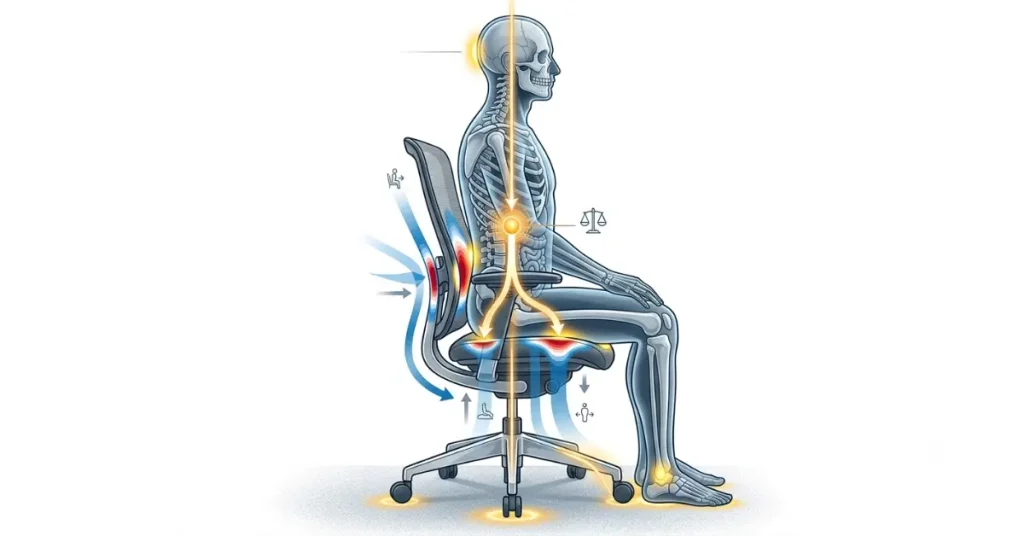
Furniture does not interact with individual muscles or isolated body parts. Instead, it supports the body’s structural framework as a connected system that transfers body weight through bones, joints, and support surfaces. Whether sitting on an office chair, relaxing on a sofa, or resting on a bed, every furniture design must accommodate how the body carries load, maintains balance, and changes position over time. This is why furniture designers begin with human body structure before determining dimensions such as seat height, seat depth, backrest angle, or lumbar support location.
When a person sits, body weight follows a predictable pathway through the body’s structural framework:
Body Weight
        ↓
Skeleton
        ↓
Pelvis
        ↓
Chair
        ↓
Floor
This pathway explains where the load travels, but furniture must also respond to how that load changes. Sitting is not a completely static activity. People lean forward to work, shift sideways while relaxing, recline to reduce fatigue, and reposition themselves throughout the day. Each movement changes the body’s center of gravity, redistributes pressure across the seat and backrest, and creates new loading patterns that the furniture must accommodate.
From a biomechanical perspective, furniture supports two types of loading:
Static Load
        ↓
Maintaining a stable sitting posture
        ↓
Continuous support

Dynamic Load
        ↓
Leaning, reaching, reclining, and shifting position
        ↓
Continuous adjustment of support
A well-designed chair manages both. During static sitting, the seat cushion, backrest, and frame distribute body weight evenly to minimize pressure on the pelvis and spine. During dynamic sitting, those same components respond to changing forces by maintaining stability and supporting natural movement instead of forcing the body into a rigid position. As the body’s center of gravity shifts, pressure also shifts, requiring furniture to maintain support across different contact areas rather than at a single fixed point.
Different furniture types demonstrate this principle in different ways. An office chair is designed to accommodate frequent posture changes while typing, reaching, and turning, so it often includes adjustable lumbar support, reclining mechanisms, and movable armrests. A dining chair supports a more upright, relatively stable posture during shorter periods of sitting. A sofa spreads body weight across a larger seating surface and is designed to support multiple reclining positions, creating a different pattern of pressure distribution and load transfer. Although these products look different, they all follow the same structural principle: furniture responds to the body’s biomechanics rather than simply supporting body weight.
Understanding this relationship establishes the foundation for every section that follows. Each anatomical structure contributes differently to how furniture manages load, maintains alignment, and distributes pressure. The first structure to examine is the skeleton, because it forms the body’s primary load-bearing framework and provides the foundation upon which all furniture support systems are designed.
The Skeleton: The Framework Furniture Supports
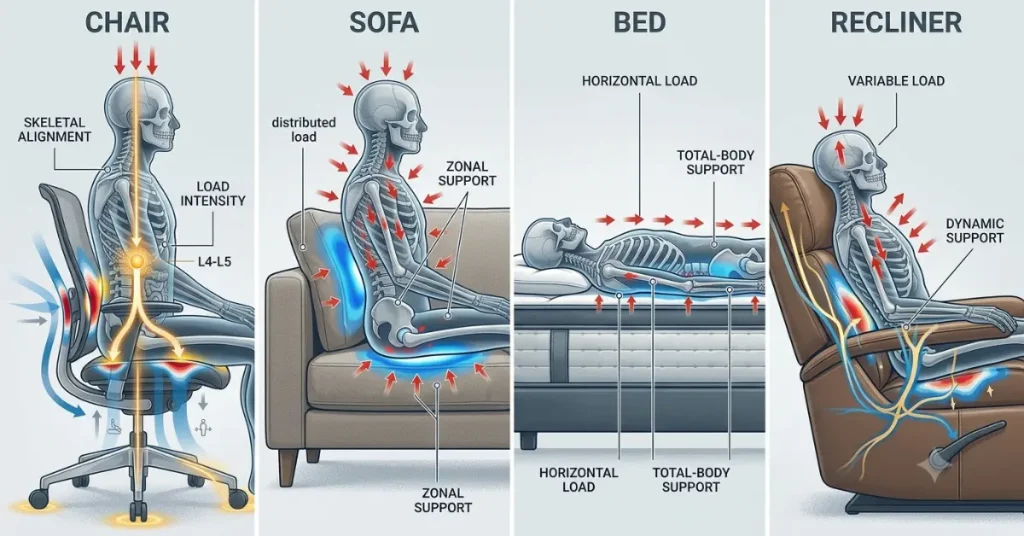
The skeleton is more than the body’s structural framework—it is the primary system that furniture is designed to support. Whether sitting in an office chair, relaxing on a sofa, or sleeping on a mattress, most of the body’s weight is carried through the skeleton rather than through muscles or soft tissues alone. Furniture designers therefore begin by understanding how the skeleton bears load, maintains alignment, and transfers forces before determining the size, shape, or cushioning of a product. Every successful furniture design starts with structural support and only then considers surface comfort.
The skeleton consists of two interconnected systems. The axial skeleton forms the body’s central support column, including the skull, spine, and rib cage, while the appendicular skeleton includes the shoulders, arms, pelvis, and legs that position the body for movement and interaction with furniture. Together, these systems maintain alignment, distribute body weight, and provide the stable framework that furniture must accommodate. Rather than supporting individual bones, furniture supports the way these skeletal regions work together as one load-bearing structure.
When sitting, the chair frame and seat structure carry the skeleton’s load while the seat cushion manages how that load is distributed across the contact surface. This distinction is important because comfort depends on both structural support and pressure management. A thicker or softer cushion may reduce pressure on the skin, but it cannot correct poor skeletal alignment. If the chair frame positions the pelvis too low, the spine loses its natural alignment regardless of how soft the cushion feels. Likewise, a sofa with deep, highly compressible cushions may initially feel luxurious, yet excessive sinking can rotate the pelvis, alter spinal posture, and increase fatigue during longer periods of sitting. In contrast, a supportive office chair combines a stable frame with controlled cushioning so the skeleton remains aligned while pressure is distributed more evenly.
The relationship can be summarized as:
Skeleton
        ↓
Structural Alignment
        ↓
Furniture Frame
        ↓
Support Surface
        ↓
Pressure Distribution
        ↓
Comfort
Different furniture categories also support the skeleton in different ways because the direction of loading changes with the activity being performed.
Office Chair
        ↓
Primarily Vertical Skeletal Loading

Sofa
        ↓
Distributed Skeletal Loading Across Multiple Contact Areas

Bed
        ↓
Horizontal Skeletal Loading Along the Entire Body
An office chair concentrates support beneath the pelvis and spine while allowing frequent movement during work. A sofa spreads skeletal load across a wider seating surface to accommodate relaxed postures and reclining. A mattress supports the skeleton horizontally, reducing concentrated pressure by distributing body weight across the shoulders, pelvis, legs, and other contact regions. Although these furniture types differ in design, each follows the same engineering principle: the support structure must first maintain skeletal alignment before cushioning materials can improve comfort.
Understanding the skeleton in this way also explains why posture and comfort are closely connected. When skeletal alignment is maintained, body weight is shared more evenly across furniture, reducing localized pressure and minimizing the effort required to remain stable. When alignment is lost, pressure becomes concentrated, muscles compensate to restore balance, and comfort gradually decreases even if the furniture initially feels soft.
Among all skeletal regions, the pelvis plays the most important role during sitting because it becomes the primary point where body weight transfers from the skeleton into the seat. Understanding how the pelvis receives and distributes this load is the next step in explaining why furniture fits—or fails—for different body proportions.
The Pelvis: The Body’s Primary Weight-Bearing Structure
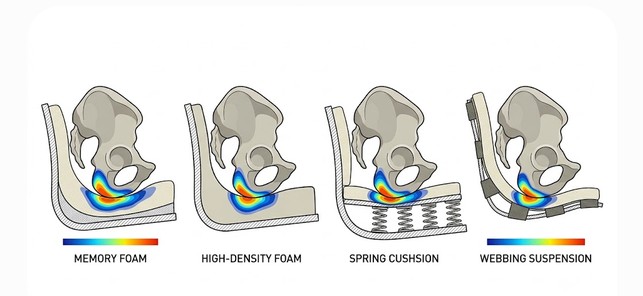
The pelvis remains the body’s primary weight-bearing structure during sitting because it transfers most upper-body load from the spine into the seat. While muscles help maintain posture, the pelvis provides the stable foundation that allows the spine, shoulders, and legs to stay aligned. For this reason, furniture designers focus on supporting the pelvis before refining details such as lumbar support, armrests, or recline angle. When the pelvis is stable, the rest of the body has a stronger foundation for balanced and comfortable sitting.
Most sitting pressure is concentrated through the seat bones—the two bony points at the base of the pelvis that make direct contact with the seat surface. Rather than supporting the entire pelvis evenly, furniture must manage the concentrated forces beneath these contact points while distributing pressure across the surrounding seating area. This is where furniture construction becomes just as important as furniture dimensions.
Different support materials change how pelvic loading is managed, even when two chairs have identical seat dimensions.
Pelvis
        ↓
Seat Bones
        ↓
Support Material
        ↓
Pressure Distribution
        ↓
Comfort
A memory foam cushion compresses slowly and molds around the seat bones, reducing localized pressure during extended sitting. High-resilience foam compresses less deeply and rebounds more quickly, helping maintain pelvic stability during frequent posture changes. Springs beneath the cushion redistribute load across a broader seating area, while webbing introduces controlled flexibility that changes how the pelvis settles into the seat. Although these materials influence comfort differently, none can compensate for poor structural support. If the seat platform allows excessive sinking or places the pelvis in an unstable position, even premium cushioning cannot restore proper alignment.
The relationship can be summarized as:
Memory Foam
        ↓
Slow Compression
        ↓
Pressure Relief

High-Resilience Foam
        ↓
Elastic Support
        ↓
Pelvic Stability

Springs
        ↓
Load Redistribution

Webbing
        ↓
Controlled Seat Flexibility
Pelvic mechanics also influence how the body maintains balance. The pelvis sits close to the body’s center of gravity, making it the region that initiates many posture adjustments. Leaning forward to type, reaching for an armrest, turning toward a conversation, or reclining into a sofa all begin with subtle pelvic movement before the rest of the body follows.
Pelvis
        ↓
Center of Gravity
        ↓
Balance Recovery
        ↓
Movement
        ↓
Furniture Stability
Because sitting is dynamic rather than static, furniture must support these continuous adjustments without forcing the pelvis into awkward positions. A well-designed chair allows small weight shifts while preserving stability, whereas an overly soft seat may allow excessive pelvic rotation that gradually alters spinal alignment and increases fatigue.
Different furniture categories illustrate this principle in different ways. An office chair is engineered to maintain pelvic stability during constant movement, often combining supportive foam with adjustable seat mechanisms. A dining chair uses firmer construction to keep the pelvis in a neutral, upright position during meals. A sofa typically combines softer foam and flexible webbing to encourage relaxed sitting and reclining, allowing greater pelvic rotation but often reducing long-term structural support. A recliner deliberately changes pelvic orientation as the backrest and footrest move together, redistributing body weight across multiple support surfaces.
These differences demonstrate that pelvic comfort depends on far more than seat softness. It is the interaction between pelvic position, furniture dimensions, structural support, and construction materials that determines how body weight is distributed over time. Once the pelvis establishes this foundation, the spine becomes the next critical structure, translating pelvic position into overall back alignment and determining how effectively a backrest can maintain natural posture.
The Spine: Maintaining Neutral Alignment
The spine builds upon the stable foundation created by the pelvis, transferring body weight upward while allowing the body to remain balanced, flexible, and comfortable during sitting. Rather than functioning as a single rigid column, the spine contains several regions that respond differently to body weight and movement. Furniture design reflects this by creating support zones, where each part of the backrest is intended to assist a different region of the spine. The objective is not simply to support the back, but to maintain the spine’s natural alignment while distributing pressure across multiple contact areas.
The spine can be viewed as four functional support regions during sitting:
Lumbar Spine
        ↓
Lumbar Support
        ↓
Maintains Lower-Back Alignment

Thoracic Spine
        ↓
Backrest Support
        ↓
Supports Upper Torso

Cervical Spine
        ↓
Headrest
        ↓
Supports Head Position

Sacrum
        ↓
Pelvic Transition
        ↓
Transfers Load Into the Seat
Each region contributes differently to furniture fit. The lumbar spine depends on properly positioned lumbar support to preserve its natural inward curve and prevent the pelvis from collapsing backward. The thoracic spine requires a backrest with sufficient height and shape to support the upper torso without restricting natural shoulder movement. The cervical spine benefits from a headrest only when reclining or during prolonged sitting, where the weight of the head would otherwise increase muscular effort. The sacrum forms the transition between the spine and pelvis, making pelvic position the starting point for healthy spinal alignment rather than an isolated factor.
Furniture achieves this support through both backrest geometry and contact area, not simply through cushioning. The contour of the backrest determines where the spine receives support, while the cushion controls how pressure is distributed across those contact points. A thick cushion cannot compensate for a poorly shaped backrest, just as a correctly shaped backrest cannot perform well if the pelvis is positioned incorrectly. Structural alignment and pressure management must work together.
The relationship can be summarized as:
Backrest Geometry
        ↓
Contact Area
        ↓
Pressure Distribution
        ↓
Spinal Support
        ↓
Comfort
Recline introduces another important biomechanical change. As the recline angle increases, the direction of spinal loading changes rather than simply decreasing. In an upright position, a larger proportion of body weight is transferred vertically through the pelvis into the seat. As the backrest reclines, some of that load shifts onto the backrest, allowing pressure to be redistributed across a larger support surface.
Recline Angle
        ↓
Spinal Loading
        ↓
Pressure Redistribution
        ↓
Reduced Muscle Demand
        ↓
Comfort
This explains why reclining chairs often feel more comfortable during long periods of sitting. They do not remove body weight—they redistribute it. By sharing the load between the seat, backrest, and leg support, a recliner reduces concentrated pressure on the lower spine while allowing the back muscles to work less to maintain posture.
Different furniture categories apply these principles in different ways. An ergonomic office chair provides segmented lumbar and thoracic support because users frequently change posture while working. A dining chair offers minimal back support to encourage an upright position during shorter sitting periods. A sofa typically distributes support across a broader surface, encouraging relaxed postures but often providing less precise lumbar support. A recliner intentionally changes spinal loading by coordinating the movement of the backrest and footrest, creating variable support as body position changes.
The spine also links the lower and upper body into one coordinated system. Small changes in pelvic rotation immediately influence the lumbar curve, which affects the position of the thoracic spine and ultimately changes where the head and shoulders are held.
Pelvis
        ↓
Lumbar Curve
        ↓
Thoracic Alignment
        ↓
Head Position
        ↓
Shoulder Position
This relationship explains why the next step in understanding furniture fit is to examine the shoulders and arms. Once spinal alignment establishes the body’s central posture, shoulder position determines how comfortably a person can reach armrests, desks, keyboards, and other everyday furniture without unnecessary strain.
Shoulders and Arms During Sitting
The shoulders and arms determine how comfortably a person interacts with furniture rather than simply how they sit. Once the pelvis and spine establish a stable posture, the upper body becomes responsible for reaching, supporting the arms, and positioning the hands for everyday tasks such as typing, writing, eating, or using a mobile device. Furniture must therefore support natural upper-body movement while minimizing unnecessary muscular effort. A chair that supports the spine but forces the shoulders to elevate or the arms to overreach still creates poor furniture fit.
The shoulder complex—including the clavicle, scapula, and upper arm—forms the body’s primary connection between the torso and the workspace. Instead of viewing these structures as isolated anatomical parts, furniture designers use them to determine how armrests, desks, and work surfaces should be positioned. Each upper-body segment influences a different furniture dimension:
Upper Arm
        ↓
Armrest Height & Armrest Spacing
        ↓
Shoulder Relaxation

Forearm
        ↓
Desk Distance
        ↓
Neutral Elbow Position

Hand
        ↓
Reach Envelope
        ↓
Workspace Layout
This relationship explains why furniture dimensions are based on body proportions rather than total height. A person with shorter upper arms may require lower or closer armrests, while someone with longer forearms may need a greater desk depth to maintain a comfortable elbow angle. The hand defines the usable reach envelope—the area that can be accessed comfortably without leaning or rotating the torso—which helps determine the placement of keyboards, mice, controls, cup holders, and other frequently used objects.
Shoulder position also influences the entire workspace, not just the chair itself. The shoulders help establish the body’s visual field, which affects where monitors, laptops, and reading materials should be placed.
Shoulders
        ↓
Visual Field
        ↓
Monitor Position
        ↓
Desk Layout
        ↓
Reach Distance
When the monitor is positioned too high, too low, or too far away, users often compensate by raising the shoulders, extending the arms, or leaning forward. Even if the chair fits well, poor workspace layout changes upper-body posture and increases muscular effort. A properly arranged workstation allows the shoulders to remain relaxed while the eyes, hands, and forearms work within a comfortable range.
Furniture designers therefore think in terms of reach zones rather than arm length alone. The primary reach zone contains frequently used items such as the keyboard and mouse, allowing them to be accessed without moving the shoulders or trunk. The secondary reach zone accommodates objects that require occasional reaching, such as notebooks, phones, or desk accessories. Organizing furniture around these reach zones reduces unnecessary movement and supports efficient work.
Adjustability is another important response to differences in body proportions. Height-adjustable armrests, movable keyboard trays, and adjustable monitor stands exist because shoulder position and arm length vary significantly between users. An office chair with adjustable armrests allows someone with shorter upper arms to maintain relaxed shoulders while typing. A keyboard positioned too far away forces the forearms to extend beyond their neutral position, increasing shoulder effort despite otherwise good chair support. Likewise, a lounge chair creates a much larger reach envelope than a dining chair, changing where side tables, cup holders, or remote controls should be placed for comfortable access.
The upper body controls how people interact with furniture, but comfortable sitting depends equally on the lower body. While the shoulders and arms determine reach and workspace organization, the legs and feet provide the stable foundation that supports balance, transfers body weight to the floor, and determines critical furniture dimensions such as seat height and seat depth.
Legs and Feet: Creating Stable Sitting
The legs and feet create the stable foundation that allows the upper body to remain balanced while sitting. Once the pelvis establishes the body’s primary weight-bearing point, the thighs, knees, lower legs, ankles, and feet determine how that weight is transferred to the floor and how comfortably the body maintains posture over time. For furniture designers, lower-body dimensions are not simply anatomical measurements—they determine critical furniture dimensions such as seat height, seat depth, footrest position, and leg clearance.
The thigh is especially important because it forms the primary contact area between the body and the seat. Rather than supporting the entire thigh equally, furniture must provide enough contact to distribute pressure while leaving adequate clearance behind the knees. This balance explains why seat depth is one of the most important dimensions for shorter adults.
The relationship can be summarized as:
Thigh Length
        ↓
Seat Depth
        ↓
Seat Edge Position
        ↓
Knee Clearance
        ↓
Comfort & Movement
If the seat is too deep, the front edge presses into the back of the knees before the user can fully utilize the backrest. If it is too shallow, the thighs receive insufficient support, causing more body weight to concentrate beneath the pelvis. Good furniture fit therefore depends on supporting enough of the thigh to distribute pressure while preserving freedom of movement.
Furniture designers also shape the front edge of the seat, not just its depth. Many ergonomic chairs use a waterfall seat edge, where the front of the seat curves gently downward instead of ending with a sharp edge.
Waterfall Seat Edge
        ↓
Reduced Pressure Behind the Knees
        ↓
Improved Blood Circulation
        ↓
Greater Long-Term Comfort
This curved edge reduces compression on the soft tissues behind the knee while allowing the lower legs to move more naturally. It also helps maintain blood circulation during prolonged sitting by reducing localized pressure where the seat meets the lower leg. The seat cushion, front edge radius, and overall seat pan geometry therefore work together to manage pressure—not simply to make the chair feel softer.
Different furniture categories apply thigh support in different ways because they are designed for different activities.
Office Chair
        ↓
Controlled Thigh Support
        ↓
Frequent Posture Changes

Dining Chair
        ↓
Shorter Thigh Support
        ↓
Easy Standing & Upright Sitting

Sofa
        ↓
Distributed Thigh Support
        ↓
Relaxed Sitting

Recliner
        ↓
Full Thigh & Calf Support
        ↓
Pressure Redistribution
An ergonomic office chair supports a substantial portion of the thighs while using a waterfall edge to maintain circulation during long working sessions. A dining chair usually has a shorter seat pan and firmer front edge because users frequently stand up and sit down during meals. A sofa often supports more of the thighs with deeper cushions, encouraging relaxation but sometimes leaving shorter users with dangling feet if the seat is too high or deep. A recliner extends support beneath both the thighs and calves, spreading body weight across a much larger surface to reduce concentrated pressure.
Lower-body comfort also depends on dynamic sitting rather than remaining perfectly still. People naturally extend their legs, cross their ankles, shift foot position, or move forward before standing. Furniture must accommodate these changes without creating pressure points or reducing stability.
Leg Position
        ↓
Dynamic Sitting
        ↓
Weight Redistribution
        ↓
Furniture Response
Feet complete this support system by providing stable ground contact. When both feet rest comfortably on the floor—or on an appropriately positioned footrest—the body forms a stable base that allows the pelvis and spine to remain aligned. When the feet dangle because the seat height exceeds the user’s popliteal height, body weight shifts rearward, pressure behind the knees increases, and overall stability decreases. This explains why shorter adults frequently experience discomfort on furniture designed around average body proportions.
The lower body demonstrates that furniture dimensions are determined by individual body regions rather than overall height. Each leg segment contributes a specific measurement that designers convert into seat height, seat depth, footrest position, and leg clearance. The next section expands this idea by examining body segments as measurable units, showing how furniture dimensions correspond to body proportions instead of total body height.
Understanding Body Segments
Body segments are the individual structural units that make up the human body, but from a furniture design perspective they are far more than anatomical regions. They are the measurable building blocks that designers use to determine furniture dimensions. Rather than designing furniture around a person’s total height, manufacturers begin by measuring the lengths and proportions of individual body segments because each segment controls a different aspect of furniture fit. This approach forms the bridge between human anatomy, anthropometric measurement, and furniture engineering.
The relationship follows a consistent progression:
Body Segment
        ↓
Anthropometric Measurement
        ↓
Furniture Dimension
        ↓
Furniture Fit
Each body segment contributes to one or more furniture dimensions rather than functioning as an isolated anatomical part.
| Body Segment | Furniture Dimension | Why It Matters |
|---|---|---|
| Head | Monitor Height | Maintains a comfortable visual field without excessive neck movement. |
| Neck | Headrest Position | Supports the head during reclining and prolonged sitting. |
| Torso | Backrest Height & Lumbar Support Position | Determines where the backrest should contact the spine. |
| Pelvis | Seat Width & Seat Cushion Position | Transfers body weight into the chair and establishes sitting posture. |
| Upper Arm | Armrest Height & Spacing | Keeps the shoulders relaxed while supporting the arms. |
| Forearm | Desk Distance & Keyboard Position | Maintains a comfortable elbow angle for desk work. |
| Hand | Reach Envelope | Defines where controls, keyboards, and frequently used objects should be placed. |
| Thigh | Seat Depth | Balances pressure distribution with knee clearance. |
| Lower Leg | Seat Height | Determines whether the feet rest comfortably on the floor. |
| Foot | Footrest Position & Ground Contact | Provides stability and completes the body’s support system. |
Instead of treating these segments independently, furniture designers evaluate how they work together. The torso determines sitting height, which influences backrest height and lumbar support placement. The neck helps establish where a headrest should contact the body during reclining, while the head determines sitting eye height, influencing monitor position and overall workspace layout. The upper arm, forearm, and hand together define the user’s reach envelope, guiding the placement of armrests, keyboards, desks, and frequently used objects. Likewise, the pelvis, thigh, lower leg, and foot determine seat depth, seat height, footrest placement, and overall lower-body stability.
The most important concept, however, is body segment ratio. People with the same overall height often have different body proportions, which means they may require very different furniture.
Body Segment Ratios
        ↓
Anthropometric Measurements
        ↓
Furniture Dimensions
        ↓
Furniture Fit
Consider two people who are both 160 cm (5’3″) tall. One has a long torso and shorter legs, while the other has a short torso and longer legs. Although their standing height is identical, the first person may require a taller backrest with lumbar support positioned higher above the seat, whereas the second may need a higher seat height and deeper seat pan to properly support longer thighs. Height alone cannot explain these differences—only body segment ratios can.
This principle is especially important for shorter adults. Two people who both identify as “short” may experience completely different furniture problems because their body proportions differ. One may struggle with seat depth because of shorter thighs, while another may need lower armrests due to shorter upper arms. This variation explains why adjustable office chairs can independently modify seat height, seat depth, armrest height, and lumbar position: each adjustment corresponds to a different body segment rather than overall stature.
Understanding body segments therefore transforms anatomy into measurable design data. The next step is to examine joint locations, where these body segments connect and move, because furniture must accommodate not only body size but also the natural movement that occurs between each segment during sitting, reaching, reclining, and standing.
Joint Locations That Influence Furniture Fit
Body segments determine the size of furniture, but joint locations determine how the body moves while using it. Every time a person sits, reaches, reclines, types, or stands up, movement occurs around the hip, knee, ankle, shoulder, elbow, and wrist joints. Furniture is therefore designed not only to fit the body’s dimensions but also to accommodate the natural range of motion at these joints. The goal is to maintain comfortable movement without forcing awkward angles or unnecessary muscular effort.
Rather than thinking of joints as isolated anatomical structures, furniture designers treat them as movement centers that guide the placement and adjustment of furniture components. This explains why ergonomic furniture is adjustable: body proportions and joint locations vary from person to person, so a fixed configuration cannot maintain neutral joint positions for every user.
The relationship follows this progression:
Joint Location
        ↓
Range of Motion
        ↓
Furniture Adjustment
        ↓
Neutral Joint Position
        ↓
Comfort
Each major joint influences a different furniture adjustment or dimension.
Hip Joint
        ↓
Seat Angle
        ↓
Pelvic Position

Knee Joint
        ↓
Seat Height
        ↓
Leg Clearance

Shoulder Joint
        ↓
Armrest Height
        ↓
Reach Distance

Elbow Joint
        ↓
Desk Height
        ↓
Keyboard Position

Wrist Joint
        ↓
Mouse Position
        ↓
Hand Support
This translation from joint location to furniture adjustment explains why modern ergonomic chairs include independent controls for seat height, seat depth, armrests, headrests, and recline. These mechanisms are not added simply for convenience—they exist so furniture can accommodate different joint locations and movement patterns while preserving neutral alignment.
Joint position also changes according to the activity being performed. Instead of designing furniture for a single posture, designers consider the task and the movement it requires.
Typing
        ↓
Elbow
        ↓
Keyboard Position
        ↓
Desk Height

Reading
        ↓
Neck
        ↓
Head Position
        ↓
Backrest Angle

Standing Up
        ↓
Hip
        ↓
Seat Height

Reclining
        ↓
Hip & Knee
        ↓
Backrest and Footrest Movement
These task-based relationships explain why one piece of furniture cannot optimize every activity. An office workstation prioritizes continuous arm and shoulder movement during computer work, while a recliner is designed to redistribute body weight and change joint angles together during relaxation. Furniture therefore supports movement patterns, not simply static body positions.
Different furniture categories accommodate joints in different ways.
Office Chair
        ↓
Dynamic Joint Accommodation

Dining Chair
        ↓
Fixed Joint Geometry

Sofa
        ↓
Passive Joint Accommodation

Recliner
        ↓
Variable Joint Accommodation
An ergonomic office chair provides multiple adjustment mechanisms because users alternate between typing, writing, reaching, and leaning throughout the day. A dining chair generally uses fixed dimensions because meals involve shorter periods of upright sitting with relatively consistent joint positions. A sofa accommodates movement passively through deeper cushions and a relaxed posture, while a recliner actively coordinates the movement of the backrest and footrest so the hip, knee, and ankle joints change position together without losing support.
Understanding joint locations completes the transition from anatomy to furniture engineering. The body’s structural framework defines where support is needed, body segments determine measurable proportions, and joint locations explain how the body moves within those proportions. The final step is to translate these anatomical relationships into anthropometric measurements that become practical furniture dimensions such as seat height, seat depth, backrest height, armrest height, and leg clearance. This conversion forms the foundation of furniture fit for people of every body size, especially shorter adults.
How Human Body Structure Determines Furniture Dimensions
Throughout this article, each anatomical structure has contributed a different piece of the furniture-fit puzzle. The skeleton provides structural support, the pelvis transfers body weight, the spine establishes alignment, the shoulders and arms determine reach, the legs and feet create stability, body segments define measurable proportions, and joint locations explain how the body moves during sitting. Together, these systems form the foundation that furniture designers use to create dimensions that support real people rather than abstract averages.
The complete progression can be summarized as:
Human Body Structure
        ↓
Body Segments & Joint Locations
        ↓
Anthropometric Measurements
        ↓
Furniture Dimensions
        ↓
Furniture Fit
        ↓
Comfort
However, furniture designers do not convert anatomy directly into products. Between human anatomy and the finished chair sits an entire design process that transforms body structure into manufacturable dimensions.
Human Body Structure
        ↓
Anthropometric Measurements
        ↓
Anthropometric Database
        ↓
Percentile Selection
        ↓
CAD Modeling
        ↓
Prototype
        ↓
Usability & Pressure Testing
        ↓
Furniture Production
This workflow begins with anthropometric databases, which contain measurements collected from large populations rather than a handful of individuals. These databases provide values such as popliteal height, buttock-popliteal length, hip breadth, sitting shoulder height, and functional reach. Designers then select a design population based on the intended users of the furniture instead of assuming one body size fits everyone.
One of the most important concepts in this process is the use of population percentiles. Furniture is rarely designed around an “average” person because average measurements often fail to represent the diversity of human body proportions. Instead, designers frequently consider a range of users.
5th Percentile Female
        ↓
Smaller Body Dimensions

50th Percentile Adult
        ↓
Reference Population

95th Percentile Male
        ↓
Larger Body Dimensions

        ↓
Design Population
        ↓
Furniture Dimensions
These percentiles do not represent “ideal” users. They are statistical reference points that help manufacturers decide which body sizes a product should accommodate. For example, an office chair intended for a broad workforce may be designed with adjustable seat height, seat depth, lumbar support, and armrests so it can comfortably fit users across a much wider percentile range than a fixed dining chair. A compact accent chair, by contrast, may intentionally target a narrower design population based on its intended use and available space.
This also explains why adjustable furniture exists.
Population Variation
        ↓
Design Compromise
        ↓
Adjustable Furniture
        ↓
Improved Furniture Fit
No single set of dimensions can perfectly match every combination of torso length, thigh length, shoulder width, and lower-leg length. Instead of creating thousands of chair sizes, manufacturers combine anthropometric data with adjustment mechanisms that allow one product to accommodate many different body proportions.
Engineering teams then transform these measurements into technical designs. CAD models establish seat height, seat depth, backrest geometry, armrest position, and recline mechanisms. Prototypes are evaluated through usability testing and, in many cases, pressure mapping to confirm that body weight is distributed appropriately across the pelvis, thighs, back, and feet before the design moves into production.
For example, popliteal height becomes the basis for seat height, buttock-popliteal length informs seat depth, hip breadth influences seat width, sitting shoulder height guides backrest height, and functional reach helps determine desk depth and armrest placement. In every case, the furniture dimension is a direct translation of human structure into practical design specifications.
Understanding this workflow completes the foundation of the Human Body Structure topic. The next page moves from structure to Human Body Measurements, where each anatomical region will be measured using anthropometric methods and converted into practical dimensions that help shorter adults evaluate, compare, and choose furniture that truly fits their bodies.