
Furniture is often blamed when a chair feels uncomfortable, a sofa seems too deep, or an office chair causes poor posture. In reality, the same piece of furniture can provide excellent support for one person and a poor experience for another because furniture fit begins with the human body, not with the furniture itself.
A chair does not change its dimensions from one user to the next. What changes are the characteristics of the person using it. Differences in body size, body proportions, body shape, body mass, flexibility, and mobility alter how the body contacts, loads, and moves on furniture. As these characteristics change, the interaction between the body and the furniture changes as well.
This is why people often disagree about whether a chair is comfortable. One person may sit with both feet supported, their thighs fully supported, and their spine comfortably aligned. Another person using the same chair may experience dangling feet, excessive pressure beneath the thighs, or insufficient back support. The furniture has not changed—the relationship between the furniture and the human body has.
Many people assume that furniture comfort depends primarily on the product itself. They compare cushion softness, upholstery materials, or brand reputation before considering whether the furniture actually matches their body. While these product characteristics influence the sitting experience, they cannot compensate for a poor physical fit. A well-built chair with dimensions that do not match the user is unlikely to provide effective support, just as an inexpensive chair with appropriate dimensions may feel surprisingly comfortable.
Understanding furniture fit therefore begins with a different question:
How does the human body interact with furniture?
The answer starts with the Human Body, the primary reference entity of furniture ergonomics.
The human body is the measurable system that furniture is designed to accommodate. Rather than treating the body as a single object, ergonomics considers it as a collection of dimensions, proportions, movement capabilities, and support requirements. Every seat, backrest, armrest, and foot support is intended to correspond to characteristics of this system.
This creates the first fundamental relationship:
Human Body → determines → Furniture Fit
Without understanding the body, it is impossible to evaluate whether furniture truly fits its intended user.
Furniture fit refers to the degree to which furniture accommodates the physical characteristics of the person using it during the intended activity. It is not determined by a single measurement or by comfort alone. Instead, furniture fit is the combined result of dimensional compatibility, functional support, ergonomic alignment, and the user’s ability to perform the intended task effectively.
To understand this relationship, five connected entities must be considered together.
The Human Body is the user being accommodated.
Body Size describes overall physical dimensions, including stature, body mass, and general body breadth. These characteristics influence furniture selection but cannot, on their own, determine whether furniture will fit correctly.
Body Proportions describe the relationships between individual body segments. Two people of identical height may have very different proportions, such as longer legs with a shorter torso or shorter legs with a longer torso. Although their overall height is the same, they may require different furniture dimensions.
Anthropometry is the science of measuring human body dimensions for design purposes. It includes both static anthropometry, which measures the body in fixed positions, and functional anthropometry, which measures the body while performing activities such as sitting or reaching. Because furniture is used during movement and seated tasks rather than standing still, functional anthropometry provides many of the measurements most relevant to furniture design.
Ergonomics applies these human measurements and capabilities to the design and evaluation of furniture so that products better support the intended user and activity.
Together, these entities explain why furniture dimensions originate from the human body rather than from arbitrary design decisions.
The human body also does not interact with furniture as a single unit. Different body regions contact different furniture components, and each interaction contributes to support, stability, posture, and movement. These functional interactions collectively determine overall furniture fit.
Every measurable furniture dimension can be traced back to one or more measurable characteristics of the human body.
For example:
| Furniture Dimension | Primary Human Reference |
|---|---|
| Seat height | Lower leg dimensions while seated |
| Seat depth | Upper leg dimensions while seated |
| Seat width | Hip breadth |
| Backrest height | Sitting upper-body dimensions |
| Armrest height | Seated elbow height |
Furniture dimensions are therefore measurable characteristics of furniture components that create the physical interface between the body and the furniture. They are not selected at random; they are derived from anthropometric data collected from human populations.
However, knowing a person’s overall height is not enough to predict furniture fit.
Imagine two people who are both 170 cm (5 ft 7 in) tall.
The first person has relatively long legs and a shorter torso.
The second person has shorter legs and a longer torso.
Although they share the same standing height, they may require different seat heights, seat depths, backrest heights, and armrest positions. Height describes overall body size, but body proportions determine how the body occupies furniture.
Body shape introduces another important difference. Two individuals with similar height and weight may distribute body mass differently around the hips, thighs, or shoulders. These differences change the contact area between the body and the furniture. A larger contact area generally distributes body weight across a broader surface, while a smaller contact area concentrates pressure on fewer support points. As contact conditions change, pressure distribution and perceived comfort change as well.
Flexibility and mobility also influence furniture fit. A user with greater joint mobility may comfortably adopt a wider range of sitting positions, while someone with limited mobility may require furniture dimensions and support that reduce the need for repositioning. The same chair may therefore accommodate two users differently even when their body measurements appear similar.
This illustrates an important cause-and-effect chain:
Body characteristics
↓
Anthropometric measurements
↓
Furniture dimensions required
↓
Human–furniture interaction
↓
Furniture fit
↓
Comfort, support, and usability
Furniture design must also account for variation across populations rather than a single “perfect” body.
Many products are developed using anthropometric data collected from a target population. Designers often use statistical averages and population percentiles to estimate the range of body sizes and proportions a product should accommodate. An average user is therefore a statistical reference rather than an actual person. Furniture designed around average measurements may fit many users reasonably well, but it cannot provide an ideal fit for every individual because human bodies vary considerably.
This explains why one chair can receive both excellent and poor reviews. The chair has not changed; the users interacting with it have different body characteristics.
Furniture fit also depends on the intended furniture category and activity.
A sofa is designed for relaxed postures, extended sitting durations, and frequent posture changes.
An office chair supports task-focused work, frequent adjustments, and sustained upright sitting.
A dining chair encourages relatively upright posture during meals.
A recliner redistributes body weight by changing body orientation and support angles.
Although each product is used for sitting, the interaction between the body and the furniture differs because the purpose of the furniture differs.
Furniture fit should also be understood in both static and dynamic conditions. Static fit describes how well furniture supports the body while remaining in a relatively fixed posture. Dynamic fit considers how furniture accommodates normal movement, posture changes, and reaching throughout use. Furniture that appears suitable during a brief test may perform very differently during extended use if it does not continue to support the body’s movements.
Several common misconceptions arise from overlooking these relationships.
Height alone does not determine furniture fit.
Larger furniture is not automatically more comfortable.
A chair that feels comfortable for one person will not necessarily fit another.
Soft cushions do not guarantee ergonomic support.
Furniture dimensions are based on measurable human characteristics rather than arbitrary styling choices.
Understanding these principles changes how furniture should be evaluated. Instead of beginning with appearance, materials, or brand, users can first determine whether a piece of furniture corresponds to their body characteristics and intended use. This creates a more reliable basis for comparing products, identifying potential fit issues, and making informed purchasing decisions.
The Human Body is therefore the root entity of furniture ergonomics. Body size, body proportions, body shape, body mass, flexibility, mobility, anthropometric measurements, and ergonomics together explain why furniture dimensions exist and why furniture fits people differently.
To understand furniture fit, we must first understand the seated human body.
The Human Body Is the Foundation of Furniture Ergonomics
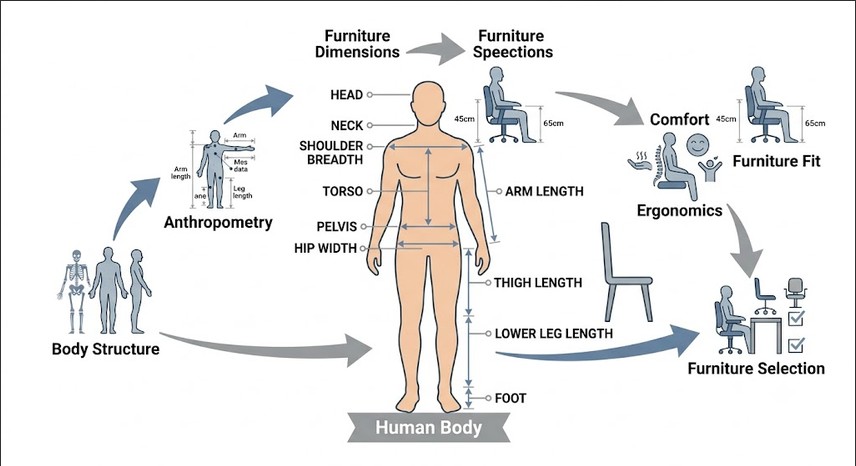
When people evaluate furniture, they often begin by comparing the product. They look at the upholstery, cushion firmness, frame material, appearance, or price. Furniture ergonomics begins from the opposite direction. The first question is not “What is this furniture like?” but “Who is this furniture designed to fit?”
The answer is the Human Body.
The human body is the root entity of furniture ergonomics because every furniture decision ultimately depends on the characteristics of the person using the furniture. Furniture does not create the requirements for comfort, support, or usability. The human body creates those requirements, and furniture is designed to accommodate them.
This establishes the fundamental relationship of furniture ergonomics:
Human Body
↓
Furniture Design
↓
Furniture Dimensions
↓
Furniture Fit
↓
Comfort
Understanding this sequence is essential because each step depends on the one before it. Furniture cannot be designed without knowing the body it is intended to support, and comfort cannot be evaluated without first determining whether the furniture fits that body.
Defining the Core Entities
To understand why the human body is the foundation of furniture ergonomics, five core entities must be understood together.
Human Body
The Human Body is the measurable physical system that interacts with furniture. In ergonomics, it is viewed through characteristics that influence furniture use, including body size, body proportions, body shape, body mass, flexibility, mobility, and movement during sitting.
Rather than treating every person as identical, furniture ergonomics recognizes that every individual has unique physical characteristics. These differences explain why one piece of furniture may fit one person well while fitting another poorly.
Furniture
Furniture is a physical system designed to support the human body while a specific activity is performed.
Unlike decorative objects, furniture has a functional purpose. A chair supports seated work, a sofa supports relaxation, a dining chair supports eating, and a recliner supports resting through changes in body position. Each category is designed around a different pattern of human interaction.
Furniture therefore exists to accommodate the body—not the other way around.
Furniture Fit
Furniture Fit describes how well furniture accommodates the measurable characteristics and functional needs of the user.
Furniture fit is not determined by appearance or perceived quality. Instead, it depends on whether the furniture dimensions correspond to the user’s body dimensions during the intended activity.
A properly fitted piece of furniture allows the body to sit in a supported, stable, and functional position. A poorly fitted piece forces the body to compensate through awkward posture, unsupported body segments, or unnecessary muscular effort.
Ergonomics
Ergonomics is the discipline of designing products, environments, and systems to match human capabilities and limitations.
Within furniture design, ergonomics applies knowledge about human dimensions, movement, posture, support, and comfort to create furniture that accommodates its intended users rather than requiring users to adapt themselves to the furniture.
The goal of ergonomics is not simply comfort. It is to improve the relationship between the human body, the task being performed, and the furniture supporting that task.
Anthropometry
Anthropometry is the science of measuring human body dimensions for design purposes.
These measurements provide the numerical data required to determine furniture dimensions.
Anthropometry includes:
- Static anthropometry, which measures the body in fixed positions.
- Functional anthropometry, which measures the body while performing activities such as sitting, reaching, or standing up.
Because furniture is used during real activities rather than perfectly still positions, functional anthropometry often provides the measurements that are most valuable for furniture ergonomics.
Why Furniture Depends on the Human Body
A common misconception is that furniture dimensions are chosen first and people simply select the furniture they like.
The design process works in the opposite direction.
Design begins by asking questions about the intended users.
Examples include:
- How tall are they?
- How wide are their hips while sitting?
- How long are their thighs?
- How high are their elbows while seated?
- How much movement should the furniture allow?
- How long will they remain seated?
Only after these questions are answered can appropriate furniture dimensions be established.
The process follows a logical sequence:
Human characteristics
↓
Anthropometric measurements
↓
Design requirements
↓
Furniture dimensions
↓
Furniture construction
↓
Human–furniture interaction
↓
Furniture fit
↓
Comfort and usability
Furniture is therefore a physical response to human characteristics rather than an independent design object.
Furniture Dimensions Originate From Human Measurements
Every major furniture dimension corresponds to one or more measurable characteristics of the human body.
| Furniture Dimension | Human Measurement Used |
|---|---|
| Seat height | Popliteal height (lower leg while seated) |
| Seat depth | Buttock-popliteal length |
| Seat width | Hip breadth |
| Backrest height | Sitting shoulder or upper-body height |
| Armrest height | Seated elbow height |
These relationships demonstrate that furniture dimensions are measurable design decisions based on measurable human dimensions.
Without anthropometric data, there is no objective basis for determining appropriate furniture dimensions.
Why Furniture Is Not Designed First
Imagine designing a chair before considering the people who will use it.
There would be no way to determine:
- How high the seat should be.
- How deep the seat should be.
- How wide the seat should be.
- How high the armrests should be.
- How much back support should be provided.
Every one of these decisions depends on the intended user.
For this reason, the human body is not simply one consideration among many—it is the starting point of the entire design process.
Comparison: Body-First vs Furniture-First Thinking
A furniture-first approach asks:
- Which chair looks the most comfortable?
- Which sofa has the softest cushions?
- Which product has the best reviews?
A body-first approach asks:
- Does this furniture match my body dimensions?
- Will it support my posture?
- Does it fit my intended activity?
- Are the furniture dimensions appropriate for my body proportions?
The second approach produces more reliable furniture decisions because it evaluates furniture according to measurable human characteristics rather than subjective impressions.
Expert Insight: Comfort Is an Outcome, Not a Starting Point
One of the most common mistakes in furniture selection is treating comfort as the first criterion.
From an ergonomic perspective, comfort is an outcome produced by earlier conditions.
The sequence is:
Human Body
↓
Anthropometric Measurements
↓
Furniture Design
↓
Furniture Dimensions
↓
Furniture Fit
↓
Support and Body Alignment
↓
Comfort
If furniture dimensions do not correspond to the user’s body, improvements in materials, cushioning, or aesthetics cannot fully compensate for the mismatch.
This explains why two people can have completely different experiences using the same chair.
Key Takeaways
- The human body is the root entity of furniture ergonomics.
- Furniture is designed to accommodate people, not the reverse.
- Anthropometry provides the measurements used to determine furniture dimensions.
- Ergonomics applies those measurements to create functional furniture.
- Furniture fit is the result of matching furniture dimensions to human characteristics.
- Comfort is the consequence of appropriate furniture fit rather than the starting point of furniture design.
Understanding that the human body drives every furniture design decision leads to the next question: Which version of the human body should designers evaluate? A standing person interacts with furniture very differently from a seated person, making the seated human body the next essential concept in understanding furniture fit.
The Seated Human Body: The Real Entity Behind Furniture Fit
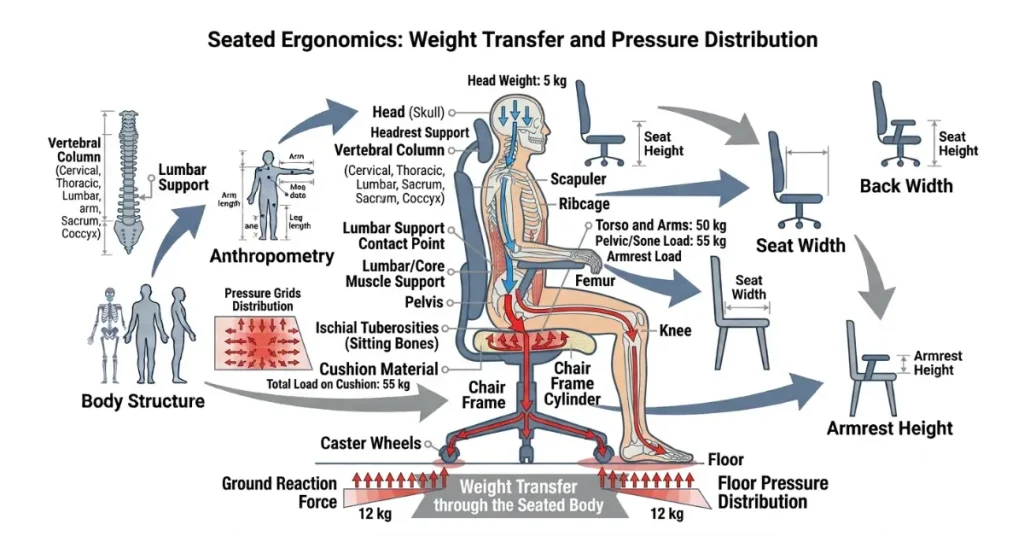
In the previous section, we established that the Human Body is the root entity of furniture ergonomics because every furniture dimension originates from human characteristics. However, furniture is rarely used while standing. Chairs, sofas, benches, recliners, and most other seating products are designed for people after they transition into a seated position.
This distinction introduces the most important operational entity in furniture ergonomics: the Seated Human Body.
The seated human body is the body in its functional state while interacting with furniture. It is this version of the body—not the standing body—that determines how weight is distributed, where support is required, which body parts contact the furniture, and whether the furniture ultimately fits the user.
Understanding furniture fit therefore requires a shift in perspective.
The question is no longer:
“What are the dimensions of the human body?”
Instead, it becomes:
“How does the human body change when it sits?”
Standing Body and Seated Body Are Not the Same
A common assumption is that standing body dimensions can predict furniture fit. While standing measurements provide useful information about overall body size, they do not describe how the body behaves during sitting.
Standing and sitting are different physical states.
When standing:
- Body weight is transferred primarily through the feet to the ground.
- The legs support most of the body’s mass.
- Contact with external surfaces is minimal.
- The body’s height reaches its maximum.
- Body segments are vertically aligned against gravity.
When sitting:
- Body weight shifts toward the seat.
- The pelvis becomes the primary load-bearing structure.
- The thighs begin supporting part of the body’s weight.
- The feet transition from primary support to stabilizing support.
- The spine adapts to a new orientation.
- Multiple body segments simultaneously contact furniture.
The furniture therefore interacts with a body that has changed mechanically, geometrically, and functionally.
This is why:
Standing Body ≠ Seated Human Body
The seated human body is not simply the standing body with bent hips and knees. Sitting changes how the body carries weight, occupies space, and interacts with its surroundings.
Defining the Core Entities
Understanding the seated human body requires four closely related entities.
Seated Human Body
The Seated Human Body is the functional configuration of the body while performing seated activities.
It represents the complete interaction between the user’s body and the supporting furniture.
Unlike the standing body, the seated human body continuously exchanges forces with the seat, backrest, armrests, floor, and other supporting surfaces.
Because furniture is designed for this interaction, the seated human body becomes the operational reference for ergonomic evaluation.
Sitting Position
A Sitting Position describes the physical arrangement of the body while seated.
It defines where body segments are located relative to the furniture.
Examples include:
- Upright sitting
- Relaxed sitting
- Reclined sitting
- Forward-leaning sitting
Each sitting position changes how body weight is distributed, which body parts contact the furniture, and which furniture components provide support.
A sofa designed for relaxed sitting therefore differs from an office chair designed for upright task work because the intended sitting positions differ.
Sitting Posture
Sitting Posture describes how body segments align with one another while seated.
Rather than describing where the body is located, posture describes how the pelvis, spine, shoulders, head, and lower limbs are positioned relative to each other.
Two people may occupy the same chair and the same sitting position while maintaining completely different postures.
Good furniture fit supports stable and functional posture rather than forcing the body into unnecessary compensation.
Sitting Anthropometry
Sitting Anthropometry is the measurement of human body dimensions while seated.
Unlike standing anthropometry, sitting anthropometry reflects the body exactly as furniture encounters it.
Common sitting measurements include:
- Sitting height
- Popliteal height
- Buttock-popliteal length
- Hip breadth while seated
- Seated elbow height
- Seated shoulder height
These measurements form the basis for determining seat height, seat depth, seat width, backrest height, and armrest height.
Because furniture is used in a seated state, sitting anthropometry provides more relevant design information than standing height alone.
What Changes When the Body Sits?
The transition from standing to sitting creates several simultaneous changes that directly influence furniture fit.
Load Transfer Begins
While standing, the lower limbs carry most of the body’s weight.
As the body sits, this load begins transferring to the furniture.
The pelvis becomes the primary load-bearing structure.
The seat begins supporting a significant proportion of body weight.
The floor continues supporting the feet, but their primary role changes from carrying the entire body to stabilizing the seated posture.
This change in load transfer explains why seat dimensions have such a strong influence on comfort.
Contact Begins
Standing involves relatively few contact points with external surfaces.
Sitting creates multiple contact areas between the body and furniture.
Examples include:
- Pelvis contacting the seat
- Buttocks contacting the cushion
- Thighs contacting the seat surface
- Back contacting the backrest
- Arms contacting armrests
- Feet contacting the floor or footrest
These contact points create the physical interface through which support, stability, and pressure are managed.
Without contact, furniture cannot support the body.
Support Begins
As contact increases, furniture begins supporting the seated body.
Support is distributed across multiple furniture components rather than a single surface.
The seat supports body weight.
The backrest supports the trunk.
Armrests support portions of the upper limbs.
The floor or footrest supports the feet.
Together, these support systems create the conditions required for stable sitting.
Why Standing Height Cannot Predict Furniture Fit
Standing height is one of the most commonly reported body measurements, yet it provides surprisingly little information about furniture fit.
Consider two people who are both 175 cm (5 ft 9 in) tall.
Person A has relatively long legs and a shorter torso.
Person B has shorter legs and a longer torso.
Although their standing height is identical:
- Their seated height differs.
- Their popliteal height differs.
- Their buttock-popliteal length differs.
- Their seated elbow height differs.
As a result, they may require different seat heights, seat depths, armrest heights, and backrest heights despite sharing the same overall stature.
Furniture therefore depends on functional sitting measurements, not simply standing height.
The Process Behind Furniture Fit
Furniture fit begins only after the body enters a seated state.
The complete process can be described as:
Standing Human Body
↓
Transition to Sitting
↓
Seated Human Body
↓
Load Transfer
↓
Body–Furniture Contact
↓
Support Distribution
↓
Sitting Posture
↓
Furniture Interaction
↓
Furniture Fit
This sequence explains why evaluating furniture from standing dimensions alone produces incomplete conclusions.
Expert Insight: Furniture Interacts With a Dynamic Body
An important misconception is that sitting is a fixed position.
In reality, the seated human body is continuously making small adjustments.
People shift weight, lean forward, recline, reach for objects, reposition their feet, and alter their posture throughout the day.
Furniture must therefore accommodate a body that moves within the seated state rather than one that remains perfectly still.
This is one reason why sitting anthropometry is paired with ergonomic principles rather than used in isolation. Measurements describe the body’s dimensions, while ergonomics explains how those dimensions change during real use.
Comparison: Standing vs Seated Human Body
| Standing Human Body | Seated Human Body |
|---|---|
| Weight supported primarily by the feet | Weight distributed between the pelvis, thighs, feet, and furniture |
| Minimal furniture contact | Multiple body–furniture contact points |
| Standing anthropometry | Sitting anthropometry |
| Vertical load path | Distributed load path through furniture |
| Limited relevance to seating design | Primary reference for furniture ergonomics |
Key Takeaways
- Furniture is designed for the seated human body, not the standing body.
- Sitting changes body geometry, weight distribution, and support requirements.
- Sitting position describes where the body is placed, while sitting posture describes how body segments are aligned.
- Sitting anthropometry provides the measurements required to design and evaluate seating furniture.
- Load transfer, body contact, and support all begin when the body transitions from standing to sitting.
- Standing height alone cannot predict furniture fit because seated dimensions vary between individuals.
Understanding the seated human body establishes the operational reference for furniture ergonomics. The next step is to identify which body structures contact furniture, carry body weight, stabilize posture, and create the foundation for furniture fit.
How the Human Body Interacts with Furniture
After understanding that furniture is designed for the seated human body, the next question is not what furniture looks like, but how the body physically interacts with it.
Furniture does not support the body simply because a person sits down. Support develops through a sequence of physical interactions between the body and the furniture. These interactions determine whether body weight is distributed appropriately, whether posture can be maintained efficiently, and whether the furniture ultimately fits the user.
The interaction model can be expressed as a continuous relationship:
Human Body
↓
Sitting
↓
Contact Points
↓
Support
↓
Alignment
↓
Furniture Fit
Each stage depends on the one before it. If contact is incomplete, support cannot be distributed correctly. Without adequate support, body alignment changes. When alignment changes, furniture fit and comfort are affected.
Human–Furniture Interaction
Human–Furniture Interaction is the continuous physical relationship between the seated human body and the furniture supporting it.
This interaction is not a single event that occurs when someone sits down. It is an ongoing exchange of forces, movement, and support throughout the entire period of sitting.
Every adjustment in posture, every shift in body weight, and every reach toward an object changes the interaction between the body and the furniture.
Furniture ergonomics therefore evaluates the quality of this interaction rather than evaluating furniture in isolation.
Contact: Where the Body Meets the Furniture
Contact is the physical meeting between body surfaces and furniture surfaces.
Without contact, furniture cannot transfer support to the body.
When a person sits, several contact points are created simultaneously.
Typical contact points include:
| Body Structure | Primary Furniture Contact |
|---|---|
| Pelvis and buttocks | Seat cushion |
| Thighs | Seat surface |
| Back | Backrest |
| Forearms or elbows | Armrests |
| Feet | Floor or footrest |
These contact points form the interface through which body weight is transferred and support is delivered.
The amount of contact also matters.
A larger contact area generally spreads body weight across a wider surface, reducing pressure on individual areas. A smaller contact area concentrates body weight, increasing localized pressure and making support more sensitive to furniture dimensions.
Support: How Furniture Carries the Body
Support is the ability of furniture to carry and stabilize the body during the intended activity.
Support begins only after contact has been established.
Different furniture components provide different types of support.
The seat supports the pelvis, buttocks, and thighs.
The backrest supports the trunk.
Armrests support part of the upper limbs during appropriate activities.
The floor or footrest supports the feet and contributes to overall stability.
Support is therefore distributed rather than concentrated in a single location.
Effective furniture support does not eliminate body movement. Instead, it provides a stable foundation while allowing natural posture adjustments throughout the sitting task.
Pressure: The Result of Load Acting on Contact Areas
Pressure describes how body weight is distributed across the contact areas between the body and the furniture.
Pressure is not determined by body weight alone.
It depends on two interacting factors:
- The amount of load being transferred.
- The size and shape of the contact area receiving that load.
For example, two people may have identical body weight but different body shapes.
If one person distributes weight across a larger contact area while seated, pressure is spread more evenly.
If another person has a smaller effective contact area, more pressure is concentrated beneath specific body regions.
This explains why two users of similar weight can experience the same chair differently.
Pressure therefore emerges from the relationship between the body and the furniture rather than from either one independently.
Stability: Maintaining Controlled Body Position
Stability is the body’s ability to maintain a controlled seated position with minimal unnecessary effort.
A stable sitting position depends on coordinated support from multiple contact points.
The pelvis establishes the primary base of support.
The feet stabilize the lower body through the floor or footrest.
The backrest assists the trunk when appropriate.
Together, these support systems help the body maintain balance during both stillness and movement.
When one support point is reduced or removed, the body compensates by increasing effort elsewhere.
For example, if the feet cannot comfortably reach the floor because the seat is too high, stability decreases. The body may respond by sliding forward, increasing muscular effort, or changing posture to regain balance.
Stability is therefore a product of the entire support system rather than any single furniture component.
Reach: Extending Beyond the Base of Support
Reach is the body’s ability to interact with surrounding objects while maintaining stability.
People rarely remain completely still while seated.
They reach for keyboards, books, dining utensils, remote controls, phones, or armrests.
Every reaching movement shifts body weight and changes the interaction between the body and the furniture.
A stable furniture system allows these movements without excessive loss of balance or support.
For example, an office chair should allow a user to reach a keyboard while maintaining a supported sitting posture. A lounge chair may prioritize relaxed reaching toward a side table rather than sustained forward work.
Reach therefore links furniture ergonomics to the activities the furniture is intended to support.
Which Body Parts Touch Furniture?
Not every body structure contacts furniture directly.
The primary contact structures during sitting include:
- Pelvis
- Buttocks
- Thighs
- Back
- Forearms or elbows
- Feet
Other body structures contribute indirectly by maintaining posture and movement, but these primary contact regions form the main pathways through which support is transferred.
Different furniture categories may emphasize different contact patterns.
For example, a dining chair encourages greater back and seat contact, while a recliner increases contact across a larger portion of the back and lower limbs.
Which Body Parts Support Weight?
Body weight is distributed rather than carried by a single body part.
During sitting:
- The pelvis carries the largest proportion of seated load.
- The buttocks transfer body weight into the seat.
- The thighs support part of the lower body.
- The feet stabilize the seated position and continue to bear a portion of the body’s weight through the floor.
- The back may transfer part of the upper-body load to the backrest, depending on posture and furniture design.
The exact distribution changes with furniture type, sitting posture, and activity.
This explains why changing only one furniture dimension, such as seat height or seat depth, can alter support throughout the entire body.
The Human–Furniture Interaction Process
Furniture fit develops through a predictable sequence of interactions.
Human Body
↓
Transition to Sitting
↓
Body–Furniture Contact
↓
Load Transfer
↓
Support Distribution
↓
Body Alignment
↓
Furniture Fit
↓
Comfort and Functional Performance
This process demonstrates that comfort is not an isolated property of furniture. It is the result of successful interaction between the user’s body and the furniture’s supporting components.
Comparison: Contact vs Support
Although the terms are often used interchangeably, they describe different concepts.
| Contact | Support |
|---|---|
| Physical meeting between the body and furniture | Transfer of load from the body to furniture |
| Occurs whenever body surfaces touch furniture | Occurs only when contact carries body weight or stabilizes posture |
| Creates the opportunity for support | Determines the quality of furniture fit |
| Can exist without effective support | Requires appropriate contact and load distribution |
Understanding this distinction explains why simply touching a backrest does not guarantee that the back is being properly supported.
Expert Insight: Furniture Does Not Support the Entire Body Equally
A common misconception is that every body region requires the same amount of support.
In reality, furniture is designed to support different body structures according to their functional role.
Weight-bearing structures require primary support.
Stabilizing structures require controlled positioning.
Upper-body structures often require intermittent rather than continuous support, depending on the activity.
Recognizing these differences helps explain why furniture uses separate components such as seats, backrests, armrests, and footrests instead of relying on a single supporting surface.
Key Takeaways
- Human–furniture interaction is the continuous relationship between the seated body and the furniture.
- Contact creates the physical interface through which support is delivered.
- Support distributes body weight across multiple furniture components.
- Pressure results from the interaction between body load and contact area.
- Stability enables the body to maintain balance during sitting and movement.
- Reach allows users to perform tasks without unnecessarily compromising support.
- Furniture fit develops through a sequence of contact, support, alignment, and interaction rather than through furniture dimensions alone.
Understanding how the body interacts with furniture explains where support is created, but it does not yet explain which specific body structures create that support or how each contributes to posture and movement. Those functional body structures form the next layer of furniture ergonomics.
Why Every Body Fits Furniture Differently
The previous sections established that furniture is designed for the seated human body and that furniture fit develops through the interaction between the body and furniture. The next question is why two people using the same chair or sofa often have completely different experiences.
The answer lies in human variability.
No two bodies share exactly the same combination of dimensions, proportions, shape, mass, movement capability, and flexibility. Even when two people appear similar, small differences in these characteristics change how the body contacts furniture, how body weight is distributed, and how support is received.
Furniture fit is therefore not determined by the furniture alone. It is created by the relationship between the furniture and the individual body using it.
This relationship follows a consistent sequence:
Different Body
↓
Different Measurements
↓
Different Furniture Dimensions Required
↓
Different Furniture Fit
Understanding this sequence explains why furniture that fits one person exceptionally well may not fit another, even when they are similar in height or weight.
Body Size: The Overall Dimensions of the User
Body Size describes the overall physical dimensions of a person.
It includes characteristics such as:
- Standing height
- Sitting height
- Body mass
- Overall body breadth
- Overall body depth
Body size provides a broad description of the user and influences the general range of furniture dimensions that may be appropriate.
However, body size is only the starting point. Two people with similar body size can still require different furniture because other characteristics influence how the body interacts with furniture.
Body size answers the question:
“How large is the person overall?”
It does not answer:
“How should furniture be dimensioned for that person?”
Body Shape: How the Body Occupies Space
Body Shape describes how body mass and body dimensions are distributed across the body.
Unlike body size, which focuses on overall dimensions, body shape influences how the body contacts furniture.
For example:
- One person may have wider hips.
- Another may have broader shoulders.
- Another may have greater thigh volume.
- Another may have a narrower pelvis.
These differences change the size, location, and distribution of contact areas between the body and furniture.
A wider hip breadth may require greater seat width to avoid side compression.
Greater thigh volume may change how the thighs contact the seat surface.
A broader upper body may interact differently with backrests or armrests.
Body shape therefore influences both pressure distribution and perceived support without necessarily changing overall body size.
Body Proportions: The Relationships Between Body Segments
Body Proportions describe how individual body segments relate to one another.
Furniture dimensions are often determined more by proportions than by overall height.
Consider three people who are each 170 cm (5 ft 7 in) tall.
Person A
- Long legs
- Short torso
Person B
- Average leg length
- Average torso length
Person C
- Short legs
- Long torso
Although all three individuals have the same standing height, their seated body dimensions differ.
Person A is likely to require:
- Greater seat height
- Greater seat depth
- Lower backrest height relative to sitting height
Person C may require:
- Lower seat height
- Shallower seat depth
- Greater backrest height relative to sitting height
The furniture dimensions that fit one individual may therefore be unsuitable for another, despite identical overall stature.
This demonstrates why standing height cannot predict furniture fit.
Furniture interacts with individual body segments rather than total body height.
Body Mass: How Load Is Applied to Furniture
Body Mass describes the amount of weight the body transfers to furniture.
Body mass influences:
- Cushion compression
- Load transfer
- Pressure distribution
- Stability
- Support requirements
Two users with identical body measurements but different body mass may experience the same seat differently.
A heavier user may compress the cushion further, changing the effective seat height and altering body alignment.
A lighter user may experience less compression and therefore interact with the furniture differently.
Body mass changes the forces acting between the body and the furniture without necessarily changing body dimensions.
Mobility: The Body’s Ability to Move
Mobility describes the body’s ability to change position, transition between postures, and move efficiently while seated.
Mobility influences furniture interaction in several ways.
A person with greater mobility may:
- Reposition frequently.
- Lean forward easily.
- Rotate the trunk comfortably.
- Stand up with less effort.
Another user with reduced mobility may require furniture that minimizes unnecessary movement and provides greater assistance during sitting and standing.
Mobility therefore changes how the body uses furniture rather than simply how it fits within furniture dimensions.
Flexibility: The Body’s Available Range of Motion
Flexibility describes the available range of motion of joints and body segments during movement.
Although flexibility and mobility are closely related, they are not identical.
Flexibility determines how easily the body can adopt or maintain different sitting positions.
Mobility determines how effectively the body can move between those positions.
A flexible user may comfortably sit with greater variation in posture.
A user with limited flexibility may require furniture dimensions that reduce excessive joint angles or awkward positioning.
Furniture fit therefore depends not only on body dimensions but also on how the body is capable of moving within those dimensions.
Why Height Does Not Predict Comfort
One of the most common misconceptions is that taller people simply need larger furniture and shorter people simply need smaller furniture.
Height provides only one measurement within a much larger system.
Furniture fit depends on multiple measurements, including:
- Sitting height
- Popliteal height
- Buttock-popliteal length
- Hip breadth
- Shoulder breadth
- Seated elbow height
Two individuals with identical height may have different values for each of these measurements.
Because furniture dimensions correspond to these individual measurements rather than total height, standing stature alone cannot reliably predict comfort or furniture fit.
Comparison: Same Height, Different Furniture Fit
Consider three users with identical standing height.
| Characteristic | User A | User B | User C |
|---|---|---|---|
| Standing height | 170 cm | 170 cm | 170 cm |
| Leg length | Long | Average | Short |
| Torso length | Short | Average | Long |
| Hip breadth | Narrow | Average | Wide |
| Likely seat height | Higher | Medium | Lower |
| Likely seat depth | Deeper | Medium | Shallower |
| Likely seat width | Narrower | Medium | Wider |
Although all three users measure the same height, the furniture dimensions most appropriate for each differ because their body proportions and body shape differ.
How Individual Differences Change Furniture Fit
The interaction between body characteristics and furniture follows a predictable process.
Body Size
Body Shape
Body Proportions
Body Mass
Mobility
Flexibility
↓
Different Anthropometric Measurements
↓
Different Human–Furniture Interaction
↓
Different Support
↓
Different Body Alignment
↓
Different Furniture Fit
↓
Different Comfort
Each body characteristic contributes to the final furniture experience. No single characteristic determines furniture fit independently.
Expert Insight: Furniture Fits Measurements, Not People
A common way to describe furniture is by saying that it “fits people.”
From an ergonomic perspective, this statement is incomplete.
Furniture is dimensioned to accommodate measurable human characteristics rather than individual identities.
When a person’s anthropometric measurements correspond closely with the dimensions used during furniture design, the likelihood of effective support and functional comfort increases.
When those measurements differ substantially, furniture fit becomes less predictable regardless of the product’s quality or price.
This perspective explains why ergonomic furniture often includes adjustable features. Adjustment allows one product to accommodate a wider range of human measurements rather than assuming that all users share the same body characteristics.
Key Takeaways
- Every body differs in size, shape, proportions, body mass, mobility, and flexibility.
- These characteristics produce different anthropometric measurements.
- Furniture dimensions are based on those measurements rather than overall height alone.
- Two people with identical standing height can require different seat heights, seat depths, seat widths, and backrest dimensions.
- Furniture fit is created by the relationship between individual body characteristics and furniture dimensions.
- Height alone cannot predict comfort because furniture interacts with body segments rather than total stature.
Understanding why every body fits furniture differently explains why human measurements vary, but the next question is how those measurements are obtained and used during furniture design. That requires an understanding of anthropometry, the measurement system that connects the human body to furniture dimensions.
Anthropometry Connects the Human Body to Furniture
The previous section explained that every person has different body size, body shape, body proportions, body mass, mobility, and flexibility. These differences create different furniture requirements. The next question is how designers convert these human characteristics into measurable furniture dimensions.
The answer is anthropometry.
Anthropometry provides the measurement system that links the human body to furniture design. Without anthropometric measurements, furniture dimensions would be based on assumptions rather than measurable evidence. Every seat height, seat depth, seat width, backrest height, and armrest height begins with measurements taken from the human body.
This relationship follows a continuous design process:
Human Body
↓
Measurement
↓
Furniture Dimensions
↓
Furniture Fit
Anthropometry is therefore the bridge between people and furniture.
What Is Anthropometry?
Anthropometry is the science of measuring the size, shape, proportions, and reach of the human body for design and evaluation.
Rather than describing whether a person is tall or short, anthropometry records measurable body dimensions that can be used to design products, workspaces, and environments.
For furniture ergonomics, anthropometry answers questions such as:
- How high should a seat be?
- How deep should a seat be?
- How wide should a chair be?
- How high should armrests be positioned?
- How much clearance does the body require?
Each answer is based on measurable human dimensions instead of subjective opinions.
Anthropometry transforms the variability of the human body into numerical information that designers can use consistently.
Static Anthropometry
Static Anthropometry measures the human body in standardized, fixed positions.
The purpose of static measurement is to establish consistent body dimensions that can be compared across individuals and populations.
Examples of static measurements include:
- Standing height
- Sitting height
- Shoulder breadth
- Hip breadth
- Arm length
- Lower leg length
These measurements describe the body’s structure without considering movement or changing posture.
Static anthropometry provides the baseline dimensions from which many furniture dimensions are initially estimated.
Functional Anthropometry
Functional Anthropometry measures the body while it performs real activities.
Instead of recording only body size, it evaluates how the body occupies space during movement and task performance.
Examples include measurements taken while:
- Sitting
- Reaching
- Leaning forward
- Standing up
- Changing posture
Functional anthropometry reflects how the body actually interacts with furniture rather than how it appears in a standardized measuring position.
Because furniture is used during activities instead of perfectly still positions, functional anthropometry often provides the most relevant information for ergonomic furniture design.
Static and Functional Anthropometry Work Together
Although static and functional anthropometry are different, they are complementary rather than competing approaches.
Static anthropometry defines the body’s physical dimensions.
Functional anthropometry explains how those dimensions behave during use.
For example, lower leg length may be measured while the body remains still, but determining an appropriate seat height also requires understanding how the feet contact the floor, how the knees bend during sitting, and how posture changes throughout use.
Similarly, hip breadth provides a structural measurement, while functional sitting measurements show how body tissues spread under load and how much seating space is required during actual sitting.
Furniture ergonomics therefore combines structural measurements with functional behavior instead of relying on either one alone.
What Measurements Matter for Furniture?
Standing height is one of the most familiar body measurements, but it is only one component of furniture design.
Furniture dimensions depend on multiple anthropometric measurements, including:
| Furniture Dimension | Primary Anthropometric Measurement |
|---|---|
| Seat height | Popliteal height |
| Seat depth | Buttock-popliteal length |
| Seat width | Hip breadth while seated |
| Backrest height | Sitting shoulder height or sitting upper-body height |
| Armrest height | Seated elbow height |
| Leg clearance | Knee height and thigh clearance |
| Reach distance | Functional arm reach |
Each furniture dimension corresponds to one or more specific body measurements rather than to total body height.
This explains why two people with identical stature may require different furniture dimensions.
Why Height Is Not Enough
Height provides an overall description of body size, but furniture does not interact with the body as a single measurement.
A chair supports the pelvis, thighs, back, arms, and feet independently.
Each of these body regions has its own dimensions.
For example, two individuals may both measure 175 cm (5 ft 9 in) in standing height.
One may have:
- Longer lower legs
- Narrow hips
- Shorter thighs
Another may have:
- Shorter lower legs
- Wider hips
- Longer thighs
Although their height is identical, they require different seat heights, seat depths, and seat widths because the furniture interacts with individual body segments rather than total stature.
Height therefore cannot predict furniture fit without additional anthropometric measurements.
Anthropometric Measurements Become Furniture Dimensions
Anthropometry does not end when measurements are collected.
The measurements are translated into design dimensions that determine how furniture is constructed.
The process follows a predictable sequence.
Human Body
↓
Anthropometric Measurements
↓
Design Criteria
↓
Furniture Dimensions
↓
Human–Furniture Interaction
↓
Furniture Fit
Each stage depends on accurate measurement.
If the measurements are inappropriate for the intended users, the resulting furniture dimensions are unlikely to provide effective fit, regardless of construction quality or materials.
Example: Designing Seat Height
Consider the design of seat height.
Designers do not begin by deciding that a seat should have a particular height because it appears visually balanced.
Instead, they identify the anthropometric measurement most closely related to that dimension: popliteal height, which is the vertical distance from the underside of the foot to the underside of the thigh behind the knee while seated.
This measurement helps determine a seat height that allows the user’s feet to rest on the floor while supporting the thighs appropriately.
The same design process is repeated for every major furniture dimension.
Seat depth is derived from buttock-popliteal length.
Seat width is derived from hip breadth.
Armrest height is derived from seated elbow height.
Backrest dimensions are derived from seated upper-body measurements.
Anthropometry therefore provides the measurable foundation for every primary furniture component.
Comparison: Static vs Functional Anthropometry
| Static Anthropometry | Functional Anthropometry |
|---|---|
| Measures the body in standardized positions | Measures the body during activities |
| Describes body structure | Describes body use |
| Provides baseline dimensions | Provides design dimensions for real tasks |
| Limited movement considered | Movement and posture are integral |
| Useful for structural sizing | Essential for ergonomic furniture evaluation |
Both approaches are necessary because furniture must accommodate both the body’s dimensions and its behavior.
Expert Insight: Anthropometry Supports Design, Not Individuals
A common misconception is that anthropometric measurements prescribe one perfect furniture size for every person.
In practice, anthropometry supports the design of furniture that accommodates a range of users.
Designers compare anthropometric data collected from populations to determine which body dimensions should be accommodated, how much adjustability is required, and which users may fall outside the intended design range.
This explains why ergonomic furniture often includes adjustable seat height, armrests, lumbar support, or reclining mechanisms. These adjustments allow one product to accommodate variation in anthropometric measurements rather than assuming every user has identical body dimensions.
Key Takeaways
- Anthropometry is the science of measuring the human body for design purposes.
- It connects human characteristics to furniture dimensions through measurable data.
- Static anthropometry measures body structure in standardized positions.
- Functional anthropometry measures the body while performing real activities such as sitting and reaching.
- Furniture dimensions are based on specific anthropometric measurements rather than standing height alone.
- Every major furniture dimension originates from one or more human body measurements.
- Accurate furniture fit depends on selecting the appropriate anthropometric measurements for the intended activity and user population.
Understanding anthropometry explains where furniture dimensions come from, but the next step is to examine how individual body measurements correspond to specific furniture dimensions such as seat height, seat depth, seat width, backrest height, and armrest height.
How Furniture Dimensions Come From Human Measurements
The previous section explained that anthropometry provides the measurements used in furniture design. The next step is understanding how those measurements become the physical dimensions of furniture.
Furniture dimensions are not selected because they look balanced or follow a design trend. They are derived from specific human measurements that describe how the seated body occupies space, transfers weight, and interacts with furniture.
This creates a direct relationship between the human body and furniture design:
Human Measurements
↓
Furniture Dimensions
↓
Human–Furniture Interaction
↓
Furniture Fit
Each major furniture dimension corresponds to one or more anthropometric measurements. Changing a body measurement changes the furniture dimensions required for an appropriate fit.
Furniture Dimensions Are Human Responses
A furniture dimension is a measurable characteristic of a furniture component that is intended to accommodate a measurable characteristic of the human body.
This relationship is fundamental to furniture ergonomics.
Furniture dimensions do not exist independently. They are design responses to human dimensions.
For example, a seat is not made higher simply because it appears more attractive. Its height is determined by the dimensions of the lower leg while seated. Likewise, a seat is not made deeper because a larger number seems better. Its depth is determined by the dimensions of the upper leg and the space needed to support it.
Understanding this relationship changes how furniture should be evaluated. Instead of asking whether a chair is large or small, the more useful question is whether its dimensions correspond to the user’s body measurements.
Seat Height
Seat Height is the vertical distance from the floor to the top of the seating surface.
Its primary purpose is to position the lower body so that the feet can rest on the supporting surface while the thighs receive appropriate support.
The primary anthropometric measurement used for seat height is popliteal height, which measures the vertical distance from the underside of the foot to the underside of the thigh behind the knee while seated.
The relationship is straightforward:
Popliteal Height
↓
Seat Height
↓
Foot Support
↓
Lower-Body Stability
↓
Furniture Fit
When seat height corresponds closely with popliteal height, the feet can contribute to stability while the thighs remain appropriately supported.
If seat height is too high, the feet may lose effective contact with the floor, reducing stability and increasing pressure beneath the thighs.
If seat height is too low, the knees may bend excessively, changing body alignment and increasing the effort required to stand up.
Seat height therefore influences much more than leg comfort. It affects stability, posture, support, and movement throughout the seated body.
Seat Depth
Seat Depth is the horizontal distance from the front edge of the seat to the point where the seat meets the backrest.
Its purpose is to support the thighs while allowing appropriate clearance behind the knees.
The primary anthropometric measurement is buttock-popliteal length, which measures the horizontal distance from the back of the buttocks to the back of the lower leg behind the knee while seated.
The relationship is:
Buttock-Popliteal Length
↓
Seat Depth
↓
Thigh Support
↓
Pressure Distribution
↓
Furniture Fit
When seat depth corresponds with the user’s thigh length, the thighs receive support without the front edge of the seat pressing excessively against the area behind the knees.
If seat depth is too great, the user may be unable to use the backrest without compressing the area behind the knees. Many people compensate by sliding forward, reducing back support and changing posture.
If seat depth is too short, a smaller portion of the thighs is supported, reducing the available contact area and increasing pressure over a smaller surface.
Seat depth therefore balances thigh support with freedom of movement.
Seat Width
Seat Width is the usable horizontal distance available between the sides of the seating surface.
Its purpose is to accommodate the user’s pelvis and hips while allowing natural sitting movement.
The primary anthropometric measurement is hip breadth while seated.
The relationship follows:
Hip Breadth
↓
Seat Width
↓
Lateral Clearance
↓
Movement
↓
Furniture Fit
A seat that closely accommodates hip breadth allows stable sitting while providing enough clearance for posture adjustments.
If seat width is too narrow, the hips may experience side compression, reducing freedom of movement and increasing localized pressure.
If seat width is excessively wide, lateral support may decrease, making certain seated activities less stable.
The appropriate seat width therefore depends on both body dimensions and the intended function of the furniture.
Backrest Height
Backrest Height is the vertical dimension of the back support measured from the seating surface.
Its purpose is to support the upper body according to the intended sitting activity.
The primary anthropometric references include sitting shoulder height and other seated upper-body measurements.
The relationship is:
Sitting Upper-Body Measurements
↓
Backrest Height
↓
Upper-Body Support
↓
Postural Assistance
↓
Furniture Fit
Different furniture categories require different backrest heights.
A dining chair typically supports the lower and middle back while allowing upper-body movement.
An office chair often provides greater upper-back support during prolonged work.
A recliner usually extends support across a larger portion of the back because the intended posture changes during reclining.
Backrest height therefore depends not only on body measurements but also on the furniture’s intended activity.
Armrest Height
Armrest Height is the vertical distance between the seating surface and the top of the arm support.
Its primary anthropometric reference is seated elbow height.
The relationship is:
Seated Elbow Height
↓
Armrest Height
↓
Upper-Limb Support
↓
Shoulder Position
↓
Furniture Fit
Appropriately positioned armrests allow the forearms to rest without unnecessarily elevating or lowering the shoulders.
If armrests are positioned too high, the shoulders may elevate during use.
If they are positioned too low, users may receive little practical support from them during seated activities.
The effectiveness of armrests also depends on the intended task. Office chairs frequently require adjustable armrests because keyboard work differs from relaxed sitting on a sofa.
Every Furniture Dimension Begins With a Human Measurement
Each major furniture dimension corresponds to one or more anthropometric measurements.
| Furniture Dimension | Primary Human Measurement | Primary Function |
|---|---|---|
| Seat height | Popliteal height | Foot support and lower-body stability |
| Seat depth | Buttock-popliteal length | Thigh support and pressure distribution |
| Seat width | Hip breadth while seated | Lateral clearance and movement |
| Backrest height | Sitting shoulder height and seated upper-body dimensions | Upper-body support |
| Armrest height | Seated elbow height | Forearm support and shoulder positioning |
This table illustrates an important principle of furniture ergonomics: every major furniture dimension originates from the human body rather than from arbitrary product design.
Why Seat Height and Seat Depth Differ Between Furniture
People often notice that one chair has a higher seat or that one sofa has a deeper seat than another.
These differences are intentional rather than accidental.
Seat height changes because furniture is designed for users with different lower-leg dimensions, footwear, activities, and support requirements.
Seat depth changes because users have different thigh lengths and because different activities require different levels of thigh support and freedom of movement.
For example, an office chair typically balances support with ease of standing and frequent movement.
A lounge chair or sofa may provide greater seat depth to encourage relaxed sitting and multiple sitting positions.
Furniture dimensions therefore change in response to both human measurements and functional purpose.
Comparison: Furniture Dimensions and Their Human References
| Furniture Dimension | Human Measurement | Primary Body Region Influenced |
|---|---|---|
| Seat height | Popliteal height | Feet, knees, thighs |
| Seat depth | Buttock-popliteal length | Thighs and knees |
| Seat width | Hip breadth | Pelvis and hips |
| Backrest height | Sitting upper-body dimensions | Spine, trunk, shoulders |
| Armrest height | Seated elbow height | Forearms, elbows, shoulders |
Looking at furniture this way shifts attention from the furniture itself to the body structures each dimension is intended to accommodate.
Expert Insight: One Furniture Dimension Influences Others
Furniture dimensions should not be evaluated independently.
Changing seat height alters the relationship between the feet, knees, pelvis, and armrests.
Changing seat depth influences thigh support, backrest contact, and sitting posture.
Changing backrest height affects trunk support, which can influence how body weight is distributed across the seat.
Furniture ergonomics therefore evaluates dimensions as an interconnected system rather than as isolated measurements.
This systems-based perspective explains why improving one dimension does not always improve overall furniture fit if the remaining dimensions do not correspond to the user’s body.
Key Takeaways
- Every major furniture dimension originates from one or more anthropometric measurements.
- Seat height is primarily determined by popliteal height.
- Seat depth is primarily determined by buttock-popliteal length.
- Seat width is primarily determined by seated hip breadth.
- Backrest height is based on seated upper-body measurements.
- Armrest height is based on seated elbow height.
- Furniture dimensions work together as an integrated system to accommodate the seated human body.
- Differences in furniture dimensions reflect differences in human measurements, intended activities, and ergonomic objectives rather than arbitrary design choices.
Understanding how furniture dimensions originate from human measurements explains why dimensions vary between products, but it also raises another important question: whose measurements are designers using when they create furniture for large populations? That question leads to the concept of average users, anthropometric percentiles, and design assumptions.
Average-Sized Users Are a Design Assumption
The previous section explained that furniture dimensions originate from anthropometric measurements. This naturally leads to another question: whose measurements are used when furniture is designed?
Furniture cannot be designed separately for every individual. Instead, designers use anthropometric data collected from groups of people to estimate the body dimensions a product should accommodate. As a result, most furniture is designed for a design population, not for a specific person.
This means that the idea of an average-sized user is a design assumption rather than a description of every individual.
The design process follows a predictable sequence:
Population
↓
Anthropometric Data
↓
Statistical Analysis
↓
Design Population
↓
Furniture Dimensions
↓
Who Fits
↓
Who Doesn’t
Understanding this process explains why furniture that works well for many people may still be a poor fit for others.
The Average User Is a Statistical Reference
An Average User is a statistical representation created from anthropometric measurements collected from a population.
It does not represent a real individual.
Instead, it summarizes selected body measurements, such as average sitting height, average hip breadth, or average lower-leg length, to help designers establish initial furniture dimensions.
An average user is therefore a design tool rather than a physical person.
One individual may have average height but longer legs.
Another may have average leg length but wider hips.
Another may have average hip breadth but a shorter torso.
Very few people match average values across every relevant body measurement simultaneously.
This is why designing furniture for the “average person” does not guarantee that the resulting furniture will fit most people equally well.
Design Population
A Design Population is the group of users a piece of furniture is intended to accommodate.
The design population is selected before furniture dimensions are determined.
Examples include:
- Office workers
- University students
- Older adults
- Children
- Restaurant customers
- Airline passengers
Each population has different anthropometric characteristics.
Furniture intended for elementary school students is based on different body measurements than furniture designed for adults.
Likewise, furniture intended for prolonged office work often differs from furniture designed for short-duration waiting areas because the intended users and activities differ.
Choosing the appropriate design population is therefore one of the earliest decisions in ergonomic furniture design.
Anthropometric Percentiles
Because people vary considerably in body dimensions, designers rarely use a single measurement.
Instead, anthropometric data are often organized into percentiles.
An Anthropometric Percentile indicates how a particular body measurement compares with measurements collected from a reference population.
For example:
- A 5th percentile measurement represents a relatively small value within the reference population.
- A 50th percentile measurement represents the median value.
- A 95th percentile measurement represents a relatively large value.
Percentiles do not describe quality, health, or comfort.
They simply describe where a measurement falls within the distribution of a population.
Designers use percentiles to estimate the range of body sizes that a product should accommodate rather than assuming that every user shares identical measurements.
Accommodation Range
The Accommodation Range is the span of body dimensions that furniture is intended to support effectively.
No single chair can accommodate every possible combination of body size, body proportions, body shape, and mobility.
Designers therefore determine an accommodation range that reflects the intended users and the purpose of the furniture.
A broader accommodation range generally allows more people to achieve an acceptable furniture fit.
A narrower accommodation range may optimize performance for a more specific group of users.
Adjustment mechanisms, such as adjustable seat height or armrest height, increase the accommodation range by allowing one product to fit a wider variety of anthropometric measurements.
Accommodation is therefore a design objective rather than a fixed furniture dimension.
Why Average Furniture Does Not Fit Everyone
One of the most common questions people ask is:
“Why doesn’t average furniture fit me?”
The answer is that furniture is designed to accommodate a range of body measurements rather than perfectly matching every individual.
Consider three users.
The first has shorter lower legs but average hip breadth.
The second has average lower-leg length and average hip breadth.
The third has longer lower legs and wider hips.
Even if all three belong to the same design population, they may require different seat heights, seat widths, and seat depths.
The chair has not failed.
Instead, the user’s body characteristics differ from the measurements around which that particular product was designed.
Furniture fit therefore depends on the relationship between the user’s anthropometric measurements and the accommodation range of the furniture.
Comparison: Average User vs Individual User
| Average User | Individual User |
|---|---|
| Statistical reference | Real person |
| Represents summarized measurements | Has a unique combination of body characteristics |
| Used to establish design dimensions | Evaluates actual furniture fit |
| Cannot represent every body proportion | May differ substantially from statistical averages |
| Supports product design | Determines real-world comfort and usability |
This comparison highlights an important distinction.
Furniture is designed using population data, but it is experienced by individuals.
Example: Designing an Office Chair
Imagine an office chair intended for adult office workers.
Designers begin by identifying the design population.
Anthropometric measurements are collected from that population.
The measurements are analyzed statistically.
Appropriate percentiles are selected for important dimensions such as seat height, seat depth, and armrest height.
The chair is then designed to accommodate the intended range of users.
When an individual sits in the chair, furniture fit depends on how closely that person’s measurements correspond to the accommodation range established during design.
The process can be summarized as:
Design Population
↓
Anthropometric Measurements
↓
Percentile Selection
↓
Accommodation Range
↓
Furniture Dimensions
↓
Individual Furniture Fit
Why Adjustable Furniture Exists
If every user matched the same anthropometric measurements, adjustable furniture would rarely be necessary.
In reality, people differ in body dimensions, proportions, movement capabilities, and task requirements.
Adjustment mechanisms compensate for this variability.
For example:
- Adjustable seat height accommodates different popliteal heights.
- Adjustable armrests accommodate different seated elbow heights.
- Adjustable backrests accommodate different sitting postures and trunk dimensions.
Rather than assuming one set of dimensions fits everyone, ergonomic furniture increases the accommodation range by allowing the furniture to adapt to different users.
Expert Insight: Designers Do Not Design for the Average Body
A common misconception is that furniture designers simply choose average measurements and build products around them.
Professional ergonomic design is more sophisticated.
Designers identify the intended user population, determine which anthropometric measurements are most important for the furniture’s function, evaluate the range of variation within that population, and establish dimensions that accommodate as many intended users as practical.
The objective is not to create furniture for an imaginary average person.
The objective is to create furniture that effectively accommodates a defined range of real people performing a specific activity.
Comparison: Anthropometric Percentiles
| Percentile | General Interpretation | Design Consideration |
|---|---|---|
| 5th percentile | Relatively smaller body dimensions | Helps accommodate smaller users for dimensions with minimum limits |
| 50th percentile | Median body dimensions | Useful as a statistical reference, not as a universal design target |
| 95th percentile | Relatively larger body dimensions | Helps accommodate larger users for dimensions with maximum limits |
Percentiles are tools for understanding population variability, not rules that determine whether an individual piece of furniture will fit every person.
Key Takeaways
- The average user is a statistical reference rather than a real individual.
- Furniture is designed for a defined design population instead of every possible user.
- Anthropometric percentiles describe the distribution of body measurements within a population.
- Accommodation range defines the span of users a product is intended to fit.
- Furniture fit depends on how an individual’s measurements relate to that accommodation range.
- Adjustable furniture expands the accommodation range by adapting to different body dimensions.
- Average furniture may not fit every person because human variability extends beyond statistical averages.
Understanding design populations and accommodation ranges explains why one product cannot perfectly fit everyone, but furniture fit is influenced by more than body measurements alone. The next step is to examine how different activities and furniture categories change the way the human body interacts with furniture and alter the dimensions and support required for effective fit.
Furniture Fit Changes With Activity
The previous section explained that furniture is designed to accommodate a range of human body measurements rather than a single “average” person. However, body measurements alone do not determine furniture fit. The activity being performed is equally important because the same body interacts with furniture differently depending on the task.
A chair that fits well for one activity may provide a poor fit for another, even when the user and the furniture remain unchanged.
This is because furniture ergonomics is based on the relationship between the body, the task, and the furniture.
The interaction follows a predictable sequence:
Task
↓
Body Position
↓
Human–Furniture Interaction
↓
Furniture Requirements
↓
Furniture Fit
Changing the task changes body position. Changing body position changes how the body contacts the furniture, distributes weight, reaches surrounding objects, and requires support. As a result, furniture fit changes with the activity being performed.
Why Activity Matters
Furniture is designed to support people while they perform specific activities rather than while they remain motionless.
Reading, working, eating, gaming, watching television, and relaxing all require different combinations of posture, movement, visual attention, reach, and support.
The body therefore uses the same furniture differently depending on the intended task.
A chair that supports prolonged keyboard work may feel restrictive during relaxation.
A deep, soft sofa that encourages reclining may feel comfortable while watching television but may make focused desk work difficult.
Furniture fit is therefore activity-specific, not universally fixed.
Reading
Reading usually involves sustained visual attention with periodic posture adjustments.
Depending on whether the reading material is held in the hands, placed on a desk, or positioned on a stand, the body may alternate between upright sitting and slight reclining.
Furniture used for reading generally benefits from:
- Stable pelvic support.
- Consistent back support.
- Comfortable arm support for holding books or devices.
- Body positions that reduce unnecessary muscular effort during prolonged sitting.
The interaction emphasizes endurance rather than frequent movement.
Working
Working often involves task-focused sitting with frequent reaching and repeated upper-body movement.
Office work commonly includes:
- Looking at a monitor.
- Using a keyboard.
- Operating a mouse.
- Writing.
- Reaching for work materials.
These activities require furniture that supports an upright working posture while allowing repeated movement without reducing stability.
Furniture intended for work often includes adjustable features because users vary in body dimensions and workstation configuration.
Support, reach, and adjustability become more important than deep relaxation.
Gaming
Gaming combines sustained sitting with frequent upper-limb movement and continuous visual attention.
Unlike many work tasks, gaming often includes rapid hand movements while maintaining prolonged seated positions.
Depending on the gaming environment, users may:
- Lean forward.
- Sit upright.
- Recline during less active periods.
- Shift posture repeatedly over long sessions.
Furniture for gaming therefore benefits from balancing stability with opportunities for movement and posture variation.
The longer the gaming session, the more important sustained support and posture changes become.
Watching Television
Watching TV generally encourages more relaxed body positions than task-oriented activities.
Users often recline, extend their legs, shift posture frequently, or rest their upper limbs on armrests.
The visual task usually requires less forward reach than computer work.
Furniture used for television viewing often prioritizes:
- Relaxed body orientation.
- Broad support areas.
- Multiple sitting positions.
- Comfortable posture changes over time.
As body orientation becomes more relaxed, the interaction between the body and furniture differs substantially from that of office seating.
Eating
Eating requires an upright sitting position that allows efficient interaction with a dining surface.
Unlike relaxing activities, dining generally requires:
- Forward reach.
- Controlled trunk position.
- Stable pelvic support.
- Easy transitions into and out of the chair.
Excessive reclining reduces functional reach toward the table.
Excessive seat depth may interfere with maintaining an appropriate distance from the dining surface.
Furniture intended for dining therefore emphasizes functional posture rather than prolonged relaxation.
Relaxing
Relaxing places different demands on furniture than productive or task-oriented activities.
Users frequently:
- Recline.
- Stretch their legs.
- Shift weight.
- Change posture.
- Alternate between multiple sitting positions.
Rather than maintaining one fixed posture, relaxing often involves continuous adjustment.
Furniture designed for relaxation therefore accommodates movement, varied body positions, and longer sitting durations.
Large support surfaces and generous opportunities for posture variation often become more important than maintaining a highly upright position.
The Same Body Uses Different Furniture Differently
Consider the same individual during a typical day.
While working, the person may sit upright with frequent reaching.
While eating, the person moves closer to a table and maintains a stable trunk position.
While reading, the person alternates between upright and slightly reclined postures.
While watching television, the person reclines further and changes posture more frequently.
While relaxing, the person may adopt several different sitting positions within the same session.
The person’s anthropometric measurements remain unchanged.
The furniture interaction changes because the activity changes.
This illustrates an important ergonomic principle:
The task determines how the body uses furniture.
Activity Changes Furniture Requirements
Different activities emphasize different ergonomic requirements.
| Activity | Typical Body Position | Primary Furniture Requirement |
|---|---|---|
| Reading | Upright to slightly reclined | Sustained support and visual comfort |
| Working | Upright with frequent reach | Stability, adjustability, and reach |
| Gaming | Upright with repeated upper-limb movement | Stability and prolonged support |
| Watching TV | Relaxed or reclined | Broad support and posture variation |
| Eating | Upright and forward-oriented | Functional posture and easy reach |
| Relaxing | Variable and frequently changing | Freedom of movement and prolonged comfort |
Although every activity involves sitting, the body interacts with furniture differently because the functional objectives differ.
Why One Chair Is Good for Work but Bad for Watching TV
A common question is why a chair that feels excellent for office work often feels uncomfortable during television viewing.
The answer lies in the difference between task requirements.
Office work emphasizes:
- Upright posture.
- Frequent reaching.
- Controlled body alignment.
- Repeated upper-limb movement.
Watching television emphasizes:
- Relaxed posture.
- Reduced forward reach.
- Greater opportunities for reclining.
- Frequent posture variation.
A chair optimized for one activity may intentionally limit the body positions that another activity requires.
The furniture has not become less ergonomic.
It has been optimized for a different interaction between the body and the task.
Activity Influences Furniture Dimensions
Activities influence more than posture.
They also influence the furniture dimensions considered appropriate.
For example:
- Task-oriented seating often prioritizes seat heights that facilitate repeated standing and sitting.
- Relaxation seating may incorporate greater seat depth to support extended sitting and multiple postures.
- Dining chairs often balance seat height with table height to facilitate eating.
- Recliners change body orientation by altering backrest and leg support positions.
The intended activity therefore influences both furniture design and furniture evaluation.
Expert Insight: Ergonomics Optimizes Tasks, Not Furniture Alone
A common misconception is that there is one universally ergonomic chair.
In reality, ergonomics evaluates how effectively a piece of furniture supports a specific activity performed by a specific user.
A chair designed for focused computer work and a recliner designed for evening relaxation solve different ergonomic problems.
Comparing them without considering the intended activity overlooks one of the fundamental principles of furniture ergonomics: fit is contextual.
Key Takeaways
- Furniture fit changes with the activity being performed.
- Different tasks create different body positions and movement patterns.
- Changing body position changes human–furniture interaction.
- Reading, working, gaming, watching television, eating, and relaxing each require different combinations of support, reach, stability, and posture.
- A chair optimized for one activity may provide a poor fit for another because the ergonomic requirements differ.
- Furniture should be evaluated according to the interaction between the user, the task, and the furniture rather than by furniture dimensions alone.
Understanding how activities influence furniture fit explains why different furniture categories exist and why their dimensions vary, but activity is only one source of variation. Even during the same activity, the interaction between the body and furniture changes over time, making the duration of sitting another essential factor in furniture ergonomics.
Furniture Fit Changes Over Time
The previous section explained that furniture fit changes with the activity being performed. Another important factor is time. A chair that feels comfortable during the first few minutes of sitting may feel very different after prolonged use, even if neither the furniture nor the user has changed.
This introduces the concept of temporal ergonomics.
Temporal ergonomics examines how the interaction between the human body and furniture changes as sitting duration increases. It recognizes that furniture fit is not a single moment of evaluation but a continuous process influenced by body movement, load distribution, posture changes, and the accumulation of physical demands over time.
The relationship follows a predictable sequence:
Sit
↓
5 Minutes
↓
30 Minutes
↓
2 Hours
↓
Pressure Distribution Changes
↓
Fatigue Develops
↓
Comfort Changes
Furniture should therefore be evaluated not only by its initial impression but also by how effectively it supports the body throughout the intended duration of use.
What Is Temporal Ergonomics?
Temporal Ergonomics is the study of how human–furniture interaction changes over time during continuous use.
Rather than asking whether a chair is comfortable, temporal ergonomics asks:
- Does the chair remain supportive after extended sitting?
- Does posture remain stable as time passes?
- Does pressure become concentrated in certain body regions?
- Does the user need to compensate by changing position frequently?
These questions recognize that the seated human body is dynamic rather than static.
Furniture fit must therefore be evaluated across time rather than at a single point.
The First Few Minutes of Sitting
During the first few minutes of sitting, the body is adapting to the furniture.
Initial contact points are established.
Body weight begins transferring through the pelvis, thighs, back, and feet.
Support is distributed across the available furniture surfaces.
Because muscular fatigue is minimal and pressure has not accumulated over time, many chairs feel comfortable during this initial period.
This first impression is important, but it represents only the beginning of the human–furniture interaction.
After Approximately 30 Minutes
As sitting continues, the interaction between the body and furniture begins to change.
Small posture adjustments become more frequent.
Pressure distribution may shift as users reposition themselves.
Body tissues experience continuous loading at contact points.
Support requirements become more noticeable because the body has remained in one activity for a longer period.
Furniture that initially felt comfortable may begin revealing limitations in support, stability, or pressure distribution.
At this stage, users often begin making voluntary posture changes to maintain comfort.
These movements are a normal response to prolonged sitting rather than evidence of poor furniture design alone.
After Approximately 2 Hours
During extended sitting, additional changes occur.
Pressure continues acting on the body’s contact regions.
Muscular effort accumulates as the body maintains or repeatedly adjusts posture.
Body alignment may gradually change if support is insufficient.
Users often shift position more frequently in response to localized discomfort or fatigue.
The interaction between the body and furniture therefore becomes increasingly dependent on how effectively the furniture accommodates movement rather than how comfortable it felt initially.
A chair that maintains effective support throughout prolonged use generally provides a more consistent furniture fit than one that performs well only during the first few minutes.
Why Pressure Changes Over Time
Pressure is not constant during sitting.
As the body remains in contact with furniture, pressure distribution changes because:
- The body makes posture adjustments.
- Load shifts between contact points.
- Cushions deform under continued loading.
- Different body regions alternately receive greater or lesser support.
These changes explain why users often reposition themselves without consciously deciding to do so.
Movement helps redistribute pressure across different contact areas and reduces continuous loading of the same body regions.
Furniture that accommodates natural movement generally maintains a more consistent interaction with the body over time.
Why Fatigue Develops
Fatigue is the gradual reduction in the body’s ability to maintain the same physical effort over time.
In furniture ergonomics, fatigue develops because the body continuously works to maintain posture, stabilize movement, and adapt to changing support conditions.
Fatigue does not necessarily indicate poor furniture.
Even well-designed furniture cannot eliminate the physiological effects of prolonged sitting.
However, appropriate furniture fit can reduce unnecessary muscular effort and provide support that delays the development of fatigue during the intended activity.
Why Comfort Changes
One of the most common questions people ask is:
“Why does a chair feel comfortable at first but uncomfortable later?”
The answer is that comfort is not a fixed property.
Comfort reflects the current relationship between the body and the furniture.
As time passes:
- Pressure distribution changes.
- Body position changes.
- Support requirements change.
- Fatigue increases.
- Movement becomes more frequent.
These changes alter the user’s perception of comfort even though the furniture itself has not changed.
Comfort should therefore be understood as a dynamic outcome of ongoing human–furniture interaction rather than a permanent characteristic of a chair.
Example: Office Chair vs Lounge Chair
Consider two seating situations.
An office chair is designed for prolonged task-oriented sitting with frequent reaching, posture adjustments, and repeated movement.
A lounge chair is designed for relaxation with more reclined postures and slower body movements.
Both may feel comfortable during the first five minutes.
After two hours, however, their performance depends on whether they continue supporting the intended activity.
An office chair that encourages productive work may become less suitable for prolonged television viewing.
A lounge chair that promotes relaxation may become less suitable for focused computer work.
Time therefore interacts with activity to influence furniture fit.
The Timeline of Furniture Fit
Furniture fit develops continuously rather than instantaneously.
The process can be summarized as:
Initial Sitting
↓
Body–Furniture Contact
↓
Support Distribution
↓
Pressure Redistribution
↓
Posture Adjustments
↓
Fatigue Development
↓
Changing Comfort
↓
Long-Term Furniture Fit
Each stage influences the next, making furniture evaluation a continuous process instead of a single observation.
Comparison: Initial Comfort vs Long-Term Comfort
| Initial Comfort | Long-Term Comfort |
|---|---|
| Evaluated during the first few minutes | Evaluated over extended sitting |
| Reflects first impressions | Reflects sustained human–furniture interaction |
| Minimal fatigue | Increasing fatigue |
| Limited pressure accumulation | Ongoing pressure redistribution |
| Few posture adjustments | Frequent posture adjustments |
Both perspectives are valuable, but long-term furniture fit provides a more complete understanding of how furniture performs during real use.
Expert Insight: Good Furniture Supports Movement Over Time
A common misconception is that good furniture should keep the body perfectly still.
From an ergonomic perspective, continuous stillness is neither realistic nor desirable.
People naturally shift weight, adjust posture, lean forward, recline, and reposition themselves throughout sitting.
Effective furniture accommodates these normal movements while continuing to provide stable support.
The goal of furniture ergonomics is therefore not to prevent movement but to support the body’s changing requirements as time passes.
Key Takeaways
- Furniture fit changes over time because the interaction between the body and furniture is dynamic.
- Temporal ergonomics studies how support, pressure, posture, fatigue, and comfort evolve during continuous sitting.
- Initial comfort does not necessarily predict long-term furniture fit.
- Pressure distribution changes as body position and support conditions change.
- Fatigue gradually increases during prolonged sitting, influencing posture and comfort.
- Effective furniture accommodates natural movement while maintaining appropriate support throughout the intended duration of use.
- Furniture should be evaluated according to both its immediate performance and its ability to sustain support over time.
Understanding how furniture fit changes over time explains when furniture performance changes, but furniture is also influenced by where it is used. The same chair may perform differently in a home, office, classroom, or restaurant because each environment creates different tasks, expectations, and patterns of human–furniture interaction.
Furniture Fit Depends on Environment
The previous section explained that furniture fit changes with time because the interaction between the body and furniture evolves during continuous sitting. Another factor that changes furniture fit is the environment in which furniture is used.
The same person may sit differently at home, in an office, in a restaurant, in a waiting room, or in a classroom. Although the human body remains the same, the environment changes the purpose of sitting, the expected duration, the available movement, and the furniture designed to support those activities.
Furniture ergonomics therefore considers not only who is using the furniture and what they are doing, but also where the interaction takes place.
This relationship follows a predictable sequence:
Environment
↓
Task
↓
Furniture Design
↓
Body Interaction
↓
Furniture Fit
Different environments create different ergonomic requirements because they support different patterns of human behavior.
What Is an Ergonomic Environment?
An ergonomic environment is the physical setting in which people interact with furniture while performing specific activities.
The environment establishes the conditions under which furniture will be used.
These conditions include:
- The primary activity.
- Typical sitting duration.
- Frequency of posture changes.
- Expected movement.
- Available workspace.
- User population.
Furniture designed for one environment may therefore be inappropriate for another, even if the furniture dimensions appear similar.
Home Environment
The home supports a wide variety of activities.
People may:
- Read.
- Watch television.
- Eat.
- Work remotely.
- Relax.
- Socialize.
Because these activities vary considerably, home furniture often accommodates multiple sitting positions rather than a single fixed posture.
Sofas encourage posture variation and relaxation.
Dining chairs support upright sitting during meals.
Home office chairs prioritize productive work while remaining suitable for residential spaces.
Furniture designed for home environments generally balances comfort, flexibility, and versatility.
Office Environment
The office is designed primarily for productive work.
Typical office activities include:
- Computer use.
- Writing.
- Meetings.
- Reading documents.
- Reaching for work materials.
These activities require sustained attention, repeated upper-limb movement, and prolonged sitting.
Office furniture is therefore designed to support:
- Upright working postures.
- Frequent reaching.
- Repeated movement.
- Position adjustments.
- Consistent support throughout extended work sessions.
Compared with many home furniture products, office seating commonly provides greater adjustability because users differ in anthropometric measurements and workstation configurations.
Restaurant Environment
The restaurant environment is designed for eating and social interaction over a limited period.
Dining chairs prioritize:
- Stable upright sitting.
- Appropriate table reach.
- Easy entry and exit.
- Efficient use of space.
Unlike lounge seating, restaurant chairs generally discourage excessive reclining because the primary task requires forward interaction with the dining surface.
The furniture is optimized for eating rather than prolonged relaxation.
Waiting Room Environment
A waiting room accommodates users for uncertain durations.
People may remain seated for only a few minutes or considerably longer depending on the situation.
Furniture in waiting areas is commonly designed to:
- Accommodate many different users.
- Require minimal adjustment.
- Allow easy access.
- Support neutral sitting positions.
Because designers cannot predict exactly who will use the furniture or how long they will remain seated, waiting-room furniture often prioritizes broad accommodation rather than highly individualized adjustment.
Classroom Environment
The classroom supports learning activities that combine listening, reading, writing, and interaction with educational materials.
Students repeatedly:
- Sit upright.
- Reach toward desks.
- Write.
- Read.
- Turn to communicate with others.
- Stand and sit throughout the day.
Furniture must therefore support learning tasks while accommodating repeated movement and a wide range of body dimensions within the intended student population.
Classroom furniture also differs according to age because children’s anthropometric measurements differ substantially from those of adults.
Why Office Chairs Are Different
A common question is:
“Why are office chairs different from other chairs?”
Office chairs are designed for a unique combination of prolonged sitting, repeated movement, and task-oriented activities.
Unlike dining chairs, which primarily support eating, office chairs must accommodate:
- Continuous visual attention.
- Frequent reaching.
- Repeated arm movement.
- Keyboard and mouse use.
- Extended sitting duration.
- Regular posture adjustments.
These requirements often justify features such as:
- Adjustable seat height.
- Adjustable armrests.
- Adjustable back support.
- Swivel mechanisms.
- Rolling bases.
These features are not added simply for convenience.
They allow the chair to accommodate different body measurements while supporting the movement patterns required in office work.
Environment Changes Body Interaction
The same individual may use five different chairs during a single day.
At breakfast, the body sits upright on a dining chair.
At work, it uses an adjustable office chair.
At lunch, it sits in a restaurant chair.
During an appointment, it waits in a waiting-room chair.
In the evening, it relaxes on a sofa at home.
The person’s anthropometric measurements remain unchanged.
However, body position, movement frequency, support requirements, sitting duration, and furniture interaction change continuously because the environment changes.
This demonstrates an important ergonomic principle:
Environment shapes furniture interaction as much as body measurements do.
Comparison: Furniture Across Different Environments
| Environment | Primary Task | Typical Body Interaction | Primary Furniture Goal |
|---|---|---|---|
| Home | Relaxing, reading, socializing | Variable postures and frequent posture changes | Versatility and comfort |
| Office | Productive work | Upright posture, frequent reach and adjustment | Sustained support and adjustability |
| Restaurant | Eating | Upright posture with forward reach | Functional dining support |
| Waiting room | Waiting | Neutral sitting with broad user accommodation | Accessibility and general comfort |
| Classroom | Learning | Upright posture with repeated writing and reading | Task support and population accommodation |
Although all of these environments involve sitting, the ergonomic requirements differ because the tasks, users, and patterns of interaction differ.
Environment Influences Furniture Design
Environment affects furniture design through several connected decisions.
The intended environment determines:
- The expected user population.
- The primary activities.
- Typical sitting duration.
- Required movement.
- Necessary adjustability.
- Appropriate furniture dimensions.
These decisions influence every stage of furniture development.
The design process follows this sequence:
Environment
↓
User Activities
↓
Human–Furniture Interaction
↓
Design Requirements
↓
Furniture Dimensions
↓
Furniture Fit
This explains why furniture designed for one environment cannot automatically be considered appropriate for another.
Expert Insight: Furniture Is Designed for Context, Not Isolation
A common misconception is that ergonomic furniture should perform equally well everywhere.
Professional ergonomic design follows a different principle.
Furniture is evaluated within the environment for which it is intended.
An office chair is judged by how effectively it supports productive work.
A dining chair is judged by how effectively it supports eating.
A waiting-room chair is judged by how effectively it accommodates many different users.
The same chair may perform exceptionally well in one environment while performing poorly in another because the ergonomic objectives are different.
Context is therefore an essential part of furniture fit.
Key Takeaways
- Furniture fit depends on the environment in which furniture is used.
- Different environments create different activities, movement patterns, sitting durations, and ergonomic requirements.
- Home, office, restaurant, waiting-room, and classroom furniture are designed to support different forms of human–furniture interaction.
- Office chairs differ because they must accommodate prolonged work, repeated movement, and a wide range of users.
- The same body interacts differently with furniture as the environment changes.
- Furniture should be evaluated within the context for which it was designed rather than by appearance or dimensions alone.
- Environment, activity, body characteristics, and furniture dimensions work together to determine overall furniture fit.
You now understand that furniture fit depends on the human body, anthropometric measurements, activities, time, and environment. Together, these concepts establish the knowledge foundation needed to evaluate whether a specific piece of furniture fits a specific person in a specific context.
The Complete Furniture Fit Chain
The previous sections introduced each part of the furniture ergonomics framework individually. We began with the human body, identified the seated body as the operational entity, examined body structure, explained anthropometry, connected human measurements to furniture dimensions, explored design populations, and showed how activity, time, and environment influence furniture fit.
This final section connects every concept into a single semantic model.
Rather than viewing furniture fit as the result of one measurement or one furniture feature, it should be understood as the outcome of an interconnected system. Every stage depends on the previous one, and changes at any stage influence every stage that follows.
The complete furniture fit chain is:
Human Body
↓
Seated Human Body
↓
Body Segments
↓
Anthropometry
↓
Measurements
↓
Furniture Components
↓
Furniture Dimensions
↓
Human–Furniture Interaction
↓
Support
↓
Posture
↓
Pressure Distribution
↓
Comfort
↓
Furniture Fit
↓
Furniture Decision
Understanding this chain allows furniture to be evaluated systematically rather than by appearance or first impressions.
Human Body
The Human Body is the root entity of furniture ergonomics.
It defines the biological characteristics that furniture must accommodate, including body size, body shape, body proportions, body mass, mobility, and flexibility.
Without the human body, furniture has no ergonomic reference.
Everything that follows originates from this entity.
Seated Human Body
Furniture is not designed for the standing body.
It is designed for the Seated Human Body.
When sitting begins:
- Body orientation changes.
- Weight transfers to furniture.
- Contact points develop.
- Support requirements begin.
- Functional anthropometric measurements become relevant.
The seated body transforms general human characteristics into furniture-related requirements.
Body Segments
Furniture interacts with individual body segments, not with the body as a single object.
Major body segments include:
- Pelvis
- Spine
- Buttocks
- Thighs
- Knees
- Lower legs
- Feet
- Shoulders
- Arms
Each segment performs a different role during sitting.
Some transfer body weight.
Some stabilize posture.
Some require support.
Others perform reaching and movement tasks.
Understanding body segments explains why different furniture components correspond to different parts of the body.
Anthropometry
Anthropometry converts body characteristics into measurable information.
Instead of describing the body qualitatively, anthropometry provides numerical measurements that designers can use to create furniture dimensions.
Both static anthropometry and functional anthropometry contribute to furniture design.
Static anthropometry describes body dimensions.
Functional anthropometry explains how those dimensions behave during real activities such as sitting, reaching, reclining, and standing.
Anthropometry creates the bridge between the human body and engineering decisions.
Measurements
Anthropometric measurements quantify the body segments that interact with furniture.
Examples include:
- Popliteal height
- Buttock-popliteal length
- Hip breadth
- Sitting shoulder height
- Seated elbow height
- Knee height
- Functional reach distance
Each measurement corresponds to one or more furniture dimensions.
Measurements replace assumptions with objective design data.
Furniture Components
Furniture is constructed from individual components, each designed to interact with specific body regions.
Primary components include:
- Seat
- Backrest
- Armrests
- Headrest
- Leg support
- Base
Each component serves a different ergonomic function.
The seat supports the pelvis and thighs.
The backrest supports the trunk.
Armrests support the upper limbs.
Leg supports assist the lower limbs during reclining furniture.
Furniture components are therefore physical responses to specific human requirements.
Furniture Dimensions
Each furniture component has measurable dimensions.
Examples include:
- Seat height
- Seat depth
- Seat width
- Backrest height
- Armrest height
These dimensions are derived directly from anthropometric measurements rather than arbitrary design preferences.
For example:
Popliteal Height
↓
Seat Height
Buttock-Popliteal Length
↓
Seat Depth
Hip Breadth
↓
Seat Width
The relationship between measurements and dimensions is one of the fundamental principles of furniture ergonomics.
Human–Furniture Interaction
Furniture dimensions alone do not determine furniture fit.
They create the conditions for human–furniture interaction.
Interaction begins the moment the seated body contacts furniture.
During interaction:
- Contact areas develop.
- Body weight transfers.
- Pressure is distributed.
- Stability is established.
- Reach becomes possible.
- Movement continues.
Human–furniture interaction transforms physical dimensions into functional performance.
Support
Support is the furniture’s ability to maintain the body’s position while accommodating the intended activity.
Support occurs through coordinated interaction between furniture components and body segments.
Appropriate support helps maintain functional body alignment while reducing unnecessary physical effort.
Different activities require different support strategies.
Office work emphasizes sustained upright support.
Relaxation emphasizes distributed body support across larger contact areas.
Support therefore depends on body measurements, furniture dimensions, activity, time, and environment simultaneously.
Posture
Support influences posture.
Posture is the arrangement of body segments while sitting.
When furniture dimensions correspond appropriately with body measurements, the body can maintain functional sitting positions more easily.
When dimensions differ substantially from user requirements, posture often changes as users compensate for insufficient support or inappropriate dimensions.
Posture is therefore an outcome of the interaction between the body and furniture rather than a characteristic of either one independently.
Pressure Distribution
As posture develops, body weight is distributed across furniture contact surfaces.
This creates pressure distribution.
Pressure is influenced by:
- Contact area.
- Body mass.
- Body position.
- Cushion behavior.
- Furniture dimensions.
- Sitting duration.
Pressure distribution changes continuously as users shift posture and perform different activities.
It is therefore a dynamic property of human–furniture interaction rather than a fixed measurement.
Comfort
Comfort is the user’s perception of how effectively furniture accommodates the body during the intended activity and duration of use.
Comfort is not created by one furniture component.
It emerges from the interaction of:
- Body characteristics.
- Anthropometric measurements.
- Furniture dimensions.
- Support.
- Posture.
- Pressure distribution.
- Activity.
- Time.
- Environment.
This explains why comfort differs between individuals using the same furniture.
Comfort is an outcome of the entire ergonomic system.
Furniture Fit
Furniture Fit is the degree to which furniture dimensions, support, and functional characteristics correspond to the user’s body and intended activity.
Furniture fit is not determined by appearance, product size, or price.
It is determined by how successfully the furniture accommodates:
- The user’s anthropometric measurements.
- The intended activity.
- The expected sitting duration.
- The intended environment.
Furniture fit therefore represents the integration of every preceding stage within the semantic chain.
Furniture Decision
The final stage is the Furniture Decision.
After understanding the complete furniture fit chain, users can evaluate furniture systematically instead of relying on subjective impressions.
An informed furniture decision considers:
- Who will use the furniture.
- Their body measurements.
- Their body proportions.
- Their primary activities.
- The intended environment.
- Expected sitting duration.
- Whether the furniture dimensions correspond to those requirements.
Rather than asking, “Is this chair comfortable?”, a more accurate question becomes:
“Does this chair fit my body, my activities, and my environment?”
This shift transforms furniture selection from guesswork into evidence-based decision making.
The Complete Semantic Relationship
The complete ergonomic model can be summarized as a continuous knowledge chain:
Human Body
↓
Determines
↓
Seated Human Body
↓
Creates
↓
Body Segments
↓
Measured By
↓
Anthropometry
↓
Produces
↓
Anthropometric Measurements
↓
Determine
↓
Furniture Components
↓
Dimensioned By
↓
Furniture Dimensions
↓
Enable
↓
Human–Furniture Interaction
↓
Creates
↓
Support
↓
Influences
↓
Posture
↓
Changes
↓
Pressure Distribution
↓
Influences
↓
Comfort
↓
Determines
↓
Furniture Fit
↓
Guides
↓
Furniture Decision
Every stage depends on the integrity of the stages before it. Removing or misunderstanding any entity weakens the entire ergonomic model.
Example: Applying the Complete Furniture Fit Chain
Consider a person choosing an office chair.
The evaluation begins with the user’s body characteristics and seated anthropometric measurements.
Those measurements are compared with the chair’s seat height, seat depth, seat width, backrest height, and armrest height.
These dimensions determine how the body interacts with the chair.
The interaction influences support during computer work.
Support influences sitting posture.
Posture affects pressure distribution during prolonged sitting.
Pressure distribution contributes to long-term comfort.
Comfort influences whether the chair provides an appropriate furniture fit.
The furniture fit ultimately determines whether purchasing that chair is an appropriate decision.
The decision is therefore the final outcome of the entire ergonomic chain rather than the result of one isolated furniture specification.
Expert Insight: Furniture Fit Is a System, Not a Feature
A common misconception is that one furniture feature determines comfort or ergonomics.
For example, users often focus only on seat height or lumbar support.
Professional ergonomic evaluation follows a systems-based approach.
Each furniture dimension influences other dimensions.
Each body measurement influences multiple interactions.
Each activity changes support requirements.
Each environment changes design priorities.
Furniture fit emerges only when the entire system functions together.
Evaluating isolated features without understanding their relationships provides an incomplete picture of furniture ergonomics.
Key Takeaways
- Furniture fit is the final outcome of an interconnected ergonomic system rather than a single furniture feature.
- The Human Body is the root entity from which every furniture decision originates.
- Anthropometry converts body characteristics into measurable design information.
- Anthropometric measurements determine furniture dimensions.
- Furniture dimensions influence human–furniture interaction.
- Human–furniture interaction determines support, posture, pressure distribution, and comfort.
- Comfort contributes to overall furniture fit but does not define it independently.
- Furniture decisions should be based on the complete ergonomic chain rather than appearance, trends, or isolated specifications.
The complete furniture fit chain provides a knowledge framework for evaluating any chair, sofa, recliner, bench, or other seating product. Instead of asking whether furniture is universally comfortable, you can now determine whether it is ergonomically appropriate for a specific body, activity, duration, and environment.
Common Misconceptions About Furniture Fit
The previous sections established that furniture fit depends on an interconnected system involving the human body, seated anthropometry, furniture dimensions, human–furniture interaction, support, posture, pressure distribution, activity, time, and environment. Despite these principles, several misconceptions continue to influence how people evaluate furniture.
Most purchasing mistakes occur because furniture is judged using simple assumptions instead of ergonomic relationships.
The following misconceptions illustrate why understanding the complete furniture fit chain leads to better furniture decisions.
Misconception 1: Height Is Enough to Choose Furniture
One of the most common beliefs is that standing height alone determines whether furniture will fit.
Height is an overall body measurement, but furniture does not interact with the body as a single dimension.
Instead, furniture interacts with individual body segments.
Seat height primarily relates to popliteal height.
Seat depth relates to buttock-popliteal length.
Seat width relates to seated hip breadth.
Backrest height relates to seated upper-body dimensions.
Armrest height relates to seated elbow height.
Each furniture dimension corresponds to a different anthropometric measurement.
Two people who are 175 cm (5 ft 9 in) tall may have different lower-leg lengths, thigh lengths, torso lengths, or hip breadths.
As a result, they may require different seat heights, seat depths, seat widths, and backrest dimensions despite having identical standing height.
Height is therefore one body measurement within a much larger anthropometric system rather than a reliable predictor of furniture fit.
Misconception 2: Bigger Furniture Is Better
Many people assume that larger furniture automatically provides greater comfort.
In ergonomics, larger dimensions are not inherently better.
Furniture dimensions must correspond to the user’s body measurements.
For example:
An excessively high seat may prevent the feet from resting comfortably on the floor.
An excessively deep seat may reduce effective backrest use because the user cannot comfortably reach the back support.
An excessively wide seat may reduce lateral support during task-oriented sitting.
Larger furniture increases dimensions.
It does not automatically improve support, posture, or comfort.
The goal is appropriate dimensions, not maximum dimensions.
Misconception 3: Comfort Means Good Ergonomics
Comfort and ergonomics are closely related, but they are not identical.
Comfort is the user’s perception of the furniture experience.
Ergonomics evaluates how effectively furniture accommodates the human body during the intended activity.
A chair may feel comfortable during the first five minutes because of soft cushioning.
However, prolonged sitting may reveal limitations in support, posture, or pressure distribution.
Conversely, furniture designed for productive office work may initially feel firmer while providing more consistent support during extended use.
Comfort is therefore one outcome of furniture ergonomics rather than a complete measure of ergonomic quality.
Misconception 4: Expensive Furniture Fits Everyone
Price is often mistaken for ergonomic suitability.
High-quality materials, craftsmanship, or premium construction do not change the user’s anthropometric measurements.
An expensive chair still has:
- A specific seat height.
- A specific seat depth.
- A specific seat width.
- A specific backrest height.
- A specific accommodation range.
If these dimensions do not correspond with the user’s body measurements, the furniture may still provide a poor fit regardless of price.
Conversely, a less expensive product that closely matches the user’s anthropometric characteristics may provide better furniture fit.
Furniture fit depends on dimensional compatibility rather than purchase cost.
Misconception 5: Soft Cushions Equal Comfort
Soft cushions are commonly associated with comfort.
However, cushion softness is only one component of human–furniture interaction.
Cushions influence:
- Body support.
- Pressure distribution.
- Body immersion.
- Contact area.
The relationship is more complex than simply “softer equals better.”
If a cushion compresses substantially under body weight, the effective seat height, body alignment, and support conditions may change.
A firmer cushion may initially feel less plush but may maintain more consistent support throughout prolonged sitting.
Appropriate cushion performance depends on:
- Body mass.
- Sitting duration.
- Intended activity.
- Overall furniture design.
Cushion characteristics should therefore be evaluated as part of the complete furniture system rather than independently.
Comparison: Common Assumptions vs Ergonomic Principles
| Common Assumption | Ergonomic Principle |
|---|---|
| Height determines furniture fit | Multiple anthropometric measurements determine furniture fit |
| Bigger furniture is more comfortable | Furniture dimensions should correspond to body measurements |
| Comfort and ergonomics are identical | Comfort is one outcome of effective ergonomics |
| Expensive furniture fits everyone | Furniture must match the user’s anthropometric characteristics |
| Softer cushions are always better | Cushion performance depends on support, pressure distribution, body characteristics, and activity |
This comparison demonstrates that furniture fit is based on measurable relationships rather than simple generalizations.
Why These Misconceptions Persist
These misconceptions persist because many furniture decisions are based on characteristics that are easy to observe.
People naturally notice:
- Furniture size.
- Cushion softness.
- Brand reputation.
- Product price.
- Visual appearance.
In contrast, anthropometric measurements, accommodation ranges, support strategies, and human–furniture interaction are less visible.
As a result, consumers often evaluate furniture using observable features while overlooking the ergonomic relationships that determine long-term furniture fit.
Example: Two Different Buyers
Consider two people shopping for the same sofa.
The first buyer chooses the largest model because it appears more luxurious.
The second buyer measures seat height, seat depth, and seat width, then compares those dimensions with their own popliteal height, buttock-popliteal length, and seated hip breadth.
Although both buyers purchase high-quality furniture, the second buyer is more likely to achieve an appropriate furniture fit because the decision is based on measurable compatibility rather than assumptions.
This illustrates the difference between appearance-based purchasing and ergonomics-based decision making.
Expert Insight: Furniture Should Be Evaluated by Relationships, Not Features
Professional ergonomic evaluation does not begin with questions such as:
- Is this chair expensive?
- Is this cushion soft?
- Is this sofa large?
Instead, it begins with questions such as:
- Which body measurements determine furniture fit?
- Which activity will the furniture support?
- Which user population was the furniture designed for?
- Do the furniture dimensions correspond with the intended user’s anthropometric measurements?
- Will the furniture maintain appropriate support throughout the intended duration of use?
These questions evaluate relationships rather than isolated product features.
This systems-based approach produces more accurate furniture decisions than relying on common assumptions.
Key Takeaways
- Standing height alone cannot predict furniture fit because furniture dimensions correspond to multiple anthropometric measurements.
- Larger furniture does not automatically provide better support or comfort.
- Comfort and ergonomics are related but are not interchangeable concepts.
- Furniture price does not determine whether furniture fits a particular user.
- Cushion softness influences comfort but must be evaluated together with support, pressure distribution, body characteristics, and intended activity.
- Effective furniture evaluation focuses on the relationship between the human body, furniture dimensions, and the intended use rather than on individual product features.
Understanding these misconceptions completes the conceptual foundation of furniture ergonomics. Instead of relying on common assumptions, you can now evaluate furniture using anthropometric measurements, human–furniture interaction, support, posture, pressure distribution, activity, time, and environment to make evidence-based furniture decisions.
How This Knowledge Helps You Choose Better Furniture
The previous sections established that furniture fit is determined by the relationship between the human body, anthropometric measurements, furniture dimensions, human–furniture interaction, support, posture, pressure distribution, activity, time, and environment. This knowledge becomes valuable only when it improves real furniture decisions.
The purpose of furniture ergonomics is not simply to understand how furniture is designed. It is to evaluate whether a specific piece of furniture is appropriate for a specific person performing a specific activity in a specific environment.
Instead of relying on appearance, marketing claims, or first impressions, you can use a structured decision process based on measurable evidence.
The decision process follows a complete ergonomic sequence:
Measure the Body
↓
Identify Body Proportions
↓
Understand the Intended Activity
↓
Compare Human Measurements With Furniture Dimensions
↓
Evaluate Human–Furniture Interaction
↓
Determine Furniture Fit
↓
Buy
or
Modify
or
Reject
Every furniture decision should follow this sequence because each step depends on the information established before it.
Step 1: Measure the Body
The first step is understanding the user rather than the furniture.
Before evaluating any chair, sofa, recliner, or bench, identify the body measurements that influence furniture fit.
Depending on the furniture category, important anthropometric measurements may include:
- Popliteal height.
- Buttock-popliteal length.
- Seated hip breadth.
- Sitting shoulder height.
- Seated elbow height.
- Knee height.
These measurements provide objective information that can later be compared with furniture dimensions.
Without body measurements, furniture evaluation becomes largely subjective.
What Should You Measure First?
One of the most common questions is:
“What should I measure first?”
There is no single measurement that applies to every furniture decision.
Instead, begin with the measurements that correspond to the furniture dimensions most critical for the intended product.
For seating furniture, the first measurements commonly evaluated are:
- Popliteal height, because it corresponds to seat height.
- Buttock-popliteal length, because it corresponds to seat depth.
- Seated hip breadth, because it corresponds to seat width.
These measurements determine whether the primary support surfaces of the furniture are likely to correspond to the seated body.
Additional measurements become important as different furniture components are evaluated.
Step 2: Identify Body Proportions
Overall body size does not provide enough information to predict furniture fit.
Body proportions determine how individual body segments interact with furniture.
Consider two people with identical standing height.
One has longer legs and a shorter torso.
The other has shorter legs and a longer torso.
Although their height is the same, their required seat height, seat depth, and backrest dimensions may differ considerably.
Identifying body proportions prevents furniture decisions from being based solely on overall stature.
Step 3: Understand the Intended Activity
Furniture should always be evaluated according to the activity it is intended to support.
Ask questions such as:
- Will the furniture be used for working?
- Will it be used for reading?
- Will it be used for dining?
- Will it be used for watching television?
- Will it be used primarily for relaxation?
The intended activity determines:
- Sitting posture.
- Movement frequency.
- Reach requirements.
- Support priorities.
- Typical sitting duration.
The same furniture may provide an excellent fit for one activity while providing a poor fit for another.
Step 4: Compare Human Measurements With Furniture Dimensions
After understanding both the body and the activity, compare anthropometric measurements with furniture dimensions.
Typical comparisons include:
| Human Measurement | Furniture Dimension |
|---|---|
| Popliteal height | Seat height |
| Buttock-popliteal length | Seat depth |
| Seated hip breadth | Seat width |
| Sitting shoulder height | Backrest height |
| Seated elbow height | Armrest height |
Furniture fit should be evaluated by these relationships rather than by general product descriptions such as “large,” “compact,” or “executive.”
This comparison transforms furniture selection into a measurable process.
Step 5: Evaluate Human–Furniture Interaction
Matching dimensions alone does not guarantee appropriate furniture fit.
The next step is evaluating how the body interacts with the furniture during actual use.
Observe:
- Contact points.
- Body support.
- Sitting posture.
- Freedom of movement.
- Reach.
- Stability.
- Pressure distribution.
Then consider how these interactions change over time and during the intended activity.
Furniture dimensions establish the possibility of good furniture fit.
Human–furniture interaction determines whether that potential is realized.
Step 6: Determine Furniture Fit
Furniture fit is evaluated after the previous steps have been completed.
Ask questions such as:
- Does the furniture correspond with my body measurements?
- Does it support my intended activity?
- Does it maintain appropriate support over time?
- Does it allow natural posture changes?
- Does it function appropriately within my intended environment?
Furniture fit is not determined by one measurement or one feeling.
It is the result of evaluating the complete ergonomic system.
The Three Possible Decisions
After evaluating furniture fit, three outcomes are possible.
Buy
Purchase the furniture when:
- Body measurements correspond with furniture dimensions.
- The furniture supports the intended activity.
- Human–furniture interaction remains effective throughout the expected duration of use.
- The furniture fits the intended environment.
The decision is based on measurable compatibility rather than appearance alone.
Modify
Some furniture can be adapted when dimensions are close to, but not perfectly aligned with, the user’s requirements.
Examples include:
- Adjusting seat height.
- Adjusting armrests.
- Modifying lumbar support.
- Using a footrest to improve lower-body support.
- Adding cushions to change effective seat depth or support characteristics.
Modification increases compatibility between the body and the furniture without replacing the product.
Reject
Furniture should be rejected when fundamental ergonomic mismatches cannot reasonably be corrected.
Examples include:
- Seat height incompatible with the user’s lower-leg dimensions.
- Seat depth incompatible with thigh length.
- Insufficient seat width for seated hip breadth.
- Furniture designed for activities different from the user’s needs.
- Limited accommodation range despite required adjustments.
Rejecting unsuitable furniture prevents long-term dissatisfaction and avoids relying on features that cannot compensate for fundamental dimensional incompatibility.
Example: Choosing a Sofa
Imagine selecting a sofa for daily evening use.
The evaluation begins by measuring popliteal height, buttock-popliteal length, and seated hip breadth.
Next, body proportions are considered to understand how the torso and legs will interact with the seating surface.
The intended activity is relaxation and television viewing rather than office work.
Seat height, seat depth, and seat width are compared with the user’s measurements.
The sofa is evaluated for body support, posture variation, pressure distribution, and comfort during prolonged sitting.
If the dimensions correspond appropriately, the sofa is purchased.
If seat depth is excessive but can be corrected with support cushions, modification may be appropriate.
If the dimensions fundamentally conflict with the user’s anthropometric characteristics, the sofa should be rejected regardless of appearance or price.
Decision Tree
The complete ergonomic decision process can be summarized as:
Measure the Body
↓
Identify Body Proportions
↓
Identify the Intended Activity
↓
Identify the Intended Environment
↓
Compare Anthropometric Measurements With Furniture Dimensions
↓
Evaluate Human–Furniture Interaction
↓
Assess Support, Posture, Pressure Distribution, and Comfort
↓
Determine Furniture Fit
↓
Buy
or
Modify
or
Reject
This decision tree transforms furniture buying from intuition into a structured evaluation based on ergonomic relationships.
Comparison: Traditional Buying vs Ergonomic Buying
| Traditional Buying | Ergonomic Buying |
|---|---|
| Begins with product appearance | Begins with the human body |
| Focuses on style and marketing | Focuses on anthropometric measurements |
| Uses first impressions | Uses measurable comparisons |
| Judges comfort immediately | Evaluates comfort over time and during activities |
| Purchases based on preference | Purchases based on body–furniture compatibility |
The ergonomic approach produces decisions that are more closely aligned with the user’s body, activities, and long-term furniture requirements.
Expert Insight: Good Furniture Decisions Begin Before You Enter the Store
Many people believe furniture evaluation begins when they sit on a chair in a showroom.
From an ergonomic perspective, the evaluation begins much earlier.
It begins by understanding your own body.
When you know your anthropometric measurements, body proportions, intended activities, and environmental requirements, you can evaluate furniture objectively instead of relying solely on subjective impressions.
The best furniture decision is not the furniture that feels most comfortable during a brief trial.
It is the furniture whose dimensions, support characteristics, and intended purpose correspond most closely with your body and the way you actually use it.
Key Takeaways
- Effective furniture selection begins with understanding the human body rather than evaluating furniture products.
- Measure the body before comparing furniture dimensions.
- Evaluate body proportions instead of relying only on standing height.
- Consider the intended activity and environment before judging furniture fit.
- Compare anthropometric measurements with furniture dimensions using objective relationships.
- Evaluate human–furniture interaction, support, posture, pressure distribution, and comfort together rather than independently.
- Every furniture decision should end with one of three evidence-based outcomes: buy, modify, or reject.
By following this decision process, you can apply the complete furniture ergonomics framework developed throughout this guide. Instead of asking whether furniture is generally “good” or “comfortable,” you can determine whether it is the right fit for your body, your activities, your environment, and your long-term needs.
Conclusion
Furniture fit does not begin with the furniture itself. It begins with the human body.
Every ergonomic decision follows the same chain of relationships.
The Human Body provides the physical characteristics that furniture must accommodate.
Those characteristics are translated into anthropometric measurements, which quantify the dimensions and proportions of the seated body.
These measurements guide the furniture dimensions used to design seats, backrests, armrests, and other supporting components.
The relationship between human measurements and furniture dimensions determines furniture fit—how well furniture accommodates the user’s body during a specific activity, over a specific period, and within a specific environment.
When furniture fit corresponds appropriately to the user’s body and intended use, it is more likely to provide effective support, maintain functional posture, distribute pressure appropriately, and contribute to long-term comfort.
The complete ergonomic chain can be summarized as:
Human Body
↓
Anthropometric Measurements
↓
Furniture Dimensions
↓
Furniture Fit
↓
Comfort
Understanding this sequence changes how furniture should be evaluated. Instead of choosing furniture based on appearance, size, price, or first impressions, you can evaluate it using measurable relationships between the body and the furniture.
This systems-based approach provides a more reliable foundation for selecting, comparing, and assessing furniture across different activities, environments, and user characteristics.
Now that you understand why the human body determines furniture fit, the next step is learning which specific body structures interact with furniture and how each contributes to support, posture, and comfort.