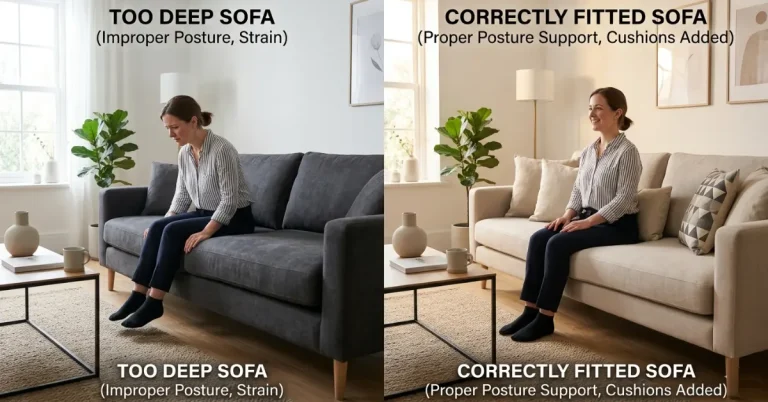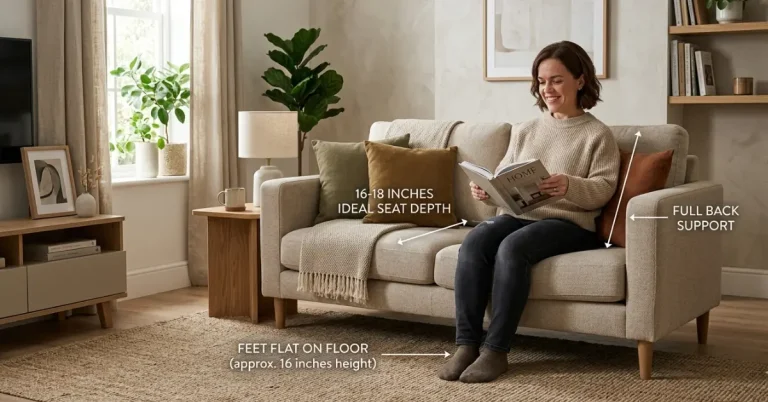
If you are under 5’5″, your ideal sofa dimensions are:
- Seat height: 15 to 17 inches
- Seat depth: 18 to 21 inches
- Backrest height: 20 to 26 inches from the seat
These dimensions match shorter body proportions so your feet stay flat on the floor, your knees sit close to a right angle, and your back actually rests against the backrest.
If any of these are off, you will feel it quickly. Not always as pain. More like constant shifting, slouching, or never quite settling in.
2. Why Most Sofas Feel Uncomfortable for Short People
Most sofas are not built for you.
They are designed around average heights closer to 5’7″ to 5’10”. That difference sounds small. It is not. A few inches change how your body lines up with the seat, the backrest, and the floor.
You sit down and something feels off. You shift. You tuck your legs. You lean forward. None of it fixes the problem.
What actually goes wrong?
Feet don’t touch the floor
The seat height is too high. Your legs hang slightly. Pressure builds under your thighs. Circulation feels off after a while.
Seat is too deep
You cannot sit all the way back. So you slide forward or slouch. Your lower back loses support. That “sink-in comfort” turns into fatigue.
Backrest does not match your torso
Too tall or angled wrong and your head pushes forward. Too low and your shoulders get no support. Either way, your posture suffers.
These are not small issues. They show up fast during daily use. Watching TV. Sitting with a laptop. Even short conversations feel less comfortable.
3. The Core Formula: How to Calculate Ideal Sofa Fit
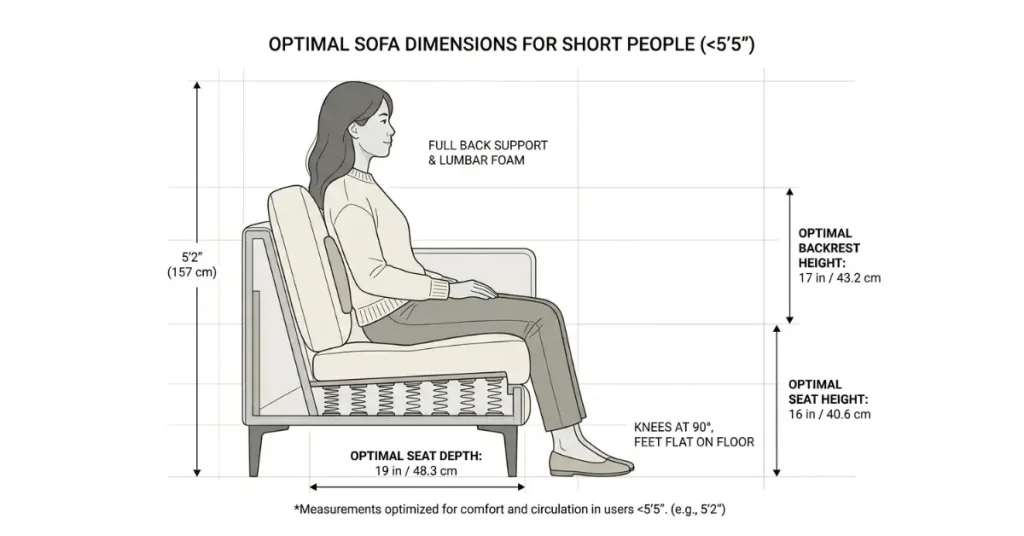
Guessing does not work here.
Most people test a sofa for two minutes and decide. That is how you end up with something that looks good but feels wrong every day.
Use your body measurements instead. This is what actually fixes comfort.
3.1 What Is the Ideal Seat Height?
Start with your lower leg length.
Measure from the floor to the back of your knee while standing.
Your ideal seat height is:
- 100% to 110% of that measurement
Quick method:
- Stand straight
- Measure floor to knee
- Add about 1 inch for cushion compression
Real-life check:
If your feet are not flat on the floor when sitting, the seat is too high. If your knees sit higher than your hips, it is too low.
Both feel uncomfortable over time.
Seat height is not an arbitrary design choice. It follows basic lower-body proportions that determine whether your feet stay flat and your knees sit at a natural angle. In ergonomics research, seating posture is closely tied to lower limb alignment and pressure distribution across the thighs. You can explore more on this through established human ergonomics guidelines for seating posture.
3.2 How Do You Calculate the Right Seat Depth?
Now look at your thigh length.
Sit upright and measure from your lower back to the back of your knee.
Your ideal seat depth is:
- 80% to 95% of that length
Simple rule to confirm:
- Sit all the way back
- Leave about 2 to 3 fingers of space behind your knees
What happens if you ignore this:
Too deep and you slide forward or slouch. Too shallow and you feel unsupported.
That “deep comfy sofa” most stores push is usually the wrong choice for shorter users.
3.3 How Tall Should the Backrest Be?
Backrest height decides whether you relax or constantly adjust your posture.
Your target:
- The backrest should reach at least your mid-shoulder
Typical range depends on how you sit:
- Upright sitting needs solid shoulder support
- Lounging can work with a slightly higher back
If the backrest stops too low, your upper back floats. If it pushes your head forward, the angle is wrong.
Optional fix:
- Add a headrest or cushion if your neck feels unsupported
Do not ignore this dimension. It is often the reason a sofa feels fine at first but tiring after 30 minutes.
Before You Buy
The Short Person’s Sofa Fit Guide
A printable height-to-dimensions chart, self-measuring steps, and a shopping checklist — know your exact numbers before you shop.
Get the Guide — $9 →4. Ideal Sofa Dimensions Chart for People Under 5’5″
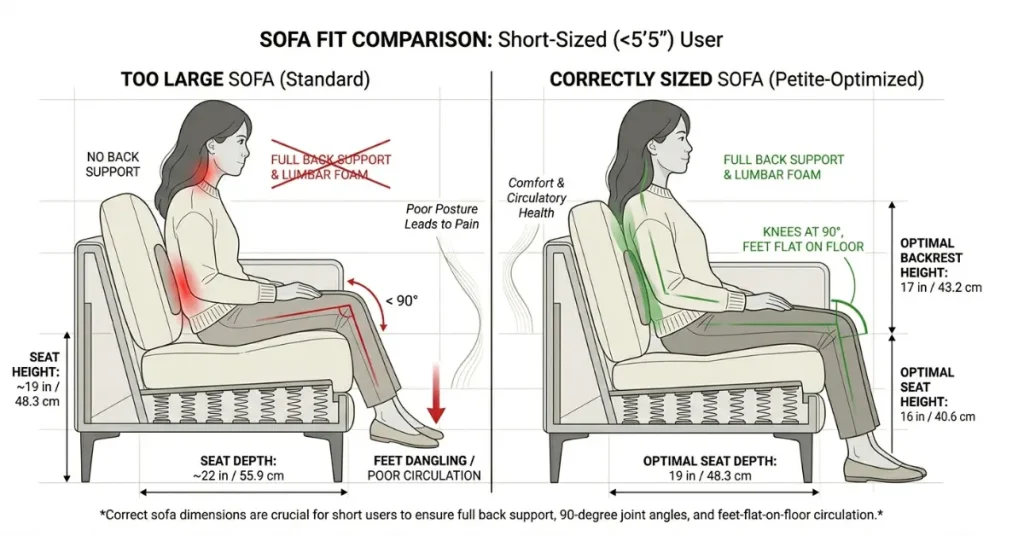
This is where everything becomes practical.
You can understand formulas, but most people just want a clear reference before they buy. This chart removes the guesswork and shows what actually fits shorter body proportions.
It is based on real ergonomics, not showroom styling or oversized “comfort” marketing.
Sofa Size Guide by Height
| Height Range | Seat Height | Seat Depth | Backrest Height |
|---|---|---|---|
| 4’10″–5’1″ | 15–16 inches | 18–19 inches | 20–22 inches |
| 5’2″–5’5″ | 16–17 inches | 19–21 inches | 22–26 inches |
These ranges are not random design preferences. They align with how furniture is scaled across different body types in interior planning and manufacturing. Standard sizing conventions help ensure consistency in comfort and usability across populations. For a broader understanding of how furniture dimensions are defined in design contexts, see standard sofa dimensions and furniture design guidelines.
How to use this chart correctly
Do not treat this like a strict rulebook.
Think of it as a boundary check.
- If the seat height is above your range, expect feet-to-floor issues
- If the seat depth goes beyond your range, expect slouching
- If the backrest is too low, you lose upper back support
Most comfort problems start when one of these numbers is ignored.
A quick reality check before you buy
Sofas often feel fine in a showroom. That changes at home after 20–30 minutes.
Before committing, ask yourself:
- Do my feet stay flat without effort?
- Can I sit fully back without sliding forward?
- Does my upper back actually touch the support?
If any answer feels uncertain, the size is probably wrong for your height range.
This chart is meant to stop that mistake before it happens.
5. 3-Step Sit Test Before Buying a Sofa
Most people overthink sofa buying.
They compare fabrics, colors, and brand names. Then they sit for 30 seconds and decide. That is how uncomfortable sofas end up in homes.
This test is simpler. And more reliable.
Step 1: Are your feet flat on the floor?
Sit normally. No adjusting. No stretching your legs.
Your feet should rest flat without effort.
If your feet hang even slightly, the seat height is too high for your body. Over time, this creates pressure under the thighs and a restless sitting posture.
Step 2: Are your knees at a natural 90° angle?
Look at your legs while seated.
Your knees should sit close to a right angle, not pointed upward or dropped too low.
If your knees are higher than your hips, the sofa is too low. If your legs feel extended forward, it is too deep or too high overall.
This angle matters more than people realize. It affects how long you can sit without discomfort.
Step 3: Does your back touch the backrest naturally?
Sit all the way back.
Do not force posture. Do not lean.
Your lower and upper back should both make contact with the backrest without you slouching forward.
If you need to lean or shift to feel supported, the seat depth or backrest alignment is off.
Final rule
If any answer is no, the sofa does not fit your body.
Not “kind of works.” Not “feels okay for now.”
Wrong size usually feels acceptable for the first few minutes. Comfort problems show up later, at home, during real use.
6. Common Mistakes Short People Make When Choosing a Sofa
Most sofa regrets don’t come from bad luck.
They come from predictable choices that look good in a store but fail in real use.
If you are under 5’5″, these are the mistakes that quietly ruin comfort.
Choosing deep-seated sofas because they feel “luxurious”
Deep seats look inviting. You sink in and think it feels premium.
But for shorter people, depth quickly becomes a problem.
Your body cannot sit fully back. So you slide forward or slouch. That removes lower back support and forces your posture to compensate.
What feels like luxury in a showroom often turns into constant readjustment at home.
Prioritizing style over actual dimensions
Clean lines. Modern frames. Trendy silhouettes.
It is easy to get distracted.
But a sofa is not wall art. You sit on it every day.
If the seat height or depth does not match your body, no design choice can fix the discomfort later.
People often realize this only after the return window closes.
Ignoring cushion sink and softness levels
This is one of the most overlooked issues.
Soft cushions compress under your weight. That changes the actual seat depth while you sit.
A sofa that measures “fine” on paper can behave like a much deeper seat in real life.
For shorter users, that extra sink is enough to break posture alignment completely.
Firmer cushions usually give more predictable support.
Buying based on showroom comfort instead of real use
A sofa in a store is not the same experience as a sofa at home.
In a showroom:
- You sit for a few minutes
- You are slightly upright
- You are not relaxed or distracted
At home:
- You sit longer
- You lean back
- You shift positions naturally
That is when poor proportions show up. What felt “okay” in the store starts feeling wrong after real use.
The pattern behind all these mistakes
Most issues come from one assumption.
That comfort is about softness or looks.
In reality, it is about proportion. If the sofa does not match your height, nothing else fully compensates for it.
7. How to Fix an Existing Sofa That’s Too Big
Buying a new sofa is not always the answer.
If you already own one that feels too large, there are practical ways to correct the fit. It will not become perfect, but it can become usable and noticeably more comfortable.
The goal here is simple. Bring your body and the sofa closer together in proportion.
Add lumbar support to control posture
A sofa that is too deep forces you to collapse backward or slide forward.
A firm lumbar cushion changes that.
Place it at your lower back so you naturally sit more upright. This reduces the effective seat depth and brings your posture forward without effort.
Avoid overly soft cushions. They disappear when you lean into them and do not fix alignment.
Use a footrest to correct seat height issues
If your feet do not reach the floor comfortably, do not ignore it.
A low footrest or ottoman helps stabilize your legs.
This reduces pressure under the thighs and prevents that hanging-leg feeling that often leads to discomfort within minutes.
It is a simple fix, but it changes how long you can sit without shifting constantly.
Reduce seat depth with firm back pillows
Deep sofas are the most common problem for shorter users.
You cannot physically shrink the frame, but you can change how you sit on it.
Place firm cushions behind your back to push your seating position forward. This effectively shortens the usable seat depth.
The key is firmness. Soft pillows compress and bring the problem back immediately.
Raise perceived seat height with denser cushions
If the sofa sits too low, your knees may rise above hip level.
One workaround is adding firmer seat cushions or overlays.
This slightly lifts your sitting position and helps your legs align more naturally with the floor.
It is not a full correction, but it reduces strain during longer sitting periods.
What these fixes can and cannot do
These adjustments improve comfort, but they do not redesign the sofa.
If the proportions are far off, you will still feel it.
Think of these as compensation tools, not permanent solutions. They help you make a mismatched sofa more livable, especially if replacing it is not an option right now.
8. Best Sofa Types for Short People
Not all sofas are designed with the same body proportions in mind.
Some styles naturally fit shorter users better because of their structure, seat depth, and cushion behavior. Others look appealing but work against comfort the moment you sit down.
If you are under 5’5″, the difference between “good design” and “bad fit” is usually the sofa type itself.
1. Apartment-size sofas: the safest starting point
Apartment-size sofas are designed for smaller spaces, but that also means better proportions for shorter users.
They typically come with:
- Shallower seat depth
- Lower overall scale
- More balanced seat height
They are not oversized or exaggerated. That makes them easier to sit in without constantly adjusting posture.
For many users, this is the most reliable category to start with.
2. Mid-century modern sofas: naturally better proportions
Mid-century modern designs often work well for shorter people without trying too hard.
Brands in this style usually prioritize:
- Clean, lower profiles
- Moderate seat depth
- Firmer cushions instead of deep sink-in seating
The result is more predictable comfort.
You sit down and stay supported instead of sinking too far back.
3. Firm cushion sofas: stability over softness
Cushion firmness matters more than most buyers realize.
Firm sofas:
- Maintain their shape under weight
- Keep seat depth consistent
- Help your posture stay upright
Soft sofas feel comfortable at first. Then they compress, and the seat effectively becomes deeper than expected.
For shorter users, that shift usually causes slouching and loss of lower back support.
What to avoid if you are under 5’5″
Some sofa types consistently create discomfort for shorter body proportions.
Be cautious with:
- Oversized sectionals
- Deep lounge sofas
- Low-profile “sink-in” designs
They are built for stretching out, not sitting upright with feet flat.
What feels like luxury in marketing photos often translates to poor alignment in real use.
The simple rule behind all good choices
If the sofa looks like it is designed for lounging across, it is usually not ideal for shorter users.
If it looks structured, compact, and supportive, it is far more likely to fit your body correctly.
Sofa design is not just about aesthetics. It is also about scale, proportion, and how furniture interacts with human posture in real environments. Interior design principles consistently emphasize that furniture must match body proportions to avoid discomfort over time. You can read more about these interior design principles for furniture scale and proportion here.
Before You Buy
The Short Person’s Sofa Fit Guide
A printable height-to-dimensions chart, self-measuring steps, and a shopping checklist — know your exact numbers before you shop.
Get the Guide — $9 →9. FAQ: Common Sofa Fit Questions for Short People
These are the questions people usually ask after they already feel something is wrong with their sofa. The answers are simple, but they matter more than most buying guides admit.
What is the best seat height for a short person?
For most people under 5’5″, the ideal seat height is 15 to 17 inches.
That range keeps your feet flat on the floor and your knees close to a natural 90-degree angle. Anything higher starts lifting your legs. Anything lower can make standing up feel awkward over time.
Why do my feet not touch the floor on a sofa?
This usually means the seat height is too high for your lower leg length.
It is common in modern sofas because many are designed around average or taller users. When your feet dangle or barely reach, pressure builds under your thighs and your posture shifts without you noticing.
It is not about comfort preference. It is a mismatch in dimensions.
Is a deep sofa bad for short people?
In most cases, yes.
A deep sofa pushes your body away from the backrest. That forces you to slouch or sit forward instead of sitting fully supported.
You may enjoy it for short lounging, but for daily sitting it often leads to back and posture fatigue.
Depth matters more than people expect.
Can I make a big sofa more comfortable?
You can improve it, but you cannot fully redesign it.
Practical fixes include:
- Adding firm lumbar cushions to support your lower back
- Using a footrest so your legs are not hanging
- Bringing your seating position forward with back pillows
These help, especially for short-term comfort. But they only compensate. They do not replace proper proportions.
10. Key Takeaway
Comfort is not about price, fabric, or brand.
It is about proportions.
Most sofa discomfort comes down to three measurements:
- Seat height
- Seat depth
- Backrest height
If these three align with your body, most sofas will feel fine.
If they do not, even an expensive sofa will feel slightly off every time you sit down.
Good design is not what looks best in a showroom. It is what disappears when you sit in it.